Showing posts sorted by date for query Jesus Good Shepherd. Sort by relevance Show all posts

Friday, 10 October 2025

To "follow" Jesus - an exercise

I have often argued, in recent years, that the key instruction in the IV Gospel is to "follow" Jesus, and that the best encapsulation is (probably) the Good Shepherd section of this Gospel. 

But I suggest an exercise - which takes about ten minutes: Here is the IV Gospel - do a word search on "follow, and read quickly but attentively through all the usages of this word in relation to Jesus instructing his disciples what to do. 

I think, through this, we can then begin to glimpse the simplicity of what Jesus is asking. 


To me, he seems to be saying that because he is - like us - a Man, and also a Son of God; we can do after our death what Jesus will do after his death

Meaning: attain eternal resurrected life, after death. 

And that Jesus shall personally make this possible, for each person as an individual.  

In other words; "follow" has a sort-of double meaning, a more-passive and more-active meaning. 

Passively, we follow-behind, in the route Jesus has made between this mortal life, via death to resurrected everlasting life in heaven. 


More actively; Jesus will help us do this, he will "come back, and help us in this "journey". And it is us who chooses to make this journey, who takes the "steps" on it - because even a sheep must choose to follow specifically he whom the sheep regards as his Good Shepherd. 

The lost sheep does not follow just-anybody; but to be saved the lost sheep must follow the Good Shepherd. 

Nor is the act of following, something automatic and inevitable - the lost sheep must recognize the Good Shepherd, and choose to follow, and actually take the steps of following.   


That's what seems to be said to me - and also what is actually true; but you may, of course, read it differently!


Monday, 19 May 2025

Following Jesus - literally

As readers may know, I feel a need to understand Christianity so simply and clearly that it can be grasped as a whole, by a single act of thinking. 

I have previously explained what Jesus meant in the Fourth Gospel ("John") when he requires people to "follow" him; and I explained it in terms of the Good Shepherd leading his sheep from the front. 

I have also explained following in terms of us meeting Jesus post-mortally and being led by Him through the process of resurrection into Heaven.  


It now seems to me that Jesus might have meant  by "following", something even simpler and clearer because more literal.

We are enjoined to follow Jesus where he went

That is: if we want resurrected eternal life; we should follow Jesus to Heaven


That is: we should follow Jesus through the process of resurrection to get to that place or state of Heaven. 

But the main thing is to follow Jesus to Heaven. 

And we do that by wanting it. 


By wanting Heaven more than we want anything else, so that we will do... whatever is needful to get there; what is needful to achieve Heaven; and we will know what that is, when the time is right.


Following Jesus to Heaven is something we do after death, just as Jesus went to Heaven after his death.  

Here and now; what is required, is to be known in the context of having decided that we want to follow Jesus to Heaven. 

How we personally should live, is in expectation of following Jesus to Heaven.  

+++


*Note: "Following is Not therefore meant as instructions to follow a specific path or rules, nor modelling our life on Jesus's life, nor a matter of following any purported intermediary such as membership, words, rituals or symbols. In the past it was different since Men in those days were groupish by nature; and responded spontaneously in the right way to words, symbols, rituals. For us, here and now, we must follow Jesus specifically and personally - or, probably, we won't be following him at all.

Sunday, 9 March 2025

Jesus Christ and the ongoing Second Creation - reason for a personal relationship with Jesus during this mortal life

I have been blogging recently about the idea that Jesus's "cosmic" role was the Second Creation that is Heaven - Jesus made possible resurrected eternal life, and therefore Heaven. 

But, in addition, Jesus has a role as the Good Shepherd, who will lead each of us to Heaven, if we choose to follow him from love. 

One part of this leading, is for Jesus to show the way and make possible our transformation from mortal to immortal that is resurrection. 


Another aspect is that Jesus - who is the Holy Ghost - can (if voluntarily sought) provide guidance, comfort and positive encouragement, on a moment-by-moment basis, during this mortal life on earth. 

This guidance/ comfort/ encouragement from the Holy Ghost may come via prayer - in other words, by prayers addressed to Jesus. Or it may come by any other manifestation of a loving friendship with Jesus; such as in meditation, or by directing our thoughts and attention to Jesus at any time or place or situation.   


(It's not that I regard prayers and thoughts directed at God the Primary Creator as a wrong thing to do - but it seems to me that these are not specifically Christian. A Christian should, surely, be focused on Christ? And that includes prayer, meditation, and our best kind of thinking.)  


The purpose of this mortal life can be conceptualized negatively and positively. 

Negatively, there is the matter of learning from problems and mistakes, from disease and death, repenting sins... and the like. 

But a positive and strongly-motivating life goal is essential in these adverse times; and this motivation (because of the corruption of churches, along with other institutions, to the-side-of-evil) must be something that arises-from and works-at the individual personal level


In the first place it seems evident (from our own set-up and the way the world now is) that this motivating-purpose is something we need to work-out for ourselves, consciously and by active choice. 

This needs to come primarily from our intuition - which means from our real and eternal self. 

But this inner source is, of course, prone to error and self-deception; and that leads to the special role of the Holy Ghost. 


I think that, in general (there are exceptions), the role of the Holy Ghost is Not to provide primary guidance: Not to "tell us what to do". 

But instead the Holy Ghost is meant to serve as a check and confirmation on what we have personally discerned and worked-out. 

As a mega-simplification (!): First we decide what we ought to do; then we consult with the Holy Ghost that we have got-it-right; that this is, indeed, what we ought to do. 


So far; we are still in the double-negative territory... 

However; the positive role of the Holy Ghost is then in the comfort and encouragement, the energizing and enthusing, deriving from "knowing" that we are indeed personally and in these exact circumstances: doing the right thing.    


Tuesday, 7 January 2025

"Fear and Trembling"? Certainly Not!

"Wherefore, my beloved, as ye have always obeyed, not as in my presence only, but now much more in my absence, work out your own salvation with fear and trembling." 

Philippians 2:12 (written by the Apostle Paul.)


This seems fundamentally wrong for these days and times, in terms of how a Christian ought to approach life. 


Of course, this mortal life is tragic - as well as joyous; and we ourselves are weak, and prone to fear, resentment, dishonesty and many other sins - as well as blessed by divine freedom and the capacity for love.

But I am sure that Christians are not intended by Jesus Christ to regard our salvation with fear and trembling; and that - indeed - to do so is a sin akin to despair. 

F&T is a sin because it is evidence of a lack of faith in God's goodness and power. 


On the contrary; salvation is in our own hands; as is evident throughout the Fourth Gospel - which (to simplify) means that if we want salvation, we can have it

We get it by following Jesus Christ - and that "following" means after this mortal life; and following analogously to a lost sheep following a Good Shepherd. 

For us (here, now) the great thing, the great problem - is Not-at-all about the difficulties of navigating salvation; but much more fundamentally and lethally Not Wanting Salvation.


It is therefore misguided and counter-productive to emphasize the uncertainty of salvation, to make it a matter properly approached in a spirit of F&T. 

(As if God was a stern monarch and Judge - rather than God being our loving parent/s.)

What we need and ought to be doing, is not inculcating an attitude of fear and trembling; but instead helping people to want salvation...

Firstly by clarifying what salvation is; secondly by clarifying what are the alternatives.


And then (hardest of all) getting people to think about this matter sufficiently deeply and consecutively, to decide what they really hope-for, for themselves - on a timescale of eternity. 


Friday, 8 November 2024

My "kingdom" is not of this world... On being led by the Fourth Gospel (called John)

A couple of days ago I wrote that we should think of Jesus primarily as The Good Shepherd (leading those who will follow to resurrected life everlasting beyond biological death); and not as a King. 

Such is a natural consequence of the decision I made to base my Christian belief on the Fourth Gospel (called John) - the background to which decision is covered in my 'mini-book' from a few years ago, Lazarus Writes

I am aware that history took a very different path of putting the Synoptic Gospels, and indeed the Epistles of Paul, above the Fourth Gospel; and also of interpreting the Fourth Gospel in light of the rest of the New Testament. However, I regard this as an error, simply because I believe what the Fourth Gospel says about itself, and therefore put it first and above all other scriptures. 


The Fourth Gospel tells us, repeatedly and in many ways, that Jesus is Not a King, that it is a mistake to regard him as such. How then do I interpret the phrase "My kingdom is not of this world"? [See this verse in context below the post.]

Quite simple - in the context of the whole Gospel and of the section in which this occurs; I understand Jesus to be saying to Pilate something like: My "kingdom" is not of this world. 

In other words, Jesus is telling Pilate something like: "I am Not saying that I am a king - that is Your assertion, and that of Jews who have misunderstood my mission and role. 

"Furthermore what You might think of as the kingdom to which I belong is Not even part of this mortal life on earth. 

"I am, in other words, not primarily concerned with this mortal world. What I have to teach and do is concerned with life beyond death, the world of eternity: Heaven not earth". 


In other words, it is a radical misunderstanding to suppose that the Fourth Gospel asserts Jesus is a King. 


Of course, most Christians through history regard Jesus as a King because this is clearly and repeatedly stated in other parts of the New Testament. Jesus (after death and ascension) is often regarded as true ruler of this world ("Pantocrator"). But if the Fourth Gospel is what is says it is; then this must be an error - no matter how common. 

I completely understand that Christians who take the orthodox and traditional, church-led, view of Christianity; will reject this idea outright as being ridiculous. They have made very different assumptions concerning the relative validity and authority of Scriptures, and of the authority of their church - or of historical churches. 

I understand this perspective, and why people do not want to go-against the weight of tradition and church authority - but I reject it for myself; because I believe the Fourth Gospel and therefore think it is a mistake. 


Here-and-now (however differently it may have been in the past) I believe that understanding Christ as King of this world, first and foremost, may well lead to contradiction and adverse consequences.

Instead of a King - we need to grasp that Jesus is essentially the Good Shepherd, one who enables all who will follow him to attain resurrection into Heaven.   


John: 18 [33] Then Pilate entered into the judgment hall again, and called Jesus, and said unto him, Art thou the King of the Jews? [34] Jesus answered him, Sayest thou this thing of thyself, or did others tell it thee of me? [35] Pilate answered, Am I a Jew? Thine own nation and the chief priests have delivered thee unto me: what hast thou done? [36] Jesus answered, My kingdom is not of this world: if my kingdom were of this world, then would my servants fight, that I should not be delivered to the Jews: but now is my kingdom not from hence. [37] Pilate therefore said unto him, Art thou a king then? Jesus answered, Thou sayest that I am a king. To this end was I born, and for this cause came I into the world, that I should bear witness unto the truth. Every one that is of the truth heareth my voice. [38] Pilate saith unto him, What is truth?

Saturday, 18 May 2024

Heaven is Not about perfect happiness - but life everlasting as resurrected Sons of God

Heaven is not a place or situation of perfect happiness, and people get terribly confused by trying to explain how it could be! 


Heaven could, in theory, be a place of perfect happiness; but only by changing people very fundamentally - including permanently destroying their individuality and freedom. 

People would need to be re-made as Beings incapable of anything but total happiness. 

Maybe this could be done (perhaps by some kind of supernatural-spiritual equivalent of genetic engineering, psychopharmacology and lobotomy?) - and if it was done then the people in Heaven would always be happy, whatever Heaven was actually like. 

After all, they couldn't Not be happy! 

Such modifications would overcome any and all possible objections of the "I couldn't be happy in Heaven, and would not want to go there, unless..." type. e.g. I would not want to be in Heaven "unless my wife was also in heaven" - or "unless my wife was not in Heaven" perhaps?

The only realistic answer (if Heaven is to be happy) is that in such a Heaven we will be re-made such that nothing could ever possibly disturb our state perfect happiness.  


In other words, if we do try to make Heaven a place of perfect and unalloyed happiness, then we have defined Heaven in terms of how people react to it; which makes Heaven all about the constitution of the people in it, their set-up, their capabilities and reactions. 

But in reality Heaven is (surely?) what it is - and therefore not how all people will react to it? 


In the Fourth Gospel, Jesus tells us that Heaven is the place of eternal life after this mortal life, or life everlasting. He describes its characteristics by means of stories and symbols - in what we might regard as "poetic" or metaphorical language. 

Heaven is the "place" where we go when resurrected. Its basis is love. When in Heaven we are fully Sons of God. 

Heaven is a choice, and Jesus assumes that some, many or most people will not choose it - will not want it. 

We get there by "following" Jesus (the Good Shepherd). 

Jesus desires that we shall be his friends, not his servants. 

And so on...


The point is that resurrection to eternal life is not described in terms of how we feel about it; but in terms of the new possibilities that Jesus has made available to Men. 

Instead of a life of this mortal life of partial and temporary gratifications, lived among evil from others and within our-selves; Heaven is a place of love, with everlasting and transcendent satisfactions. 

..As with the "living water" Jesus describes to the Samaritan woman; or the "meat which endureth into everlasting life" he contrasts with earthly food - including manna - he expounds after feeding the five thousand.


But even aside from the descriptions of the Fourth Gospel - based on the assumptions that God is the prime creator, wholly Good, and our Father (and Men His Sons); a Heaven of total happiness doesn't make sense - while a Heaven of eternal resurrected wholly-loving life can make sense. 


Monday, 15 April 2024

What does Jesus teach in the Fourth Gospel? - my renewed understanding and conviction

I have been re-reading the Fourth Gospel (in the Authorized or King James version) with intensity of engagement, and the large sweep of narrative - the miracles and the teaching - that runs from the third through the sixteenth Chapters: from meeting Nicodemus at night to just before Jesus's arrest. 


I am struck afresh and with great force what Jesus does and does-not speak of. Again and again Jesus explains who and what he is; and that he is asking to be believed, loved and "followed". 

(What "following" means is explained in the Good Shepherd section.)

Once his hearers know who Jesus is; they are asked repeatedly to love and follow him - and that is very much the focus and the core of the Gospel.  

Jesus apparently has great difficulty in communicating the simplicity of his message to the disciples; and only just before his arrest (at the end of Chpater 16) does Jesus seem satisfied that the disciples have at last grasped what Jesus has told them so many times.


Jesus does not talk about rules for living, does not talk of morality. Does not tell people how to behave in the details (or indeed the sweep) of everyday life. 

Indeed, this trait is very marked indeed. Jesus is hardly-at-all a moral teacher. When he refers to sin, he nearly always means death, and suchlike realities of this mortal life.  

And when Jesus speaks of "commandments" he essentially means to "love one another" (as he goes on to explain) and Himself - clearly a qualitatively different matter from the commandments of Moses. 

All this is very different from how Jesus is usually described. 


The shaping emphasis is on the life and world to come; not this mortal life and world - it is the post-resurrection reality that ought to shape our current goals and behaviours.

In other words; Jesus is usually talking about having brought a change in ultimate, "cosmic" reality; a change in the set-up of divine creation: new realities and new possibilities. 


Throughout, Jesus talks of his Father as a distinct person from himself: clearly with complete harmony between the two of them, but his Father absolutely as a real and separate person from Jesus himself; a person with whom Jesus has a relationship of the same kind as with the disciples, but vastly greater and perfected. 

Thus Jesus's message is cosmic; but the cosmic is personal - indeed a matter of many persons; because Jesus links God to himself, and to the disciples (broadly considered - not meaning some particular number of men); all those with whom Jesus shares mutual love.

Love is mentioned many, many times; and seems like the core term - a new and all-transcending principle of life - the new reality that Jesus made-happen. Reading this, one is immediately compelled to ponder this astonishing reality that Jesus has placed at the heart of creation  

The Holy Ghost, the Comforter, is described Jesus himself (not a separate person) after he will have ascended to Heaven - and who will be present to all who love and follow Jesus. The Holy Ghost is stated to provide - in a personal way - all that is required of guidance and knowledge.  

This is emphasized: everything the disciples need to know after Jesus has ascended to Heaven, will be provided by the Holy Ghost. 


Something that is very evident is that Jesus asserts the exclusivity of his message. That only by Jesus, via Jesus, can we attain resurrected everlasting life. There is no other way. 

This is asserted as a fact; although what that fact means is apparently very different from the usual way it has been taught in the centuries since - because the Fourth Gospel is utterly indifferent to any form of church. 

The gospel is all about relationships, and these relationships are personal - indeed Jesus declares (at some length, in detail) that they need to be the relationships of friends, rather than hierarchical or formal.  


But Jesus's insistence on the exclusivity of his role in salvation is absolutely hard-line. If resurrection is what people want, there is simply no alternative (when the time comes) to knowing and following Jesus.

The reason why is also explained; which is that those who reject Jesus do not want what Jesus offers. The monotheists (such as the Pharisees) want something altogether different from what Jesus offers: they are rejecting the new cosmic possibilities that Jesus brings. 


What this partial summary fails to do is to describe the power of this reading when I am able to give the engagement full and intense attention; the authority and conviction with which the words and actions of Jesus reach across the centuries; in which these words over-leap the vast complexity of "Christianity" that grew in the generations in-between Jesus and myself. 

Of course, yesterday and today is not the first time I have felt this (as I wrote previously) - but this was a fresh amazement - and evoked a fear that it might not be so!

...Leading-on to a new affirmation of faith and another experience of conviction; of direct validation. 


What Jesus is saying and offering in the Fourth Gospel is astonishing to me, breathtaking in its originality and radicalism.

For me it is something that I want deeply, something I therefore really want to be true! And the whole thing therefore hinges on whether I personally believe what Jesus is saying - whether I believe He was who he said, and whether I regard as true what he claimed. 

After which, according to the Fourth Gospel; I am told to turn to the Holy Ghost (that is; to Jesus himself, in person, as available to us here-and-now) to provide exactly that knowledge, and the comfort that derives from conviction of its truth.  


Note added: I see that I failed to complete the circuit of the above description; because no matter how overwhelming a spiritual experience may be at the time of experiencing it - such conviction does not last. Almost immediately, the experience is subjected to doubts, and indeed is readily explained-away by all kinds of familiar materialistic/ scientistic arguments (just a dream, a delusion, wishful thinking etc.). That is the situation of modern man - and not by accident. As men who have become conscious of much that was once spontaneous and implicit; modern Men must consciously choose. We must decide whether or not to believe our spiritual experiences; whether or not to regard them as an intuition of ultimate reality. This is a free choice, and one for which we ought to take personal responsibility. Specifcially; we ought not to desire to be permanently overwhelmed by a conviction so powerful and lasting that we never get out from under it. Nor should we regard such inescapable experiences as the most valid. Because that would be to desire to be un-free and to evade personal responsibility. Therefore - to complete the circuit - I freely choose to believe as real that religious experience of conviction: I choose to make its validity a bottom line assumption for me. 

Sunday, 18 June 2023

The character of Jesus in the Fourth Gospel

The author of the Fourth Gospel (who I believe to be the risen Lazarus) is the only person in the Bible who claims to be a witness of the last three years of Jesus's life and teachings, and a disciple. 

He is the only one who knew Jesus personally, loved and was loved-by him; and so is (presumably) the single person in the best position to provide a true account of Jesus's character during the period of his ministry, death and resurrection. 


In the first Chapters of the Fourth Gospel, there is initially more about John (the Baptist) than Jesus, and more of his words. 

Jesus only gradually gets-into the narrative from a few phrases of reported conversation with the disciples and his mother, and the account of the 'scourging' of the Temple; until the interaction with Nicodemus. 

Even from these snatches of conversation, it seems that Jesus is enigmatic, even mercurial. He does not answer direct questions; but instead responds with a further question, or a 'riddle' or a 'story'. 

This, together with the violent actions at the temple, depict Jesus as a confrontational personality: very much "in your face", regardless of whoever he is currently interacting with.  


But there is another side: Jesus as Prophet. These prophetic utterances are often prefaced with "Verily, Verily, I say unto you..."

The first is during the meeting with Nathaniel in Chapter One: Verily, verily, I say unto you, Hereafter ye shall see heaven open, and the angels of God ascending and descending upon the Son of man

Jesus here introduces the term "Son of man" for himself*. Again we can see that - even when teaching directly - by modern standards Jesus's speech is what we moderns might term poetic or symbolic (i.e. it means more than it says, and means several things at once). 

The truth of such prophetic statements is occult: i.e. hidden, non-obvious to mundane understanding. Thus; when teaching spiritually, Jesus employs a spiritual - unworldly, unpractical - form of language.   


Then, in Chapter 3, when when Jesus meets Nicodemus, we get a great outpouring of such vatic teachings. 

We get, indeed, the essence of Jesus's work and message distilled in its entirety

And different versions of this core-teaching recur several times throughout this Gospel - sometimes encapsulating in a verse or two; sometimes in an extended parable-teaching, such as "the feeding of the five thousand" or The Good Shepherd. 


The impression of Jesus as a character in the Fourth Gospel is very striking indeed! 

He is volatile, unpredictable, moody; fearless, elusive, direct, kind, harsh, empathic, highly intellectual, simple like a child - each as he discerns that the occasion demands. 

(A word for this personality type in the classical-medieval astrological system is "Mercurial" : as described by CS Lewis in The Discarded Image, and explicated by Michael Ward in The Narnia Code.)


And then Jesus may suddenly - as it were - stand tall and speak from the great prophetic heights of one who is the 'only begotten Son of God".

...Which I take to mean the first and only among all of God's children who fully understands, and is in full accord-with The Creator's divine purposes and will. 

The One who is uniquely capable of offering a path to all men, all those who are (unlike himself) 'sinners - out-of-accord with God and desirers of death... 

Offering all such men a path to everlasting life on the far side of death when they are Born Again; all this by the simple act of 'believing on' Him! That is (approximately) knowing who He is, and following him to Heaven - but after death, by being 'born-again' or resurrected:

[16] For God so loved the world, that he gave his only begotten Son, that whosoever believeth in him should not perish, but have everlasting life. [17] For God sent not his Son into the world to condemn the world; but that the world through him might be saved. [18] He that believeth on him is not condemned: but he that believeth not is condemned already, because he hath not believed in the name of the only begotten Son of God.


The "already" of to be "condemned already", means that this is not a threat of punishment - but a rescue from the otherwise inevitable fate of men before the time of Jesus: which was to die and descend, as discarnate "ghosts", to witless and depersonalized mere-existence in Sheol/ Hades/ the underworld. 

(There to await the coming of Jesus, and the coming of choice.)

Hell only emerged after Jesus, because Hell is the choice of those who know, but reject and oppose Jesus's offer and gift of resurrected eternal Heavenly life - which is a very different matter from passively having-imposed the default state of Sheol. 


* Chapter 3: [12] If I have told you earthly things, and ye believe not, how shall ye believe, if I tell you of heavenly things? [13] And no man hath ascended up to heaven, but he that came down from heaven, even the Son of man which is in heaven. [14] And as Moses lifted up the serpent in the wilderness, even so must the Son of man be lifted up: [15] That whosoever believeth in him should not perish, but have eternal life. 

Jesus is here saying, in vatic-poetic mode - that he himself is the Son of man who 'ascended up to Heaven' - when baptized by John and becoming fully-divine albeit mortal; having come 'down from heaven' as a man in perfect accord with God the Father; and therefore 'which is in heaven' even as he speaks with Nicodemus (heaven being a place or state of those Beings whose natures are in full and eternal harmony with God's creative will).  


Note added: It is often said that Jesus wants us to become more like him. The implication is that we ought to behave more like Jesus; model our behaviour on that of Jesus. I don't see it, it would anyway be impossible; and I do not believe it is true. Jesus wants us to believe-on and to follow him - but surely not to behave like him, nor have characters like his character. The essence of Christianity is resurrection, which is a wholly-good and eternal restoration of our-self! Heaven is full of unique characters, each contributing something unique hence vital: not populated by Jesus-copies! (Which would, if true, be redundant and render eternal life futile.)  

Monday, 10 April 2023

Christianity as a 'natural religion'?

Christianity is nearly-always described as a religion of revelation - in other words it needs to be 'revealed' to us, we need to be told about it; told by - for example - written scripture, handing on by tradition, teachings of church authorities etc. 

The contrast is a natural religion that could be reached by each person for himself, by intuition, reasoning, observation etc. based on suggestions from the material that can be found in pretty-much any human culture. 

(The paganism of animistic hunter-gatherers is regarded as an example of natural religion; since it seems to have arisen spontaneously - albeit with local variations - all over the world.) 


When I became a Christian, it was partly by accepting the need for revelation (and by evaluating the strength of validity in various contending revelations) that I got-out from trying to reach Christianity by my own unaided efforts. 

The is no real doubt that mainstream Christianity, in whatever of its denominations or churches, is way too complex to be arrived at except by revelation; but the big question is whether the necessary and sufficient essence is, in principle, attainable without external help... 

And, if not accessible during this mortal life, then potentially core Christianity might be accessible after this mortal life (i.e. after death) but before making the choice to accept or reject resurrection. 


Over the years I have come around to the idea that Christianity is, or can be, a natural religion; and does not require revelation - indeed, what has traditionally been regarded as revelation may more often be an obstacle than assistance nowadays -- especially since the churches are so corrupted by worldliness (corrupted to the point of value-inversion), and their teachings so vast and (to common sense) incoherent or contradictory. 

I think it is largely uncontroversial that theism - specifically the belief in a personal creator God - can be a natural belief. The this world was made, and with some design and purpose, and by a being who is like a person - is a plausible line of reasoning, that often occurs to children. 

And the further idea that this God is relates to each of us like a loving parent, is also one that can occur to anyone who thinks about the subject - by analogy with the human family. 


In short, all the necessary background to Christianity can be arrived-at without being taught - and (because it is true) potentially confirmed by intuitive conviction. 

As for Christianity; I think the core idea is also simple enough, and close enough to the desires of the human heart, that it could be arrived at by almost anyone. 

The fear of death and desire for everlasting life is spontaneous; and that this continued life would be embodied is also natural; and that this life-after-life would be in a better world without death or decay are all plausible day dreams - even for a child. 

So the necessary materials for a Christian yearning are there. As for the mechanism by which this might be achieved - which is by following Jesus Christ, as a sheep follows the Good Shepherd - this is not something that is likely to be a natural or spontaneous conclusion. 

Therefore, natural religion breaks-down at the point where we need to know how to attain resurrected life eternal. 


But, since this following of Jesus through-death to life-everlasting happens after our death, it seems reasonable to assume that it is something made clear to us after death. 

No matter what a person's experience during mortal life, he could be shown the possibility of resurrection after his death and how to attain it. 

Therefore; whether he was born before Jesus's time or lived in a part of the world where Christianity was unknown, or had been taught or reasoned-out some false idea of Christianity - every soul could be given the knowledge of what he need to do to follow Jesus.


Thus, Christianity can be a natural religion. And this fact may turn out to be vital to salvation, as the corruption of the churches continues to spread and advance.  


Monday, 3 April 2023

How did so many people (including far too many Christians) get the idea that Christians regard this mortal life as unimportant?

The truth is that Christianity (properly understood!) says that this mortal life is of vital importance - and this importance derives-from the destination of personal, resurrected eternal life. 


But the idea that this temporary and sin-ridden mortal life is unimportant apparently entered Christianity very early; and I believe it came along with the idea that salvation is only available by means of each Christian adhering to stringent behavioural criteria (e.g. and especially, membership of and obedience to the requirements of The True Church). 

I regard this kind of (de facto) anti-Christian Pharisee-ism as ultimately a consequence of some early decisions to make (the one true) Church an essential mediator between each Man and Salvation; without which damnation was the default. 

It never was metaphysically essential for Christians to be obedient Church-obeyers; but there was a practical reason why churches became regarded as essential - which was that human individuality was much less in the early years (probably at least 3/4 of the years) of Christian history. 

Since individual Christians were essentially communal and social beings; in practice they had-to be Christians via churches.

But now, humans are individuals (like it or not) and it is not just possible but unavoidable that we each take personal responsibility for our faith, and behaviours. We can no longer obey external authority (such as churches) spontaneously and unconsciously; and we should not try to do so - precisely because we now Can take personal responsibility.


(*In particular, it is overdue that Christians ceased to spend their lives circling around-and-around a perpetual and unassuageable worry about their own salvation, sometimes returning to this theme every time they pray, like a hamsters trapped a wheel - or, worse, like being chained to a never-stopping treadmill of pleading, propitiation and rumination on the same theme. Read again the Fourth Gospel - is there the slightest indication that Jesus wanted us to live this way?) 


I am confident that the original teaching of Jesus Christ was that anyone who truly desires resurrected eternal life in Heaven can have it, after our physical death; through the simple means of following The Good Shepherd who will guide us to that destination; and - at that time - doing whatever is required of us to follow Him. 

This means that salvation is Not A Problem for those who want it, and 'believe-on' Jesus as The Way to achieve it. 

The difficult thing may be getting people to want it, or to believe the claims of Jesus as The Way - although the Truth about Jesus should become apparent after death, to anyone who really wants resurrection. 


When salvation ceases to be our primary concern; then we can and should focus on living well this mortal life; which (in a nutshell) means learning from the teachings, the life-lessons, that God the Creator will provide for each of us during the time He sustains this life. 

In other words; the importance of this mortal life is learning from it; and such lessons are important only because they have relevance to us (personally) for eternity. 

...After all, mortal life-lessons are not very important for someone whose individuality is extinguished by death - such as atheists on the one hand, and on the other those who believe the individuality is dissolved into 'the divine' after death. 


Far from Christians regarding this mortal life as un-important; Christians are just about the only people who regard this life as genuinely important: as vitally important, everlastingly important; and important to both the individual and all the other 'inhabitants' of Heaven.   


(*Note added - see above)


Thursday, 16 March 2023

Nuts and bolts of how to deal with fear by love through faith

For Christians; living in fear is wrong, and sinful when accepted or embraced; but how we deal with fear is important - since some apparently-effective ways of dealing with fear are also sinful (such as prideful anger fuelled by resentment).

Yes, this is not a complex problem, it does not require abstraction, difficult analysis, nor any kind of theological 'balancing act' - the proper answers are simple, and clear as nuts and bolts. 


Jesus's idea was that people should follow him because of love, not from fear. Jesus deserves to be followed when we desire what he offers (resurrected life everlasting), and because we regard him as the Good Shepherd; because we love Him and have faith in his love for us. 

This does entail that we believe Jesus has the unique/ supernatural/ cosmic power to 'deliver' what he offers, but we ought not to follow Jesus because of our awe and fear of His power. 

That would be a wrong, negative, sinful - hence a self-defeating motivation; because Heaven has no place for such motivations. 


Therefore, when we fear (and who can avoid fear in this mortal life?) we need to recognize it as wrong, repent it; and fight-our-fears by reflection on what Jesus offers and the always-presence of Jesus in this world and our lives (as the Holy Ghost). 

We are never alone, nor bereft of help. 

The Good Shepherd will lead us to salvation; if only we follow Him; and to follow Him requires no more than this belief in His motives, and His capability. 

Therefore we can fight fear with strengthened faith; and our faith can be strengthened by something as simple and clear as a parable


Wednesday, 15 March 2023

Incoherence in traditional concepts of sin: Understanding 'sin' as the entropic nature of this mortal world; as anything-other-than resurrected life

Ever since I began to consider the matter seriously; I have found the ways that sin and forgiveness are discussed to be incoherent. They just don't seem to add up, or hold together. 

What I think I was sensing, was a clash between the temporary and the eternal, the individual and the social -- resulting from changes in human consciousness and the concept of 'Christianity' since the time of Jesus. 


I think it likely that, when Christianity was developed as an institutional, then a state, religion; it became bound-up with the prescription and enforcement of good, pro-social, 'Christian behaviour' - and this became regarded as the pre-requisite to salvation. 

So we get the idea of 'sin' as transgression of laws, and 'forgiveness' as some mixture of punishments, penances, and wiping the slate clean of past transgressions. In practice, 'sin' was externally, socially, defined. 

Thus laws and other rules of conduct were societally developed, validated and imposed; the individual was the sinner (law-breaker); and some representative of society decided what ought to be done about it.


This pragmatic system relating to social behaviour (primarily) was then harnessed to the 'cosmic' aspects of Christianity; i.e. the fact of Jesus Christ having change created reality - made possible a new Heaven of eternal resurrected life etc. 

This was the - to me - peculiar picture from Christianity; of a reality made up of moral laws/ legal codes and the system for developing and enforcing them; which was strangely linked with a narrative of the history of everything

It seemed hard to grasp how - in creating - God had built-in objective morality of this social kind... I just couldn't picture how this might work. 


When I spent a year or so, reading and re-reading the Fourth Gospel ("John") - I gradually became aware of a very different way in which sin was being conceptualized. 

The IV Gospel (overall) saw sin as ultimately death; and milder sins as including sickness and others kinds of dysfunction, corruption (away from proper purpose and function), wrong attitudes towards God, expounding of false realities, and so forth. 

I gathered that Jesus's work in taking-away sin, was to take-away death; in other words to offer Men the possibility of resurrection into life everlasting. 

Miracles of healing were perhaps Jesus taking-away lesser 'sins' of disease and disability. 

'Forgiveness' is not mentioned as such in the Fourth Gospel; but in some parables and miracles, Jesus seems to be declaring something about a change of mind or heart, or a reorientation, on the part of the one who is healed - this (here-and-now) commitment to Jesus is the 'faith' that has made the miracle possible. 


But this is not necessarily an eternal transformation of behaviour. I don't think we are meant to assume that one who has had faith, and received a miracle, would 'never sin again' in the sense of never again breaking any of the Laws of morality. 

The transformation of those who encountered Jesus was not a permanent change of their behaviour; but a here-and-now change of heart, of desire, of attitude. 


It seems possible that Jesus was talking about repentance or forgiveness in terms of a person turning to Jesus as Saviour, as Good Shepherd - as recognizing that only by 'loving' and following Jesus can we have eternal resurrected life. 

This can only be guaranteed as a temporary state of affairs in this mortal life - because somebody might at first decide to follow Jesus, and then later change his mind. As a sheep might begin following the Shepherd to safety; but change his mind, stray, and fall off a precipice to his death (i.e. to choose damnation). 

Thus, concepts such as 'repentance' and more generally 'faith' may best be understood as referring to the here-and-now; to the current situation in mortal life. 


These concepts are also, at root, personal and not institutional - at least to us modern men. 

Personal and institutional were, indeed, de facto inseparable in earlier stages of Man's development of consciousness, including the time of Christ and the centuries that followed. 

It was only from the late medieval era that Western Men began mentally to distinguish the individual group his group, more and more fully, and then to experience as a fact of reality. 

So, my confusion about 'sin' (and the confusion of Christian teaching, from which my confusion derived) was - in part - a consequence of trying to combine concepts from different stages of Man's consciousness.  


My conclusion is that we have now arrived at a very different point from where Christianity arrived at after the ascension of Jesus and the rapid development of first the Church, and then the Christian State. We are, indeed, now returned to a situation much closer to that described in the Fourth Gospel, during the life of Jesus. 

'Faith' is now something-like a here-and-now determination to follow Jesus to eternal life; and 'sin' is... anything else, i.e. any other commitment or purpose than that of following Jesus to resurrection-specifically. 

'Repentance' (the word itself isn't used in the Fourth Gospel) is (perhaps) simply the renewed commitment to following Jesus; whereas 'apostasy' is, like Judas Iscariot, referring to one who once had faith, later changing his mind and deciding Not to believe or follow Jesus. 

(And then, of course, apostasy may be repented.) 


So 'sin' is ultimately choosing death - meaning not-resurrection; but choosing instead some other fate for our post-mortal soul.

Thus 'damnation' may entail something like loss of personhood, loss of agency, loss of consciousness... Or refusing to leave this mortal world, and remaining bound to the domination of entropy and death. Damnation may be many or several possibilities, because it is anything-but resurrection. 

And, from this, 'sin' is used more generally to refer to mortal life and its innate nature - this world, dominated by entropic change: corruption, disease, decay, degeneration... 

In other words: 'sin' is all of that from-which we are rescued by resurrection into eternal life


Saturday, 31 December 2022

Post-mortal, pre-resurrected, spirit life is analogous to dreaming sleep


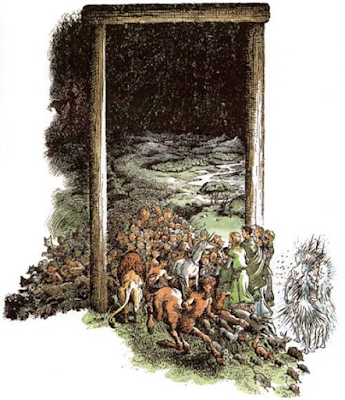
From The Last Battle by CS Lewis - Lewis's vision of the choice confronting post-mortal spirits


After mortal life we die and become spirit-beings - and it is these post-mortal spirits who may choose to become resurrected. 

What is life like as a post-mortal spirit? What will you and I be like at the time when we are confronted by the chance and choice of resurrected eternal life? 


The condition of post-mortal souls seems to have been accessible and known in ancient times; and in the years before Christ; the ancient Greeks left us with descriptions of Hades, while the ancient Hebrews described much the same condition as Sheol.  

The condition of such spirit life can be described in terms of a state of 'dementia' or 'delirium'; but is perhaps most easily comprehended in terms of dreaming sleep


During dreaming sleep; our spirit is cut-off from the body, and from the environment. That is, in general; we lose sensations of what is going-on inside us, and in the world around us. 

Our spiritual self mostly breaks free from the body - but in sleep the spirit does not wholly break-free, because the spirit must return to the body on awakening - and therefore there must remain a connection, and this residual connection of spirit with body can be greater or lesser. 

When the connection is greater, then the body and/or the environment around the sleeping body can influence the dreaming spirit; and we find some degree in which the physical shapes our dreams. For instance, a stomach pain or a ticking clock may be taken-up in the dream, and (in part or in whole) become part of a dream. 

But sometimes the connection between spirit and body is diminished to the merest thread; and to the extent that the spirit does break free; we are then in a similar state to post-mortal spirit life. 


What are the characteristic experiences of this kind of dreaming sleep, in a qualitative and formal sense? 

In dreaming we retain our sense of 'self', of being an individual with a personal persepctive, and we remain who-we-are; but the quality of experience changes. 

The typical mood of dreaming is one of perplexity - a sense of insecure grasp of the situation; of our understanding continually slipping-away. 

We forget important things in the dream, and then later in the dream they are recalled with a sense of puzzlement: how could I have forgotten that? Or else we may discover major things of great importance in the dream that, somehow, (in real life) we had never noticed before. 

In the dream we may take-for-granted bizarre situations that we (somehow!) find ourselves in; or conversely, may find ourselves unable to comprehend and function in situations that we would normally find routine. 

Recognition of people and situations is unmoored - much as the spirit is unmoored from the body. For example, we may recognize someone familiar who then turns-out 'really' to be someone else; or else it turns-out that a stranger in the dream is 'really' someone familiar (although they may look and behave completely differently). 

(These dream experiences are very similar to delusional misidentifications observed in psychoses.) 


These kinds of dreaming experiences derive, I believe, from the greatly diminished connection between the spirit and the body during dreaming sleep. If we can imagine this disconnection becoming total and potentially 'permanent'; then we may have some idea of what it may be like to be dead - but not resurrected. 

And it may be from such a dreamlike state - or perhaps more exactly from a temporarily lucid dream state (made possible by divine intervention) - that we make the choice about resurrection. 

That is; a state when the dream situation becomes suffused by an increased self-consciousness and ability to choose; when (perhaps) the dream-self becomes more detached-from dream-experience - and knows it as "a dream" - in other words, knows the reality of the situation. 

Then, it may be, we are confronted by the decision of whether to follow Jesus Christ through the process of transformation that is resurrection, to render us eternally incarnated, and to continue into Heaven.  


Perhaps this transformation can itself be imagined, as if from a dream; as our spirits meeting with Jesus Christ and knowing Him to be Jesus Christ - standing as the Good Shepherd in front of a portal, a doorway - the entrance into the 'sheep fold' that is Heaven. 

We are granted the comprehension that we may choose to follow Jesus through that doorway; and the knowledge that if we do so - as we are solidifying ('condensing') into eternal bodies - we will be taking with us only that which Good; only that which is Love - Love of God, of fellow Men, of divine creation... 

Also, if we choose to pass through that doorway; all that is of sin, death, corruption - will be left-behind. 


What I would emphasize here, is that when we make that decision; it will be from an experienced-situation that is somewhat like a dream, and the decision will be made by selves that are somewhat like our dream selves...

But a dream-like-state that we know to be reality; and the choice will be made by what we then-know to be our real, eternal and divine self.


Friday, 19 August 2022

Beware of developing and following your conscious 'will power', except when you have chosen to align it with divine creation

The development of human consciousness means that strategies that once were (overall) directed towards Good, have now become net-harmful. Will power is one of them. 

This is because (to a nearly complete degree) modern Man's will power is cut-off from the creative purposes of God; and cut-off also from his former immersion in the unconscious mind of other-Men. 


In the past, an individual Man's will arose from a context of other Men and from at least some degree of spontaneous sharing of divine purpose - for example, from some degree of 'automatic' harmony with the natural world. 

But nowadays a Man's free will lacks these former (unconscious, spontaneous, automatic) elements of coherence and direction. 

Therefore any strengthening of will power, of focused concentration upon an inner purpose, will - unless deliberately directed into harmony with divine creation - be directed against God and fellow Men. And nowadays this maldirection does not tend to be corrected 'automatically' by unconscious inner feedback impulses. 

In effect; there is only one Good direction for will to be harmonious with God; and an 'infinite' number of bad/ wrong/ evil directions - in pursuit of which will power is dissonant, disruptive - and ultimately destructive of creative harmony.  


Thus we moderns are more free in our will and thinking than ever before; consequently for us to will in harmony with divine creation is a conscious choice; whereas to will in conformity to divine creation used to be, to some extent - albeit an extent dwindling through recorded history - natural and spontaneous.

Yet nowadays we are confronted with a vast array of options and alternatives among which we must and do choose. 

Given this range of choice; most Men choose to conform by (what they regard as) expediency: i.e. they make their choices for their own best advantage... And, in practice, this usually means they will choose whatever is most powerfully imposed upon them


In the modern world; this means that Men typically choose whatever is imposed by saturation (by marination) in the outputs of mass media, state and corporate bureaucracies; and by propaganda from all these plus from (what used to be called) churches, law, science, schools and colleges etc. 

And since 2020; it has been obvious that all these are 'converged' onto a single global program: so (in those matters of core importance to the 'world government', the passive individual experiences a unified external will.

What is the nature and direction of this external pressure that is imposed? It is demonic, purposively-evil; it is a will unified in opposition to God, divine creation and The Good. 

Thus passivity is evil; and the scope of such evil is unbounded - including even nonsensical incoherence and the gross inversion of Good - since modern Man's will power can now 'make' whatever 'reality' it chooses. 


But this is not inevitable - it is always a choice. 

In effect, it is often a choice made by the cut-off will power to deny choice

It is simply choosing passively to yield to external pressure.  


Yet, all the time, the divine harmony and purpose of God's creation is still there - (as it were); in the background; waiting to be noticed and waiting to be chosen: waiting to have will power directed at it

Any Man is free make this choice, but it must be a conscious choice.


How can a Man know where this choice lies? 

By the possibility of directly knowing God-within each Man, through directing our attention to our real-divine Self; and by directing our will power to make such choices. 

And from 'externally'; through knowing in our hearts the personal presence of the Holy Ghost; which is the spirit of the ascended Jesus Christ... 

This through love-of, and faith-in, that same Jesus Christ - by making the choice to follow the Good Shepherd to eternal resurrected life.  


Tuesday, 12 July 2022

Why was it 'impossible' for Men to attain resurrection before Jesus?

I'm assuming here (as explained here) that the essence of what Jesus did was to make possible resurrected eternal life in Heaven. 


One way I think about resurrection is that Jesus described himself as the Good Shepherd, and developed the explanation that we were like sheep who could follow him - implicitly from biological death of the body, to eternal resurrected life. 

I take this parable rather 'literally' as describing a 'process' or transformation - happening through time - which we may choose to go-through after death. 

It seems, from the Fourth Gospel, that the process is one in which it is necessary, in some sense, to follow Jesus; and that this following happens (broadly) because we love Jesus and have faith in his promises. 

This raises the question of why is it necessary to follow Jesus; why cannot at least some Men find their own way? 

One answer is that Jesus's own death and resurrection 'blazed the trail' which Men coming after were then able to follow - metaphorically, Jesus created or 'cleared' a path from mortal to immortal life; and afterwards this path was enough for Men to follow. 

However, I am convinced that Lazarus was resurrected by Jesus before Jesus himself had undergone the transformation. If correct; this means that Jesus made possible resurrection for those who loved and believed him even before he himself died. 

When did resurrection become possible? At the time of Jesus's baptism by John- when he began his ministry and became fully divine and capable of primary creation, as demonstrated by the miracles and direct interaction with God The Father. 


In other words, Jesus's death and resurrection was 'only' a matter of providing him with an immortal body; because he had already - even while still mortal - made the eternal spiritual commitment to live in total harmony with God's creative motivations. 


Putting these together; it suggests that resurrection was made possible by Jesus, a Man, attaining fully divine creative ability; and this itself is an aspect of Jesus (from his baptism) living (yet still a mortal Man) in permanent and complete harmony with the will of God the primary creator. 

When other Men than Jesus (e.g. but not exclusively saints) have done miracles; these happened because the miracle worker was - at that moment, but temporarily - in harmony with God's will

The difference between Jesus after baptism and other Men was that Jesus (while still mortal) had made a permanent and irreversible commitment to live in total harmony with God's creation; and we men are not able to make this permanent commitment during mortal life - but only afterwards, after biological death, and by means of following Jesus. 


I have not really answered the question of what it is that Jesus uniquely does to enable us to choose resurrection; but perhaps the analysis provides some extra focus and specificity. 

What happens to enable resurrection is this choice to allow ourselves to be made wholly harmonious with God's divine creative will. 

This is mostly a positive desire to be resurrected, to dwell eternally in Heaven; but also vitally, 'double-negatively', it entails a willingness to discard our sins. That is, desiring to be cleansed of all our motivations that are Not aligned-with God's creative will.

Thus, to enter Heaven we must want to enter Heaven, and as party of this, we must want to be transformed such as to remove all aspects of ourselves that are hostile to Heaven. And we must want these permanently. 


Until Jesus; no Man had ever been in the position of loving God so fully that he was able (or willing) to make this total and permanent commitment.  

But after Jesus had made this commitment; reality was changed forever for those who loved Jesus and wished to follow him. 

The crucial difference between Jesus and us, is that we cannot (as he did) make eternal commitments while still mortal; we can only make such commitments after biological-death. The 'entropic' nature of our-selves (including our minds and wills), and of this world, seem to render all permanence impossible to us.


There may perhaps be some exceptions, as with some (not all) of the true saints: so, perhaps some mortal Men can (since Jesus) love him perfectly enough to make an eternal commitment? 

But for most of us, we are too labile and corruptible; and we are provided-for by having the final choice made post-mortal, at a time when we have become discarnate spirits.

All we have to do in mortal life is decide whether we want resurrected life in Heaven; and know that this is possible for any who choose to follow Jesus Christ's guidance on this path; and we can do this with the help of the Holy Ghost - who is the spirit of Jesus active in this world. 


By this account - the deep meaning of Grace, is that this was done for us by Jesus Christ; and we need merely to assent; rather than having to find the path to resurrection by-ourselves.  


Thursday, 26 May 2022

How rapidly could the world convert to Christianity?

The historical-sociological writings of Rodney Stark concerning the phenomenon of religious conversion suggest that the process is much slower than usually realized; it usually takes hundreds of years before a whole nation or empire really comes to believe in a new religion, or a new variant of an existing denomination. 

Also, much of this conversion has traditionally been due to 'natural increase' whereby the new religion (by one means or another) leads to higher rates of successful reproduction, out-growing the rival religions; and with the handing-on of religion from parent to child. 

Also, new religions tend to grow from a basis in biological relatives of the founder; and relatives by marriage; and the spread is often by friends and neighbours rather than by missionary activity. 

So that, in sum, traditional religious conversion has been much more of a 'family affair' than generally realized.

If such mechanisms applied today, it would mean that any resurgent Christianity could grow only a little faster than the rate of natural increase; and that it would probably take hundreds of years to convert the world. 


But these are unprecedented times; and many of the principles that previously applied to traditional societies are no longer operative - and have even been reversed. And this particularly includes aspects to do with marriage, families and fertility. 

Furthermore, all the major traditional religions are net-controlled by the 'New World Order' - which is leftist, secular, materialist/ anti-spiritual, and anti-religious (particularly anti-Christian.)

From this point of view the prospects of Christian conversion seem so bleak as to be all-but impossible.


Yet - exactly because these times are unprecedented; we might expect that God would ensure that there were also unprecedented opportunities for conversion, of a qualitatively different kind than in the past; and these might potentially be much faster than in the past.

In the past, religion was a social or group-level phenomenon; and without an institutional church it was hardly even conceivable and even less desirable - thus de facto impossible.   

But now it has become possible to conceive religion - including Christianity - as a personal matter; and (although many would disagree) as a thing so simple that it could be apprehended and implemented by wholly personal experience and choice. 

My understanding of Christianity is rooted in the Fourth Gospel, and the offer of eternal resurrected Heavenly life to all who 'follow' Jesus; where the 'following' is seen as something like a commitment spiritually to follow The Good Shepherd through death to everlasting list. 


Something as simple as this can be understood by a child, and can be reasoned out by anyone who desires the end result (i.e. resurrection, eternal life, to dwell in Heaven). 

It could, in theory, be adopted almost instantly, and by anyone who wanted it. 

And such a Christianity could spread very rapidly... as fast as human thought. 

That is, as fast as anyone who rejects what is on offer from the totalitarian global establishment - and instead (for instance by intuition, by contact with the Holy Ghost, by learning from the resources of Christianity that are almost ubiquitous) who decides that this is what he wants.  


Maybe it is now possible for the world to become Christian as fast as thought, in a few moments? 

Maybe that is what the demon-affiliated world-rulers most fear triggering by their actions?   

Rooted in my personal understanding of Christianity - this ultimately-Good outcome, or something en route to it, does seem at least possible


Sunday, 10 April 2022

The simple message of Christianity - emphasized at least twenty-nine times in the Fourth Gospel

If the Fourth Gospel (named 'John') had been accorded the primacy of authority that it deserves; then Christianity would be understood differently, and much more simply

Because that Gospel repeats in different words and explains in different ways the core of Jesus's work - which is that Jesus offered us eternal life through belief in him

I have listed below twenty-nine instances from the 'John' Gospel in which this matter is referenced. 


Of course this immediately raises the questions of what is meant by eternal life; and what is meant by believing in Jesus. 

Most of the rest of the Gospel provides these explanations - for example that believing in Jesus is like a sheep following a shepherd - that Jesus will lead us to eternal life. 

Or that eternal life is a resurrected life and therefore only attainable by passing through the portal of death. 

And that this life eternal is qualitatively superior to this mortal life - this indicated by analogies of the life eternal with (for instance) bread, 'meat'/ food, water... but of an inexhaustible and wholly-satisfying nature, beyond anything possible on earth. 


But that core message of Jesus Christ's teaching - of life eternal, and that this life eternal comes via Jesus, is emphasized over-and-again. 


In the past couple of thousand years, Christianity has been elaborated (and distorted) from this simple core and into a variety of vast and complex systems - often focused on morality and behaviour; and with many and various justifications. 

All kinds of other things than life eternal have (in most times and places) become emphasized far more strongly than the core message. 

The simple, direct and personal relation between Jesus the Good Shepherd and those who love and wish to follow him, has often been made indirect - mediated by some interpretative source as the church, theology or scripture. 


Yet the Fourth Gospel shows us that we can answer the question 'What is Christianity?' or 'What is a Christian?' by a single sentence... Albeit it will probably take many sentences and much honest thinking to clarify what that sentence means - especially in the context of Modern Man whose consciousness and assumptions are so very different from those of the time and place of Jesus. 


As Easter approaches - when the complexities of Christianity reach a kind of climax - we might wish to try and keep this core of Jesus's teaching near the front of our minds. 


Twenty-nine indications of eternal life 

1. That whosoever believeth in him should not perish, but have eternal life. 

2. For God so loved the world, that he gave his only begotten Son, that whosoever believeth in him should not perish, but have everlasting life. 

3. He that believeth on the Son hath everlasting life: and he that believeth not the Son shall not see life; but the wrath of God abideth on him. 

4. But whosoever drinketh of the water that I shall give him shall never thirst; but the water that I shall give him shall be in him a well of water springing up into everlasting life. 

5. And he that reapeth receiveth wages, and gathereth fruit unto life eternal: that both he that soweth and he that reapeth may rejoice together. 

6. Verily, verily, I say unto you, He that heareth my word, and believeth on him that sent me, hath everlasting life, and shall not come into condemnation; but is passed from death unto life. Verily, verily, I say unto you, The hour is coming, and now is, when the dead shall hear the voice of the Son of God: and they that hear shall live. For as the Father hath life in himself; so hath he given to the Son to have life in himself; And hath given him authority to execute judgment also, because he is the Son of man. 

7. And shall come forth; they that have done good, unto the resurrection of life; and they that have done evil, unto the resurrection of damnation. 

8. Search the scriptures; for in them ye think ye have eternal life: and they are they which testify of me. And ye will not come to me, that ye might have life. 

9. Labour not for the meat which perisheth, but for that meat which endureth unto everlasting life, which the Son of man shall give unto you: for him hath God the Father sealed. 

10. For the bread of God is he which cometh down from heaven, and giveth life unto the world. 

11. And Jesus said unto them, I am the bread of life: he that cometh to me shall never hunger; and he that believeth on me shall never thirst. 

12. And this is the will of him that sent me, that every one which seeth the Son, and believeth on him, may have everlasting life: and I will raise him up at the last day. 

13. Verily, verily, I say unto you, He that believeth on me hath everlasting life. I am that bread of life. 

14. I am the living bread which came down from heaven: if any man eat of this bread, he shall live for ever: and the bread that I will give is my flesh, which I will give for the life of the world. 

15. Whoso eateth my flesh, and drinketh my blood, hath eternal life; and I will raise him up at the last day. 

16. It is the spirit that quickeneth; the flesh profiteth nothing: the words that I speak unto you, they are spirit, and they are life. 

17. Then Simon Peter answered him, Lord, to whom shall we go? thou hast the words of eternal life. 

18. Then spake Jesus again unto them, saying, I am the light of the world: he that followeth me shall not walk in darkness, but shall have the light of life. 

19. The thief cometh not, but for to steal, and to kill, and to destroy: I am come that they might have life, and that they might have it more abundantly. I am the good shepherd: the good shepherd giveth his life for the sheep. 

20. As the Father knoweth me, even so know I the Father: and I lay down my life for the sheep. 

21. Therefore doth my Father love me, because I lay down my life, that I might take it again. 

22. And I give unto them eternal life; and they shall never perish, neither shall any man pluck them out of my hand. 

23. Jesus said unto her, I am the resurrection, and the life: he that believeth in me, though he were dead, yet shall he live: And whosoever liveth and believeth in me shall never die. 

24. Verily, verily, I say unto you, Except a corn of wheat fall into the ground and die, it abideth alone: but if it die, it bringeth forth much fruit. He that loveth his life shall lose it; and he that hateth his life in this world shall keep it unto life eternal. 

25. And I know that his commandment is life everlasting: whatsoever I speak therefore, even as the Father said unto me, so I speak. 

26. Jesus saith unto him, I am the way, the truth, and the life: no man cometh unto the Father, but by me. 

27. Greater love hath no man than this, that a man lay down his life for his friends. 

28. As thou hast given him power over all flesh, that he should give eternal life to as many as thou hast given him. And this is life eternal, that they might know thee the only true God, and Jesus Christ, whom thou hast sent. 

29. But these are written, that ye might believe that Jesus is the Christ, the Son of God; and that believing ye might have life through his name.

Saturday, 26 February 2022

We are assumed to want what Jesus offers

It is a universal problem for mortal incarnate Men here on earth that we are subject to disease, decay and death. Jesus offers an answer to this problem - resurrection to life eternal in Heaven. 

This - in turn - puts this mortal life into a new and different perspective... 

Instead of being 'the whole thing', full of difficulties, and with a bad ending; this mortal life becomes a period of learning and preparation for a better thing.  


This was not supposed to be controversial! 

It was assumed that people would already want eternal resurrected life in Heaven. 

Christianity was just about telling people how to get them. 


In other words; Jesus assumed that everybody already-wanted what he had to offer them - his job was 'merely' to tell people how to get it.

(That is, by following him. By loving, trusting, having faith in him as sheep do the Good Shepherd. So Jesus could lead each Man through death to resurrection.) 

For the offer to be convincing, for people could know that Jesus really could deliver what he offered; Jesus also needed to argue and demonstrate that he was divine.    


This was not supposed to need to be argued! 

Once you find yourself in the position of trying to persuade people that resurrection is desirable, to justify why eternal life is better than death, Heaven better then Hell... well, the situation has become absurd! 

People should only need persuading that Jesus really could provide what he offered - not that what he offered was indeed Good... 


Anyone who doesn't already want life and Heaven is clearly not going to be interested in how to get them!  


Note: Sin can be understood in this light. Despair is a sin because such a person does not want resurrection, or does not believe it is possible. Pride is a sin because it falsely believes that resurrection can be achieved without following Jesus. Existential fear is a sin because it is a consequence of lack of faith in the power of Jesus to save us from death - which means he will not be followed. Etc. 

Friday, 3 December 2021

Jesus is our Good Shepherd - not our King

By Yongsung Kim. Note the lack of crown...

Concentrating on the Fourth Gospel (so called John), where he consistently rejects the title; it is clear that Jesus ought not to be conceptualized as our King - despite that this title is given him so often at this Christmas time of year. 

Instead Jesus is self-described as the Good Shepherd.


Clearly, as The Messiah, many Jews expected Jesus to become a literal King of the nation of Israel. But Jesus states that his 'kingdom' is not 'of this world'; and this is more of a negation of his this-worldly kingship (I am Not what you mean by a King) - than it is an assertion that he will be some other kind of 'a King' in the next world.

Jesus's 'Kingship' of Heaven is not explicitly stated or confirmed elsewhere in the Gospel, yet in the Fourth Gospel, Jesus's core claims and teachings always are repeated; apparently for clarification and to reduce ambiguity. 

At most; only a very qualified form of Heavenly Kingship could be regarded as having been claimed by Jesus in the Fourth Gospel.   


When asked outright by Pilate 'Art thou a King?' - Jesus replies 'thou sayest'; and indeed Pilate is determined that Jesus be conceptualized as one who claimed the Kingship of the Jews - even going so far as to put this title onto his cross. 

But - in the Fourth Gospel - King is not a title claimed or asserted by Jesus; quite the contrary. 

In terming Jesus King, we follow Pilate - not Jesus himself. 


This also fits with the extended passage in John 15, where Jesus describes the relationship between himself and the disciples as a friendship - and therefore not like King and Subject. Indeed, throughout the Gospel, family (therefore not Kingdom, nor anything formally analogous) is the consistent 'metaphor' (or model) used to describe the kind of world that Jesus wants and promises.  


Jesus does not claim to be King, but does state that he is the Good Shepherd. 

The difference between King and Shepherd is that a King leads his people on earth; while the Good Shepherd will lead his people to Heaven.

This is important because it makes clear that Jesus's central message was about resurrection to that eternal Heavenly life to which he would lead those who would follow. 


Jesus's message was not primarily about setting-up any new kind of kingdom in this world; not even a new kingdom led by Christ as King.

Instead; the core message of Jesus Christ was about leading those who loved and would follow him to another world - beyond death. 


Sunday, 22 August 2021

If you want to know why so many people choose hell - read The Great Divorce by CS Lewis

It is pretty well recognized that if you want to understand how demons think, the CS Lewis's The Screwtape Letters - followed by Screwtape Proposes a Toast - are the best source. 

It is much less widely appreciated that the best understanding of why so many reject Heaven and prefer to choose Hell can be found in Lewis's later The Great Divorce - text version here, and downloadable ebook from here.  

The story has the protagonist (Lewis himself) visiting Heaven on a holiday from Hell with a group of other (self-) damned souls, with the chance of remaining in Heaven - if only they will repent their sins.

The meat of the book is an exploration of the foothills/ outskirts of Heaven and series of encounters between Lewis and a range of representative unrepentant sinners (insubstantial ghosts - by comparison with the hardness and density of Heavenly beings and landscapes). 


What comes across - in a way that I found revelatory and unforgettable - is why people will not give-up and be cleansed-of what seem quite 'trivial' sins, even when the reward is Heaven. 

It is shown how people come to build their life and self-image around some particular sinful activity, such that they can scarcely imagine putting it aside - even when it makes them miserable. This is a fact of everyday life, found in many people around us - and we can surely see it in our-selves. 

A few examples include a 'liberal Christian' Bishop whose self esteem is so based upon his delight in debate and skeptical analysis, that he does not want to know the real answers to his questions - but only to go on showing-off his cleverness and discussing them forever, without end. 

A particularly hard-hitting instance is when a ghost from Hell meets a man who was a murderer in earthly life but repented and chose Heaven; whereas it emerges that the ghost is kept in Hell by his own consuming resentment against the murderer, and the 'unfairness' that a murderer can be forgiven. He chooses Hell rather than forgiveness. 

A woman who spent her life micro-managing her miserable husband into someone more in-line with her own wishes, wants nothing more than to be 'given him' so she can continue the process forever. Unless she can continue to tyrannize over this husband (now one of the happy and blessed in Heaven) - she insists on remaining in Hell. 

A ghost man called Frank meets his Heavenly wife who has become a saint and is followed by a joyous 'family' of those whom she loved and sustained during mortal life. But this man will not speak to his wife directly, but only via a kind of Shakesperian ham-actor 'tragedian' puppet; who is always speechifying to make her feel sorry for him. 

Lewis here quotes some deep insights about this particular sin, through the mouth of the sainted wife (slightly edited by me):


You are using pity, other people's pity, in the wrong way. 

We have all done it a bit on earth, you know. Pity was meant to be a spur that drives joy to help misery. But it can be used the wrong way round. It can be used for a kind of blackmailing. Those who choose misery can hold joy up to ransom, by pity... 

Even as a child you did it. Instead of saying you were sorry, you went and sulked in the attic... because you knew that, sooner or later, one of your sisters would say, 'I can't bear to think of him sitting up there alone, crying.' You used your pity to blackmail them, and they gave in in the end... 

"And that," said the Tragedian, "that is all you have understood of me, after all these years!..." 

"No, Frank, not here!" said the Lady. "Listen to reason. 

Did you think joy was created to live always under that threat? Always defenceless against those who would rather be miserable than have their self-will crossed? 

For it was real misery. I know that now. You made yourself really wretched. That you can still do. But you can no longer communicate your wretchedness. 

Here in Heaven, everything becomes more and more itself. Here is joy that cannot be shaken. Our light can swallow up your darkness: but your darkness cannot now infect our light. 

No, no, no. Come to us. We will not go to you. Can you really have thought that love and joy would always be at the mercy of frowns and sighs? Did you not know they were stronger than their opposites?"


This is marvelous stuff, making points I've never found elsewhere, and there is a good deal more of it; making The Great Divorce one of the key books in my Christian understanding...


Because it is a very common stumbling block that people literally cannot understand why anybody would choose hell over Heaven; and therefore they jump to the conclusion that God is keeping people out of Heaven and that our task on earth is to persuade God to let us in. 

The truth is almost the opposite. God's intention is, through the experiences of our mortal lives, to persuade us to set aside sin and accept the offer of resurrection (which leaves-behind sin) and follow (as a sheep follows the Good Shepherd) Jesus Christ to Heaven. 

Yet it seem to be the hardest thing in this modern world to persuade Men that it is worth giving up their favourite sin to receive the blessings of Heaven - which can only be Heaven when inhabited by Men who have, voluntarily and by positive choice, set-aside evil.


Probably it has not always been thus - and in the ancient world Men merely needed to be told of Heaven and believe it was possible, to wish to follow Jesus. 

Indeed, those who come to know the truth about Jesus and the possibility of Heaven only after their death, and who then recognize and love him, can also make the choice.

Anyone who loves and wishes to follow Jesus, and is prepared to pay the 'price' of repentance, is welcomed by God. 


But Modern Man does not want this - he prefers to hold onto his favourite sin (often some resentment disguised as a political 'ism'; perhaps a sexual sin - a preference for lust over love; perhaps a clinging to mortal life and the refusal to regard death as a portal to everlasting life; perhaps that despair which prefers extinction to eternal participation in creation)... and to take the miserable consequences. 

And if the above does not make sense to you; then you need to read and ponder CS Lewis's The Great Divorce