*
Sleep does not have A function, rather its functions can be regarded from several perspectives: for example (not exclusively) there are biological, medical, psychological and spiritual functions.
And form each of these perspectives there is a positive and negative function: the positive function describes what sleep does, and the negative function what bad things happen when this function is not performed (which may not be obviously-related to the positive function).
And within these functions there will probably be different functions for Deep (Non-REM) and Dreaming (REM) types of Sleep.
*
Biological function of Deep Sleep and Dreaming Sleep
The mind (which includes the Awake state, and the two types of Deep and Dreaming sleep) is a complex system, and can be analysed as such.
1. Deep Sleep (NREM)
Deep sleep is a cyclical process (as reflected in the regular slow wave patterns of EEG), and is restorative and reparative in its function.
(In waking life cyclical processes are typically associated with the development of habits and skills - with improvement in specific types of functionality : for example the repeating 'drills' used in learning a foreign language, and the repetitious 'practice' used in learning a musical instrument or sporting technique. It is noticable how new skills that are practiced using repetitious drills often become learned only after a sufficient period of restorative sleep.)
More exactly, the cycles of Deep sleep serve to associate and integrate the complex processes of sleeping and waking - because sleep and waking are both complex entities which include variations in the degree and coordination of processes such as awareness, muscle tone, will, memory.
Inadequate Deep sleep therefore leads to the dissociation of sleep processes (and dis-integration of Waking phase life), which may be seen as symptoms of intrusive sleep into waking, with poor concentration, thought disorder - interrupted streams of thought for example with hallucinations - and to delirium (clouded consciousness, disorientation) and psychotic symptoms as well as changes in mood such as depression or elation (mania).
These problems are essentially problems of harmonization, coordination, synchronisation, integration and correct-association of dissociable mental processes: deep sleep activates, suppresses and links-between these processes appropriately; and lacking adequate Deep sleep, the proper associations break down.
*
In a (restricted) computing analogy, the cyclical aspects of Deep sleep are somewhat like the multiple 'Restarts' necessary when patching and repairing the software problems of a dysfunctional computer.
*
In one word, Deep sleep is about healing.
And this further implies that Waking life generates pathologies which require healing.
*
2. Dreaming Sleep (REM)
To continue the computing analogy, Dreaming sleep is a way of testing the integrity of the complex system of the mind.
In a word - dreaming sleep is a simulation.
In Dreaming sleep, the various internal processes of the brain are allowed to run, freely and in an open-ended fashion, to simulate may situations and combinations of situations, to test the coherence and integration between the sub-systems.
*
So if deep sleep is about healing and associating, then Dreaming sleep is about testing the effectiveness and integrity of this healing.
An analogy from computing might be that Dreaming sleep is similar to the period of testing following an attempted repair of a glitch or bug, or following a software patch or update.
In terms of medicine, if Deep sleep is about healing, perhaps an operation to repair a broken leg - then Dreaming sleep is somewhat like the period of physiotherapy and rehabilitation which tests the integrity of that repair and various stresses.
*
If Dreaming sleep is about testing, then this may provide a hint of why dreams can be diagnostic - mostly dreams tell us, when dreams tell us anything, that something is wrong.
But it can be hard to understand exactly what is wrong, what that 'something' actually is, since dreams are in general forgotten, and the process of testing does not depend upon conscious awareness or memory of dream content).
Therefore, the problems detected during dreaming sleep are mostly subsequently dealt with during following periods of Deep sleep - either in a phase of deep sleep immediately following dreaming sleep, or else the next or following night of sleep.
*
Lack of Dreaming sleep means lack of testing, poor quality control of mental repairs, and the consequences are not as devastating as lack of deep sleep.
Loss of Dreaming sleep (for example when REM sleep is suppressed by a drug) (and what follows is somewhat speculative...) seems to produce subtle symptoms are shallowness and hardening of personality and coarsening of character, desensitization or inappropriate responsivity to the environment, and a non-psychotic level of dis-integration with phenomena such as mood swings, anxiety, impaired concentration, impaired creativity.
After some days, Dreaming sleep (REM patterned EEGs) break through to 'interrupt' both Deep sleep and the awake state - as if the brain had moved form its daily cycle of long phases of compartmentalized phases of Awake, Deep and Dreaming sleep - or Damage/ Repair/ Testing functions - into short, less-compartmentalized micro-cycles which mix together these Awake, Deep and Dreaming phases and functions to produce a more-continuous and less-efficient mixed state of variable amplitude and balance between damage, repair and testing.
In other words, suppression of Dreaming (REM) sleep pushes towards shallow, unsatisfying, unrestorative sleep characterized by multiple awakening and continuous dreaming; and drowsy, inattentive wakefulness prone to narcoleptic phenomena (with sudden onsets of Dreaming sleep).
*
Waking Life
So, what is the function of Waking life?
Well, at this level of analysis, the biological function of Waking life is proximately to interact with the environment - to perceive the salient features of the environment and behave appropriately; and at a distal level the purpose of this interaction is survival and reproduction.
However, this Waking life interaction is conceptualized (using the systems theory approach) as being disintegrative and disruptive. Thus interaction with the environment breaks up the harmonious interaction of mental processes, and creates bugs and glitches that accumulate and impair function unless or until these problems are repaired by Deep sleep.
*
Showing posts sorted by relevance for query dreaming. Sort by date Show all posts
Showing posts sorted by relevance for query dreaming. Sort by date Show all posts
Monday, 20 May 2013
Sunday, 1 September 2019
Dreaming and Deep Sleep as kinds of experience
There are three types of consciousness we experience: Deep Sleep, Waking and Dreaming.
The relative rate of Time runs differently in each state. While inside each state, time is experienced as if running at the same rate - because our thinking can only be at the speed of thinking. But a huge amount of subjective experience can be fitted into a dream of a few minutes; while hours of Deep Sleep may pass without any awareness of time having passed...
To use an audio analogy; from the perspective of our Waking consciousness, playing a vinyl LP recording at 33 revolutions per minute (rpm); Deep Sleep sounds something like it was recorded at 33 revs per second - so at 33 rpm everything is so slowed-down, that it sounds like almost nothing happening except low groaning noises... Whereas a Dream sounds as if it was recorded at 33 revs per day - so that when played at 33 rpm the audio is so fast as to be incomprehensible gabble.
Or, with a video metaphor - from the Awake state, Deep Sleep is so slow that it is like a still picture, a photograph; while Dreaming is on ultra-fast-forward.
A Being living in Deep Sleep would see our Waking life whizzing past in a blur. (This looks to be what is happening when a waking person tries to interact with a sleep walker - who is in Deep Sleep; the sleep walker stares uncomprehendingly in response to blurringly fast movements and sounds). Whereas a Being in Dreaming time would see our Waking lives in slow motion; every moment 'dissected' into a sequence of tiny sub-components; like the super-slo-mo action-replay, analysing the precise details of releasing a cricket ball from a spin-bowler's fingers...
It is this difference in the relative speed of experience in Deep Sleep, Waking and Dreaming; that probably explains why we cannot recall Dreams, and why nothing seems to happen in Deep Sleep.
If that observing Being was divine, and was intervening to affect our lives; a Deep Sleep Being could only affect the broad outlines and shapes of our lives, and after a delay; whereas a Being in Dreaming Sleep time would be able to affect many detailed things in Waking life, almost instantly.
If we then consider the purpose of our three states of consciousness, in terms of our mortal lives having the purpose of giving us experiences from which we may learn that which we (personally) most need to learn; it seems likely that Dreaming has a very important role in our lives - because in Dreaming we can experience a far greater range of experiences than in waking life.
Since dream experience feels pretty much the same as Waking experience, but we can fit (say) 100 times more into an hour of Dreaming than an hour of Waking; and since furthermore Dreaming is not constrained by material limitations, but can provide any experience that can be imagined; it may be that most of our experience of life is achieved in the Dreaming State.
Perhaps in Dreaming we get the greatest breadth and quality of experience; but the experience is not as powerful as Waking experience - which is narrower, deeper and simpler; and is dominated by external, sensory input.
And then Deep Sleep provides experiences that are extremely simple and relatively few; experienced derived via inner sources - but perhaps the most powerful experiences of all.
Perhaps - in other words - there is a trade-off between the speed of time, and the depth of experience; such that the three states of consciousness - between themselves, and overall - provide each person with what they need to experience, in ways suited to their capacity for learning.
Note: I think that Deep Sleep, Waking and Dreaming all continue all of the time; to varying degrees - and consciousness moves between them. So, as we are awake, as you read this; Dreaming is ongoing, and also the slow motion of Deep Sleep. For instance' when we 'nod-off' to sleep, our consciousness can suddenly 'drop-into' an already on-going Dream, or the on-going process of Deep Sleep.
The sources of experience, the source of 'content' of these states of consciousness, is likely to differ; although probably this is a difference in emphasis rather than absolute. For example it seems likely that Waking States are dominated by the senses, and perhaps especially vision. Dreams seem to be in the universal realm of consciousness - the underworld, the 'dwat' of the Ancient Egyptians, the realm of what Jung misnames the Collective Unconscious (because it is actually as Conscious as we ourselves are conscious in dreams). Deep Sleep probably derives its content from emotion; that is from our inner world of organs and vegetative functions.
So Dreaming, Waking Deep perhaps broadly correspond to our persepctive on universal reality, immediate external environment, internal environment.
The relative rate of Time runs differently in each state. While inside each state, time is experienced as if running at the same rate - because our thinking can only be at the speed of thinking. But a huge amount of subjective experience can be fitted into a dream of a few minutes; while hours of Deep Sleep may pass without any awareness of time having passed...
To use an audio analogy; from the perspective of our Waking consciousness, playing a vinyl LP recording at 33 revolutions per minute (rpm); Deep Sleep sounds something like it was recorded at 33 revs per second - so at 33 rpm everything is so slowed-down, that it sounds like almost nothing happening except low groaning noises... Whereas a Dream sounds as if it was recorded at 33 revs per day - so that when played at 33 rpm the audio is so fast as to be incomprehensible gabble.
Or, with a video metaphor - from the Awake state, Deep Sleep is so slow that it is like a still picture, a photograph; while Dreaming is on ultra-fast-forward.
A Being living in Deep Sleep would see our Waking life whizzing past in a blur. (This looks to be what is happening when a waking person tries to interact with a sleep walker - who is in Deep Sleep; the sleep walker stares uncomprehendingly in response to blurringly fast movements and sounds). Whereas a Being in Dreaming time would see our Waking lives in slow motion; every moment 'dissected' into a sequence of tiny sub-components; like the super-slo-mo action-replay, analysing the precise details of releasing a cricket ball from a spin-bowler's fingers...
It is this difference in the relative speed of experience in Deep Sleep, Waking and Dreaming; that probably explains why we cannot recall Dreams, and why nothing seems to happen in Deep Sleep.
If that observing Being was divine, and was intervening to affect our lives; a Deep Sleep Being could only affect the broad outlines and shapes of our lives, and after a delay; whereas a Being in Dreaming Sleep time would be able to affect many detailed things in Waking life, almost instantly.
If we then consider the purpose of our three states of consciousness, in terms of our mortal lives having the purpose of giving us experiences from which we may learn that which we (personally) most need to learn; it seems likely that Dreaming has a very important role in our lives - because in Dreaming we can experience a far greater range of experiences than in waking life.
Since dream experience feels pretty much the same as Waking experience, but we can fit (say) 100 times more into an hour of Dreaming than an hour of Waking; and since furthermore Dreaming is not constrained by material limitations, but can provide any experience that can be imagined; it may be that most of our experience of life is achieved in the Dreaming State.
Perhaps in Dreaming we get the greatest breadth and quality of experience; but the experience is not as powerful as Waking experience - which is narrower, deeper and simpler; and is dominated by external, sensory input.
And then Deep Sleep provides experiences that are extremely simple and relatively few; experienced derived via inner sources - but perhaps the most powerful experiences of all.
Perhaps - in other words - there is a trade-off between the speed of time, and the depth of experience; such that the three states of consciousness - between themselves, and overall - provide each person with what they need to experience, in ways suited to their capacity for learning.
Note: I think that Deep Sleep, Waking and Dreaming all continue all of the time; to varying degrees - and consciousness moves between them. So, as we are awake, as you read this; Dreaming is ongoing, and also the slow motion of Deep Sleep. For instance' when we 'nod-off' to sleep, our consciousness can suddenly 'drop-into' an already on-going Dream, or the on-going process of Deep Sleep.
The sources of experience, the source of 'content' of these states of consciousness, is likely to differ; although probably this is a difference in emphasis rather than absolute. For example it seems likely that Waking States are dominated by the senses, and perhaps especially vision. Dreams seem to be in the universal realm of consciousness - the underworld, the 'dwat' of the Ancient Egyptians, the realm of what Jung misnames the Collective Unconscious (because it is actually as Conscious as we ourselves are conscious in dreams). Deep Sleep probably derives its content from emotion; that is from our inner world of organs and vegetative functions.
So Dreaming, Waking Deep perhaps broadly correspond to our persepctive on universal reality, immediate external environment, internal environment.
Thursday, 30 May 2013
What happens to Short-term/ Working memory during Dreaming sleep?
*
I will argue here that Dreaming (REM) sleep entails that Short Term Memory (STM) remains active, while Executive Function is disconnected from Long Term Memory (LTM).
Executive Function refers to our explicit awareness of choice in what we 'think about' (and plan to do) - Executive Function can control Long Term Memory (LTM) such that it can initiate the activation of LTMs into STM.
In other words, Executive Function can direct thought by causing retrieval of Long Term Memories, and can activate them in Short Term Memory - and it is this choice and retrieval process which is suppressed in Dreaming sleep.
The result of suppressing Executive Function is that we do not control our dreams; instead our dreams happen, our awareness 'observes' what happens, and we try to make sense of it all.
*
Short-term memory (STM), also - in a rather expanded concept - called Working memory (WM), is considered to be the process - lasting some seconds - by which material is held in awareness; perhaps in the form of symbolic 3-D patterns of activated neurons, which can actively be combined, sequenced and manipulated. This is reckoned to happen in the (probably lateral) pre-frontal cerebral cortex.
By contrast, Long term memory (LTM) is conceptualized as a structural change in brain circuitry - perhaps encoded in the form of sequences or patterns of facilitated pathways, or differential synaptic strengths.
*
J Allan Hobson (in The Dream Drugstore, 2002) suggests that the lateral pre-frontal cortex, hence STM/ WM, is suppressed or switched-off in Dreaming (REM) sleep - and he relates this to suppression of the aminergic neurotransmitter systems.
But I think this is only partly correct, since the phenomena of dreams are much better explicable if we suppose that STM remains fully active in dreaming sleep, but there is a disconnection between STM and LTM.
In the waking state, STM is capable of mobilizing and activating Long-term memories (to translate patterns of synaptic strengths into patterns of neural activation), in order to 'make sense' of Short-term memories using accumulated knowledge and experience.
But, I suggest that the STM remains fully active in Dreaming sleep, and 'doing its best' to make sense of the material being 'thrown at it' by activations of LTM that it no longer controls - thus, in dreaming sleep the STM is disconnected from LTM and does not have the ability to mobilize or control LTM.
*
If so, this contributes to convergent evidence concerning the specific function of Dreaming (REM) sleep in terms of 'testing' the short-term coherence and inter-consistency of variously-activated long-term memories, by stringing them together in various permutations in narratives.
If Dreaming sleep is a testing process, then it would make sense that the test would be of the nature of a cross-check between memories - rather than following the memories in the same order and with the same specific meanings as they had when they were stored.
This would imply that for the testing process to work, the order and manner of activation of Long Term Memories should not be under the control of Executive Function - because EF would tend to elicit memories in the temporal sequence and semantic (meaning) categories they were originally stored.
*
The principle upon which these LTMs are elicted in Dreaming sleep is not precisely known.
Clearly there must be a principle or principles, since nature is never random. Something of these principles is understood insofar as a 'dream logic' is recognized, based upon associations, or similarity of elicited emotions (what one is 'reminded-of').
So dreams are made from these disparate LTMs, which are activated simultaneously and in sequence according to the poorly understood principles of dream logic - and Short Term Memory 'inspects' these memories, and tries to synthesize them into meaningful wholes within the constraints of the (several to tens of seconds) timespan and finite processing power of STM.
*
In other words, Dreaming sleep constitutes a check of the coherence and inter-consistency between LTMs from different periods of time, and with different subject matter and meaning; on the assumption that 'reality' must be mutually coherent, therefore any two memories on any subject from any point in personal history, should be compatible...
And if they are discovered to be not compatible, then these memories need to be 'edited' to make them compatible.
And that checking and editing is what is happening during Dreaming sleep, as partially sampled during dreams.
*
I will argue here that Dreaming (REM) sleep entails that Short Term Memory (STM) remains active, while Executive Function is disconnected from Long Term Memory (LTM).
Executive Function refers to our explicit awareness of choice in what we 'think about' (and plan to do) - Executive Function can control Long Term Memory (LTM) such that it can initiate the activation of LTMs into STM.
In other words, Executive Function can direct thought by causing retrieval of Long Term Memories, and can activate them in Short Term Memory - and it is this choice and retrieval process which is suppressed in Dreaming sleep.
The result of suppressing Executive Function is that we do not control our dreams; instead our dreams happen, our awareness 'observes' what happens, and we try to make sense of it all.
*
Short-term memory (STM), also - in a rather expanded concept - called Working memory (WM), is considered to be the process - lasting some seconds - by which material is held in awareness; perhaps in the form of symbolic 3-D patterns of activated neurons, which can actively be combined, sequenced and manipulated. This is reckoned to happen in the (probably lateral) pre-frontal cerebral cortex.
By contrast, Long term memory (LTM) is conceptualized as a structural change in brain circuitry - perhaps encoded in the form of sequences or patterns of facilitated pathways, or differential synaptic strengths.
*
J Allan Hobson (in The Dream Drugstore, 2002) suggests that the lateral pre-frontal cortex, hence STM/ WM, is suppressed or switched-off in Dreaming (REM) sleep - and he relates this to suppression of the aminergic neurotransmitter systems.
But I think this is only partly correct, since the phenomena of dreams are much better explicable if we suppose that STM remains fully active in dreaming sleep, but there is a disconnection between STM and LTM.
In the waking state, STM is capable of mobilizing and activating Long-term memories (to translate patterns of synaptic strengths into patterns of neural activation), in order to 'make sense' of Short-term memories using accumulated knowledge and experience.
But, I suggest that the STM remains fully active in Dreaming sleep, and 'doing its best' to make sense of the material being 'thrown at it' by activations of LTM that it no longer controls - thus, in dreaming sleep the STM is disconnected from LTM and does not have the ability to mobilize or control LTM.
*
If so, this contributes to convergent evidence concerning the specific function of Dreaming (REM) sleep in terms of 'testing' the short-term coherence and inter-consistency of variously-activated long-term memories, by stringing them together in various permutations in narratives.
If Dreaming sleep is a testing process, then it would make sense that the test would be of the nature of a cross-check between memories - rather than following the memories in the same order and with the same specific meanings as they had when they were stored.
This would imply that for the testing process to work, the order and manner of activation of Long Term Memories should not be under the control of Executive Function - because EF would tend to elicit memories in the temporal sequence and semantic (meaning) categories they were originally stored.
*
The principle upon which these LTMs are elicted in Dreaming sleep is not precisely known.
Clearly there must be a principle or principles, since nature is never random. Something of these principles is understood insofar as a 'dream logic' is recognized, based upon associations, or similarity of elicited emotions (what one is 'reminded-of').
So dreams are made from these disparate LTMs, which are activated simultaneously and in sequence according to the poorly understood principles of dream logic - and Short Term Memory 'inspects' these memories, and tries to synthesize them into meaningful wholes within the constraints of the (several to tens of seconds) timespan and finite processing power of STM.
*
In other words, Dreaming sleep constitutes a check of the coherence and inter-consistency between LTMs from different periods of time, and with different subject matter and meaning; on the assumption that 'reality' must be mutually coherent, therefore any two memories on any subject from any point in personal history, should be compatible...
And if they are discovered to be not compatible, then these memories need to be 'edited' to make them compatible.
And that checking and editing is what is happening during Dreaming sleep, as partially sampled during dreams.
*
Friday, 31 December 2010
To sleep, to dream...
*
I have never been satisfied with the usual cultural and scientific views on sleeping and dreaming.
These see sleep and dream as both subordinate to awake life, and also as optional extras.
Behind current concepts is the idea that it would be better not to sleep at all, but if we must sleep then it should be as little as possible.
*
By contrast, I tend to think that sleep is, in a sense, primary - at least in its creative and generative role -
http://medicalhypotheses.blogspot.com/2009/04/sleep-elaborationawake-pruning-seap.html
I think it possible that sleep (or equivalent but weaker states which occur during awakeness, daydreaming trances etc) produce most of our subjective 'experience' - which is then shaped and fitted to the world around us during awakeness.
*
Valuation of dreaming is split between a minority of people who regard dreams in a distorted and exaggerated way as the royal road to understanding neurosis (Freudians) or to understanding the prerequisites for personal growth (Jungians); and the large majority who see dreams as (merely) a kind of entertainment.
A few who trivialize dreaming regard them as a kind of home movie, which might be controlled and made more enjoyable - e.g. people interested in lucid dreaming.
And of course the highest value on dreams is placed by 'shamans' - in the broadest sense of the word - who regard dreams as a source of arcane knowledge; and in some societies these individuals are accorded high social status.
*
I am unconvinced by psychodynamic concepts of dreaming since most people do not remember their dreams most of the time - so it seems unlikely that dream recall is of the essence.
Like Tolkien, I believe that dreams can, by various mechanisms and routes - some psychological and others revelatory, be a source of knowledge otherwise unavailable to the awake mind; but I regard this as a rare gift (and one usable for evil as well as good).
What what about 'normal' people who certainly dream but cannot remember much about it: people like myself?
*
Dreaming certainly feels important to personal well-being (I regard this insight of Jung's as correct), and if so this means that dreaming does its work whether we recall dreams or not.
In a nutshell, I believe that dreams are important in giving 'depth' to our subjective experience.
Without dreaming I think that life would be a matter of 'what you see is what you get' - like watching soaps or the news on TV - a matter of emotional stimulation by this, then that, then something else.
With dreaming, our minds make connections and relate things to one another; so life has at least a semblance of being whole.
Of course, since we fill our minds with dross, our dreams don't have much to 'work on'; nonetheless they do what they can.
And, of course, since modernity regards sleeping and dreaming as a big waste of time, we don't sleep enough and do things which probably damage our dreams; and so get less good from this than we should (or could).
*
But, since most dreams are not remembered, how could we know any of this? How would we know if dreams were doing this kind of work?
Well, there are theoretical arguments such as I make in the co-authored paper linked above (which I think is one of the best - or at least cleverest - things I ever did in psychology - although naturally it has been completely ignored).
And there is introspection (what the German psychiatrists termed phenomenology), i.e. awareness of one's own psychological states - which ought to be regarded as a vital check on all psychology and psychiatry.
Introspection is an ability which varies quite widely between individuals, and can also be trained or suppressed - and bear in mind that introspective ability is quite different from the ability to write on the subject of inner states.
Jung was a hugely naturally-gifted introspector who developed this ability, Freud seemed to have no abilities at all in this domain - but Freud was a much better writer.
Among modern writers Tolkien was an introspector of genius and also a writer of genius - so is a primary source.
*
I conclude that if we introspect we know that sleep and dream are very important indeed.
At the very highest levels, ascetic Saints seem to reach a state in which sleep and awakeness merge and fuse; but at the lower levels the rest of us inhabit, sleeping and dreaming represent a vital alternation of human being - even though we can seldom recall or discuss explicitly and exactly what they are doing.
*
I have never been satisfied with the usual cultural and scientific views on sleeping and dreaming.
These see sleep and dream as both subordinate to awake life, and also as optional extras.
Behind current concepts is the idea that it would be better not to sleep at all, but if we must sleep then it should be as little as possible.
*
By contrast, I tend to think that sleep is, in a sense, primary - at least in its creative and generative role -
http://medicalhypotheses.blogspot.com/2009/04/sleep-elaborationawake-pruning-seap.html
I think it possible that sleep (or equivalent but weaker states which occur during awakeness, daydreaming trances etc) produce most of our subjective 'experience' - which is then shaped and fitted to the world around us during awakeness.
*
Valuation of dreaming is split between a minority of people who regard dreams in a distorted and exaggerated way as the royal road to understanding neurosis (Freudians) or to understanding the prerequisites for personal growth (Jungians); and the large majority who see dreams as (merely) a kind of entertainment.
A few who trivialize dreaming regard them as a kind of home movie, which might be controlled and made more enjoyable - e.g. people interested in lucid dreaming.
And of course the highest value on dreams is placed by 'shamans' - in the broadest sense of the word - who regard dreams as a source of arcane knowledge; and in some societies these individuals are accorded high social status.
*
I am unconvinced by psychodynamic concepts of dreaming since most people do not remember their dreams most of the time - so it seems unlikely that dream recall is of the essence.
Like Tolkien, I believe that dreams can, by various mechanisms and routes - some psychological and others revelatory, be a source of knowledge otherwise unavailable to the awake mind; but I regard this as a rare gift (and one usable for evil as well as good).
What what about 'normal' people who certainly dream but cannot remember much about it: people like myself?
*
Dreaming certainly feels important to personal well-being (I regard this insight of Jung's as correct), and if so this means that dreaming does its work whether we recall dreams or not.
In a nutshell, I believe that dreams are important in giving 'depth' to our subjective experience.
Without dreaming I think that life would be a matter of 'what you see is what you get' - like watching soaps or the news on TV - a matter of emotional stimulation by this, then that, then something else.
With dreaming, our minds make connections and relate things to one another; so life has at least a semblance of being whole.
Of course, since we fill our minds with dross, our dreams don't have much to 'work on'; nonetheless they do what they can.
And, of course, since modernity regards sleeping and dreaming as a big waste of time, we don't sleep enough and do things which probably damage our dreams; and so get less good from this than we should (or could).
*
But, since most dreams are not remembered, how could we know any of this? How would we know if dreams were doing this kind of work?
Well, there are theoretical arguments such as I make in the co-authored paper linked above (which I think is one of the best - or at least cleverest - things I ever did in psychology - although naturally it has been completely ignored).
And there is introspection (what the German psychiatrists termed phenomenology), i.e. awareness of one's own psychological states - which ought to be regarded as a vital check on all psychology and psychiatry.
Introspection is an ability which varies quite widely between individuals, and can also be trained or suppressed - and bear in mind that introspective ability is quite different from the ability to write on the subject of inner states.
Jung was a hugely naturally-gifted introspector who developed this ability, Freud seemed to have no abilities at all in this domain - but Freud was a much better writer.
Among modern writers Tolkien was an introspector of genius and also a writer of genius - so is a primary source.
*
I conclude that if we introspect we know that sleep and dream are very important indeed.
At the very highest levels, ascetic Saints seem to reach a state in which sleep and awakeness merge and fuse; but at the lower levels the rest of us inhabit, sleeping and dreaming represent a vital alternation of human being - even though we can seldom recall or discuss explicitly and exactly what they are doing.
*
Friday, 15 April 2011
Lucid Dreaming and Tolkien
*
The Notion Club Papers - an unfinished, posthumously published novel by JRR Tolkien - open with the character Ramer's accounts of what are often termed Lucid Dreams - that is, dreams in which the dreamer is aware they are dreaming, has some degree of control of the dream, and in which the dream experience feels real.
http://en.wikipedia.org/wiki/Lucid_dream
One question is whether Tolkien uses Lucid Dreaming as a literary device (although at the time he was writing there was no concept of Lucid Dreaming - but there was a long tradition of dreams of this type - whether shamanic, mystical, prophetic or pure imagination or fantasy - e.g. 'opium dreams'); or whether, on the other hand, Tolkien was using Ramer to report his own experiences.
I have argued in my Notion Club Papers blog that there is sufficient evidence to suggest that Tolkien was indeed expressing his own dream experiences in a fictional form.
http://notionclubpapers.blogspot.com/
*
This inference has now been confirmed for me by a personal experience of Lucid Dreaming.
From this it is even clearer that Ramer's experiences are consistent with being precise reports of Tolkien's experience of Lucid Dreaming.
*
From the perspective of the NCPs, the striking feature of a Lucid Dream is the feeling of sensory contact with the dream world.
In most instances, dreams are 'dreamy' - they have a feeling of imprecise unreality due to the constant shifting of association and the shortness of memory - so that the dream is happening to the dreamer (who is trying, but failing, to make sense of it), rather than in Lucid Dreams being dreamed-by the dreamer.
The Lucid Dream is not 'dreamy' - except in that it is known to be a dream, and that events unfold in a somewhat slow motion and emphatically experienced way. By contrast, it is more sensitively appreciated and considered than normal everyday reality: as if realer than real.
*
Furthermore, in a Lucid Dream moral agency is preserved: the dreamer consciously makes choices. This chimes with Tolkien's discussion in NCPs that there is potential for evil influences to enter dreams, but that this can only happen if the influences are invited by the dreamer.
http://notionclubpapers.blogspot.com/2010/10/evil-minds-attacking-during-sleep.html
By contrast, normal dreaming is not subject to the agency of the dreamer, and the dreamer is not responsible for what he dreams - because he cannot help what he dreams.
*
Assuming that Tolkien was indeed a Lucid Dreamer - and one for whom this was a regular experience, rather than my own one off experience - this leads onto further speculations.
The Lucid Dream turns out to be phenomenologically (experientially) identical to Tolkien's description of how elves might create Faerian Drama (as described in the essay On Fairy Stories and again discussed in the NCPs) - I mean the presumed elves experience of creating this kind of drama.
*
Furthermore, the rather overwhelming experience of Lucid Dreaming raises may of the problems about fantasy, its validity - and the nature of that validity, and the potential benefits and hazards; matters with which Tolkien so often grappled in his writings.
After all, Lucid Dreaming approximates to being given Absolute Power, and none knew better than Tolkien that Absolute Power has a strong tendency to corrupt.
*
In sum, I am suggesting that Faery, for Tolkien, was directly experienced via Lucid Dreams; and in that sense he was an intermittent visitor to Faery; and perhaps in that sense it was fear of a cessation of Lucid Dreaming which provoked Tolkiens mid-life poem The Sea Bell/ Frodo's Dreme/ Looney - and when the Lucid Dreams had actually stopped in Tolkien's experience, provoked Tolkien's late story of Smith of Wootton Major. The story was his farewell to Faery.
*
I make the tentative guess that Tolkien was always aware of the fragility and unpredictability of his ability to experience Lucid Dreams of Faery; and that when Tolkien stopped having Lucid Dreams in later life, he was (as it were) no longer 'allowed' to visit Faery himself, but had only fading memories of these experiences, and the hope that the ability would be passed-on to others - as the Faery star was passed-on by the eponymous Smith.
*
The Notion Club Papers - an unfinished, posthumously published novel by JRR Tolkien - open with the character Ramer's accounts of what are often termed Lucid Dreams - that is, dreams in which the dreamer is aware they are dreaming, has some degree of control of the dream, and in which the dream experience feels real.
http://en.wikipedia.org/wiki/Lucid_dream
One question is whether Tolkien uses Lucid Dreaming as a literary device (although at the time he was writing there was no concept of Lucid Dreaming - but there was a long tradition of dreams of this type - whether shamanic, mystical, prophetic or pure imagination or fantasy - e.g. 'opium dreams'); or whether, on the other hand, Tolkien was using Ramer to report his own experiences.
I have argued in my Notion Club Papers blog that there is sufficient evidence to suggest that Tolkien was indeed expressing his own dream experiences in a fictional form.
http://notionclubpapers.blogspot.com/
*
This inference has now been confirmed for me by a personal experience of Lucid Dreaming.
From this it is even clearer that Ramer's experiences are consistent with being precise reports of Tolkien's experience of Lucid Dreaming.
*
From the perspective of the NCPs, the striking feature of a Lucid Dream is the feeling of sensory contact with the dream world.
In most instances, dreams are 'dreamy' - they have a feeling of imprecise unreality due to the constant shifting of association and the shortness of memory - so that the dream is happening to the dreamer (who is trying, but failing, to make sense of it), rather than in Lucid Dreams being dreamed-by the dreamer.
The Lucid Dream is not 'dreamy' - except in that it is known to be a dream, and that events unfold in a somewhat slow motion and emphatically experienced way. By contrast, it is more sensitively appreciated and considered than normal everyday reality: as if realer than real.
*
Furthermore, in a Lucid Dream moral agency is preserved: the dreamer consciously makes choices. This chimes with Tolkien's discussion in NCPs that there is potential for evil influences to enter dreams, but that this can only happen if the influences are invited by the dreamer.
http://notionclubpapers.blogspot.com/2010/10/evil-minds-attacking-during-sleep.html
By contrast, normal dreaming is not subject to the agency of the dreamer, and the dreamer is not responsible for what he dreams - because he cannot help what he dreams.
*
Assuming that Tolkien was indeed a Lucid Dreamer - and one for whom this was a regular experience, rather than my own one off experience - this leads onto further speculations.
The Lucid Dream turns out to be phenomenologically (experientially) identical to Tolkien's description of how elves might create Faerian Drama (as described in the essay On Fairy Stories and again discussed in the NCPs) - I mean the presumed elves experience of creating this kind of drama.
*
Furthermore, the rather overwhelming experience of Lucid Dreaming raises may of the problems about fantasy, its validity - and the nature of that validity, and the potential benefits and hazards; matters with which Tolkien so often grappled in his writings.
After all, Lucid Dreaming approximates to being given Absolute Power, and none knew better than Tolkien that Absolute Power has a strong tendency to corrupt.
*
In sum, I am suggesting that Faery, for Tolkien, was directly experienced via Lucid Dreams; and in that sense he was an intermittent visitor to Faery; and perhaps in that sense it was fear of a cessation of Lucid Dreaming which provoked Tolkiens mid-life poem The Sea Bell/ Frodo's Dreme/ Looney - and when the Lucid Dreams had actually stopped in Tolkien's experience, provoked Tolkien's late story of Smith of Wootton Major. The story was his farewell to Faery.
*
I make the tentative guess that Tolkien was always aware of the fragility and unpredictability of his ability to experience Lucid Dreams of Faery; and that when Tolkien stopped having Lucid Dreams in later life, he was (as it were) no longer 'allowed' to visit Faery himself, but had only fading memories of these experiences, and the hope that the ability would be passed-on to others - as the Faery star was passed-on by the eponymous Smith.
*
Sunday, 19 May 2013
The structure of life: waking and (two types of) sleeping
*
Life is a unity - it is not just waking life. And it is divided into three mains parts.
It is divided in order that basic functions may be performed more efficiently - since specialization allows for increased efficiency; however, the parts are complex and subdivided, and there may be dissociations - the three parts may become mixed or partial.
*
The three main functional parts of life are Awake, Deep Sleep and Dreaming Sleep.
(Deep Sleep is also called slow wave sleep and non-REM sleep; Dreaming Sleep is also called Rapid Eye Movement or REM sleep.)
Information processed by the brain is two main types: instinctual or 'built-in' and environmental or experiential - i.e. added during living consequent upon interaction between the organism and its environment.
*
Awake
When awake, a person interacts with the environment - that is, they are in sensori-motor contact with the environment: getting information via the senses and acting via movement.
Brain activity is open-ended and linear - non-repeating, progressive. Brain waves show disorganized, unpatterned activation
There is awareness of time, and there is typically memory - a record of awake experience is available to introspection for some time afterwards.
*
Deep Sleep
The person is mostly cut-off from the environment: information comes from within, there are no purposive actions.
Brain activity seems to be cyclical, recurrent patterns revealed as various types of slow waves on electroencephalogram.
There is no awareness of time (because processing is cyclical, not linear), and no explicit memory of what has happened in Deep Sleep.
*
Dreaming Sleep.
The person is mostly cut-off from the environment: information comes from within, there are no purposive actions.
Brain activity is open-ended and linear - non-repeating, progressive. Brain waves show disorganized, unpatterned activation.
There is awareness of time (because processing is linear), and typically no explicit memory of what has happened in dreaming sleep (however, there may sometimes be a partial memory of some of what happens in Dreaming Sleep, and these are dreams).
*
We know, introspectively, that Dreaming Sleep is different from Deep Sleep because in Dreaming Sleep we are aware of time, and we may remember a progressively unfolding and non-repeating narrative - i.e. a dream.
*
In sum:
Waking is a linear interaction with the environment unfolding over time - this interaction is the focus of awareness, and there may be explicit memories of this acquired information;
Deep Sleep is a cyclical, and therefore timeless, non-linear state focused on recurrent processing of internally generated information (instinctual and from memories);
Dreaming Sleep is a linear state of interaction with internal information unfolding over time - explicit memory of this linear process is possible but not necessary, because internal information comes-from memory (and instinct) and has therefore already been memorized (or was built-in): therefore we do not need to remember dreams.
*
So, leaving-out instinct, this simplifies to:
Waking = Linear interaction with environment = Experience being laid down in memory
Deep Sleep = Cyclical interaction with memory
Dreaming sleep = Linear interaction with memory
*
Life is a unity - it is not just waking life. And it is divided into three mains parts.
It is divided in order that basic functions may be performed more efficiently - since specialization allows for increased efficiency; however, the parts are complex and subdivided, and there may be dissociations - the three parts may become mixed or partial.
*
The three main functional parts of life are Awake, Deep Sleep and Dreaming Sleep.
(Deep Sleep is also called slow wave sleep and non-REM sleep; Dreaming Sleep is also called Rapid Eye Movement or REM sleep.)
Information processed by the brain is two main types: instinctual or 'built-in' and environmental or experiential - i.e. added during living consequent upon interaction between the organism and its environment.
*
Awake
When awake, a person interacts with the environment - that is, they are in sensori-motor contact with the environment: getting information via the senses and acting via movement.
Brain activity is open-ended and linear - non-repeating, progressive. Brain waves show disorganized, unpatterned activation
There is awareness of time, and there is typically memory - a record of awake experience is available to introspection for some time afterwards.
*
Deep Sleep
The person is mostly cut-off from the environment: information comes from within, there are no purposive actions.
Brain activity seems to be cyclical, recurrent patterns revealed as various types of slow waves on electroencephalogram.
There is no awareness of time (because processing is cyclical, not linear), and no explicit memory of what has happened in Deep Sleep.
*
Dreaming Sleep.
The person is mostly cut-off from the environment: information comes from within, there are no purposive actions.
Brain activity is open-ended and linear - non-repeating, progressive. Brain waves show disorganized, unpatterned activation.
There is awareness of time (because processing is linear), and typically no explicit memory of what has happened in dreaming sleep (however, there may sometimes be a partial memory of some of what happens in Dreaming Sleep, and these are dreams).
*
We know, introspectively, that Dreaming Sleep is different from Deep Sleep because in Dreaming Sleep we are aware of time, and we may remember a progressively unfolding and non-repeating narrative - i.e. a dream.
*
In sum:
Waking is a linear interaction with the environment unfolding over time - this interaction is the focus of awareness, and there may be explicit memories of this acquired information;
Deep Sleep is a cyclical, and therefore timeless, non-linear state focused on recurrent processing of internally generated information (instinctual and from memories);
Dreaming Sleep is a linear state of interaction with internal information unfolding over time - explicit memory of this linear process is possible but not necessary, because internal information comes-from memory (and instinct) and has therefore already been memorized (or was built-in): therefore we do not need to remember dreams.
*
So, leaving-out instinct, this simplifies to:
Waking = Linear interaction with environment = Experience being laid down in memory
Deep Sleep = Cyclical interaction with memory
Dreaming sleep = Linear interaction with memory
*
Saturday, 31 December 2022
Post-mortal, pre-resurrected, spirit life is analogous to dreaming sleep
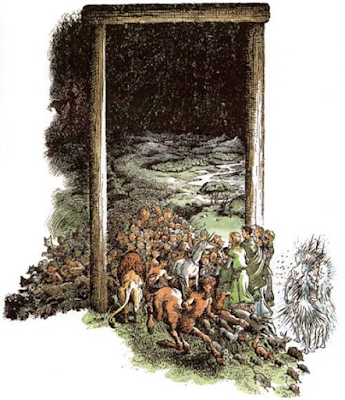
From The Last Battle by CS Lewis - Lewis's vision of the choice confronting post-mortal spirits
After mortal life we die and become spirit-beings - and it is these post-mortal spirits who may choose to become resurrected.
What is life like as a post-mortal spirit? What will you and I be like at the time when we are confronted by the chance and choice of resurrected eternal life?
The condition of post-mortal souls seems to have been accessible and known in ancient times; and in the years before Christ; the ancient Greeks left us with descriptions of Hades, while the ancient Hebrews described much the same condition as Sheol.
The condition of such spirit life can be described in terms of a state of 'dementia' or 'delirium'; but is perhaps most easily comprehended in terms of dreaming sleep.
During dreaming sleep; our spirit is cut-off from the body, and from the environment. That is, in general; we lose sensations of what is going-on inside us, and in the world around us.
Our spiritual self mostly breaks free from the body - but in sleep the spirit does not wholly break-free, because the spirit must return to the body on awakening - and therefore there must remain a connection, and this residual connection of spirit with body can be greater or lesser.
When the connection is greater, then the body and/or the environment around the sleeping body can influence the dreaming spirit; and we find some degree in which the physical shapes our dreams. For instance, a stomach pain or a ticking clock may be taken-up in the dream, and (in part or in whole) become part of a dream.
But sometimes the connection between spirit and body is diminished to the merest thread; and to the extent that the spirit does break free; we are then in a similar state to post-mortal spirit life.
What are the characteristic experiences of this kind of dreaming sleep, in a qualitative and formal sense?
In dreaming we retain our sense of 'self', of being an individual with a personal persepctive, and we remain who-we-are; but the quality of experience changes.
The typical mood of dreaming is one of perplexity - a sense of insecure grasp of the situation; of our understanding continually slipping-away.
We forget important things in the dream, and then later in the dream they are recalled with a sense of puzzlement: how could I have forgotten that? Or else we may discover major things of great importance in the dream that, somehow, (in real life) we had never noticed before.
In the dream we may take-for-granted bizarre situations that we (somehow!) find ourselves in; or conversely, may find ourselves unable to comprehend and function in situations that we would normally find routine.
Recognition of people and situations is unmoored - much as the spirit is unmoored from the body. For example, we may recognize someone familiar who then turns-out 'really' to be someone else; or else it turns-out that a stranger in the dream is 'really' someone familiar (although they may look and behave completely differently).
(These dream experiences are very similar to delusional misidentifications observed in psychoses.)
These kinds of dreaming experiences derive, I believe, from the greatly diminished connection between the spirit and the body during dreaming sleep. If we can imagine this disconnection becoming total and potentially 'permanent'; then we may have some idea of what it may be like to be dead - but not resurrected.
And it may be from such a dreamlike state - or perhaps more exactly from a temporarily lucid dream state (made possible by divine intervention) - that we make the choice about resurrection.
That is; a state when the dream situation becomes suffused by an increased self-consciousness and ability to choose; when (perhaps) the dream-self becomes more detached-from dream-experience - and knows it as "a dream" - in other words, knows the reality of the situation.
Then, it may be, we are confronted by the decision of whether to follow Jesus Christ through the process of transformation that is resurrection, to render us eternally incarnated, and to continue into Heaven.
Perhaps this transformation can itself be imagined, as if from a dream; as our spirits meeting with Jesus Christ and knowing Him to be Jesus Christ - standing as the Good Shepherd in front of a portal, a doorway - the entrance into the 'sheep fold' that is Heaven.
We are granted the comprehension that we may choose to follow Jesus through that doorway; and the knowledge that if we do so - as we are solidifying ('condensing') into eternal bodies - we will be taking with us only that which Good; only that which is Love - Love of God, of fellow Men, of divine creation...
Also, if we choose to pass through that doorway; all that is of sin, death, corruption - will be left-behind.
What I would emphasize here, is that when we make that decision; it will be from an experienced-situation that is somewhat like a dream, and the decision will be made by selves that are somewhat like our dream selves...
But a dream-like-state that we know to be reality; and the choice will be made by what we then-know to be our real, eternal and divine self.
Tuesday, 29 June 2021
Overcoming the division of sleep from consciousness (my speculation on ideas from Owen Barfield and Rudolf Steiner)
It is interesting to consider how the relationship between sleeping states - deep sleep and dreaming sleep - and the awake state may have changed through the evolutionary development of Men.
If we start with the historical (and early childhood) conscious state termed Original Participation by Owen Barfield; then it was a striking idea of Rudolf Steiner that this is characterized by what we would consider a less complete difference between sleep and waking. The awake person was not so fully awake is the case now; and aspects of deep and dreaming sleep remained active throughout the daytime.
This would be a more passive and unconscious form of waking; whereby we were involuntarily influenced by the sleeping states; immersed-in them. In Original Participation Man's consciousness was integrated, but dominated by sleep.
A suggestion is that the sleep states are (in some fashion) in communication with the divine and spiritual world; and therefore in Original Participation awake Man has direct experiential knowledge of the gods and spiritual reality. This may be why all early Men and all young children assume the reality of gods and the spiritual realm - because the experience and know it; not just when asleep but all of the time.
The idea is that, as Man's consciousness evolved through history, the division between sleeping and waking states became more distinct; until with modern Man it was complete (the phase called the Consciousness Soul). We are not aware of our sleeping and dreaming consciousness while awake (although they continue); and indeed we almost never remember anything from deep sleep, and even dream memories tend to be absent, partial or uncertain.
It struck me that presumably the same applies in the opposite direction: that waking consciousness has probably lost access to deep and dreaming sleep. Perhaps in earlier phases, waking consciousness could affect dreaming sleep, and even deep sleep; and therefore in original Participation these sleeping states were more conscious, more subject to waking motivations, and probably more memorable.
Whereas nowadays (for many people) dreams are characterized by their own crazy illogic and irrelevance; perhaps for early Men they were coherent, useful, memorable - by the waking Man. And maybe something analogous applied even with the slower, simpler, 'tidal' consciousness-world of deep sleep.
(Steiner suggests that in dreaming sleep, ancient Man - and children - are in communion with the lower angelic powers; and in deep sleep, the higher angels - or, I would guess, perhaps even the simple and basic aspects of the knowledge of God, Jesus Christ and/or the Holy Ghost.)
So, modern Man's consciousness states are not integrated; but instead divided, alienated, encapsulated.
And what of the goal of Final Participation? We might assume that the division between sleeping and waking would again become crossable, 'permeable' - but this time dominated by waking consciousness and by its capacity for free agency, for conscious choice.
Thus we may be able to choose to bring our waking consciousness and cross into dreaming, and even deep sleep; there to both gain conscious control of these states, and to remember better what happens in them.
So we may again become integrated in our consciousness; but this time with awakeness dominating.
However, this state is voluntary - not automatic; conscious not unconscious; and is subject to the constraints of Final Participation - which is, after all, an attainment of divine consciousness (albeit usually partial and always temporary) even when we are mortal on earth.
Therefore, we might be able to choose to bring awake consciousness into dreaming and deep sleep; but only insofar as we our-selves are aligned with God's purposes, meanings and mode of thinking.
If a person has chosen the side of Satan against God, then Final Participation is not (at that time) possible.
Furthermore sin interferes with Final Participation. Un-repented sin blocks FP in the long term (because we are not aligned with the divine); while currently-active sin in thinking will curtail FP for its duration; which is surely one reason, albeit not the only reason, why Final Participation is always temporary - indeed usually very brief.
Nonetheless, even with all these provisos, this gives an idea of what to aim for in Final Participation how to go about it; and how to know when it has happened. That is, we can aim towards more frequent and fuller integration of the waking and sleep states; do so consciously; and within a Christian context.
Saturday, 15 December 2018
Deep Sleep, Waking and Dreaming - a range of cognitive capacities
In terms of our subjective experience of Time, there is a gradient between the three conscious states - Deep sleep, Waking and Dreaming, between-which we alternate through our lives.
Deep sleep - when we are hardly aware of Time passing, and hardly anything seems to be experienced (in so far as we recall anything at all from Deep Sleep - I personally do not).
Waking - when Time passes in the way we know; not always at the same subjective speed, but within limits of a few-fold variation between time passing quickly and slowly. Experience likewise.
Dreaming sleep - in which time seems to pass at the same subjective speed as it does in waking life, but, relative to waking life Dreaming sleep moves much more rapidly; so that we can fit ?100 fold more events and emotions into a section of dreaming, than we could do in the equivalent time awake.
In other words, Dreaming is a very rapid and complex type of cognitive processing. However, Dreaming is poorly remembered; and notoriously unreliable - in terms of its content being incoherent within itself, and incoherent with subsequent and previous experience.
This implies that the gain in rapidity and complexity of mental processing that we get in dreaming has a price to pay in terms of the validity of 'conclusions'.
We can think, and experience, many many more things in five waking-minutes of a dream than in five waking-minutes; but a great deal of the dream material is unreliable, and does not stand up to scrutiny: it is not confirmed by experience.
If we assume that these conscious states are on a continuum; then I can back-extrapolate to the situation of Deep sleep. I can then assume that:
1. Deep sleep is necessary - and has important functions; or else we wouldn't do it, and would not have to do it.
2. Deep sleep is only capable of very slow and simple cognitive processing.
3. The thinking of Deep sleep is of the greatest coherence, within itself and with Life; and the knowledge of Deep sleep has the highest validity.
In sum, Deep sleep seems to be a kind of Intuition. That is; a bottom-line form of thinking, a self-validating form of thinking. If we can Deep sleep a thing; then that thing is real: or, it is as subjectively-real as something can be, for us.
My guess is that the things were are most sure about, or become surest about; are things that we have 'processed' in Deep sleep; and that the slowness, and simplicity of concepts, of Deep sleep is a constraint upon our capacity really to know things.
Note, aside: I've hidden the blog comments for a while, to take a break from dealing with them. I shall reveal them again soon, when I feel refreshed.
Deep sleep - when we are hardly aware of Time passing, and hardly anything seems to be experienced (in so far as we recall anything at all from Deep Sleep - I personally do not).
Waking - when Time passes in the way we know; not always at the same subjective speed, but within limits of a few-fold variation between time passing quickly and slowly. Experience likewise.
Dreaming sleep - in which time seems to pass at the same subjective speed as it does in waking life, but, relative to waking life Dreaming sleep moves much more rapidly; so that we can fit ?100 fold more events and emotions into a section of dreaming, than we could do in the equivalent time awake.
In other words, Dreaming is a very rapid and complex type of cognitive processing. However, Dreaming is poorly remembered; and notoriously unreliable - in terms of its content being incoherent within itself, and incoherent with subsequent and previous experience.
This implies that the gain in rapidity and complexity of mental processing that we get in dreaming has a price to pay in terms of the validity of 'conclusions'.
We can think, and experience, many many more things in five waking-minutes of a dream than in five waking-minutes; but a great deal of the dream material is unreliable, and does not stand up to scrutiny: it is not confirmed by experience.
If we assume that these conscious states are on a continuum; then I can back-extrapolate to the situation of Deep sleep. I can then assume that:
1. Deep sleep is necessary - and has important functions; or else we wouldn't do it, and would not have to do it.
2. Deep sleep is only capable of very slow and simple cognitive processing.
3. The thinking of Deep sleep is of the greatest coherence, within itself and with Life; and the knowledge of Deep sleep has the highest validity.
In sum, Deep sleep seems to be a kind of Intuition. That is; a bottom-line form of thinking, a self-validating form of thinking. If we can Deep sleep a thing; then that thing is real: or, it is as subjectively-real as something can be, for us.
My guess is that the things were are most sure about, or become surest about; are things that we have 'processed' in Deep sleep; and that the slowness, and simplicity of concepts, of Deep sleep is a constraint upon our capacity really to know things.
Note, aside: I've hidden the blog comments for a while, to take a break from dealing with them. I shall reveal them again soon, when I feel refreshed.

Friday, 2 May 2014
Being awake, dreaming and deeply asleep by analogy with General Relativity - Christian speculations
*
For the 'scientific' explanation, first read:
http://iqpersonalitygenius.blogspot.co.uk/2014/05/understanding-dreaming-sleep-awake.html
This strange-seeming way of thinking about dreaming, the awake state and deep sleep comes from combining the Mormon understanding that we had a pre-mortal existence with an insight of William Arkle that our mortal, earthly incarnated life is characterized by being a slowly-moving, close-up and detailed form of consciousness as perceived from a 'Heavenly' perspective.
http://charltonteaching.blogspot.co.uk/2014/03/is-mortal-life-behind-veil-of.html
This is related to trying to understand the reason for earthly incarnated mortal life - what is it that we can do in this form of existence that could not be accomplished in Heaven/ an immortal and spiritual world (or, at least, would be more difficult, slower, less probable than in Heaven).
I am also trying to understand how - say - angels can operate between Heaven (or some other spiritual realm) and Earth - how they can sometimes apparently get so much done in such a short period of time; yet at other times are described as taking-on bodies and operating on a human timescale, but somewhat like 'superhuman' Men.
*
Anyway, I came-up with the idea that from the awake perspective we have an understanding of Heavenly operations in dreaming sleep - when there is so much done in a very short time.
So Heavenly time and action can be understood as a more extreme version of the dreaming mind as it is perceived by our awake mind; in the sense that we can experience (say) a thousand hours of dreaming experience in just one hour of awake time - or can accomplish things a thousand times faster while dreaming than while awake.
*
And, alternatively from the perspective of our awake state, we could view deep sleep as analogous to how earthly, mortal incarnate life might seem to a Heavenly being such as an angel. Our earthly mortal incarnate life might seem incredible slowed-up and uneventful.
When we awaken from deep sleep, it seems as if little or nothing has been going on - perhaps just a certain mood, or theme remains... Likewise, an angel might have time to think and do a thousand things while we were only able to think a sentence, lift a hand or experience a mood.
*
And, perhaps, to angelic consciousness a whole human lifespan seems like the life of a mayfly...
This would mean that human consciousness perceives vastly more detail, drama, dilemmas per unit time than do angels - all the great issues of which we are aware in mortal life may just whiz past an angelic consciousness.
So mortal incarnate life on Earth might be much better that the Heavenly realm as an arena for the exercise of human agency, free will, as a place when the choices arrive slowly, singly, linearly - where the whizzing pace of spiritual existence gets slowed-down, dissected into its components, put under a microscope...
*
I find this helpful in understanding why it was necessary (or most-beneficial) to create an earth for men to be born into as mortals - why this situation is better than Heaven for doing what we are here to do.
*
For the 'scientific' explanation, first read:
http://iqpersonalitygenius.blogspot.co.uk/2014/05/understanding-dreaming-sleep-awake.html
This strange-seeming way of thinking about dreaming, the awake state and deep sleep comes from combining the Mormon understanding that we had a pre-mortal existence with an insight of William Arkle that our mortal, earthly incarnated life is characterized by being a slowly-moving, close-up and detailed form of consciousness as perceived from a 'Heavenly' perspective.
http://charltonteaching.blogspot.co.uk/2014/03/is-mortal-life-behind-veil-of.html
This is related to trying to understand the reason for earthly incarnated mortal life - what is it that we can do in this form of existence that could not be accomplished in Heaven/ an immortal and spiritual world (or, at least, would be more difficult, slower, less probable than in Heaven).
I am also trying to understand how - say - angels can operate between Heaven (or some other spiritual realm) and Earth - how they can sometimes apparently get so much done in such a short period of time; yet at other times are described as taking-on bodies and operating on a human timescale, but somewhat like 'superhuman' Men.
*
Anyway, I came-up with the idea that from the awake perspective we have an understanding of Heavenly operations in dreaming sleep - when there is so much done in a very short time.
So Heavenly time and action can be understood as a more extreme version of the dreaming mind as it is perceived by our awake mind; in the sense that we can experience (say) a thousand hours of dreaming experience in just one hour of awake time - or can accomplish things a thousand times faster while dreaming than while awake.
*
And, alternatively from the perspective of our awake state, we could view deep sleep as analogous to how earthly, mortal incarnate life might seem to a Heavenly being such as an angel. Our earthly mortal incarnate life might seem incredible slowed-up and uneventful.
When we awaken from deep sleep, it seems as if little or nothing has been going on - perhaps just a certain mood, or theme remains... Likewise, an angel might have time to think and do a thousand things while we were only able to think a sentence, lift a hand or experience a mood.
*
And, perhaps, to angelic consciousness a whole human lifespan seems like the life of a mayfly...
This would mean that human consciousness perceives vastly more detail, drama, dilemmas per unit time than do angels - all the great issues of which we are aware in mortal life may just whiz past an angelic consciousness.
So mortal incarnate life on Earth might be much better that the Heavenly realm as an arena for the exercise of human agency, free will, as a place when the choices arrive slowly, singly, linearly - where the whizzing pace of spiritual existence gets slowed-down, dissected into its components, put under a microscope...
*
I find this helpful in understanding why it was necessary (or most-beneficial) to create an earth for men to be born into as mortals - why this situation is better than Heaven for doing what we are here to do.
*
Sunday, 30 September 2018
Death as dreaming sleep (and the coming of Hell)
What is it like to be dead?
Modern materialist Man seems to have decided that to be dead is like being permanently in deep sleep, unaware of the self, unaware of anything.
The ancient world also seems to have regarded death as like being asleep; but like dreaming sleep. The Hades of the Greeks and Sheol of the Jews were states of being much like the world of dreams - the self was feeble, agency was feeble, the individual had little control and was merely swept-along by events.
In the ancient underworlds, as in dreams; memories slipped away almost as soon as formed, motivations likewise; understanding likewise. To be dead was thus to be delirious, or demented - to become a ghost - living in a perpetual present mostly dominated (like dreams) by perplexed incomprehension, confusion, angst - but presumably with interludes of pleasure and satisfaction.
We should note, therefore, that the ancient understanding of death as underworld, Hades, Sheol was Not that all men 'went to Hell'. The state of dead souls was one to be dreaded, as a modern Man would dread delirium or dementia - but it was Not a state of perpetual misery or torment.
*
Among Rudolf Steiner's ideas is that our self is spiritual and not located, and our body is like a mirror for the external self; the self sees-itself in the body. A similar idea from Rupert Sheldrake is that memory is like an electromagnetic field - a radio signal - and the brain is like a receiver - a radio - which intercepts this field, interprets and broadcasts it.
Common to such ideas is the notion that the human brain, the body, are not the origin of our-selves; but these solid things are necessary for our immaterial/ extensive selves to become centred, focused, autonomous, agent...
Back to Steiner... he suggested that during sleep the consciousness and the self left-behind the living body - so deep sleep without dreams is our experience of merely being alive in the body, rather like a plant; whereas dreaming sleep was when we became 'located' with the consciousness outside the body, in the spirit.
By such an account, sleep is closely analogous to death; because with death the physical body dies - but not human consciousness. The body dies, but the soul continues. If our awareness becomes cut-off from our bodies; we might expect that the remaining consciousness would be incomplete, and we would experience its life much as does the dreamer.
An immortal soul detached from its living body is in much the same situation as the dreaming consciousness.
*
So - until the work of Jesus Christ - Man's death was universally like sleep, but like dreaming sleep; and this state seemed to be the permanent fate of the dead.
But since Jesus; the universal fate of Men has been resurrection; and resurrection reunites consciousness with the body; but with a permanent immortal body.
This suggests that resurrection would be analogous to awakening from dreaming sleep; and with a similar sense of renewed agency, freedom, self-awareness, control. The consciousness returns to its living body - but not to the mortal body left-behind a few hours ago; but instead to to a new living body, the resurrected eternal body.
The choice of Heaven of Hell is a choice of where this resurrected Man will dwell. Indeed, Hell was not possible until resurrection had been instituted.
In sum; BC there was universal Sheol but no Hell; after Christ Sheol was abolished, there was universal resurrection and the possibility of Heaven - but the coming of Christ was also the coming of Hell.
With Sheol there was no possibility of Men choosing Hell, because the dead lacked free will, so the dead could not choose. But Christ's gift of life everlasting brought the post-mortal capacity to choose - to choose evil, as well as to choose Good.
Modern materialist Man seems to have decided that to be dead is like being permanently in deep sleep, unaware of the self, unaware of anything.
The ancient world also seems to have regarded death as like being asleep; but like dreaming sleep. The Hades of the Greeks and Sheol of the Jews were states of being much like the world of dreams - the self was feeble, agency was feeble, the individual had little control and was merely swept-along by events.
In the ancient underworlds, as in dreams; memories slipped away almost as soon as formed, motivations likewise; understanding likewise. To be dead was thus to be delirious, or demented - to become a ghost - living in a perpetual present mostly dominated (like dreams) by perplexed incomprehension, confusion, angst - but presumably with interludes of pleasure and satisfaction.
We should note, therefore, that the ancient understanding of death as underworld, Hades, Sheol was Not that all men 'went to Hell'. The state of dead souls was one to be dreaded, as a modern Man would dread delirium or dementia - but it was Not a state of perpetual misery or torment.
*
Among Rudolf Steiner's ideas is that our self is spiritual and not located, and our body is like a mirror for the external self; the self sees-itself in the body. A similar idea from Rupert Sheldrake is that memory is like an electromagnetic field - a radio signal - and the brain is like a receiver - a radio - which intercepts this field, interprets and broadcasts it.
Common to such ideas is the notion that the human brain, the body, are not the origin of our-selves; but these solid things are necessary for our immaterial/ extensive selves to become centred, focused, autonomous, agent...
Back to Steiner... he suggested that during sleep the consciousness and the self left-behind the living body - so deep sleep without dreams is our experience of merely being alive in the body, rather like a plant; whereas dreaming sleep was when we became 'located' with the consciousness outside the body, in the spirit.
By such an account, sleep is closely analogous to death; because with death the physical body dies - but not human consciousness. The body dies, but the soul continues. If our awareness becomes cut-off from our bodies; we might expect that the remaining consciousness would be incomplete, and we would experience its life much as does the dreamer.
An immortal soul detached from its living body is in much the same situation as the dreaming consciousness.
*
So - until the work of Jesus Christ - Man's death was universally like sleep, but like dreaming sleep; and this state seemed to be the permanent fate of the dead.
But since Jesus; the universal fate of Men has been resurrection; and resurrection reunites consciousness with the body; but with a permanent immortal body.
This suggests that resurrection would be analogous to awakening from dreaming sleep; and with a similar sense of renewed agency, freedom, self-awareness, control. The consciousness returns to its living body - but not to the mortal body left-behind a few hours ago; but instead to to a new living body, the resurrected eternal body.
The choice of Heaven of Hell is a choice of where this resurrected Man will dwell. Indeed, Hell was not possible until resurrection had been instituted.
In sum; BC there was universal Sheol but no Hell; after Christ Sheol was abolished, there was universal resurrection and the possibility of Heaven - but the coming of Christ was also the coming of Hell.
With Sheol there was no possibility of Men choosing Hell, because the dead lacked free will, so the dead could not choose. But Christ's gift of life everlasting brought the post-mortal capacity to choose - to choose evil, as well as to choose Good.
Monday, 17 September 2018
We are dreaming all the time - and need to become aware of the fact
As I have mentioned before in this blog; I believe that we are dreaming all the time that we are awake - underneath waking life, we are continually dreaming. And sometimes, when we are napping, we may dip into and out-of this continual dreaming.
In dreaming, we are in contact with divine, presumably angelic, influences; which is why dreams are a mode of archetype and myth. Ancient man lived always in this kind of dreamlike state, and we all lived this way as young children. Thus human history and our personal development was a process of becoming more alert, awake, conscious during waking life - but also a process of becoming cut-off from unconscious and pervasive divine influences.
So, for modern Man dream is our last vestige of that old mythic consciousness; but our task and destiny is - consciously and by choice - to return to a state of contact with divine beings. My understanding is that this was supposed to happen in The West from the late 1700s, at the time of the Romantic era.
In terms of dreaming while awake, we were supposed to become aware of it; become aware of the nature of the angelic influences from that mythic, archetypal undercurrent. However, this did not happen, Instead, Western man took the path of atheism, materialism; and embraced a metaphysics which regards God, angels, soul, myth, destiny, ultimate purpose and meaning (etc) as not-really-real. These were all relegated to the world of subjective imagination. Real-reality - the objective - that is the public realm of discourse upon which law, morality and policy are based, excluded all such matters by assumption.
The result is that we are self-blinded to the continual influences of waking dreams, which we experience only as 'gut-level' instincts, impulses and urges. Because we will not acknowledge their true nature and origin; these influences can be (and are) pervasively, systematically misinterpreted by public discourse. Thus divine destiny has been perverted in many ways, and turned to harm and evil.
An example is the sexual revolution. We all experience a divine impulse towards a different, more personal, less group-based, relation between men and women. Properly, this ought to signal a development towards our ultimate divine goal of an eternal loving and creative married union - a creative dyadic relationship.
But this has, in multiple ways, misinterpreted as a gut level instinct for personal gratification in this world - leading to all sorts of harms such as (via the public policy, the mass media and arts) mocking, maligning and subverting marriage and the family; promoting casual and lust-based promiscuity; dividing men and women into interest groups, set against each other; and the enforced promotion of same sex activity and wholesale delusion and contradiction about sexual identity. This has led to misery and suffering in this world, contributed to a pervasive atmosphere of resentment and selfish short-termism, and most significantly anti Christianity and the embrace of self-damnation.
My understanding is therefore that we must become aware of our waking dreams, or else be destroyed by them.
Currently, we are blocking our own awareness - so what we must do is to stop doing this. Stop it by whatever works, whatever means tends-to that end.... But first by acknowledging the problem.
In dreaming, we are in contact with divine, presumably angelic, influences; which is why dreams are a mode of archetype and myth. Ancient man lived always in this kind of dreamlike state, and we all lived this way as young children. Thus human history and our personal development was a process of becoming more alert, awake, conscious during waking life - but also a process of becoming cut-off from unconscious and pervasive divine influences.
So, for modern Man dream is our last vestige of that old mythic consciousness; but our task and destiny is - consciously and by choice - to return to a state of contact with divine beings. My understanding is that this was supposed to happen in The West from the late 1700s, at the time of the Romantic era.
In terms of dreaming while awake, we were supposed to become aware of it; become aware of the nature of the angelic influences from that mythic, archetypal undercurrent. However, this did not happen, Instead, Western man took the path of atheism, materialism; and embraced a metaphysics which regards God, angels, soul, myth, destiny, ultimate purpose and meaning (etc) as not-really-real. These were all relegated to the world of subjective imagination. Real-reality - the objective - that is the public realm of discourse upon which law, morality and policy are based, excluded all such matters by assumption.
The result is that we are self-blinded to the continual influences of waking dreams, which we experience only as 'gut-level' instincts, impulses and urges. Because we will not acknowledge their true nature and origin; these influences can be (and are) pervasively, systematically misinterpreted by public discourse. Thus divine destiny has been perverted in many ways, and turned to harm and evil.
An example is the sexual revolution. We all experience a divine impulse towards a different, more personal, less group-based, relation between men and women. Properly, this ought to signal a development towards our ultimate divine goal of an eternal loving and creative married union - a creative dyadic relationship.
But this has, in multiple ways, misinterpreted as a gut level instinct for personal gratification in this world - leading to all sorts of harms such as (via the public policy, the mass media and arts) mocking, maligning and subverting marriage and the family; promoting casual and lust-based promiscuity; dividing men and women into interest groups, set against each other; and the enforced promotion of same sex activity and wholesale delusion and contradiction about sexual identity. This has led to misery and suffering in this world, contributed to a pervasive atmosphere of resentment and selfish short-termism, and most significantly anti Christianity and the embrace of self-damnation.
My understanding is therefore that we must become aware of our waking dreams, or else be destroyed by them.
Currently, we are blocking our own awareness - so what we must do is to stop doing this. Stop it by whatever works, whatever means tends-to that end.... But first by acknowledging the problem.
Wednesday, 2 March 2022
What is the significance that dream experience is relatively much more rapid than waking experience?
It is an extraordinary to realize how rapidly a dream narrative proceeds compared with waking thought - so that a detailed dream experienced as lasting many hours, may turn-out to have happened while just a few minutes elapsed during waking life (by the clock).
In the past I have tried to 'explain' this by assuming that 'Time' operated differently in dream compared with waking. And also in dreamless sleep - which is the opposite of dreaming - because only 'an instant' in subjective experience, may have lasted several hours by-the-clock.
My 'Time' explanation was that time ran more slowly in dreaming than awake, so that more could be fitted-in; while the opposite was true for deep sleep.
But if Time cannot legitimately be abstracted from the living of Beings - as I argued recently - then be must explain this phenomenon differently.
The reason why I think that so much more can be experienced in dreams is that we are then (more-or-less) cut-off from 'external' sensory and perceptual stimuli, and from real interactions with other Beings, such as other people.
When we are interacting with 'externals' then our experience can proceed only at whatever speed these interactions occur - for example the timescale of a conversation or of physically moving through a landscape.
But in a dream, we are 'modelling' reality using material from our memories - and our processing (combinations, extrapolations and speculations upon) memories.
We could think of this in terms of recalled memories being the dream content; and what we do in processing these memories as the dream plot.
So that the primary process of dreaming can move as fast as memories are-being-recalled. This central nervous system process occurs with a timescale of less than a second, maybe tenths-of-a-second.
This is relatively much faster than interactions with the external world, so dream experience is relatively more concentrated.
What of our emotional responses? Emotions are 'enacted' by changes in body state - and these have a timescale of approximately seconds - for example, to feel terror the sympathetic nervous system needs to be activated (taking some seconds), and adrenaline is released into blood to circulate around the body (some tens of seconds).
Whatever the exact speeds, it is certain that emotions are enacted relatively more slowly than memories are recalled. But perhaps the emotions happen about as fast as we contrive our dream plots.
We would therefore expect that specific dream 'events' move faster than the body can enact emotional responses; and therefore that the emotions could easily get 'out-of-synch' with the dream contents.
But the overall dream plot might well be in accordance with our dream emotions, even when specific dream contents are not.
And this is, I think, a very common, indeed probably the usual experience of dreaming.
We often experience a kind of mismatch between dream events and emotions - and there is often a pervasive feeling of perplexity or confusion as events seem to be coming at us too fast to understand.
On the other hand, the overall shape (or plot) of a dream does tend to match up with the emotions - e.g. scary dreams have scary plots.
In dreaming I think we are therefore getting a kind of very concentrated experience that we ourselves concoct; and we react emotionally to these concoctions.
Dreams are therefore potential learning experiences, just as is waking life; and probably just as necessary and valuable.
But the source of dream experience is almost-wholly inner; and this accounts for the different subjective feeling of a dream, when compared with waking life.
Monday, 16 April 2018
Dreaming Sleep and Death/ Hades/ Sheol
It strikes me that dreaming sleep (of the usual, broadly nightmarish or bewildering kind) is often like the 'underworld' death as envisaged by the Ancient Greeks (Hades) and Ancient Hebrews (Sheol) - that is a 'demented', passive state of very partial awareness - with perplexity as the dominant emotion.
In sleep; life happens-to-us and we strive, and fail, to make sense of it, and to cope with it. Our minds are porous and connected with the dream environment - we are like the 'gibbering ghosts' of the underworld.
In dreams the environment affects our mind - and our mind affects the environment in a reciprocal causality. We are acted-upon rather than acting: there is no freedom in a dream...
The gift of Jesus is to be born-again, to waken from this unending nightmare - awaken to resurrected eternal life - that is by incarnation to be separate from the environment and act to act in free agency from it; to be alert and conscious and creative in relation to the environment rather than swept-along passively, uncomprehendingly, in perpetual bewilderment.
Dreaming sleep is a temporary death - although modern Man assumes that death is a non-being much like deep sleep: unconsciousness and oblivion, rather than the underworld, nightmare state of dreaming sleep. But by dreaming sleep, of the nightmarish/ bizarre/ confusing/ helpless kind... we can know what it is we are being rescued-from.
Jesus came to rescue Man from the inevitability of the underworld nightmare of death - by resurrection; and with the offer of a gift of life eternal, which is a creative state of divine being.
(But death is necessary: to be reborn we must die; and death is bitter vinegar, as well as purifying hyssop.)
In sleep; life happens-to-us and we strive, and fail, to make sense of it, and to cope with it. Our minds are porous and connected with the dream environment - we are like the 'gibbering ghosts' of the underworld.
In dreams the environment affects our mind - and our mind affects the environment in a reciprocal causality. We are acted-upon rather than acting: there is no freedom in a dream...
The gift of Jesus is to be born-again, to waken from this unending nightmare - awaken to resurrected eternal life - that is by incarnation to be separate from the environment and act to act in free agency from it; to be alert and conscious and creative in relation to the environment rather than swept-along passively, uncomprehendingly, in perpetual bewilderment.
Dreaming sleep is a temporary death - although modern Man assumes that death is a non-being much like deep sleep: unconsciousness and oblivion, rather than the underworld, nightmare state of dreaming sleep. But by dreaming sleep, of the nightmarish/ bizarre/ confusing/ helpless kind... we can know what it is we are being rescued-from.
Jesus came to rescue Man from the inevitability of the underworld nightmare of death - by resurrection; and with the offer of a gift of life eternal, which is a creative state of divine being.
(But death is necessary: to be reborn we must die; and death is bitter vinegar, as well as purifying hyssop.)
Thursday, 13 June 2013
A breakthrough in understanding creativity - the primacy of Long Term Memory
*
This morning I seem to have experienced a breakthrough in my understanding of creativity, and its links to the mode of thinking associated with dreaming sleep and psychosis.
*
I have been puzzling over the nature of dream logic - that is to say, the principles by which dream association works.
I had got as far as recognizing that the strange nature of dreams (which I take it are selective and partial samples of a mostly unconscious and fundamental brain process going-on especially during REM sleep), and the creativity of dreaming (such that new phenomena are produced and not just a mosaic of our previous experiences) are both a reflection of the different principles of dream processing, compared with waking processing.
*
In other words, I had got so far as understanding that dreams are not just a quantitative variation on the logic of the awake mind, dreams are not merely a matter of 'looser associations' in which the associations are of the same sort as waking associations, nor are strange and unreal dream contents wholly explicable in terms of errors in memory - but rather, the association of ideas and meanings which is going-on in dreaming sleep is qualitatively different from the associations of the awake state, and operating according to a different set of rules than during the waking state.
*
However, my attempts to understand dream logic were getting nowhere - except that I recognized that dreaming was something to do with Long Term Memory (LTM) being autonomous from the Short Term Memory (STM - and equivalent to Working Memory) which dominates the waking state; and dream logic had something to do with associations via emotions or feelings which formed some degree of contrast with waking logic which was at least relatively (or potentially) more-independent of emotions and feelings.
*
The breakthrough came, as so often, when I un-asked the question - when I recognized that I was asking for an explanation of that which was primary, and taking for granted that which was secondary.
In other words, I suddenly recognized (and remembered) that Long Term Memory was primary and Short Term Memory (Waking Memory) was a secondary phenomenon - a tiny sample of the content of perception and of Long Term Memory which was represented as patterns of neurons activated for a matter of seconds (this is what are aware of and attend to, and can manipulate by will/ executive function).
*
Therefore the associative principles or logic of Long Term Memory (which is also dream logic, and also the logic of creativity) is actually the full range of associative processes of which the human brain is capable - that is to say, all humanly-possible associations.
But this is implicit; it is the hidden part of the iceberg of which Short Term Memory is the only part that is explicitly available to introspection (becoming explicit by being activated in Short Term Memory).
*
By contrast, waking logic is a tightly-constrained, partial, distorted and tiny sub-set of the vast amount of information and vast richness of associations which are located in Long Term Memory.
So, creativity is the business of becoming aware of the vast richness of information and associations in Long Term Memory - and making these explicit and available to introspection in Short Term Memory.
*
Creativity deploys the enormous knowledge and densely rich associations of Long Term Memory - and brings the results into Short Term Memory.
Thus (to emphasize the point) creativity does not interfere with the processes of LTM; in particualr creativity does not impose STM processing onto LTM contents - it only takes the outcomes of LTM processing.
*
But how does creativity access the contents of Long Term memory, when these contents are mostly inexplicit and inaccessible to introspection?
This is where emotions and feelings come in: Creativity is the means by which STM accesses LTM through emotions and feelings.
*
Let us suppose that the processes of LTM have led to certain insights or conclusions, then this will in turn lead to an emotion; and that emotion may be experienced consciously - which is what we call a feeling.
Therefore, creativity is about the feelings we have in response to the goings-on in LTM - the feelings serve as evaluations, and these evaluations derive from the enormously complex and mysterious processes of Long Term Memory - that embody all the knowledge and associations (interconnection) of which we are capable.
*
Creativity works by feelings. For example there are positive (happy or pleasurable) and negative (uncomfortable, maybe painful) feelings that may provide an evaluation of ideas and experiences.
There are hunches which point us toward doing this, rather than that; there are felt-links between what superficially appear to be diverse and unrelated facts and domains; there is the sense of knowing when we are right (or on the right lines) and conversely the dissatisfaction and irritation when we are wrong (or going down a blind alley, or following a red herring).
This is the stuff of creativity! And it is a matter of feelings.
*
But of course these creative feelings are ultimately dependent on the knowledge and experience stored in Long Term Memory. these feelings can be no better a guide than the LTM stores which sustain and generate them.
And this conception explains how creativity becomes linked to a specific problem or domain in which the individual becomes 'expert'.
What is happening is that, by focusing their experiences and their thinking over a prolonged period of time, the creative person is orientating their LTM towards a particular problem or domain - such that Long Term Memory begins to deploy its vast informational and processing resources upon that problem or domain.
*
The creative person has a LTM which is, in the first place, well-filled with relevant knowledge to a theme, and in the second place orientated towards that theme so that during dreaming sleep (plus other times) LTM is working-on that theme.
If or when Long Term Memory comes up with answers or insights, then the creative person becomes aware of this fact during the waking state by becoming aware of the emotions which are engendered in relation to that theme - and then it is a matter of STM discovering and making-explicit the implicit and not-directly accessible associations of LTM that underlay those answers or insights.
***
More to follow, no doubt... Interestingly this breakthrough, as it seems, followed a discussion with my daughter in which we tried to understand the associations of her dream last night. Afterwards I realized that we were trying as to make explicit the primary and actual associations of the dream - we were using awake STM to explain dreaming LTM...
This morning I seem to have experienced a breakthrough in my understanding of creativity, and its links to the mode of thinking associated with dreaming sleep and psychosis.
*
I have been puzzling over the nature of dream logic - that is to say, the principles by which dream association works.
I had got as far as recognizing that the strange nature of dreams (which I take it are selective and partial samples of a mostly unconscious and fundamental brain process going-on especially during REM sleep), and the creativity of dreaming (such that new phenomena are produced and not just a mosaic of our previous experiences) are both a reflection of the different principles of dream processing, compared with waking processing.
*
In other words, I had got so far as understanding that dreams are not just a quantitative variation on the logic of the awake mind, dreams are not merely a matter of 'looser associations' in which the associations are of the same sort as waking associations, nor are strange and unreal dream contents wholly explicable in terms of errors in memory - but rather, the association of ideas and meanings which is going-on in dreaming sleep is qualitatively different from the associations of the awake state, and operating according to a different set of rules than during the waking state.
*
However, my attempts to understand dream logic were getting nowhere - except that I recognized that dreaming was something to do with Long Term Memory (LTM) being autonomous from the Short Term Memory (STM - and equivalent to Working Memory) which dominates the waking state; and dream logic had something to do with associations via emotions or feelings which formed some degree of contrast with waking logic which was at least relatively (or potentially) more-independent of emotions and feelings.
*
The breakthrough came, as so often, when I un-asked the question - when I recognized that I was asking for an explanation of that which was primary, and taking for granted that which was secondary.
In other words, I suddenly recognized (and remembered) that Long Term Memory was primary and Short Term Memory (Waking Memory) was a secondary phenomenon - a tiny sample of the content of perception and of Long Term Memory which was represented as patterns of neurons activated for a matter of seconds (this is what are aware of and attend to, and can manipulate by will/ executive function).
*
Therefore the associative principles or logic of Long Term Memory (which is also dream logic, and also the logic of creativity) is actually the full range of associative processes of which the human brain is capable - that is to say, all humanly-possible associations.
But this is implicit; it is the hidden part of the iceberg of which Short Term Memory is the only part that is explicitly available to introspection (becoming explicit by being activated in Short Term Memory).
*
By contrast, waking logic is a tightly-constrained, partial, distorted and tiny sub-set of the vast amount of information and vast richness of associations which are located in Long Term Memory.
So, creativity is the business of becoming aware of the vast richness of information and associations in Long Term Memory - and making these explicit and available to introspection in Short Term Memory.
*
Creativity deploys the enormous knowledge and densely rich associations of Long Term Memory - and brings the results into Short Term Memory.
Thus (to emphasize the point) creativity does not interfere with the processes of LTM; in particualr creativity does not impose STM processing onto LTM contents - it only takes the outcomes of LTM processing.
*
But how does creativity access the contents of Long Term memory, when these contents are mostly inexplicit and inaccessible to introspection?
This is where emotions and feelings come in: Creativity is the means by which STM accesses LTM through emotions and feelings.
*
Let us suppose that the processes of LTM have led to certain insights or conclusions, then this will in turn lead to an emotion; and that emotion may be experienced consciously - which is what we call a feeling.
Therefore, creativity is about the feelings we have in response to the goings-on in LTM - the feelings serve as evaluations, and these evaluations derive from the enormously complex and mysterious processes of Long Term Memory - that embody all the knowledge and associations (interconnection) of which we are capable.
*
Creativity works by feelings. For example there are positive (happy or pleasurable) and negative (uncomfortable, maybe painful) feelings that may provide an evaluation of ideas and experiences.
There are hunches which point us toward doing this, rather than that; there are felt-links between what superficially appear to be diverse and unrelated facts and domains; there is the sense of knowing when we are right (or on the right lines) and conversely the dissatisfaction and irritation when we are wrong (or going down a blind alley, or following a red herring).
This is the stuff of creativity! And it is a matter of feelings.
*
But of course these creative feelings are ultimately dependent on the knowledge and experience stored in Long Term Memory. these feelings can be no better a guide than the LTM stores which sustain and generate them.
And this conception explains how creativity becomes linked to a specific problem or domain in which the individual becomes 'expert'.
What is happening is that, by focusing their experiences and their thinking over a prolonged period of time, the creative person is orientating their LTM towards a particular problem or domain - such that Long Term Memory begins to deploy its vast informational and processing resources upon that problem or domain.
*
The creative person has a LTM which is, in the first place, well-filled with relevant knowledge to a theme, and in the second place orientated towards that theme so that during dreaming sleep (plus other times) LTM is working-on that theme.
If or when Long Term Memory comes up with answers or insights, then the creative person becomes aware of this fact during the waking state by becoming aware of the emotions which are engendered in relation to that theme - and then it is a matter of STM discovering and making-explicit the implicit and not-directly accessible associations of LTM that underlay those answers or insights.
***
More to follow, no doubt... Interestingly this breakthrough, as it seems, followed a discussion with my daughter in which we tried to understand the associations of her dream last night. Afterwards I realized that we were trying as to make explicit the primary and actual associations of the dream - we were using awake STM to explain dreaming LTM...
Monday, 12 October 2020
I am, apparently, always dreaming - unconsciously; a parallel dream self and world
Last night I was trying to write in my notebook; but couldn't stop myself from falling asleep for multiple brief micro-sleeps - with a longer period embedded. Meanwhile, I was writing notes!
The record of the experience is nearly illegible; but it seems that I had a chunk of dream about my having-written a novel and submitted it to a publisher - to an editor who was some kind of friend. I did not remember having written the novel or why (when I know for sure, even in the dream, that I am incapable of doing so...).
I got the novel typescript back in a large envelope which I opened, and I saw there were some detailed handwritten comments from the editor on the top-sheet. However, I was embarrassed about the whole thing, and unwilling to read exactly why this story (which I couldn't even remember having written or sent) had been rejected - so I put the thing onto my bedside table.
At that point I woke; and decided to take a look at the comments after all, and rolled-over to find a notebook on my knees, and nothing on my bedside table - and after a second or so, I realised it had been a dream.
So I started to write this into the notebook - but periodically kept on 'dropping' back into the same dream... rejoining it at various further points; having - in the dream world - forgotten how matters had reached this point, but recalling enough when I awoke to recognise some link.
Periodically; I would wake, for a few tens of seconds, start writing (scrawling, rather) as the memories ebbed-away - and then drop off to sleep again.
The dream was not really going anywhere specifically, but was meandering-along by some kind of free-associative process; all the while my memory was fading 'behind-me' so that I was continually puzzled and struggling about how I had gotten-into the current situation, although I knew that I used-to know.
(This mood is what the old time psychiatrists called 'perplexity' and is characteristic of many pychoses.)
Anyway, not to labour the point; this is another of many confirmations I have had over the years that I seem to be dreaming all of the time; and by falling asleep I am able to 'sample' the ongoing dream. It is like dipping-into a fast running stream-of-consciousness that runs below my wake state.
The ongoing dream crams a great deal more into clock time than does the awake state - something like a hundred times more stuff happens in a minute of sleep, than a minute of being awake.
The dreaming mind has a very poor memory - it apparently has a working memory of some tens of seconds, but after that period, everything rapidly fades-away (like walking along a road that is always crumbling-away a couple of hundred yards behind, so that I cannot look-back any further than that) - in much the fashion seen with people suffering dementia or in a delirium.
And the awake and dreaming states are kept apart by some kind of 'software incompatibility'; such that a dream may seem clear and comprehensible immediately upon awakening; but cannot be recalled, transcribed or 'translated'... There are exceptions, when I do remember chunks of a dream well, but these exceptions are exceptional - and may happen when my sleep is shallowest - as when I am at the end of the night's sleep and ready to wake fully.
It is interesting to me that there is an unconscious dream life running through all of my waking life (and maybe also in deep sleep?); and further that this dream narrative crams in far more detail, emotion, and incident than does the waking state.
In this sense; I have much more dream-experience in my life than I do waking experience - but this experience is not available to the waking mind.
However, I think that it is available to the dreaming mind. In other words, while in a dream I seem to remember my other dreams - there seems to be a separate 'dream memory' store, inaccessible to my wakening mind.
For instance, there are dream places that I inhabit, and recall, only in dreams; dream incidents; indeed I probably have a 'parallel but distinct' dream nature or personality, who has different aptitudes and has led (is leading) a different life.
And - presumably, since it happens; this stuff is significant and important - in some unknown way.
Saturday, 21 September 2019
Death before and after Jesus (and the possibility of resurrection)
The coming of Jesus Christ changed the nature of death.
More exactly, I believe that this happened at the point of his baptism by John; the time when Jesus became divine; when the divine spirit rested upon him and stayed with him.
From then; those who loved, trusted, had-faith-in, 'followed' Jesus (those who wanted to be resurrected and dwell in Heaven for eternity) would be resurrected.
So time is real, history is real; the nature of death is divided into before and after that moment. That moment introduced the new possibility after biological death; which was resurrection to eternal life.
Before Jesus, there was no resurrection. When Men died, the spirit was separated from the body. What then?
My understanding is that the body is what enables greater agency, greater freedom; our capacity to be an actor rather than acted-upon. A spirit without a body has a much lesser degree of agency; so when the body dies there is a loss of The Self.
We experience an analogous situation each time we sleep. Sleep itself represents two of the possibilities after death - when we live in the spirit.
Deep sleep is the loss of consciousness. We are alive but don't know it (or barely so); alive but unaware of anything. This is the nearest reality to the subjective perception of death as annihilation.
Genuine annihilation of an individual spirit is impossible since our primordial spirit had no beginning, is eternal, has no end - but self-awareness can be annihilated (which represents a return to our primordial state, before we became Children of God) - alive but unaware.
When this state of alive-but-unaware is pleasurable, blissful - then it is Nirvana; the state of being sought by Hindus and Buddhists. So I am suggesting that deep sleep is a temporary Nirvana.
Dreaming sleep is equivalent to Hades or Sheol; which are seen as conditions of 'delirious', or demented half-being; when men become witless ghosts or similar.
This is seen in the state of dreaming sleep insofar as we are in a passive state of being. Memory constantly slips away, our capacity for agency is feeble so that we 'go along with' whatever is happening.
Dreaming sleep is an experience of passivity, loss of reason and purpose. It is a vision of spirit life without incarnation.
I suggest that these states - Nirvana and Hades, corresponding to deep and dreaming sleep - were the possibilities of spirit life before Jesus.
A further possibility was reincarnation. The spirit could be re-housed in a new body.
Since the body, and its specific nature, affects the spirit - this meant the reincarnated spirit, reborn and leading another life, was 'a different person' - not the same person repeated.
An analogy would be a relative who shares a certain fundamental similarity, the same flavour, deep character - "He's Just Like his uncle John...".
After Jesus a further possibility was introduced, in addition to 'Christian resurrection' - and this was Paradise.
Paradise takes various forms - Valhalla, or the Muslim Paradise. Implicitly, Paradise is a state in which our-selves are retained and our agency; so paradise is a kind of resurrection.
But Paradise is not a resurrection to the presence of God and the participation in the work of creation that is Heaven. It is a place where one's favourite activities become possible, in principle eternally (and subject to the limits of that aspiration, and the constraints of mutual existence).
Paradise (in its variants) is, indeed, pretty much the lower or 'Telestial' Heaven as described in Mormon theology. It is pleasurable and enjoyable, but in Paradise men are not qualitatively different from how they are in this mortal life - there is no ascent to a higher, more conscious and creative and loving, form of life.
In sum; Paradise is essentially uncreative, passive ('contemplative', appreciating, consuming) a reversion to childhood or adolescence; to Original Participation. And I believe it is possible that some people in Heaven are actually experiencing Paradise - e.g. those who are resurrected as (in their essence) children, but who live (as children) with their families who include those who are participating with God in the work of creation.
What about Hell? Well some will choose that, on the basis of how they choose in mortal life - maybe even a large majority of people in the modern West.
These are self-excluded from heaven, and self-excluded from resurrection; Hell is the exclusion of Love.
Such remain spirits in the condition of Sheol, but isolated by the perspective and priorities of those who choose Hell.
Their state seems terrible to me; and is based upon a primary (pride-full) dishonesty of denying that they are God's children living in God's creation... but Hell is what they get, having rejected all the above.
So, Jesus brought Hell, as well as resurrection in Heaven - because it is deliberate, conscious rejection of the world of God, Good, Creation and Love that makes Hell hellish.
Note added: Resurrection is the single most astonishing, incredible, mysterious thing about Christianity. That is my point. What that means is that resurrection is Not something that can be 'explained' in common-sensical, ordinary, easily intelligible, procedural terms as if it was a chemical manufacturing process. It is incredible. I am not At All surprised if people don't believe it. Nonetheless, resurrection is something near the core of what Jesus taught (and did). I think resurrection is probably a much more important fact of Christianity than commonly regarded. We should work from that, rather than try to make the incredibility go away.
More exactly, I believe that this happened at the point of his baptism by John; the time when Jesus became divine; when the divine spirit rested upon him and stayed with him.
From then; those who loved, trusted, had-faith-in, 'followed' Jesus (those who wanted to be resurrected and dwell in Heaven for eternity) would be resurrected.
So time is real, history is real; the nature of death is divided into before and after that moment. That moment introduced the new possibility after biological death; which was resurrection to eternal life.
Before Jesus, there was no resurrection. When Men died, the spirit was separated from the body. What then?
My understanding is that the body is what enables greater agency, greater freedom; our capacity to be an actor rather than acted-upon. A spirit without a body has a much lesser degree of agency; so when the body dies there is a loss of The Self.
We experience an analogous situation each time we sleep. Sleep itself represents two of the possibilities after death - when we live in the spirit.
Deep sleep is the loss of consciousness. We are alive but don't know it (or barely so); alive but unaware of anything. This is the nearest reality to the subjective perception of death as annihilation.
Genuine annihilation of an individual spirit is impossible since our primordial spirit had no beginning, is eternal, has no end - but self-awareness can be annihilated (which represents a return to our primordial state, before we became Children of God) - alive but unaware.
When this state of alive-but-unaware is pleasurable, blissful - then it is Nirvana; the state of being sought by Hindus and Buddhists. So I am suggesting that deep sleep is a temporary Nirvana.
Dreaming sleep is equivalent to Hades or Sheol; which are seen as conditions of 'delirious', or demented half-being; when men become witless ghosts or similar.
This is seen in the state of dreaming sleep insofar as we are in a passive state of being. Memory constantly slips away, our capacity for agency is feeble so that we 'go along with' whatever is happening.
Dreaming sleep is an experience of passivity, loss of reason and purpose. It is a vision of spirit life without incarnation.
I suggest that these states - Nirvana and Hades, corresponding to deep and dreaming sleep - were the possibilities of spirit life before Jesus.
A further possibility was reincarnation. The spirit could be re-housed in a new body.
Since the body, and its specific nature, affects the spirit - this meant the reincarnated spirit, reborn and leading another life, was 'a different person' - not the same person repeated.
An analogy would be a relative who shares a certain fundamental similarity, the same flavour, deep character - "He's Just Like his uncle John...".
After Jesus a further possibility was introduced, in addition to 'Christian resurrection' - and this was Paradise.
Paradise takes various forms - Valhalla, or the Muslim Paradise. Implicitly, Paradise is a state in which our-selves are retained and our agency; so paradise is a kind of resurrection.
But Paradise is not a resurrection to the presence of God and the participation in the work of creation that is Heaven. It is a place where one's favourite activities become possible, in principle eternally (and subject to the limits of that aspiration, and the constraints of mutual existence).
Paradise (in its variants) is, indeed, pretty much the lower or 'Telestial' Heaven as described in Mormon theology. It is pleasurable and enjoyable, but in Paradise men are not qualitatively different from how they are in this mortal life - there is no ascent to a higher, more conscious and creative and loving, form of life.
In sum; Paradise is essentially uncreative, passive ('contemplative', appreciating, consuming) a reversion to childhood or adolescence; to Original Participation. And I believe it is possible that some people in Heaven are actually experiencing Paradise - e.g. those who are resurrected as (in their essence) children, but who live (as children) with their families who include those who are participating with God in the work of creation.
What about Hell? Well some will choose that, on the basis of how they choose in mortal life - maybe even a large majority of people in the modern West.
These are self-excluded from heaven, and self-excluded from resurrection; Hell is the exclusion of Love.
Such remain spirits in the condition of Sheol, but isolated by the perspective and priorities of those who choose Hell.
Their state seems terrible to me; and is based upon a primary (pride-full) dishonesty of denying that they are God's children living in God's creation... but Hell is what they get, having rejected all the above.
So, Jesus brought Hell, as well as resurrection in Heaven - because it is deliberate, conscious rejection of the world of God, Good, Creation and Love that makes Hell hellish.
Note added: Resurrection is the single most astonishing, incredible, mysterious thing about Christianity. That is my point. What that means is that resurrection is Not something that can be 'explained' in common-sensical, ordinary, easily intelligible, procedural terms as if it was a chemical manufacturing process. It is incredible. I am not At All surprised if people don't believe it. Nonetheless, resurrection is something near the core of what Jesus taught (and did). I think resurrection is probably a much more important fact of Christianity than commonly regarded. We should work from that, rather than try to make the incredibility go away.
Tuesday, 21 May 2013
Two kinds of nodding-off: absence or micro-dream - head erect, head hanging or resting
*
From personal experience, backed-up by a bit of scientific theory, I think there are two ways in which a person might 'nod-off' and take a very short nap:
1. A momentary absence of awareness, as the mind briefly dips-into the shallower type of Deep sleep.
2. A fragmentary micro-dream, as the mind briefly dips into Rapid Eye Movement (REM) sleep.
*
The 'absence' is what happens when somebody goes to sleep with their head held erect so that the neck muscles are tensed.
Probably, if the person was wired-up to an electroencephalogram, there would be some kind of regular slow wave activity such as occurs in the non-REM or Deep sleep and in petit mal epilepsy (also called absences).
*
In Deep sleep the voluntary muscles (such as those holding up the head) become relaxed but not completely floppy - they retain muscle tone. So, when somebody who is sitting upright nods-off, their head slowly begins to slump until the person is roused from sleep when the head jerks upright again: giving the notorious 'nodding dog' appearance.
Therefore, unless someone is suffering from narcolepsy, neck muscle tension seems to block a descent from a state of being Awake directly into Dreaming sleep.
(The same applies to other bodily muscles of posture - their tension blocks descent into REM sleep; but it is rare for someone who is standing to nod-off.)
*
However, if the neck muscles are relaxed, perhaps because the head is hanging forward, or if the head is resting on the hand, or a headrest - then a person can descend from being Awake and directly into Dreaming sleep.
This is possible because Dreaming (or REM) sleep is characterized by flaccid muscle paralysis - a near complete loss of muscle tone; and apparently a posture which maintains muscle tone makes is less likely to move directly into REM sleep, while a position which allows postural muscles to relax enables the mind to dream, instantly.
*
Subjectively, a brief Deep sleep nap is experienced as an absence - a cessation of awareness and memory; which may mean that sleep is not experienced at all (at least not consciously) - so, with the upright head/ nodding dog type of drowsiness, the person may not know that they have been asleep.
While by contrast a Dreaming sleep nap is experienced as Awareness being interrupted by snatches of dream. The person usually knows they have been asleep, because they recall (albeit perhaps only for a few seconds) the alien, bizarre, non-sequential quality of a dream.
But this is just a fraction of a second, because unless the body is supported, then the onset of flaccid paralysis will rapidly wake the sleeper as his head, body or limbs begin to slump, unresisting.
*
From personal experience, backed-up by a bit of scientific theory, I think there are two ways in which a person might 'nod-off' and take a very short nap:
1. A momentary absence of awareness, as the mind briefly dips-into the shallower type of Deep sleep.
2. A fragmentary micro-dream, as the mind briefly dips into Rapid Eye Movement (REM) sleep.
*
The 'absence' is what happens when somebody goes to sleep with their head held erect so that the neck muscles are tensed.
Probably, if the person was wired-up to an electroencephalogram, there would be some kind of regular slow wave activity such as occurs in the non-REM or Deep sleep and in petit mal epilepsy (also called absences).
*
In Deep sleep the voluntary muscles (such as those holding up the head) become relaxed but not completely floppy - they retain muscle tone. So, when somebody who is sitting upright nods-off, their head slowly begins to slump until the person is roused from sleep when the head jerks upright again: giving the notorious 'nodding dog' appearance.
Therefore, unless someone is suffering from narcolepsy, neck muscle tension seems to block a descent from a state of being Awake directly into Dreaming sleep.
(The same applies to other bodily muscles of posture - their tension blocks descent into REM sleep; but it is rare for someone who is standing to nod-off.)
*
However, if the neck muscles are relaxed, perhaps because the head is hanging forward, or if the head is resting on the hand, or a headrest - then a person can descend from being Awake and directly into Dreaming sleep.
This is possible because Dreaming (or REM) sleep is characterized by flaccid muscle paralysis - a near complete loss of muscle tone; and apparently a posture which maintains muscle tone makes is less likely to move directly into REM sleep, while a position which allows postural muscles to relax enables the mind to dream, instantly.
*
Subjectively, a brief Deep sleep nap is experienced as an absence - a cessation of awareness and memory; which may mean that sleep is not experienced at all (at least not consciously) - so, with the upright head/ nodding dog type of drowsiness, the person may not know that they have been asleep.
While by contrast a Dreaming sleep nap is experienced as Awareness being interrupted by snatches of dream. The person usually knows they have been asleep, because they recall (albeit perhaps only for a few seconds) the alien, bizarre, non-sequential quality of a dream.
But this is just a fraction of a second, because unless the body is supported, then the onset of flaccid paralysis will rapidly wake the sleeper as his head, body or limbs begin to slump, unresisting.
*
Sunday, 19 June 2011
Dream-dozing - Micro-sleeps and micro-dreams
*
Usually when people (including myself) have a micro-sleep (e.g. momentarily nodding-off while reading quietly) this is perceived as an absence, an interruption in the stream of consciousness, a jump-ahead in time with a chunk missing.
Indeed, people may not realize that they have been asleep unless told by an observer.
*
But sometimes I doze-off straight-into REM/ dreaming sleep; indeed alternate between being awake and aware of surroundings with being asleep and in dreams.
Eyes open, there is the world; eyes closed, in a dream.
So the micro-sleeps are associated with micro-dreams, or fragments of dreams.
*
(Dream-dozing can typically only happen if the person is lying down, or has their body and head supported to some extent - such as resting in an armchair; since dreaming sleep is associated with muscle relaxation which would otherwise cause the person to jerk-awake.)
*
My experience of this phenomenon of dream-dozing with micro-dreams is interesting.
It feels like flipping-between two ongoing realities, with time subjectively moving at the same rate in both waking and dreaming; but going at different rates when one state is compared with the other.
By ongoing realities, I mean that (of course) the real world is going-on even when I am not attending to it, so that when I awaken from a micro sleep things have moved-on in the real world: if I have been asleep of a second, then a second has gone past - obviously).
*
The same applied to the dream world: if I have been awake, then when I return to sleep, then time has passed in the dream world.
But if I have been awake for one second, then more than one second of subjective experience - indeed much more than one second, has passed in the dream world when I re-enter it.
And, conversely, what feels like some minutes of dream story can occur in a few seconds of awake time.
*
If awake time is taken as the calibration, then dream time moves 'faster' - in the sense that a lot more narrative happens in a dream during one second of awake time than vice versa.
*
Also, the dream world is narrative, a story; whereas the awake world may not be perceived as a story.
The micro-sleep is a slice of narrative; the micro-awakening may be simply an image - for example a static picture of the room where I am dozing.
So in the micro-sleep I am in a story, when I open my eyes, I merely see the wall and chair.
*
What this feels like is that dreams are stories going on all the time, without me being aware of them.
When I have a micro sleep I can sometimes dip-into a segment of this on-going dream narrative.
So I fall asleep and experience in dream what feels like quite a lot of some narrative, then wake-up and almost no time has passed; then fall asleep and rejoin the dream but the dream has moved on a lot while I was awake.
*
In general, dreaming seems to be like a process that is going on behind the scenes, mostly without awareness. Awareness of dreams seems like an non-essential optional extra.
Whatever it is that dreams are doing, apparently does not need our awareness (and indeed many people claim not to dream, or very seldom; and everyone rapidly forgets most of most dreams).
*
So if (if) it really was true that dreams are pre-cognitive in the kind of way tha JW Dunne and JB Priestley have said, and that JRR Tolkien and CS Lewis apparently believed, then much of this pre-cognition would have to be having effects without awareness, would be having unconscious effects.
If pre-cognition was real and had a purpose; that purpose would be unconscious, implicit, a background to our aware lives.
*
Usually when people (including myself) have a micro-sleep (e.g. momentarily nodding-off while reading quietly) this is perceived as an absence, an interruption in the stream of consciousness, a jump-ahead in time with a chunk missing.
Indeed, people may not realize that they have been asleep unless told by an observer.
*
But sometimes I doze-off straight-into REM/ dreaming sleep; indeed alternate between being awake and aware of surroundings with being asleep and in dreams.
Eyes open, there is the world; eyes closed, in a dream.
So the micro-sleeps are associated with micro-dreams, or fragments of dreams.
*
(Dream-dozing can typically only happen if the person is lying down, or has their body and head supported to some extent - such as resting in an armchair; since dreaming sleep is associated with muscle relaxation which would otherwise cause the person to jerk-awake.)
*
My experience of this phenomenon of dream-dozing with micro-dreams is interesting.
It feels like flipping-between two ongoing realities, with time subjectively moving at the same rate in both waking and dreaming; but going at different rates when one state is compared with the other.
By ongoing realities, I mean that (of course) the real world is going-on even when I am not attending to it, so that when I awaken from a micro sleep things have moved-on in the real world: if I have been asleep of a second, then a second has gone past - obviously).
*
The same applied to the dream world: if I have been awake, then when I return to sleep, then time has passed in the dream world.
But if I have been awake for one second, then more than one second of subjective experience - indeed much more than one second, has passed in the dream world when I re-enter it.
And, conversely, what feels like some minutes of dream story can occur in a few seconds of awake time.
*
If awake time is taken as the calibration, then dream time moves 'faster' - in the sense that a lot more narrative happens in a dream during one second of awake time than vice versa.
*
Also, the dream world is narrative, a story; whereas the awake world may not be perceived as a story.
The micro-sleep is a slice of narrative; the micro-awakening may be simply an image - for example a static picture of the room where I am dozing.
So in the micro-sleep I am in a story, when I open my eyes, I merely see the wall and chair.
*
What this feels like is that dreams are stories going on all the time, without me being aware of them.
When I have a micro sleep I can sometimes dip-into a segment of this on-going dream narrative.
So I fall asleep and experience in dream what feels like quite a lot of some narrative, then wake-up and almost no time has passed; then fall asleep and rejoin the dream but the dream has moved on a lot while I was awake.
*
In general, dreaming seems to be like a process that is going on behind the scenes, mostly without awareness. Awareness of dreams seems like an non-essential optional extra.
Whatever it is that dreams are doing, apparently does not need our awareness (and indeed many people claim not to dream, or very seldom; and everyone rapidly forgets most of most dreams).
*
So if (if) it really was true that dreams are pre-cognitive in the kind of way tha JW Dunne and JB Priestley have said, and that JRR Tolkien and CS Lewis apparently believed, then much of this pre-cognition would have to be having effects without awareness, would be having unconscious effects.
If pre-cognition was real and had a purpose; that purpose would be unconscious, implicit, a background to our aware lives.
*
Tuesday, 1 July 2014
Communications between my waking and dreaming self - and with angels and the pre-mortal self
*
It is as if the dreaming self is a different self - a different person; but one whose experiences I can dip-in and sample.
But the dreaming self is operating in a different time speeds - a minute of my time is many minutes, perhaps hours, of his time. relative to my experience, he seems to cram in a lot more.
And his experiences seldom seem to make sense to me or be memorable to me - but this is inevitable given that we operate at different time speeds. I simply cannot observe, take-in or remember all the stuff that happens to him.
*
So my understanding of a dream is just a sample of what the dreamer experiences - like a set of snapshots of his reality, one taken every few seconds or so... therefore I have to puzzle-out what is going on; and sometimes there are what-look-like abrupt transitions, when my camera has not taken a picture of what actually happened and I can't understand what is going-on.
And my memory of dreams are unreliable, weak and incoherent for the same reason. All I can recall are a few snapshot-like pictures, feelings, events; and my waking self has to reconstruct what happened in the dream from these clues.
*
Also, there is zero possibility of my waking memory being able to absorb dreams, because the dreams are so fast. My waking memory could not possible take in so much stuff, so rapidly.
It is physically impossible.
So - on the whole - communications between my waking and dreaming self are very partial, and highly subject to misunderstanding - simply due to the physical barriers - the temporal barriers - which separate us.
*
Probably, much the same applies to my relationship with angels, and with memories of my pre-mortal self.
These relationships are not blocked, the channels are open - but the physical/ temporal mismatch makes communications unreliable, weak and incoherent; very partial, and highly subject to misunderstanding.
*
It is as if the dreaming self is a different self - a different person; but one whose experiences I can dip-in and sample.
But the dreaming self is operating in a different time speeds - a minute of my time is many minutes, perhaps hours, of his time. relative to my experience, he seems to cram in a lot more.
And his experiences seldom seem to make sense to me or be memorable to me - but this is inevitable given that we operate at different time speeds. I simply cannot observe, take-in or remember all the stuff that happens to him.
*
So my understanding of a dream is just a sample of what the dreamer experiences - like a set of snapshots of his reality, one taken every few seconds or so... therefore I have to puzzle-out what is going on; and sometimes there are what-look-like abrupt transitions, when my camera has not taken a picture of what actually happened and I can't understand what is going-on.
And my memory of dreams are unreliable, weak and incoherent for the same reason. All I can recall are a few snapshot-like pictures, feelings, events; and my waking self has to reconstruct what happened in the dream from these clues.
*
Also, there is zero possibility of my waking memory being able to absorb dreams, because the dreams are so fast. My waking memory could not possible take in so much stuff, so rapidly.
It is physically impossible.
So - on the whole - communications between my waking and dreaming self are very partial, and highly subject to misunderstanding - simply due to the physical barriers - the temporal barriers - which separate us.
*
Probably, much the same applies to my relationship with angels, and with memories of my pre-mortal self.
These relationships are not blocked, the channels are open - but the physical/ temporal mismatch makes communications unreliable, weak and incoherent; very partial, and highly subject to misunderstanding.
*
Subscribe to:
Posts (Atom)