*
Peak experience is a name for those times, perhaps moments, of highest and happiest consciousness.
Opening Christmas presents with the family, or sharing a funny experience at the dinner table; walking past the ruined chapel on a frosty morning, looking at the stars and seeing a meteor...
*
I think I always regarded them as 'true' in some sense, truer than the ordinary mundane consciousness, and truer than existential despair - but the question always was: true in what sense?
True in what sense?
*
Some would have it that the truth of peak experiences is about consciousness and human evolution - that peak experiences are the kind of consciousness humans ought to have always, a high energy/ high frequency consciousness; and their message is that we should try and live so that we have more and more of them (each peak experience being a clue to thin kind of thing we ought to be doing, and how to get further peak experiences), until the state becomes continuous...
Some would have it that peak experiences are premier examples of the power of the imagination, the imaginative mind - not objective in the sense of having real-world factual correlates; but, yes, objective in the sense of being really in our minds and a universal human experience - and the lesson is that we should become artists of our own lives; so that our life becomes a self-creation...
Some would have it that peak experiences are an attunement with reality, moments when we cease to be separated from the rest of the world, and recognize our relatedness - moments when we become free of the curse of consciousness, the literalizing, factual, deadly and dead hand of 'rationality'; free of socialization, of civilization, modernity - and the lesson is that we should live naturally, instinctively, spontaneously, un-self-consciously: become again (like) animals inside action and inside the world and unaware of our situation...
*
But these and other variants amount to locating peak experiences in our own minds, so the peak experience is ultimately a psychological state - and the specific content of the peak experience is just a means to this state of mind.
So the frosty beauty of the morning and the light on leaves and crumbled walls is merely a means to the end of my state of mind; in particular that yearning element of the peak experience (Sehnsucht) - that yearning for some kind of ideal, eternal and perfect frosty morning - that is a thing which (by this consciousness-focused, psychological view) never can be satisfied, which has no independent existence.
*
By this consciousness-focused, consciousness-based view of peak experiences, the specific content of peak experiences are merely a trigger to the desired state of mind. So, the fact that (say) frosty mornings, the stars and planets, neolithic temples or the Cheviot Hills, or the thought of Numenor are reliable triggers - says something about me and my upbringing and the way my mind (brain) is set-up; but nothing about the ultimate nature of reality - and this consciousness-centred view of peak experiences would regard it as an error to suppose that I can ever find any of these thing in actual, factual reality.
In effect, peak experiences are like dreams - those rare paradisal dreams; and the only way that those dreams can be made 'real' is for us to dream them continuously.
By this perspective, the only possible 'place' we can find the content of our peak experiences is in the world of imagination. The only place I can find Numenor is in my own interpretation of the fictional works of JRR Tolkien and any further fictional works I may find or make on the topic; and the only way I could be in Numenor is to imagine I am in Numenor; and the only way - even in theory - I could be in Numenor 'permanently' would be to live in a dream (or a psychotic delusion).
*
So, to locate peak experiences, our best moments, in imagination is to yearn that life be a dream: a chosen dream, a lucid dream, a self-fulfilment dream - but 'just a dream' nonetheless.
*
By contrast, as a Christian my understand of peak experiences, and my interpretation of peak experiences as a glimpse of reality - locates them not in dreams, delusions, fictions, imaginations or the products of human creativity but in Heaven.
The feeling I get on a frosty morning becomes a glimpse of objective external reality, existing independent of myself and my mind or brain, and the reason I am made so happy about it is that this glimpse is a promise!
For a Christian, the yearning (the Sehnsucht) is like the child's yearning for Christmas - that is a yearning for something that really will happen; but it really will happen in a fully satisfying and permanent way. The only question being: whether I personally want to join this happening?
Christmas will happen, and it will be everything I hope for; the question is whether I want to 'join-in' and celebrate it?
*
But what of the specifics? If I yearn for the past, or an imagined place like Numenor, do they literally exist and could I literally live there in some kind of actuality that was not merely a self-gratifying daydream or happy delusion?
The answer is that these things and places and people are literally real but incompletely understood and distortedly understood - that all the things which trigger peak experiences are glimpses of the same thing - and indeed we already know this, instinctively.
We already know that peak experiences are not atomic and autonomous and one-off and disconnected and contradicting; but instead all peak experiences are linked, are separate glimpses of the same thing which - if we could see it properly and comprehend it - is one coherent and harmonious thing. Our peak experiences are momentary understandings of permanent reality; which is an actual place where we as actual people (as ourselves) can go and will go if we consent to it.
What we cannot have, is the partial glimpse only and detached; we cannot have a permanent and satisfying inhabiting of nothing-but a frosty chapel, a family joke, Christmas morning or Numenor.
Rather, what we can have is a life of the essence of all of these (and more).
*
So, in the end, peak experiences are either about a real, actual and possible place and situation that we ourselves could actually inhabit; or else they point to a world of lovely dreams and fulfilling delusions and gratifying self-deceptions.
That is the Christian difference. The peak experiences happen (thank God) either way: the frost on the fallen leaves has the same psychological effect up-front. But the Christian difference is that peak experiences are ultimately really real. It is what happens the moment after the peak experience that is different - when we ask ourselves 'what does that experience mean?
When I am a Christian, the momentary feeling of joy I get from that single frost-edged fern is a partial and distorted but true vision of some actual place that I can actually dwell-in.
And that difference makes for a big difference.
*
Think of it as a child would see it. The child has a fantasy which thrills him, which he loves, which he years-for - King Arthur or Robin Hood, Power Rangers or Bionicle, whatever it may be. He wants it to be real: really-real - actually existing as a place that he could go to, with all the things he most loves about it; and not a disappointment but as good as he hopes-for, when he gets there.
Anything less is a failure.
Anything less is not really-real.
Anything less is just something else - any adult who tries to tell the child that he really doesn't want that but wants something else, it perceived as practising a bait-and-switch.
*
Christianity properly understood, properly explained, must be really-real, and must satisfy the most powerful yearnings of children - not of course immediately, here and now - but ultimately, the promise is (must be) to give us in reality what we most deeply want in our imaginations.
Not something else, but that.
Because those deepest yearnings are placed in us by God to guide us back to Him, and are (or should be) our source of hope beyond current circumstances.
*
Thus Christianity truly is wish-fulfilment - not whim-fulfilment, but that which we must deeply, earnestly, really wish for - what we, as children of God, and as actual children, most wish for - excitement, happiness, fighting and rest, knowing everything that we want to know, perfect health and healing of all hurts, to love and be loved - securely and forever.
That is the Heaven that is glimpsed by peak experiences. Anything less is not enough. Anything other is not what we want.
*
A straight answer to a plain question.
The child asks: is it real, can I go there?
The answer: yes, and yes.
*
Showing posts sorted by relevance for query peak experiences. Sort by date Show all posts
Showing posts sorted by relevance for query peak experiences. Sort by date Show all posts
Sunday, 4 January 2015

Monday, 6 March 2023
From joy, epiphany, peak-experiences and the romantic imagination - to active intuition
Plenty of people, of many types, have the kind of positive, enjoyable - even joyous or blissful - imaginative experiences that get called things like epiphanies or peak-experiences.
These might typically happen in deep conversation with friends, in beautiful places, or in response to literature or music. These could be called "romantic imaginative" experiences.
I certainly had many such moments as an adolescent and young adult; and I also regarded them as very important in my life; in the sense that I sought and cherished them, and felt that they had significance.
But this was not enough! - and such moments did not have a sufficiently powerful effect on my life; I did not learn from such experiences, they did not transform my life, they did not give my life personal purpose or meaning.
I always felt as if on the cusp of a breakthrough that never came - and meanwhile my life was essentially just like everybody else's; and becoming more so with each year.
But, I did not have any explanation as to why such things were important: what made them important, whether the importance was just for me - or maybe had general significance.
Much of this was that my basic assumptions about life and the universe denied any overall purpose and meaning for things-in-general - so it was not really possible for my individual life to have these.
In other words; lacking a metaphysical explanation (in terms of primary assumptions about the nature of reality) that explained the purpose and meaning in Life-in-general; I lacked an explanation for the value of joy/ epiphanies/ peak-experiences.
But even for those who do have a metaphysical explanation for the value of Life Itself, will not get real value from specific romantic imaginative experiences, unless they have a metaphysical explanation for the value of joy/ epiphanies/ peak-experiences within that general context.
And this is what many/ most Christians lack. Their Christian understanding is such that they cannot explain to themselves what it is that romantic imagination contributes to their own life; and therefore they typically undervalue it - maybe even denying it has any ultimate significance.
It was the nature of Owen Barfield's contribution to the study of romantic imagination that he provided just such an explanation - although he claimed (wrongly) that his explanation was 'epistemological' rather than 'metaphysical'.
Barfield explained this in terms that Romantic Imagination was a form of 'knowledge' or knowing. (It is easier, I find, to understand this as know-ing - something dynamic happening here and now; rather than a know-ledge - something statically achieved concerning something fixed and bounded.)
Yet, I think we need to move beyond imagination as the focus, of concern to intuition. Imagination is experienced as coming from outside us, like an inspiration of knowledge; whereas intuition is about what is within us.
While imagination has connotations of passively receiving something from without; intuition recognizes that we do and must actively participate in the creation of knowledge.
By this account; the experienced romantic imagination of joy, epiphany, peak-experiences; is a step towards our active investigation of reality by means of intuitive discernment, and the active exploration of our fundamental needs for knowledge, guidance, validation.
What I mean is that romantic imagination is something that happens-to us, and its value is thus limited; but intuition can be understood as an active engagement with divine creation, something that we decide and will from our-selves.
Therefore, I think it is more important that we have a metaphysical understanding of intuition; than of imagination - and that is what I have tried to attain by my reflections on primary-thinking, heart-thinking, and direct-knowing.
Which is, I believe, the mode by which Barfield's Final Participation may be attained in this mortal life - albeit intermittently and temporarily.
Tuesday, 12 November 2024
What to make of significant-moments/ peak experiences/ epiphanies/ revelations? ...Because they don't interpret themselves.
I have for decades had a strong interest in those moments of experienced "numinous significance"; those times and places where - either at the time, or in retrospect - we have a conviction that something-has-happened which is of relevance to our life, generally.
It seems that many people have these "peak experiences" - they vary with age, circumstances, place and company; some people have them a lot, and some (apparently) not at all.
The actual raw experiences - their emotional and sensory qualities - seem pretty similar and identifiable as such. Yet whether they are significant; and, if so, what is their significance seems to depend on the interpretative scheme that is applied - and a wide range of schemes are applied.
I think it is Not the intensity of emotion that matters, but the lingering sense of significance - the way an event recurs in memory, and that "something important, and potentially good" happened.
But understanding what happened, and what are its meaning and implications; is where there are such big differences between people.
I have read many books and essays by mystical/ spiritual/ esoteric/ occult type people; and it is evident that most of them have these "peak experiences" and regard them as central to - whatever it is they believe. Yet that which they believe varies extremely widely and often in opposite directions! From atheism of an hedonic flavour, right through New Age spirituality to devout adherents of formal and traditional religions - of many kinds and with perhaps opposite tendencies.
From this; it seems clear that such experiences are not "evidence" or "proof" of any particular "system" or metaphysical assumptions. This applies even when the experience is one of "theophany" - a vision of God for example.
Reading the reports from people who believe they have experienced the presence of God, it is clear that the believed experience alone does not really get them anywhere in the longer term; because they need to understand, explain, make sense of their experience - and that requires such larger, perhaps pre-existing, scheme of assumptions.
There is therefore probably an excessive emphasis on the occurrence of mystical/ spiritual (etc) experiences, and a relative (or complete) neglect of the matter of making sense of such experiences.
In other words: the significance of unitary, discrete experiences is not self-evident.
The scheme by which one makes sense of peak experiences, and indeed of all kinds of life-experiences, is a different matter - and apparently a deeper and more significant matter; than even the most significant of moments.
Tuesday, 28 March 2023
Mystical-Peak experiences of two kinds - Original- or Final-Participation in Colin Wilson's Super Consciousness (2009)
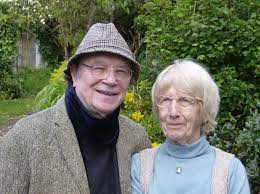
Colin Wilson, and his wife Joy, in 2009
I am re-reading Colin Wilson's last substantive book - Super Consciousness: the quest for the peak experience (2009) - which serves as a summation of this area of his interest that began with The Outsider (1956). Wilson cites and describes a 'variety of religious experiences' - or Peak Experiences, in Abraham Maslow's terminology - in which there was an alteration of consciousness and a feeling of well-being, elevation, understanding.
Looking at Wilson's accounts of these experiences through the perspective on the evolutionary-development of consciousness that I have derived from Owen Barfield; I see the reports can be understood as beginning with our normal, everyday, mundane, socially-functional "Consciousness Soul" state of feeling cut-off from reality, alienated and trapped in superficiality.
Consciousness Soul is the implicit baseline from-which Peak Experiences/ religious-mystical experience emerge.
From this baseline, and despite that Wilson did not recognize this distinction; these mystical/peak experiences of positive 'Super Consciousness' can be understood as falling into Barfield's two categories of Original Participation and Final Participation.
Most of the mystical experiences described can be regarded as a kind of functional impairment, and these seem like a reversion to the Original Participation of early childhood and tribal-Man, by a selective suppression of those (more recently developed) parts of the body (especially brain) needed for the manifestation of self-awareness in the Consciousness Soul stage.
In other words, this kind of mystical experience deletes consciousness of 'the self' as a separate entity from 'reality'.
Examples include those reported experiences of William James and Ouspensky which were triggered by nitrous oxide (laughing gas); and the same applies to other consciousness-altering drugs.
Others were associated with dream-like passivity; stasis of the body, fainting, or sleep - and mentally there are descriptions of becoming blissful in emotion yet unaware of any thinking (stopping the exhausting and futile treadmill of thoughts, worries, plans...); the apprehension of Time is suspended or deleted.
The kitchen and garden were filled with golden light. I became conscious that at the centre of the Universe, and in my garden, was a great pulsing dynamo that ceaselessly poured-out love, This love poured over and through me, and I was part of it, and it wholly encompassed me. (Cited pages 54-5)
In this Original Participation mystical state; problems are not solved so much as dis-solved; it is not a matter of 'knowing everything' so much as recognizing that knowledge does not matter.
Other, less common, reports of higher consciousness states sound more like Final Participation. In this state, the description is of thinking not stopping, but conversely having vastly greater power and comprehensiveness, such that the experience is one of 'knowing everything' - of direct-knowing without need for perception or for reasoning.
My train of thought accelerated and vastly improved in quality... New and convincing ideas came into my mind in a steady torrent, flaws in my existing ideas were illuminated, and as I made mental corrections to the the diminishing gaps in the logical sequence were filled by neat, brand-new linking concepts which made a beautiful logical pattern. (Cited page 56)
I interpret this difference as being due to the Original Participation being what Rudolf Steiner called an 'atavistic' state, that is a reversion to an earlier developmental-state (childhood, 'tribal' Man) which is being-induced by a lowering of consciousness,; resulting in a temporarily 'delirious' impairment of brain function (by drugs, drowsiness, hypnosis, illness etc).
While Final Participation is an enhancement of consciousness, the next 'evolutionary step' towards a more-divine, and more free and independent, mode of thinking; in which thinking is clarified and strengthened; and increases in scope and validity.
This relates to the 'flow state' Wilson describes earlier from the work of Csikczentmihalyi; which is associated with increased, indeed the highest, levels of functionality.
For instance; when people such as creative artists, artistic performers, athletes, and craftsmen sometimes attain their supreme performance. Sometimes called being 'in the zone' - they find themselves unerringly doing things they could not usually achieve, and with total confidence.
Thus Original Participation reduces functionality, and constitutes 'time out'; whereas Final Participation is associated with the highest, most creative and adept, levels of functionality.
Yet these two Super Conscious states - Final and Original: the one thinking, the other a cessation of thought; the one knowing without constraint, the other an indifference to knowledge; the one a flow, the other a suspension of time and movement; the one cognitive, the other contemplative... these states are not usually distinguished, are indeed generally conflated.
I do, however, regard Original Participation as potentially-valuable - but mainly as a glimpse of alternatives, a 'holiday', a recharging process, a therapeutic rest.
While Final Participation is - I hope - the ultimate state of God-like, Christ-like, divine consciousness in which - eventually - Christians will spend most of our post-mortal resurrected lives.
As for the Consciousness Soul in which we Modern Men spend most of our mortal lives, trapped and cut-off form living and reality - I regard it as merely a transitional phase between Original and Final Participations - much as adolescence should be a swift transition between childhood and maturity; therefore I expect that 'mundane' consciousness will very seldom be experienced in Heaven - although it may be normal, or at least common, in Hell.
Sunday, 23 July 2017
Life as learning not being: the significance of Peak Experiences for Final Participation
We tend to think of consciousness or thinking as a state of being; and notice that we fail to attain and sustain this state of being. For example that our peak experiences are infrequent and brief - normal life is lived at a lower level...
However, this is an incorrect inference based on a false assumption based on a misunderstanding of the nature of life, and what we are supposed to be gaining from it. The (divinely) desired purpose of life is not to achieve a state but to experience a process of learning.
Life should be a process of learning, of transformative learning. What ought to happen in a peak experience is that we are having an experience during which we are learning about life; being transformed by life in a positive way (in the kind of way that our creator intends; tending to cause theosis or making us become more-divine, more god-like).
And, in this age of Man, we should be aware of this process and its consequences. It is good if we know-about peak experiences, when they are happening, that we are learning-from them and what we have learnt...
The perspective is that this kind of aware experiencing of our selves in the moment - the state of being as instead a dynamic thing - this is the vision of life as experience, learning, 'education' towards divinity which is primarily aimed-at fulfilment after mortality (i.e. in our resurrected life that comes after mortal death).
In this era of Man, the aim is especially of greater consciousness; therefore we should strive to be explicitly aware of the process of incremental, developmental change of our consciousness that comes from serial experiences, expanded learning, awareness, reflection.
Life brings us the necessary experiences; or role is mainly to be aware of them and make the best of them. And repentance (always vital for Christians) can be understood as explicit knowledge of when our response to experience has been beneficial - and when not.
However, this is an incorrect inference based on a false assumption based on a misunderstanding of the nature of life, and what we are supposed to be gaining from it. The (divinely) desired purpose of life is not to achieve a state but to experience a process of learning.
Life should be a process of learning, of transformative learning. What ought to happen in a peak experience is that we are having an experience during which we are learning about life; being transformed by life in a positive way (in the kind of way that our creator intends; tending to cause theosis or making us become more-divine, more god-like).
And, in this age of Man, we should be aware of this process and its consequences. It is good if we know-about peak experiences, when they are happening, that we are learning-from them and what we have learnt...
The perspective is that this kind of aware experiencing of our selves in the moment - the state of being as instead a dynamic thing - this is the vision of life as experience, learning, 'education' towards divinity which is primarily aimed-at fulfilment after mortality (i.e. in our resurrected life that comes after mortal death).
In this era of Man, the aim is especially of greater consciousness; therefore we should strive to be explicitly aware of the process of incremental, developmental change of our consciousness that comes from serial experiences, expanded learning, awareness, reflection.
Life brings us the necessary experiences; or role is mainly to be aware of them and make the best of them. And repentance (always vital for Christians) can be understood as explicit knowledge of when our response to experience has been beneficial - and when not.
Saturday, 5 January 2019
Spiritual experiences - If not, then what?
A few days ago I stated my view that the 'standard methods' of attaining spiritual experiences have the disadvantage of failing to be associated with spiritual development; such that people who have frequent and intense spiritual experiences are often entirely lacking in spiritual wisdom.
Specifically, I said that magic and ritual systems of divination on the one hand; and training in meditation methods or induing of altered consciousness on the other hand; were both ineffective when it comes to developing the Romantic Christian life which I believe ought to be our priority, in The West.
Yet the Romantic Christian life is one that aims to restore the spiritual to life, so that we may reconnect with creation, and ultimately participate in creation; because Western people are dying of alienation - and mainstream Christianity does not even begin to address this core malaise - mainly because it emerged in an already alienated world, and grew to incorporate the alienated consciousness.
This is why the spiritual 'techniques' above operate separately from the kind of development in consciousness that is needed; the needed development is in the future and unprecedented; while the methods of the past only draw us back towards an obsolete consciousness that we cannot return to, nor would it be good for us if we could return.
This seems to set-up an impasse, in which on the one hand we must-have spiritual experiences - and I mean must; because I think that this is an absolute essential in The West if we are to avoid continuing down our path to mass chosen damnation... yet on the other hand we must-not seek such spiritual experiences using any of the standard, historical methods of doing so.
So, if not, then what? If not these methods, yet we must become more spiritual - then what should we do?
My answer is related to the idea of final participation as being our goal in consciousness (to use Owen Barfield's term); this is the consciousness that we will attain as resurrected beings dwelling in Heaven - but we need to attain this same quality of consciousness, as much as possible (as frequently and intensely as possible), during mortal life; in order to respond to the special challenges of this era.
To be in final participation is to participate in God's ongoing work of creation; it happens when we are thinking from our real self - because our real self is divine. Our real self - being divine - is free, and therefore our personal thinking adds to God's creation, is woven-into it; and this is indeed the main 'work' of our Heavenly lives.
When we attain to Final Participation in our mortal lives, we are having a spiritual experience. We are a part of the ongoing work of creation, which we experience in the mode of thinking. Our thinking is also divine thinking. Yet when this happens it is not in an 'altered state of consciousness' such as a trance or a dream; nor is it the narrowed and channelled consciousness of a ritual - it is simply ordinary thinking, rooted in the real self and raised to the fullness of clarity and simplicity.
Such thinking is, if we let it, self-validating - intuitively valid. We know that we know.
And I think many people have experienced this kind of thinking; although they seldom have a name for it; and very often deny its special significance. In my own life, the times when I have been thinking in this way make up a special sequence of memories I have termed the Golden Thread; the times and events that feel as if they were the only truly significant things (with all the great mass of routine and shallow pleasures falling away, barely remembered).
(These might include phenomena such as peak experiences, flow states, self-remembering, holiday consciousness, epiphanies and the like - as discussed often in the works of Colin Wilson.)
Yet these Golden Thread moments include many seemingly 'trivial' things, often unplanned and surprising; and apparently 'not real' things like reading something, or imagining something. And in the past I was more puzzled by them than inspired by them.
And this is the danger - that we have spiritual experiences but fail to notice and learn from them, for the simple reason that we discount them, disvalue them - regard them as trivial instead of The most Important Things in our lives.
In sum, spiritual experiences - properly understood - happen as a by-product of a proper way of living and understanding. And, as many people have noticed; the more they are noticed and learned-from; the more often they will happen.
So - the proper action to take is a kind of self-awareness, not simply to drift through life half-asleep; but be aware of what is happening, as it happens; and to recognise value the best of life as it deserves on the basis of intuitive experience rather than theory.
Specifically, I said that magic and ritual systems of divination on the one hand; and training in meditation methods or induing of altered consciousness on the other hand; were both ineffective when it comes to developing the Romantic Christian life which I believe ought to be our priority, in The West.
Yet the Romantic Christian life is one that aims to restore the spiritual to life, so that we may reconnect with creation, and ultimately participate in creation; because Western people are dying of alienation - and mainstream Christianity does not even begin to address this core malaise - mainly because it emerged in an already alienated world, and grew to incorporate the alienated consciousness.
This is why the spiritual 'techniques' above operate separately from the kind of development in consciousness that is needed; the needed development is in the future and unprecedented; while the methods of the past only draw us back towards an obsolete consciousness that we cannot return to, nor would it be good for us if we could return.
This seems to set-up an impasse, in which on the one hand we must-have spiritual experiences - and I mean must; because I think that this is an absolute essential in The West if we are to avoid continuing down our path to mass chosen damnation... yet on the other hand we must-not seek such spiritual experiences using any of the standard, historical methods of doing so.
So, if not, then what? If not these methods, yet we must become more spiritual - then what should we do?
My answer is related to the idea of final participation as being our goal in consciousness (to use Owen Barfield's term); this is the consciousness that we will attain as resurrected beings dwelling in Heaven - but we need to attain this same quality of consciousness, as much as possible (as frequently and intensely as possible), during mortal life; in order to respond to the special challenges of this era.
To be in final participation is to participate in God's ongoing work of creation; it happens when we are thinking from our real self - because our real self is divine. Our real self - being divine - is free, and therefore our personal thinking adds to God's creation, is woven-into it; and this is indeed the main 'work' of our Heavenly lives.
When we attain to Final Participation in our mortal lives, we are having a spiritual experience. We are a part of the ongoing work of creation, which we experience in the mode of thinking. Our thinking is also divine thinking. Yet when this happens it is not in an 'altered state of consciousness' such as a trance or a dream; nor is it the narrowed and channelled consciousness of a ritual - it is simply ordinary thinking, rooted in the real self and raised to the fullness of clarity and simplicity.
Such thinking is, if we let it, self-validating - intuitively valid. We know that we know.
And I think many people have experienced this kind of thinking; although they seldom have a name for it; and very often deny its special significance. In my own life, the times when I have been thinking in this way make up a special sequence of memories I have termed the Golden Thread; the times and events that feel as if they were the only truly significant things (with all the great mass of routine and shallow pleasures falling away, barely remembered).
(These might include phenomena such as peak experiences, flow states, self-remembering, holiday consciousness, epiphanies and the like - as discussed often in the works of Colin Wilson.)
Yet these Golden Thread moments include many seemingly 'trivial' things, often unplanned and surprising; and apparently 'not real' things like reading something, or imagining something. And in the past I was more puzzled by them than inspired by them.
And this is the danger - that we have spiritual experiences but fail to notice and learn from them, for the simple reason that we discount them, disvalue them - regard them as trivial instead of The most Important Things in our lives.
In sum, spiritual experiences - properly understood - happen as a by-product of a proper way of living and understanding. And, as many people have noticed; the more they are noticed and learned-from; the more often they will happen.
So - the proper action to take is a kind of self-awareness, not simply to drift through life half-asleep; but be aware of what is happening, as it happens; and to recognise value the best of life as it deserves on the basis of intuitive experience rather than theory.
Sunday, 26 March 2023
The double-edged sword of romanticism
Romanticism began to arise in the minds of Men from about the middle of the 1700s, in Western Europe - and has spread from there. What romanticism arose from, was Man's new awareness of himself and the world.
In other words, romanticism was a development (or an 'evolution') of human consciousness.
But there was a double-edged quality to romantic consciousness.
Men became aware of the wonderfulness of nature, and of the achievements and potential of their own thinking - but also of opposite tendencies.
With romantic consciousness; at times, for moments or bursts, life seemed raised to a higher level. Various names were given such experiences: Sehnsucht, ecstasy, epiphanies, religious experiences, mystical insights, joy, peak experiences... these episodes were noticed, described and pondered for the first time.
There seemed to be a possibility that these best-of-times might be insights into ultimate reality; and might therefore become continuous and permanent - or, at least, frequent and long-lasting.
Thus romanticism often led to great optimism, happiness, and the sense of potential for a larger and better life and world.
However; there was the other edge to the sword of romantic consciousness; which was that - in practice - these periods of romantic ecstasy were brief and infrequent, could not be aimed at and achieved directly - and the opposite conclusion soon began to emerge that they were delusional.
The everyday reality for everybody for most of the time (and, apparently, for some people all of the time) was of mundane consciousness; of life as commonplace, dull, shallow - pointless, purposeless, meaningless...
Society was so heavily-stacked against romanticism, that the most intensely romantic individuals often felt themselves to be 'outsiders' (to use Colin Wilson's term). And, even under the best imaginable social conditions; Man's life is unavoidably pervaded by change, decay, pain and disease
And, no matter what the degree of attainment was achieved; every life is always terminated by death.
The contrast between what seemed possible, and what was actually attainable, led to existential angst, to a cynicism that often led to despair - and was fought-against by seeking either for selfish hedonic oblivion, trying to blot-out awareness of failure and futility. Or by seeking an end to all conscious suffering in chronically self-destructive behaviour, and by suicide (whether deniably-sought, or actively-committed).
Romanticism was therefore a mixed-blessing at best, a curse at worst. Yet, because romanticism was a consequence of the development of consciousness, it could neither be suppressed nor ignored.
Romanticism changed everything... Yet, there was and is no 'answer' to the possibilities and problems of romanticism within the bounds of this world.
On the one hand, we now have many experiences that create yearnings and expectations for a higher form of life; on the other hand, we cannot achieve these yearnings and expectations in our actual lives; due to the many social, psychological and physical (i.e. ultimately entropic) constraints of this world.
The simple answer requires that we take-into-account a personal life beyond this life; and an afterlife that incorporates those romantic experiences of this life.
In different words; we need to regard the romanticism of this mortal life as learning experiences directed at full attainment in an eternal life to come.
Then, but only then, can we cope-with and learn-from our own romanticism; and render romantic experiences into a positive and inspiriting development of Mankind.
Wednesday, 5 April 2023
Bumping-against the evanescence of this mortal life: the ultimate meaning of Peak Experiences
Over at The Notion Club Papers; I give my conclusions regarding the ultimate nature and meaning of that most lovely and inspiring of all experiences - I mean that feeling which Novalis termed Sehnsucht, and CS Lewis called Joy - and what others (especially Colin Wilson) have called Peak Experiences.
Tuesday, 11 February 2014
What is the significance of unreasonable happiness?
*
Although a somewhat Eeyore-like and gloomy individual in many ways; I (thank Heavens) have been prone to outbreaks of unreasonable happiness through my life - those times various called, Peak Experiences (Maslow), Epiphanies (James Joyce), Joy or Sehnsucht (CS Lewis) and many other things - those feelings much loved by the Romantics such as Wordsworth and the New England Transcendentalists such as Emerson and Thoreau.
*
The mainstream secular modern view is that such moments have no deep significance - being caused by physiological change, or drugs, or a brainstorm... or something like that. The attitude is to enjoy them while they last, and then forget about them - because there is no special significance, nothing to be learned from them.
Ralph Waldo Emerson regarded these moments as significant - but cautioned against regarding them as evidence for optimism about future life. For Emerson they were not harbingers of anything, but to be valued in and of themselves - they were on the one hand the most important things in life, on the other hand utterly self-sufficient and free of general implications.
In practice, however, this remained little more than a bare literary assertion: meanwhile such moments came and went, the complications of life continued and then ended. Was Mankind any further forward after Emerson's explanations and Thoreau's experiments - were Emerson and Thoreau themselves any further forward? Seemingly not.
*
Yet, as the secular, this-worldly, spirituality which Emerson pioneered began to gather strength, there emerged a view that such moments of unreasonable happiness were harbingers - of a possible 'evolutionary' future for Man: a future of Men developing a higher and much happier consciousness. Such was the theme of Colin Wilson, and his books from The Outsider onwards collected and analyzed many examples of this.
Indeed, some kind of fundamental change to the human mind, society, or some combination of the two (whether or not this change was called evolution) was necessary if unreasonable happiness was to be anything more than a glorious interlude.
*
Yet, even this has been subverted by Transhumanism - which purports to engineer and make permanent such moments in a scientific project dedicated to transforming human physiology using drugs, genetics and anything else necessary.
Even supposing this were possible; the implicit conviction is that unreasonable happiness is a delusional epiphenomenon - the hope is to make it a permanent delusion (and without the shadow of death to cloud perfect bliss, because death would be abolished too).
A project genetically and pharmacologically to engineer a state of permanent happy delusion in Mankind is itself perhaps the bleakest and most despairing philosophy of life which humans have yet devised.
*
What of Christian views of such moments? There are many and diverse - from the pessimistic idea that moments of happiness are most likely to be demonic deceptions; to the optimistic and positive visionary theology of Thomas Traherne.
But my particular interest is the idea from CS Lewis, and less explicitly from Tolkien, that such moments of happiness are evidence for Christianity - the 'argument from desire'.
That such moments of happiness are actually a desire-for - and foretaste-of - something not-of-this-world (since nothing imaginable in this-world could be a fulfilment of this desire); and the fact that we have such other-worldly yearnings is evidence that that desired world is real (otherwise we would not have such feelings).
In a nutshell, we are unreasonably happy because of hope for Heaven - and that hope was implanted in us by God.
*
I personally find this a compelling argument (while being aware that others do not) - but as expressed in Lewis and Tolkien, it is somewhat incomplete. The reason it is incomplete is that this feeling is not only forward-looking and hopeful but (and Lewis says this very clearly) is also very powerfully nostalgic and backward-looking. Our state of unreasonable happiness is a yearning for what was, as well as what may-be.
Tolkien expresses this as a yearning for Eden - a real state of Paradise in which Man dwelt and from which he now is exiled. Tolkien seemingly regards this as a kind of inherited race-memory (indeed, the concept of hereditary memory is central for Tolkien's world view).
*
But I find the complete explanation for the unreasonable happiness of Joy, Sehnsucht, Peak Experiences in the doctrine of a pre-mortal spiritual and Heavenly existence.
This was also the implicit explanation of Wordsworth in his famous phrase: Our birth is but a sleep and a forgetting: the soul that rises with us, our life's star, hath had elsewhere its setting, and cometh from afar: Not in entire forgetfulness, and not in utter nakedness, but trailing clouds of glory do we come from God, who is our home.
*
This I find to be a full and satisfying explanation for the phenomenology and function of these significant-seeming happy experiences: that the special quality of both backward nostalgic yearning and forward hopeful yearning, combine to locate my mortal life in-the-middle - between partial memories of a pre-mortal spirit-existence in Heaven before my birth and optimistic anticipations of a resurrected Heavenly life after my death.
*
Although a somewhat Eeyore-like and gloomy individual in many ways; I (thank Heavens) have been prone to outbreaks of unreasonable happiness through my life - those times various called, Peak Experiences (Maslow), Epiphanies (James Joyce), Joy or Sehnsucht (CS Lewis) and many other things - those feelings much loved by the Romantics such as Wordsworth and the New England Transcendentalists such as Emerson and Thoreau.
*
The mainstream secular modern view is that such moments have no deep significance - being caused by physiological change, or drugs, or a brainstorm... or something like that. The attitude is to enjoy them while they last, and then forget about them - because there is no special significance, nothing to be learned from them.
Ralph Waldo Emerson regarded these moments as significant - but cautioned against regarding them as evidence for optimism about future life. For Emerson they were not harbingers of anything, but to be valued in and of themselves - they were on the one hand the most important things in life, on the other hand utterly self-sufficient and free of general implications.
In practice, however, this remained little more than a bare literary assertion: meanwhile such moments came and went, the complications of life continued and then ended. Was Mankind any further forward after Emerson's explanations and Thoreau's experiments - were Emerson and Thoreau themselves any further forward? Seemingly not.
*
Yet, as the secular, this-worldly, spirituality which Emerson pioneered began to gather strength, there emerged a view that such moments of unreasonable happiness were harbingers - of a possible 'evolutionary' future for Man: a future of Men developing a higher and much happier consciousness. Such was the theme of Colin Wilson, and his books from The Outsider onwards collected and analyzed many examples of this.
Indeed, some kind of fundamental change to the human mind, society, or some combination of the two (whether or not this change was called evolution) was necessary if unreasonable happiness was to be anything more than a glorious interlude.
*
Yet, even this has been subverted by Transhumanism - which purports to engineer and make permanent such moments in a scientific project dedicated to transforming human physiology using drugs, genetics and anything else necessary.
Even supposing this were possible; the implicit conviction is that unreasonable happiness is a delusional epiphenomenon - the hope is to make it a permanent delusion (and without the shadow of death to cloud perfect bliss, because death would be abolished too).
A project genetically and pharmacologically to engineer a state of permanent happy delusion in Mankind is itself perhaps the bleakest and most despairing philosophy of life which humans have yet devised.
*
What of Christian views of such moments? There are many and diverse - from the pessimistic idea that moments of happiness are most likely to be demonic deceptions; to the optimistic and positive visionary theology of Thomas Traherne.
But my particular interest is the idea from CS Lewis, and less explicitly from Tolkien, that such moments of happiness are evidence for Christianity - the 'argument from desire'.
That such moments of happiness are actually a desire-for - and foretaste-of - something not-of-this-world (since nothing imaginable in this-world could be a fulfilment of this desire); and the fact that we have such other-worldly yearnings is evidence that that desired world is real (otherwise we would not have such feelings).
In a nutshell, we are unreasonably happy because of hope for Heaven - and that hope was implanted in us by God.
*
I personally find this a compelling argument (while being aware that others do not) - but as expressed in Lewis and Tolkien, it is somewhat incomplete. The reason it is incomplete is that this feeling is not only forward-looking and hopeful but (and Lewis says this very clearly) is also very powerfully nostalgic and backward-looking. Our state of unreasonable happiness is a yearning for what was, as well as what may-be.
Tolkien expresses this as a yearning for Eden - a real state of Paradise in which Man dwelt and from which he now is exiled. Tolkien seemingly regards this as a kind of inherited race-memory (indeed, the concept of hereditary memory is central for Tolkien's world view).
*
But I find the complete explanation for the unreasonable happiness of Joy, Sehnsucht, Peak Experiences in the doctrine of a pre-mortal spiritual and Heavenly existence.
This was also the implicit explanation of Wordsworth in his famous phrase: Our birth is but a sleep and a forgetting: the soul that rises with us, our life's star, hath had elsewhere its setting, and cometh from afar: Not in entire forgetfulness, and not in utter nakedness, but trailing clouds of glory do we come from God, who is our home.
*
This I find to be a full and satisfying explanation for the phenomenology and function of these significant-seeming happy experiences: that the special quality of both backward nostalgic yearning and forward hopeful yearning, combine to locate my mortal life in-the-middle - between partial memories of a pre-mortal spirit-existence in Heaven before my birth and optimistic anticipations of a resurrected Heavenly life after my death.
*
Tuesday, 14 August 2018
Spiritual signs. How can we, personally, know that this is a purposive and meaningful world?
It is an error to look for 'evidence' of God's activity in this world - this is a mind set that leads to a life trapped in end-less, open-ended 'research' - one will become a seeker, never a finder.
But, if you instead begin with acknowledgement that it is possible that this world was created by a personal God, who loves us as individuals; then there are plenty of events in your life which are consistent-with such an assumption.
Yesterday I mentioned personal-miracles. For example, you pray for something and it happens in such a way that you, privately - by your own standards and nobody else's, regard it as a miracle.
This granted-prayer may be absolutely 'trivial' both in terms of the world at large and your own life-span - but that is not the point. The point is that such miracles are consistent with the vision of this world as purposive and meaning-full.
Another example is synchronicity - phenomena that are oxymoronically described as meaningful-coincidences. Typically these events are also trivial; but the point of them is that synchronicity is exactly what would be expected in a world of divine Providence; a world in which God was 'behind the scenes' and organising things.
Peak experiences are another instance - brief times of transcendent happiness that come (apparently) out of the blue; and in which we powerfully feel life to be meaningful, coherent, purposive, benign.
I think it is usually an error to try and understand the implications of the content of these spiritual gifts such as miracles, synchronicities, peak experiences. Not all are pregnant with guidance; some really are quite 'trivial'.
Such spiritual gifts are mostly 'signs' of the kind of world we live in. And they are also signs of us living well, living in a proper mode of consciousness - and such spiritual signs will apparently increase when we are in a Good frame of mind; and may well be utterly absent from a life wrongly-lived.
Spiritual signs might be absent from a materialist life that assumed there was no meaning or purpose, that the world was determined and/ or random (not created) - and if such phenomena do happen to occur, they will be regarded as insignificant, lacking importance, merely a species of delusion.
In sum - spiritual gifts are best understood as signs, consistent with the nature of reality; and we need not get too concerned by what the specific-content of each specific-sign specifically-implies for our own specific-life, or beyond...
But, if you instead begin with acknowledgement that it is possible that this world was created by a personal God, who loves us as individuals; then there are plenty of events in your life which are consistent-with such an assumption.
Yesterday I mentioned personal-miracles. For example, you pray for something and it happens in such a way that you, privately - by your own standards and nobody else's, regard it as a miracle.
This granted-prayer may be absolutely 'trivial' both in terms of the world at large and your own life-span - but that is not the point. The point is that such miracles are consistent with the vision of this world as purposive and meaning-full.
Another example is synchronicity - phenomena that are oxymoronically described as meaningful-coincidences. Typically these events are also trivial; but the point of them is that synchronicity is exactly what would be expected in a world of divine Providence; a world in which God was 'behind the scenes' and organising things.
Peak experiences are another instance - brief times of transcendent happiness that come (apparently) out of the blue; and in which we powerfully feel life to be meaningful, coherent, purposive, benign.
I think it is usually an error to try and understand the implications of the content of these spiritual gifts such as miracles, synchronicities, peak experiences. Not all are pregnant with guidance; some really are quite 'trivial'.
Such spiritual gifts are mostly 'signs' of the kind of world we live in. And they are also signs of us living well, living in a proper mode of consciousness - and such spiritual signs will apparently increase when we are in a Good frame of mind; and may well be utterly absent from a life wrongly-lived.
Spiritual signs might be absent from a materialist life that assumed there was no meaning or purpose, that the world was determined and/ or random (not created) - and if such phenomena do happen to occur, they will be regarded as insignificant, lacking importance, merely a species of delusion.
In sum - spiritual gifts are best understood as signs, consistent with the nature of reality; and we need not get too concerned by what the specific-content of each specific-sign specifically-implies for our own specific-life, or beyond...
Saturday, 24 June 2023
Stanley Messenger on distinguishing healthly from unhealthly "psychic experiences"
Daily inner life for the majority of westerners is nowadays little more than a lonely restless chat-show.
Apart from those who simply talk to themselves all day there are many whose inner lives are numbly silent till someone addresses them. Then there is a minority who pray, and a still smaller number who meditate. Of those a tiny number reach a level of mystical contemplation, or, on a different path, give themselves over to some degree of trance-mediumship.
In recent years there has been an increase in a kind of inner life which differs from these in a significant way...
In these situations a person’s focus of identity, the groundedness at the centre of their own consciousness, is not only not weakened or disturbed, it is on the contrary considerably strengthened and enhanced.
By natural endowment, or more frequently by a degree of more or less conscious self-training, often through meditation or kindred practices, normal consciousness has been expanded and enhanced.
The experience is that the person feels there is more inner space. Within this space all kinds of imaginative exercises can take place.
Different people have different talents in this regard. Some are more easily able to visualise inner events. Some have more facility in hearing them. Others again have the facility for constructing a framework for other conscious presences to occupy.
People’s experiences are almost infinitely varied in this regard. Some people remember their awareness of other entities in their inner world since early childhood, often lost as they grow older. Others construct inner worlds which are in the first place almost wholly imaginary, and only gradually become occupied with thoughts and pictures in later life which are recognisably derived from other realities.
The great difference between genuine, healthy psychic experience and the pathological situations described above is that the healthy experiences are always in control. Even when quite unfamiliar expansions take place they always do so from within.
It is the self-awareness which grows, and the self-awareness which contains the expansion. One never has the sense of losing touch.
Moreover, everything is experienced as being under the protection of love. This inner love is the crucial yardstick. In pathological conditions there is always an underlying uneasiness and fear.
Excerpted and edited from Dancing with Tears - by Stanley Messenger, 1999
Stanley Messenger (1917-2013) was a scholar of Rudolf Steiner, whose explanations I often find to be clearer and more memorable than those of his Master.
He also gave special attention to this question of what might be termed 'occult', 'psychic' or 'clairvoyant' experiences; and how these have been changed by the evolutionary-development of Western Man's consciousness - and especially in the period approaching and following the millennium.
Unsurprisingly, and like Steiner himself in this regard; Stanley M was not able fully to live up to his own peak level of understanding; and often 'lapsed' back into seeking and overvaluing exactly the kind of spiritual experiences that - elsewhere - he so lucidly had explained were dubious and prone to mislead.
Nonetheless, explanations like that above are very helpful in understanding the kind of thing we ought to be aiming for - the kind of thing I have (in different words) variously tried to formulate as primary-thinking/ heart-thinking/ direct-knowing - or Owen Barfield's concept of Final Participation.
Whereas spiritual experiences of the past tended to be approached by striving for an opening of the mind, a passive acceptance of - and being overwhelmed-by - perceptual information (seeing visions and hearing words, having conversations)...
What Stanley M is describing could, by contrast, be regarded as conscious and actively experienced throughout, and not-perceptual - but instead directly known in our thinking.
Instead of being overwhelmed by the experience - such as happens in trance mediumship, or automatic writing - the participant retains a sense of full control of a process of thinking that is quantitatively (even qualitatively) strengthened and increased in scope and surety - compared with normal thinking.
And while past experiences were often sought for practical and functional purposes; the newer experiences will only happen "under the protection of love" - which I take to mean that love (not curiosity, not usefulness, not power - for instance) must be the motivation.
The main problem with the new kind of psychic experiences is that of wishful-thinking. This temptation is, to some extent, avoidable by being aware of false motivations such as ego or advantage; and by refraining from learning material for the purposes of teaching, or to-order: e.g. in groups convened at a particular time and place for the purpose.
This is one of the areas in which I think Stanley M went wrong - as you may see from reading more of the Dances with Tears booklet - he describes working for many years with a group - dedicated to making contact with spiritual beings; aiming to collecting detailed information from such beings on specified topics; and engaging in lecturing, workshop, and writing projects in order to disseminate the resulting material.
The result was mostly made-up wishful-thinking, in line with the group's pre-existing beliefs and prejudices; and in conformity with too much, too-credulously-accepted, mainstream New Age output of that era (1980s and 90s).
The genuine, valid spiritual teaching was mostly swamped by the sheer volume of personality-level, socially-shaped, stuff.
Indeed, in a lecture, Stanley M acknowledged that he had been told that only about 5% of the material he got was genuinely from the supposed communicating entity (viz. the Archangel Michael) - the other 95% from himself.
While Stanley felt that even 5% of spiritual truth was valuable; my feeling is that the amount of conceptual distortion with so much personal invention is so great that it is, in practice, impossible to filter-out the truly factual 5%.
At any rate, what he and his group got by such means seems (as with the similar case of Steiner) to be mostly wrong - in many, very misleading, ways.
My strong feeling is that it would be much preferable to have only the 5% that is valid; and be content with a small volume of relatively simple 'information' -- than to build all sorts of castles in the air (on subjects like UFOs and Crop Circles, and an impending mass spiritual awakening) from great swathes of wishful-thinking; exacerbated (not corrected) by consensus-group-dynamics.
Nonetheless, with these caveats; I am confident that Stanley Messenger had much wisdom to impart concerning the principles of what is most needed here-and-now.
And if he did not personally live-up-to the highest levels of his aspirations, and was tripped-up by his own need for spiritual excitement and a desire for feeling incremental spiritual progress; then so are we, all of us, unable to stay at our own best levels at all times.
As always, the material needs to be explored in a discriminating fashion, and with properly 'loving' motivation; if the good and valid it genuinely includes, is to be sifted from the wishful-thinking, misleading, and irrelevant material.
Sunday, 12 December 2021
My special gratitude to Owen Barfield

When I encounter a special author, I will initially hurl myself into trying to understand him - read many books, think a lot, take notes (in a meditative fashion); and often talk and write about these experiences.
After a while, when I have become surer of what they mean and have a fairly sold grasp on it; I find that what I have learned amounts to some particular things; but I then need to detach these specifics from the whole of the writer's assertions - because I have never found any writer whose views I can endorse or believe fully.
Eventually, I get to a point where I have (more or less) obtained 'what I needed' from a writer; and may (more or less) cease to re-read or explore actively that author's works.
I have, at this point, built-into my own philosophy of life, some elements from the special author; and from then onwards, these ideas may undergo further development and refinement - and may indeed end-up by being very different from how they are in that author's own work.
So, the end result is that I retain a special gratitude to the author for insights that I needed; but I have ceased actively to engage with that author, and am then often more aware of my points of disagreement with him, rather than agreement.
Yet the core debt remains - I have been changed, and for the better, by the encounter.
I have almost reached this stage with Owen Barfield. I do continue to engage with his writings; in a cyclical fashion - but his importance to me has by-now been fed-into my own philosophy-of-life, and they have interacted with other ideas from elsewhere; have been modified; and have developed in (sometimes) different directions.
Looking back; what I got from Owen Barfield - in a general sense - was a positive and hopeful attitude to life, deriving from his articulation of Final Participation.
Until I encountered Final Participation, I could not see any positive direction for human life - here and now. I saw life as a binary choice between the present and the past; a present which was alienated and increasingly evil - and a past which seemed both irrecoverable and harmful to try and recover.
It was as if an adolescent hated being an adolescent, and yearned for childhood - but knew that childhood could not be recovered - so that this mortal life had no real hope within itself: no real positive purpose.
But through his concept of Final Participation; Barfield made me realize that there was a third possibility. Barfield terms the 'childhood' state Original Participation and the adolescent state Consciousness Soul; and he analyses how the one derived from the other through a process of unfolding development of consciousness, that stretched across different generations and historical eras.
The 'original' participation was an immersive, passive, unconscious sense of being part of the world and knowing the spiritual; while the consciousness soul was that active, self-conscious way of thinking that finds itself cut-off - alienated - from the spiritual, and indeed from the world.
I personally have found (since adolescence) this cut-offness, this being an 'observer' of life, trapped inside one's head - locked into one's thinking; to be appalling. It removed depth and meaning from experience, it dissolved all sense of purpose.
This was a demotivating and depressing situation - which recurred daily, almost hourly, and needed always to be fought; but where the fighting seemed to provide no more then a subjective and ephemeral amelioration.
For me alienation was The Problem of my adult life - and I was always seeking solutions; but never found any that were convincing, effective, strategic.
Barfield convinced me that this development pointed forward to Final Participation which was an active, chosen, conscious state of being part-of the world; and of contributing creatively to the world.
I realized that many of my best and most hopeful experiences in life could be seen as glimpses of this Final Participation state, but without Barfield's insights I could not make sense of them - could not learn the lessons they had to teach...
Instead I merely treasured these 'moments' (epiphanies', 'peak experiences'. moments of 'joy'); held onto them, and tried to seek them out - but with small and dwindling success... And the treasuring of these moments was itself alienating - given their temporary and very partial nature.
But now, with Barfield's analysis to help; these moments could be seen in terms of a developmental process, a growing towards a future and better state - and this future and better state could be recognized as resurrected eternal life in Heaven.
Having been given certain analytic tools and deep insights by Barfield; I was then starting to use them in a Christian context that I had already in-place, but which was deficient in exactly the areas that Barfield supplied. I began to see - more and more clearly - my path to the Romantic Christianity that I had always implicitly wanted but had not been able to articulate.
That is; a Christianity that supplied the Romanticism which could cure my alienation, cut-offness, trapped-in-the-headness which had been left almost untouched (or even exacerbated) by mainstream Christianity.
I found (I find, now) that I was was going beyond Barfield, and into areas where he would very probably not have followed; but I could not have done so without Barfield's help.
So, now I find myself having integrated Barfield into my own thinking; having changed some of his core ideas in the process - yet I know the Barfieldian provenance of my situation; and that he ranks as one of a handful of vital sources in my own deepest convictions.
Sunday, 25 June 2017
Knowing what to-do/ not-to-do, during a prolonged peak experience
Yesterday I enjoyed a family walk through the early summer woods in the North Tyne Valley - and managed to maintain myself in a Peak Experience state for an unusually long period (about half an hour) during which I was able to consider some important matters. I made some notes shortly afterwards.
One thing that was crystal clear was that there is a way-out, a way to overcome the current situation [of evil triumphant in the world]. This for sure - and it was something simple which could really happen.
I don't know what it is - but knew that [specific details] would/ will be clear in the relevant context [i.e. when needed] - so long as I (we) think in the real-true-divine way.
It is also clear that this way was not by perceptible politics, or organisation, or rhetoric - but something operating at a higher level, invisible to senses. Asif, an act of thinking could put it to rights. A single act.
When I get insights during a peak experience, I assume that these are in some sense true and certain; and PE-insights trump the kind of insights I might get when in a lower state of consciousness.
(Peak Experiences are glimpses of reality - and 'everyday consciousness is a liar' - as Colin Wilson used to say.)
So I am going to regard the above as a certainty - or, at least, that is my aim.
It is not very precise, at present; but it describes what I should do, and what I should not do - and that is enough.
One thing that was crystal clear was that there is a way-out, a way to overcome the current situation [of evil triumphant in the world]. This for sure - and it was something simple which could really happen.
I don't know what it is - but knew that [specific details] would/ will be clear in the relevant context [i.e. when needed] - so long as I (we) think in the real-true-divine way.
It is also clear that this way was not by perceptible politics, or organisation, or rhetoric - but something operating at a higher level, invisible to senses. Asif, an act of thinking could put it to rights. A single act.
When I get insights during a peak experience, I assume that these are in some sense true and certain; and PE-insights trump the kind of insights I might get when in a lower state of consciousness.
(Peak Experiences are glimpses of reality - and 'everyday consciousness is a liar' - as Colin Wilson used to say.)
So I am going to regard the above as a certainty - or, at least, that is my aim.
It is not very precise, at present; but it describes what I should do, and what I should not do - and that is enough.
Friday, 23 June 2017
There are no shortcuts! ... to higher consciousness in life. From William Arkle
If you wish to attain a higher 'consciousness' in life - by which I mean to experience, perceive and understand more than the five senses 'reality' of mainstream modern materialism; then you will already know that while higher consciousness is attainable in moments (aka 'peak experiences'), these moments tend spontaneously to be infrequent and last only seconds; and trying to make such moments longer and more frequent, and ideally continuous, is very difficult indeed.
(This goal of enhanced being was the major focus of Colin Wilson's thought; throughout dozens of books from The Outsider of 1956 to Super Consciousness in 2009, at the beginning and end of his publishing career.)
Another thing you might realise is that what works for one person seems seldom to work for another person. The history of those who have (apparently) attained higher consciousness is a history of different individuals with different experiences.
The lesson is that There Are No Shortcuts - the path is usually long, and each person seems to need a different path (presumably because each is, in fact, starting somewhere different).
To illustrate this, you may wish to give an hour and a half of intense attention to this recording of one of the most 'enlightened' men of whom I am aware - William Arkle.
http://www.wessexresearchgroup.org/digital_08.html
Near the end, he responds to some questions from the audience (from the well known investigator Nigel Blair, who was the host of these proceedings) concerning whether meditation was necessary for everyone and beneficial for everyone. Arkle is very definite, even somewhat harsh, in refusing to make universal recommendations or even 'hints' or 'tips'; or to imply that there are quicker and easier ways to get where you need to go.
Each of us has to struggle, because these things are difficult to learn, because they are meant to be difficult to learn.
Because without the struggle we will not really learn them.
Note: To clarify, for new readers: Arkle is a spiritual Christian - not a New Age writer. His understanding is based upon God as Creator and Loving Father, we being his children; creation being for the purpose of raising us - like Jesus Christ - to ultimate full divinity of the same kind as God. Unorthodox Christian elements in Arkle include that - as with Mormonism - Arkle envisages a Heavenly Mother consort with the Father, and human divinity as potentially rising to the same nature and level as that of the divine parents, But unlike Mormonism; Arkle also includes a scheme of incremental reincarnation (whereas Mormonism achieves much the same explanatory function by positing a significant and evolutionary pre-mortal spirit existence for all men and women).
http://williamarkle.blogspot.co.uk
(This goal of enhanced being was the major focus of Colin Wilson's thought; throughout dozens of books from The Outsider of 1956 to Super Consciousness in 2009, at the beginning and end of his publishing career.)
Another thing you might realise is that what works for one person seems seldom to work for another person. The history of those who have (apparently) attained higher consciousness is a history of different individuals with different experiences.
The lesson is that There Are No Shortcuts - the path is usually long, and each person seems to need a different path (presumably because each is, in fact, starting somewhere different).
To illustrate this, you may wish to give an hour and a half of intense attention to this recording of one of the most 'enlightened' men of whom I am aware - William Arkle.
http://www.wessexresearchgroup.org/digital_08.html
Near the end, he responds to some questions from the audience (from the well known investigator Nigel Blair, who was the host of these proceedings) concerning whether meditation was necessary for everyone and beneficial for everyone. Arkle is very definite, even somewhat harsh, in refusing to make universal recommendations or even 'hints' or 'tips'; or to imply that there are quicker and easier ways to get where you need to go.
Each of us has to struggle, because these things are difficult to learn, because they are meant to be difficult to learn.
Because without the struggle we will not really learn them.
Note: To clarify, for new readers: Arkle is a spiritual Christian - not a New Age writer. His understanding is based upon God as Creator and Loving Father, we being his children; creation being for the purpose of raising us - like Jesus Christ - to ultimate full divinity of the same kind as God. Unorthodox Christian elements in Arkle include that - as with Mormonism - Arkle envisages a Heavenly Mother consort with the Father, and human divinity as potentially rising to the same nature and level as that of the divine parents, But unlike Mormonism; Arkle also includes a scheme of incremental reincarnation (whereas Mormonism achieves much the same explanatory function by positing a significant and evolutionary pre-mortal spirit existence for all men and women).
http://williamarkle.blogspot.co.uk
Friday, 1 August 2025
Final Participation is a conscious consecration of this-moment to our eternal resurrected life
For the past decade or so, I have been trying (in multiple ways) to understand the implications of Owen Barfield's concept of Final Participation - as being the destiny and proper aim of our spiritual life.
Some modern people seem wholly enmeshed in mundane materialist thinking and feel detached and alienated from the living world - trapped inside their own heads. Their only relief is temporarily to forget this in sleep, intoxication, psychosis - and in occasional moments when there is a resurgence of a child-like sense of belonging and involvement.
These brief times are what Barfield calls Original Participation, because they were our original state of consciousness as young children, and also (it is believed) the normal state of the earliest ancestral Men.
Original Participation is - pretty much - the same as Novalis's Sehnsucht and CS Lewis's Joy; Gurdjieff's self-remembering, Maslow's Peak Experience, or Csíkszentmihályi's Flow state are psychological reductions of the experience.
Such moments may be pleasant, indeed there have been times and places (e.g. some of the Romantic movement around 1800, or the 1960s counter-culture... still ongoing) when many people aspired to abandon modern consciousness and return to Original Participation.
Although this return to the spontaneous, natural, child-like, primitive, here-and-now consciousness is powerful and alluring to many people; it has always failed - and must be assumed impossible (except briefly).
However it makes a difference how we regard these brief moments.
If they are regarded as merely pleasant psychological states, then Original Participation can only be therapeutic - like taking a short holiday from the "real world" of mundane materialism.
Yet Barfield asserted that Final Participation was not just a pleasant interlude; but in some deep sense absolutely necessary - necessary if we personally, and our society as well, were to avoid being overwhelmed by evil.
However, Barfield was vague about how this might be achieved (he usually advised consulting his mentor Rudolf Steiner's work - but Steiner's techniques seem obviously ineffective, and Barfield never claimed that decades of practicing Steiner medications had led to any very significant effect on Barfield's own thinking in terms of Final Participation.
Indeed, it seems that FP is not really achievable in a lasting and dominant way.
So we seem rather to be trapped between impossibilities! We cannot go back, cannot stay as we are - yet the destined path forward seems blocked...
Yet anyone who conceptualizes life as bounded by conception and death will find himself bounded by exactly such impossibilities. We cannot escape the constraints of entropy (and death) and evil.
But this is forgetting the reality that we are eternal Beings, and this mortal life can be (should be) seen as a finite transitional phase between eternities before and afterwards.
Furthermore (and here I depart from Barfield, with his ideas of multiple future reincarnations) a Christian sees his eternal future as including resurrected Heavenly life, following after this mortal life.
My idea of Final Participation is that it is the conscious choice to consecrate those moments of Original Participation.
So that when moments of OP happen; we choose to regard them as sacred.
In such a "consecration"; the momentary experience of OP is consciously recognized as being of potentially eternal significance to divine creation - and is actively taken-up into ongoing thinking.
This contrasts with, say, the sixties counter-culture response - which is to stay inside those OP moments, and perpetuate them or as long as possible.
I would regard this as akin to a religiously-contemplative response to Original Participation. Contemplative because it is deliberately passive and self-negating. The moment is primary and we intend to stay with it, dissolve-into it.
This is analogous to the contemplative kind of meditation where people seek a "blissful" state of consciousness and try to maintain it for as long as possible.
The ideal is of stasis in perfection.
But Final Participation is active and creative - hence is is both dynamic - like divine creation; and aspires to join-in-with and influence ongoing divine creation.
And all this is a choice, not a surrender. It is an affirmation of the self, not an attempt to lose the self.
It is the choice to be a Son of God, a sibling of Jesus; one who want to join with God in the work of creation, and add to to that creative work whatever is unique in himself.
So, Final Participation is an active self-confidence; confidence that by the "process" of resurrection after this mortal life we can be transformed such as to be able, worthy, and trust-worthy of eternal participation in creation.
Thus, FP is a state of being only achievable permanently (as a normal state) after our death, and only among those who have then chosen to follow Jesus through resurrection to everlasting Heavenly life.
But Final Participation does have a vital role in this mortal life; because it is when we can add to our resurrected life.
FP represents our choice to learn from experience in such a way that our immortal soul is permanently transformed.
We are talking about our immortal souls, not the conditions of our mortal lives on earth - so the fact that our modern experiences of participation may be relatively few, infrequent, brief - does not invalidate these experiences...
FP experiences are of permanent value not because they last a long time; but so long as we choose to consecrate them.
Consecration would go something like this:
1. Original Participation happens.
2. We recognize that it is happening.
3. We acknowledge that this happening is of potentially permanent importance to our resurrected Heavenly self.
This needs to be done when Original participation happens - Now: here-and-now.
Not put-off until later.
If we do not do it at the time of Original Participation - it will (probably) not be done.
However... An intense imagined re-living of the moment, could also be used to consecrate that moment retrospectively. Because then the moment is not merely "retrospective" but a re-experiencing here-and-now - which is perhaps one reason why we may recollect and meditate on such moments... Why they may last so tenaciously in our memories. The experiences may be re-presenting themselves for consecration.
Maybe, if we do this on principle and habitually; then this will act as a positive feedback and establish a "spiritual reward system" - so that such opportunities will become more frequent?
The thing is: we modern Men are terribly demotivated, prone to despair - and any spiritual advice that diminishes or delays our gratification seems doomed to fail*.
Consecrating our moments of Original Participation generates an immediate spiritual reward as well as a hope-full anticipation.
Instead of OP being a tragic joy; doomed to be short-lived, doomed to be forgotten and lost by age, disease, death... Instead of this; the act of consecration transforms it into a moment of permanent and positive significance.
As far as I can understand; only a follower of Jesus Christ who lives in confident expectation of resurrection can do this; and it will not "just happen" but must be done by conscious choice.
All then depends on making that choice.
NOTE: It may be objected that because Original Participation is spontaneous and natural, it is not necessarily good. This is true; and if an OP experience is not good, then it cannot and shall not be consecrated to resurrected eternal life - so any such attempt will fail. Christian discernment - knowledge of good and evil, God and that which opposes God; is a necessary part of Christian life - and always applies.
* The mass of people are (quite literally) spiritually-dying of despair, for lack of any genuinely positive purpose in life. It seems obvious that the double-negative (e.g. therapeutic) values that are exclusively propagated, including by nearly all religions (eg religions rooted in avoidance of default divine punishment), including most Christian churches - are simply ineffectual; leading to short-termist this-worldly hedonism now, and ultimate despair eventually.
Saturday, 21 October 2023
A direct link to the tear ducts - Mozart's Letter Duet from Figaro
As so often, here is some Saturday morning music; the Letter Duet from Act II of Mozart's The Marriage of Figaro:
I think it is may impossible for me to listen to this piece without tears streaming down my face; although I suppose I could distract and harden myself against its effects if, for example, I was driving a car at the time...
I picked this performance from the many on the many on YouTube by superb performers, because - even though this is roughly recorded and imperfectly balanced due to the live performance; conductor James Levine seems to catch the ideal tempo and instrumental effects - yielding the biggest emotional punch.
Aside from the always delicious combination of soprano and mezzo, what really gets me about this duet is the (mostly) woodwind accompaniment; which is something that is utterly characteristic of Mozart; and so often leads to his very greatest effects and moments.
So, even if you know this already, then perhaps this time you might focus on the orchestra; and regard the voices as instruments.
There is a very simple, rhythmic, arpeggiated accompaniment throughout; upon-which Mozart 'paints' his woodwind effects, and-against which the voices syncopate and overlap teasingly, before joining together in close harmony. The "half-way" moment at 1:27 when everything drops-out for for a moment except the oboe, which plays a descending five-note phrase, is so simple and wonderful that it defies analysis.
Concerning the singing; the melody is occasionally 'decorated' by ascending "grace notes"; when the singer initially hits and accentuates a note below the 'target', before rising to the expected note. This is almost a trope for Mozart - in his instrumental music as well as vocal; he seems to have loved the effect of poignant yearning.
As so often with Mozart's peak experiences (and perhaps especially in this opera); his 'raw material', the action and words in context of the plot; seem everyday, light, trivial... Indeed, in this case the letter is part of a rather sordid plot between the Countess (soprano) and her maid (mezzo) to entrap the Count in a fake adulterous intrigue.
Yet, somehow, Mozart brings a quality extraordinarily subtle and delicate to the piece. And we are raised far above the mundane.
Friday, 23 September 2016
How to set-about achieving a higher consciousness

by William Arkle
I am convinced by the overall validity of Rudolf Steiner's 1918 prophecy concerning the spiritual future of Western Man:
http://charltonteaching.blogspot.co.uk/search?q=steiner+prophecy
The bottom line of this insight is that within a Christian context the number one priority for modern Western Man is to expand and enhance consciousness such that we become aware of the spiritual world beyond the 'five senses', including the divinity of our fellow Men.
This enhanced consciousness aimed-at is not a matter of the kind of hallucinatory, dream or trance-state we associate with shamans and other mystics of former eras - but is to be achieved in and by lucid, alert and purposive thinking.
Overall, not so much about seeing new (and previously unseen) things, so much as seeing old things anew (see Arkle's painting above).
In other words, it is a particular kind of thinking which is to provide us with valid knowledge - but not just abstractly 'knowing about' stuff; but actual experience of the reality of knowledge.
(Why? My understanding is currently that there is a kind of thinking which is primary, spontaneous, and does not depend upon perception or any other kind of 'input' - and this comes form God-within-us, that which makes is children of God: and that is the reason why it is intrinsically valid thinking.)
The 64,000 dollar question is how do we do this? How do we raise our thinking to this level, and keep it there? Where do we even start on this task?
Having been reading Colin Wilson's Beyond the Occult recently, I think one general answer may be that we should start with any of the spiritual, paranormal or enhanced types of consciousness that we personally spontaneously experience. These go by many names, but could include peak experiences, synchronicity, self-remembering, clairvoyance, fore-sight, the sense of being transported to another time or place (what Wilson termed Faculty X)...
Or (especially) those 'magical' (or holiday) times of several or many minutes when we seem to be living inside a narrative or story or tableau, and in a state of awareness of connections and a providential unfolding...
In a nutshell, we can start with those moments or times when the ordinary and the everyday are felt to be meaningful, purposive and we are engaged by them.When this happens, we are inside the kind of thinking we are aiming-at, the kind of thinking we most need - these phenomena are (often) a sign that this is it.
That is the kind of thing we start-with, and what we need to remember, take seriously, and endeavour to build-upon.
Nothing we might do is more important - the task deserves our best efforts.
Monday, 1 February 2016
Death - why is it necessary?
It is my primary assumption that death is necessary for spiritual progression toward a higher and fuller state of divinity - but how does this work?
If the purpose of mortal life is incarnation (to get a body) then why? One answer may be that the body brings us irresistibly into contact with 'the world' - because the body is unavoidably part of the world.
(Whereas, as pre-mortal spirits, we were not in direct contact with the world, and our spiritual body - if we had one - was not subject to the world.)
So long as we are awake, alert and purposive in thinking - our body is spontaneously and by-default part of reality. And our consciousness (our spirit) identifies with the body (including the body's senses).
We spontaneously get-away-from the body during sleep - and especially in dreaming sleep when we are all-but cut-off-from the senses, and paralysed; in dreams we remain influenced by the body (e.g. illness can influence dreams) but we are no longer constrained by the body (we can dream anything, and be anywhere).
Much mysticism is trying to get away from the body - but insofar as this includes drowsiness or sleep, undirected or free-associative thinking, thinking directed by external cues etc. then this represents (merely) a regression towards the situation of pre-mortal spirit existence - which is fine, but regression is not the reason why we became incarnate mortals (otherwise we would simply have remained in our pre-mortal state).
Minimally we are incarnated for our spirit/ consciousness to identify with the body - and then die (this applies, for instance, to those people who die in the womb, or around the time of birth - they experience little more than the bare fact of incarnation).
Beyond this minimum, some people survive into childhood, adulthood - perhaps for many decades... what is that for? The purpose of prolonged life seem to be spiritual progression, divinization, theosis, sanctification (variously conceptualized) during mortal life.
I think this divinization necessarily entails a development, or evolution, of consciousness - of a type which is a foretaste of the post-mortal resurrected state.
This state of advanced consciousness has been variously termed a particular type of clairvoyance by Rudolf Steiner (also called Final Participation by Owen Barfield), or 'self-remembering' by Gurdjieff or Colin Wilson), or Active Imagination by Jung, or some versions of Abraham Maslow's Peak Experiences.
In essence, this is an awareness of ourselves as spiritual beings simultaneous with identification with the body and its senses.
Death is therefore the separation of spirit from body, the spirit having experienced the identification of spirit with body.
So there are three stages in spiritual progression in relation to mortality:
1. The spirit is identified with the body (mortal life)
2. The spirit separated from the body (death)
3. The spirit rejoined with the body from which it had separated
This three-stage process of incarnation, death and resurrection was - of course - established and made possible for us by Jesus Christ.
It leads to the post-mortal state of a permanent and habitual attainment of that state of consciousness which is typically only glimpsed (if experienced at all) during mortal life.
This is the divine mode of consciousness - which can then embark on further development.
If the purpose of mortal life is incarnation (to get a body) then why? One answer may be that the body brings us irresistibly into contact with 'the world' - because the body is unavoidably part of the world.
(Whereas, as pre-mortal spirits, we were not in direct contact with the world, and our spiritual body - if we had one - was not subject to the world.)
So long as we are awake, alert and purposive in thinking - our body is spontaneously and by-default part of reality. And our consciousness (our spirit) identifies with the body (including the body's senses).
We spontaneously get-away-from the body during sleep - and especially in dreaming sleep when we are all-but cut-off-from the senses, and paralysed; in dreams we remain influenced by the body (e.g. illness can influence dreams) but we are no longer constrained by the body (we can dream anything, and be anywhere).
Much mysticism is trying to get away from the body - but insofar as this includes drowsiness or sleep, undirected or free-associative thinking, thinking directed by external cues etc. then this represents (merely) a regression towards the situation of pre-mortal spirit existence - which is fine, but regression is not the reason why we became incarnate mortals (otherwise we would simply have remained in our pre-mortal state).
Minimally we are incarnated for our spirit/ consciousness to identify with the body - and then die (this applies, for instance, to those people who die in the womb, or around the time of birth - they experience little more than the bare fact of incarnation).
Beyond this minimum, some people survive into childhood, adulthood - perhaps for many decades... what is that for? The purpose of prolonged life seem to be spiritual progression, divinization, theosis, sanctification (variously conceptualized) during mortal life.
I think this divinization necessarily entails a development, or evolution, of consciousness - of a type which is a foretaste of the post-mortal resurrected state.
This state of advanced consciousness has been variously termed a particular type of clairvoyance by Rudolf Steiner (also called Final Participation by Owen Barfield), or 'self-remembering' by Gurdjieff or Colin Wilson), or Active Imagination by Jung, or some versions of Abraham Maslow's Peak Experiences.
In essence, this is an awareness of ourselves as spiritual beings simultaneous with identification with the body and its senses.
Death is therefore the separation of spirit from body, the spirit having experienced the identification of spirit with body.
So there are three stages in spiritual progression in relation to mortality:
1. The spirit is identified with the body (mortal life)
2. The spirit separated from the body (death)
3. The spirit rejoined with the body from which it had separated
This three-stage process of incarnation, death and resurrection was - of course - established and made possible for us by Jesus Christ.
It leads to the post-mortal state of a permanent and habitual attainment of that state of consciousness which is typically only glimpsed (if experienced at all) during mortal life.
This is the divine mode of consciousness - which can then embark on further development.
Thursday, 23 August 2018
"Everyday consciousness is a liar" - forty years of Colin Wilson

It was forty years ago that Colin Wilson made me recognise explicitly something I had unconsciously felt for about five years; which was that ordinary everyday human consciousness is essentially worthless. A life spent at that level was not really being lived - it was a mere automatic behaviour. From then onwards my main and recurring focus in life was attaining a higher consciousness.
But in this I was hampered, thwarted, by my irreligion. I believed that reality had just-happened, was not 'created'; therefore reality had no purpose... and this deep nihilism always unravelled any attempt I made to find meaning in my experiences of higher consciousness.
I might often respond with intense happiness and aliveness to beautiful countryside, and after Wilson I might acknowledge that this kind of 'peak experience' was what life was about; but ultimately I regarded this as something that happened only in my mind - and that the countryside was just a stimulus to this pleasurable state (and this stimulus was contingent - just an accidental product of my makeup and experiences).
(And when my mind ended, with disease or death, so did the reality and significance of this experience.)
If only - I now think - I could have gone on and read A Geography of Consciousness by William Arkle; the foreword to which was my introduction to Wilson. Yet that book is very difficult. And I was immune to anything which I felt was an attempt to prove the reality of God to me - that raised all resistances.
If only I had read Arkle's Letter from a Father, perhaps things would have been different? (and this was nearly included as an Appendix to GoC, as Wilson's introduction explains...) - Because there Arkle doesn't argue but just assumes the reality of God, and has him explain what he is trying to do with creation.
But very likely I needed to go the long way round to this insight...
Wednesday, 30 September 2020
One or many paths to "Enlightenment" (and what is it, anyway?)
I was watching the above video in which John Butler is asked whether Enlightenment is something achieved immediately and effortlessly (or not at all); or whether it is a matter of many years of regular and strenuous discipline? And whether there is one true path to 'the peak of the mountain', or many routes?
(One true religion only; or instead that all religions are one ultimately?)
This made me think about how I might answer this question...
I would first have to say that this question presupposes that a solid, 'permanent' state of Enlightenment is (or should be) the aim of life; whereas I would emphasise that mortal life is not about achieving a state of Enlightenment. Instead the purpose is about learning from the experiences of mortal life, with learned-lessons redeemed after death in resurrected eternal life.
What people term Enlightenment is truly therefore the (temporary) feeling we get when we have learned something important. It could be regarded as a sign of such learning. But it is not meant to be a continuous and permanent state. When we have had one Enlightenment, have learned one particular lesson - then we are meant to go on to learning more, and further, lessons; and maybe have further Enlightenment experiences.
I would therefore suggest that neither of the suggested possibilities of immediate/ total or long-term/ incremental Enlightenment are correct; because this mortal life is not the end. For Christians, this mortal life between conception and death is vitally important - yet ultimately it looks towards the life to come. The proper, ideal perspective for regarding our mortal life is therefore eternity.
In a sense it is obvious that all lives (no matter how Enlightened) will end in death; and that corruption, decay, disease and degeneration are all intrinsic to this 'entropic' world.
Therefore, it is a plain error to think in terms of Enlightenment - at least it is for a Christian. For other religions, it may be different - for example, Enlightenment may be what is required to escape the endless wheel of reincarnation... It may be that Enlightenment allows someone to die finally.
So - all religions are not one; nor do all religions lead to the same destination. We either follow Jesus through death to resurrection - or we don't. (There are probably several or many other possibilities; including Hell.)
But for a Christian; I think Enlightenment means something like an insight; properly speaking, a valid and significant insight of permanent relevance to life everlasting in Heaven.
Subscribe to:
Posts (Atom)