Showing posts sorted by date for query Hades. Sort by relevance Show all posts

Wednesday, 14 October 2026

Dying and agency: What happens to our "self" in the transition from mortal life to death?

Based on an understanding of the benefits of incarnation (embodiment) in this mortal life; it is possible to discern what happens during the transitional process of dying, and the situation of post-mortal existence (i.e. death).  

In dying we begin to lose consciousness, lose the ability to concentrate at the command of our will - we are losing our capacity to exercise freedom: losing agency. 


Dying can be understood as a process by which we are losing some of that agency we have (probably) gained in developing from a foetus and baby, through childhood and adolescence, to mature adulthood.

A young child is "in" the world of his experience; "diffusely aware" in contrast to the more detached and focused/ concentrated awareness of a (normal) mature adult. 

In dying and losing the effect of our functional body; we become more passive and reactive, more immersed in our spiritual environment, more accepting, more "childlike". 

It is because we are more passively a part-of things, more inclined to float-along responding to external influences, that we have less capacity to exercise agency. 


Dying can also be understood as a going-to-sleep into a world of dreaming; and also into a bewildering world of "psychosis" - through which we wander in a partial delirium. 

This harmonizes with the similar Ancient Greek and Ancient Hebrew conceptualizations of the state of the dead as (more-or-less) witless, will-less, demented ghosts; inhabiting Hades/ Sheol. 

Again the picture is one of the post-mortal self passively reacting-to the situation, rather than exerting agency and making choices. 


What does this change mean for salvation? In particular; how do these changes affect our capacity to choose Jesus Christ's offer of resurrected eternal life in Heaven?

It seems certain that dying - the dissolution of our body, and the loss of that enhanced agency which comes with incarnation - does have an effect on changing, and reducing, our agency...

If we further assume that dying is a process rather than an instantaneous event, then we can suppose that this decline of agency is a progressive dwindling.   

In the end our agency is reduced but not eliminated; since we know that the insane, children, and dreamers do have some independent capacity to evaluate, to choose.


If we recall the extreme Protestant idea that "the tree lies as it falls" - i.e. that salvation is completely determined by the state of the soul at the "moment" of death, and by our choice at that "moment" - we could perceive that there is some truth in the notion - insofar as our dwindling agency during dying will reduce agency and thereby affect our capacity positively to choose salvation... 

However; the above scheme also clarifies that after death is completed; our agency is diminished but not eliminated. 

This fits with the Catholic understanding that the fate of the soul after death (i.e. when the process of dying is completed) can be affected - and that the dead soul can in principle benefit from spiritual assistance, such as the prayers of the saved-and-resurrected dead and the prayers of still-living mortal s such as ourselves. 

Indeed, the greater sensitivity of the discarnate dead soul to "externals" - as seen in early childhood, or in the dreaming self, or in some states of psychosis/ delirium/ dementia - would mean that the dead soul may be especially able to benefit from the love of others - assuming that the dead soul is capable of love, and values love. 


On the other hand; a dead soul without capacity for love, or one who gives love a low priority, or who is dominated by non-loving motivations - would probably be more susceptible to evil temptations than during mortal life. 

This implies that it is a significant benefit to have chosen salvation - i.e. have made a commitment to follow Jesus to Heaven - during our mortal life. 

Choosing salvation during mortal life will enable us to make the choice in favour of resurrection while we retain the maximum agency, before the process of dying is complete, and before our consciousness and freedom have been reduced to the level of a fully discarnate post-mortal soul. 


Friday, 3 April 2026

The significance of Good Friday

For me, the significance of Good Friday is that this was when Jesus died; which he needed to do in order to fulfil, to complete, his core mission. 

He did not need to die in the way he did, because any mode of death would suffice; and death was inevitable one way or another, sooner or later, for Jesus as for all mortal Men...

But Jesus did need to die; in order to resurrect, and ascend to Heaven. 


I believe that Heaven as a state-of-being already existed before Jesus died, and that Lazarus was probably its first inhabitant - albeit Lazarus returned to dwell on earth, for a while. 


But in order for "everybody" who thenceforth desired resurrection and eternal life to be able to achieve these; Jesus himself needed to die, be resurrected, ascend. 

That salvation for "everybody" includes those who had died before the time of Jesus - and who resided as spirits in Sheol/ Hades, or had reincarnated, or were ghosts, or even demons who were not fully corrupted...

Which is what "the harrowing of Hell" on Easter Saturday, represents in a symbolic but distorted fashion. 


Wednesday, 30 July 2025

Is following Christ truly a case of "Myth made fact" - Is Christianity, indeed, "a myth" at all?

CS Lewis's conversion, as is pretty well known, had much to do with an idea he got (mostly) from JRR Tolkien that in Christianity Myth became Fact. In other words; that various of the myths of the ancient world came true in the incarnation, life, death and resurrection of Jesus Christ. 


This is one reason why Lewis regarded Christianity as the completion of paganism (as well as of Judaism) - because in essence it took much of paganism and transformed it by the addition of specifically Christian values - in particular "Faith, Hope, and Charity".

I was greatly influenced by this idea in my own conversion to Christianity; but have now come to regard the "Christian myth" as a misleading distortion of what Jesus actually did and taught. 

My interpretation nowadays is that Christianity is in its essence about the possibility of following Jesus to resurrected eternal life in Heaven - and that this was something new under the sun: an unique possibility; that was (at its core) neither foreshadowed nor foreseen among the ancient religions: neither among Jews nor among Pagans.  


I agree with Lewis that Christianity can be and actually was (especially in the earliest years of Jesus's ministry and the early period after his ascension) an add-on, easily adopted by Jews and Roman or Greek pagans alike...

But I think the reason for this was not because Christianity was aligned with Jewish expectations of the Messiah, nor that it was a completion of Greco-Roman Paganism - but simply because Christianity was a new idea about what happened after death. 

At least initially, therefore, a new Christian convert could (and apparently did) continue to practise his previous this-worldly religion; but with the additional expectation of resurrected eternal life after death...

Instead of (for instance) dying in expectation of the underworld ghost-life of Sheol or Hades, or returning by some version of reincarnation. 


Of course, Christianity as it became, developed and accreted very large and complex mythic elements - for example about Jesus's miraculous conception and early life, and expectation of his second coming. 

So Christianity-as-is has mythical aspects with all sorts of derivations and similarities to other mythic religions. 

But I believe that this was not the case originally, as Jesus lived and taught. 

And presumably this was a major reason why people found it so very difficult to understand what Jesus was actually telling then - i.e. they could not (or would not) discard their existing myths, such as The Messiah. 

And either rejected Jesus for failing to embody the prior myth, or adapted the prior myth to fit Jesus - or else adapted what Jesus did to fit the prior myth (as with the Second Coming, notion) 


I don't know if others agree; but in the IV Gospel I see Jesus trying to tell people something very simple and clear - which they repeatedly fail to comprehend; and this, in part, because they are caught-up in already-existing religious assumptions including myths. 

After Jesus's ascension, things could have (should have, perhaps) gone in the direction of the Christian after-death expectation being added-onto various existing religions - and then modifying their content in a kind of retrospective way (as the expectation of resurrected Heavenly life worked upon the pre-existing religion).

However, this did not happen; and instead Christianity became so elaborated by mythic elements that its clear and simple essence was swamped; but also the confident expectation of being able to choose resurrection was inverted - into the necessity to submit to the judgment of God/Christ-as-King to be-fearfully-hoping to be chosen as worthy of inclusion in Heaven. 


Only in recent generations has it become conceptually and consciously possible to understand that Christianity does not need to be regarded as a true myth; but instead Jesus's work can be recognized as a cosmic transformation, a new post-mortal possibility: a Second Creation -- accessible to those who commit to following Jesus, into and beyond the transformation of resurrection.


Thursday, 27 March 2025

Perhaps a womanly and procreative aspect of God is necessary for a solid belief in eternal life?


I am re-reading Geoffrey Ashe's fascinating study The Virgin (1976), which is focused on Mary, Mother of Jesus Christ (Ashe was a Roman Catholic) - but takes in the broader perspective of goddesses throughout history, in a non-hostile - indeed sympathetic - fashion. 

He makes the stimulating suggestion that a Goddess was primal in ancient spirituality, because she was the assumed basis of the procreative hence creative; and that some form of female deity is needed for Men really to believe in a life beyond life. 

The idea is that a supreme male deity cannot sustain belief in a full life beyond life. So that when the ruling Goddess goes; the afterlife becomes very partial, ghostly, and all-but irrelevant. 


Male deities could never bestow life of their own nature as the Mother had done. Zeus and his colleagues were immortal, but they did not transmit that quality to their human subjects... 

Through most civilized and semi-civilized lands... death ceased to be a passage to a future life... the dead were no longer pictured as significantly existing. They were reduced to feeble, bloodless shades in a gloomy underworld. For the Greeks this was Hades...

With the fading of the Eternal-Womanly, with her cutting-down or anathematisation, [for the vast majority, with extremely few exceptions] death had become the end with no prospect of rebirth. 

Israel's shift was similar... The Old Testament has no doctrine of survival or return... the dead become shades. They do down to an underworld called Sheol, The Grave.

The sole Israelite immortality is collective... God's chosen community...  


I think it likely that Ashe is "on to something" here. 

In the book; Ashe is preparing the ground for an attempted explanation of the rise of Mary the mother of Jesus as a more and more important focus of Christian faith - recognizing that this phenomenon cannot be accounted for by Scripture, or by the practices of the earlier generations of Christians. 

With Mariolatry (Ashe says) we seem to be dealing with some kind of deep and direct apprehension of spiritual reality, probably coming from grassroots, bottom-up, the "masses". Christian leaders and theologians seem merely to have been trying to explain and validate theoretically something that already was beginning to become important in practice. 

From my own experience; I find it striking that Mormonism included a very strong element of the "Eternal-Womanly" with its dyadic deity composed of Father and Mother in Heaven. 

And - perhaps in consequence? - the "Mormon culture of salvation" was (at least until fairly recently) probably the most vividly lived and believed-in form of Christian afterlife among the major Christian churches. 


The spiritually unsatisfactory and unconvincing nature of one-sidedly masculine, Christianity is something I find very striking. I mean the monochrome hardness, negativity, heartlessness, legalism and this-worldliness of Mary-rejecting forms of Protestantism is something I feel is very evident. It is one reason why England ceased to be "Merrie" with the reformation.

But there is something of this in all of Christianity. 

(And this defect has not-at-all been ameliorated, let alone cured, by the dominant trend towards secular materialism in all the Christian churches, which comes-in on the back of leftist ideology. Spiritual problems can only be made worse by "liberalization" - which is actually and always covert apostasy.) 

Insisting upon the non-sexual nature of God does not work either - this is just an attempt to escape contradictions absences and by raising abstractions; which has the effect of confusing people - and thereby impairing motivations.

Furthermore, the idea and ideals of ultimate transcendence of sexuality point away from Christianity (rooted in Jesus, the divine incarnate mortal Man) and towards Oneness spirituality, where (eventually) every-thing merges with everything else - in a timeless stasis.   


The problem is that it does not really make deep theoretical and theological sense to insert Mary alongside the (masculine) Trinity; and she is therefore always accorded an ultimately secondary and intercessionary" role in creation - no matter how central is her position in everyday worship (eg. devotion to the Rosary, or Marian icons). 

But even worthwhile degrees of habitual lifestyle and provision of psychological comfort are insufficient motivations in a world so dominated by evil-affiliated institutions. 

In our unavoidably self-conscious era; these inner contradictions about Mary have become nigh-lethal to strong Christian faith - as is evident all around us.


This is why I regard Eastern Orthodox and Roman Catholic Mariolatry as "on the right lines" but ultimately insufficient and unsatisfactory. 

And, as Ashe described , this requisite kind of development can only come from directly apprehended knowledge - it is not already existent. 

To emphasize: what is required is not something that can honestly be derived from existing Scripture, theology or history.

Furthermore it needs to arise bottom-up; which means from individuals, not institutions.  


If modern Men are to grasp and retain the needful structuring-focus on resurrected eternal life; if we are to live-by knowledge of Heaven; then we will need explicitly to discover and embrace what will be new truths of eternal verities concerning women in relation to creation and salvation. 


Monday, 25 March 2024

In the Fourth Gospel: Light is Life

In the Fourth Gospel, I have found it is helpful to regard the word "light" as usually meaning "life" - in particular resurrected eternal life. Light means more than this, because words in Greek 2000 years ago has multiple and simultaneous meanings - but thinking of light as life as a first approximation, can be helpful. 

This helps understand what Jesus is saying towards the end of the 12th Chapter. You can read the whole thing here; but I am going to select what I believe are the important and original passages on a particular theme of light and life.

Selected, because some parts of the 12th Chapter strike me a probable later additions by another hand; of an interpretative and commentary nature; thereby interpolating sometimes alien theological assumptions or church-justifying practices.

I have included my own interpretative notes in italics. These notes are abbreviated, and made themselves be unclear - but maybe they will provide helpful hints on what Jesus is getting at - and what he is not getting at


[24] Verily, verily, I say unto you, Except a corn of wheat fall into the ground and die, it abideth alone: but if it die, it bringeth forth much fruit. 

We all (including Jesus himself) need to die in order to attain resurrected, eternal Heavenly life. 


[25] He that loveth his life shall lose it; and he that hateth his life in this world shall keep it unto life eternal. 

Those who make this mortal life their priority, will not achieve resurrection; only those who recognize that our ultimate destination and gratification lies on the other side of death, will attain everlasting life. 

"Hateth" is intended in a non literal, not absolute, and relative sense - Jesus means that all the value of life in this world is given by the reality of life after resurrection. 


[26] If any man serve me, let him follow me; and where I am, there shall also my servant be: if any man serve me, him will my Father honour. 

Jesus is saying he will die and be resurrected (where I am), and those who love him may follow this same path to be in the same place and state - and that this following is the path to eternal life in Heaven - anyone who does, in this sense of "follow" Jesus, will follow the same path to Heaven. 

In other word; Jesus is Not asking men to serve him as servants as a pre-requisite and price necessary to being allowed eternal life. From context this would be utterly alien to teachings of the Gospel and Chapter. He is saying that nature of the "service" Jesus requires is to "follow" him.   


[31] Now is the judgment of this world: now shall the prince of this world be cast out. 

Jesus is announcing that Men may henceforth escape from the devil, may live only by good and free from all evil - as made clear before, this is escape on the other side of death. In other words; the escape from evil is via resurrection. 


[32] And I, if I be lifted up from the earth, will draw all men unto me. 

Jesus, in being "lifted up" from the earth, will attain resurrected Heavenly life in "Heaven" - which word includes the meaning of sky; and by love of Jesus all men may choose to follow where he has gone "up" into Heaven. I think that "drawing" us to Heaven is meant as a variation on the path being by following Jesus: Jesus makes the path, and all we need to do is follow that path. 

(Contra the omitted following verses; this verse is not about Jesus being raised from the ground by the execution process of killing somebody on a cross! That is not the subject of this discourse.) 


[35] Then Jesus said unto them, Yet a little while is the light with you. Walk while ye have the light, lest darkness come upon you: for he that walketh in darkness knoweth not whither he goeth. [36] While ye have light, believe in the light, that ye may be the children of light. 

Probably controversially (!); I think this is not primarily Jesus talking about himself as "the light" and that he will soon die; but instead Jesus talking about mortal life, and how mortal life should be conducted (i.e. our proper attitude to living) while yet we still live - i.e. before we die. 

I think Jesus is saying that we need to attend to our mortal lives (walk while ye have the light), while we live. The alternative is that darkness will come upon you - that you will die - and Not be resurrected. "He that walketh in darkness" is one who denies the reality or possibility of eternal life; and therefore knows not what will happen, where he will go, after death. 

While we are alive - while we have light - we ought to believe in the light: that is, we ought to acknowledge the significance of this mortal life. 

"While ye have light, believe in the light, that ye may be the children of light." I think Jesus is implying that, on the one hand our ultimate priority must be eternal resurrected life. But on the other hand - while we live now, although this mortal life is temporary, we have important work to do. We ought not to wish our mortal lives away. 

Profoundly; to be children of eternal life entails that we be children of this mortal life. It is neither atheistic materialism and its exclusive focus on this mortal incarnate life; nor the life-denying philosophies that regard embodied mortal life as profoundly negative and yearn for eternal life (typically as spirits). 

Even more strongly, if we do Not give this mortal life its due importance, we are also becoming children of darkness and not children of life: we are embracing death and not resurrection.   


[46] I am come a light into the world, that whosoever believeth on me should not abide in darkness. [47] And if any man hear my words, and believe not, I judge him not: for I came not to judge the world, but to save the world.

Roughly speaking; Jesus is reaffirming that his "job" is to bring "light" to the world, that is - resurrected eternal Heavenly life. 

Darkness is the death which is ghost-like severance of spirit from body (the Sheol of the Ancient Hebrews, the Hades of the Ancient Greeks), in which men abode until Jesus made possible resurrection. 

Not as a judge, implies that Jesus is offering this as a gift, as a possibility, available to all men by their own choice, and not in terms of some judgment of Jesus about our suitability. 

Overall; Jesus is talking about the new possibility of resurrection, and how attaining this gift is made possible. 


Sunday, 24 March 2024

Getting what you want, or believe, after death - How does this work for the God-rejecting, the demon-affiliated?

For those unfamiliar with this blog, I should clarify my oft-reiterated view that - in broad terms - I believe that people "get what they want" after death. 

This, in the sense that they will subjectively-experience (or be-aware-of) something like what they want and ask-for (or "believe in") in terms of reincarnation or paradise (of the various types), life as a kind of ghost (Sheol, Hades, ghosts on earth etc.), Nirvana, extinction, and so forth. 

Whatever they want, that (or something essentially of its nature) is what they experience.

Therefore "all religions are true" - by this meaning, anyway. 


(I think it a valuable exercise - or thought experiment - to compare religions, and Christian denominations, in this way. Suppose that they really offer what they promise to adherents. You will find that each is very different - and also that some offer a great deal more than others, as their "highest" reward.) 


An apparent exception to getting what you want is when people are affiliated to demons and desire things evil - in which case they are delivered to the demons with whom they have chosen to affiliate. 

But this is also "getting what they want", even though they will not like what they get; because what is at issue is opposition to God, God's agenda, divine creation - and all that is Good in this context. 

To affiliate oneself in opposition to creation in such a fundamental fashion, is a negation - rather than a positive desire; it is a dis-belief rather than a belief. 


The party of Satan (i.e. the demons, and their servants) is therefore the gang of those who are united only in terms of what they oppose, what they do not want. 

The relationships between the demon-affiliated Beings is therefore, in ultimate terms, necessarily oppositional. 

There is no loyalty between them, because there is no love; no genuine cooperation but only mutual exploitation, sometimes a temporary alliance for mutual advantage: no long-term plan but only competing expediencies of the individual Beings.


Consequently, while they may experience temporary pleasures; the situational and intrinsic misery of demons and their affiliates is also their choice. 

By their bottom-line rejection of divine creation; a choice has been made that has the inevitable consequence of existence without purpose, without meaning; thus without hope. 

In other words: a choice of eternal despair*.


*If it sounds implausible that anyone would choose despair; then you might consider what normal, mainstream, atheistic materialists assert concerning the purposelessness, meaninglessness, and essential horror of life - and (they are sure) will happen to them after death (utter annihilation). And consider how vehemently such people will defend the necessity, truth, inevitability of their choice of belief. Consider also their aggressive, scornful attitude towards any person or religion that asserts (or chooses to believe) that life has purpose, meaning, is ultimately Good, and/or has a "happy ending". I find it all-too-easy to imagine that such Beings will choose despair, and stick with their choice.   

Thursday, 21 March 2024

Why is Heaven postponed?

Why is Heaven postponed? Why should we be made to wait? Why can't we have Heaven now - whether here on earth, or elsewhere? Why are we compelled to go through all this mucking about in mortal life? 


This is, and perhaps always has been, the most powerful question for those who believe in a Good God. And it is a killer question for those who believe in an Omni-God. If God really is all powerful and also really is Good - then why must we wait, when we could have it now? 

Self-identified Christians are afflicted as strongly as anyone else. In the time of Jesus it seems that most people Did not Want what He offered. They instead wanted Jesus to be the Messiah. 

In other words they wanted a better mortal life now, more than they wanted resurrected everlasting life. 

Or else they did not really believe Jesus's promise of eternal joy beyond death. 

Or maybe they demanded both: paradise on earth now (or ASAP), and after death then eternal resurrected life in Heaven? 

The killer question for Christianity is: Why can't people have what they most want? 


The official compromise answer was that Jesus was indeed the Messiah, but Heaven on Earth must wait until after his second coming... 

But this compromise doesn't work at all well. The killer question still stands: Why must we wait, if Jesus is God, and God is omnipotent? 

Why - if He really is omnipotent - didn't Jesus finish his work in the first coming? 

Why - if He is really Good - does Jesus allow, indeed actually cause (because as Omni-God He is omnipotent, and created absolutely everything) even the very worst the sufferings of mortal life? Why do this when (apparently) He could give us Heaven Now? 

And if a wholly-Good God allows/ actively-causes all the nasty stuff He does in this mortal life; then is this really a definition of a Good God that we would really want for ourselves? 

How could we have faith in and trust and love such a God; a God with such incomprehensible and apparently evil understandings of Good? 


It has the same for most Christians for the past two thousand years and continuing; what these "Christians" really want is a better world now, rather than Heaven later. 

For example; they want their church to become powerful enough to impose a better world now; indeed many Christians believe that one-or-another Christian church did indeed impose a better world in some times and places - and regard this as a primary justification for Christianity.

But if then, why not now?   

Or, such church-Christians believe that Christians are better people now, than not-Christians. (Or - at least - they believe their affiliated church's kind of Christians are better people.) 

They believe this despite that better-people-now wasn't what Jesus promised - any more than he promised a better-world-now. 


Because of its implicit determination to put this world first, in a context of asserting an Omni-God; historical Christianity really has painted itself into a corner; and from here it is clear that messing around with incomprehensibly complex abstractions does not convince people anymore - if ever it really did convince, rather than compel obedience.

There are two answers. The first is to be clear that Jesus's Kingdom is, as he repeatedly said in many ways, Not Of This World. Jesus promised us eternal resurrected life after death in Heaven - and if that is not what you want above all; then maybe you aren't really a Christian? 


Secondly; we need to to explain why Heaven must be after death and resurrection, and cannot be Now - in this mortal earthly life. 

(This entails (inter alia) that the (un-Biblical) Omni-God assertion must be dropped; and God clearly conceptualized as The Prime Creator who worked and continues to work creation with already-existent Beings in an already-existing universe - a universe that already contained evil.)


To answer the question of why we must wait for Heaven, we need some such concept as the Second Creation (if not exactly that) to explain clearly and simply how it is that (as Jesus often explained - and as is obvious to observation!) this mortal life cannot become Heaven; and that is why God the Prime Creator was not sufficient; and that is why Jesus was necessary - and therefore why it is only on the other side of death that evil can be left-behind, and we can enter Heaven.  


(...Only after which can we understand the real purpose of this mortal life - which is, to learn spiritually in preparation for Heaven; and the constraints of evil and entropy within-which God's creative power operates on earth and in mortality.)


NOTE ADDED 23rd March 2024

For those unfamiliar with this blog, I should clarify my reiterated view that - in broad terms - I believe that people "get what they want" after death. In the sense that they will subjectively-experience (or be-aware-of) something like what they want and ask-for (or "believe in") in terms of reincarnation or paradise (of the various types), life as a kind of ghost (Sheol, Hades, ghosts on earth etc.), Nirvana, extinction. The exception is when people are affiliated to demons and desire things evil - in which case they are delivered to the demons with whom they have chosen to affiliate - but this is also "getting what they want", even though they will not like what they get.  

Sunday, 24 December 2023

Is it "wishful thinking" to believe in continued existence after biological death?

It is more accurate to talk of “continued existence” after biological death, rather than an “after life” – because, while all pre-modern societies agreed that death was not the end; there was a very wide range of fates described. 

Even the post-mortal fate of “reincarnation” – which has probably been the majority view through the whole of history, due to its dominance in the East, as well as the earliest known societies – has multiple, and incompatible, sub-types. 

I find it very striking, and important, that most ancient and historical societies that believed in continued existence after death, anticipated a more-or-less miserable post-mortal fate – Sheol and Hades for example, or Ragnarok. 

This tells me that “wishful thinking” was certainly Not a major motivation through most of history and in most places; and to suppose it was is just a typical piece of modern self-willed ignorance and "projection": a consequence of our endemic incapacity for coherent thinking. 

And the Good News of resurrection and Heaven after death for those who followed Jesus Christ, was surely the single most powerful reason why Jews and early pagans embraced Christianity. 

If pagans or Jews came to believe that Jesus was divine, and that Jesus’s promises were true, then it was a “no brainer” to become a Christian because it was already assumed that there would be continued existence after death; and Christianity offered a far better continued existence than any other religion.


Note: The above came from a comment I made to a meditation on death by Bonald at the Orthosphere. Bonald responded to my comment thus: 

"Even Christianity and Islam only hold out heaven as a possibility, not a certainty. I can’t think of any religion whose idea of the afterlife matches what anyone would wish for". 

In other words; if religions really did manipulate the masses by offering to fulfil wishful thinking, then they could do a much better job of giving people exactly what they most wanted after death, and making this reward easier, surer, and more straightforward to obtain. 

If wishful thinking really was the basis of after-life claims; then it would be expected that religions would compete in offering better and better lives beyond death, on easier and easier terms. 

But this does not happen - to any significant degree, and not between the major religions.

This is one reason why I tend to believe that - in some overall sense - all religions are broadly accurate in terms of their claims for the after-life; because (within constraints) God gives people "what they ask for" or "what they want" after death. 

(What they want/desire provided subjectively, in his experience, for that person - not necessarily or usually in terms of what he wants for other persons: God does not sacrifice his children to each other. ) 

Damnation is therefore, in its essence, inducing an individual to ask-for and want damnation after his death; and annihilation is what (apparently) many or most modern people ask for and want, following death. 

Sunday, 18 June 2023

The character of Jesus in the Fourth Gospel

The author of the Fourth Gospel (who I believe to be the risen Lazarus) is the only person in the Bible who claims to be a witness of the last three years of Jesus's life and teachings, and a disciple. 

He is the only one who knew Jesus personally, loved and was loved-by him; and so is (presumably) the single person in the best position to provide a true account of Jesus's character during the period of his ministry, death and resurrection. 


In the first Chapters of the Fourth Gospel, there is initially more about John (the Baptist) than Jesus, and more of his words. 

Jesus only gradually gets-into the narrative from a few phrases of reported conversation with the disciples and his mother, and the account of the 'scourging' of the Temple; until the interaction with Nicodemus. 

Even from these snatches of conversation, it seems that Jesus is enigmatic, even mercurial. He does not answer direct questions; but instead responds with a further question, or a 'riddle' or a 'story'. 

This, together with the violent actions at the temple, depict Jesus as a confrontational personality: very much "in your face", regardless of whoever he is currently interacting with.  


But there is another side: Jesus as Prophet. These prophetic utterances are often prefaced with "Verily, Verily, I say unto you..."

The first is during the meeting with Nathaniel in Chapter One: Verily, verily, I say unto you, Hereafter ye shall see heaven open, and the angels of God ascending and descending upon the Son of man. 

Jesus here introduces the term "Son of man" for himself*. Again we can see that - even when teaching directly - by modern standards Jesus's speech is what we moderns might term poetic or symbolic (i.e. it means more than it says, and means several things at once). 

The truth of such prophetic statements is occult: i.e. hidden, non-obvious to mundane understanding. Thus; when teaching spiritually, Jesus employs a spiritual - unworldly, unpractical - form of language.   


Then, in Chapter 3, when when Jesus meets Nicodemus, we get a great outpouring of such vatic teachings. 

We get, indeed, the essence of Jesus's work and message distilled in its entirety. 

And different versions of this core-teaching recur several times throughout this Gospel - sometimes encapsulating in a verse or two; sometimes in an extended parable-teaching, such as "the feeding of the five thousand" or The Good Shepherd. 


The impression of Jesus as a character in the Fourth Gospel is very striking indeed! 

He is volatile, unpredictable, moody; fearless, elusive, direct, kind, harsh, empathic, highly intellectual, simple like a child - each as he discerns that the occasion demands. 

(A word for this personality type in the classical-medieval astrological system is "Mercurial" : as described by CS Lewis in The Discarded Image, and explicated by Michael Ward in The Narnia Code.)


And then Jesus may suddenly - as it were - stand tall and speak from the great prophetic heights of one who is the 'only begotten Son of God".

...Which I take to mean the first and only among all of God's children who fully understands, and is in full accord-with The Creator's divine purposes and will. 

The One who is uniquely capable of offering a path to all men, all those who are (unlike himself) 'sinners - out-of-accord with God and desirers of death... 

Offering all such men a path to everlasting life on the far side of death when they are Born Again; all this by the simple act of 'believing on' Him! That is (approximately) knowing who He is, and following him to Heaven - but after death, by being 'born-again' or resurrected:

[16] For God so loved the world, that he gave his only begotten Son, that whosoever believeth in him should not perish, but have everlasting life. [17] For God sent not his Son into the world to condemn the world; but that the world through him might be saved. [18] He that believeth on him is not condemned: but he that believeth not is condemned already, because he hath not believed in the name of the only begotten Son of God.


The "already" of to be "condemned already", means that this is not a threat of punishment - but a rescue from the otherwise inevitable fate of men before the time of Jesus: which was to die and descend, as discarnate "ghosts", to witless and depersonalized mere-existence in Sheol/ Hades/ the underworld. 

(There to await the coming of Jesus, and the coming of choice.)

Hell only emerged after Jesus, because Hell is the choice of those who know, but reject and oppose Jesus's offer and gift of resurrected eternal Heavenly life - which is a very different matter from passively having-imposed the default state of Sheol. 


* Chapter 3: [12] If I have told you earthly things, and ye believe not, how shall ye believe, if I tell you of heavenly things? [13] And no man hath ascended up to heaven, but he that came down from heaven, even the Son of man which is in heaven. [14] And as Moses lifted up the serpent in the wilderness, even so must the Son of man be lifted up: [15] That whosoever believeth in him should not perish, but have eternal life. 

Jesus is here saying, in vatic-poetic mode - that he himself is the Son of man who 'ascended up to Heaven' - when baptized by John and becoming fully-divine albeit mortal; having come 'down from heaven' as a man in perfect accord with God the Father; and therefore 'which is in heaven' even as he speaks with Nicodemus (heaven being a place or state of those Beings whose natures are in full and eternal harmony with God's creative will).  


Note added: It is often said that Jesus wants us to become more like him. The implication is that we ought to behave more like Jesus; model our behaviour on that of Jesus. I don't see it, it would anyway be impossible; and I do not believe it is true. Jesus wants us to believe-on and to follow him - but surely not to behave like him, nor have characters like his character. The essence of Christianity is resurrection, which is a wholly-good and eternal restoration of our-self! Heaven is full of unique characters, each contributing something unique hence vital: not populated by Jesus-copies! (Which would, if true, be redundant and render eternal life futile.)  

Friday, 14 April 2023

Where are 'other worlds' located? The 'mental block' of modern consciousness.

I've changed my mind on this topic several times, over the course of this blog. It is an important issue, and one where I think we probably need a coherent answer to avoid spirituality being sabotaged by corrosive doubt.  


The general question has many specific versions. One is to ask where exactly Heaven is located - especially considering that Christians believe in resurrection, so that the vagaries of spirits being everywhere (and nowhere) are denied us. 

Is Heaven (inhabited by the resurrected dead, walking-around...) up in the sky, outer space, a remote planet? All answers seem either evasive or absurd.

Another version is the Underworld (the Dwat), or the world after death (Sheol, Hades), the 'Inner World', the Collective Unconscious - or Collective Consciousness... people talk as if these are locations, or domains - but where? Why can't we detect them?

Then there is Faerie, Elfland - is that under a mound, in or through a forest, across the seas - or maybe on a different plane of existence through-which we must travel? 


It is easy to reduce answers to absurdity; in a modern world where we assume we have explored the whole planet, and that 'scientific instruments' allow us to detect anything that is real. 


I suggest here that, as so often when a question seem unanswerable - this is because we are asking the wrong question. We are assuming that The World is reality, and our knowing of that world is secondary (and optional) thing; an essentially passive matter of recognizing reality. 

In other words, we are assuming that our minds have no significant role in the existence of reality, except to fail to notice it or to distort it - we assume that real reality (Kant's das Ding an sich: the thing-in-itself) is out there and 'solidly real', even when unthought, unperceived, unknown. 

Yet this almost universal habit of thinking about reality is incoherent - therefore wrong (as demonstrated by, amongst others, Rudolf Steiner and Owen Barfeld). Instead, a coherent understanding of reality must include the consciousness of the knower.

(Without the knowing-consciousness of a being, there is only meaningless disorder - literal primordial chaos.)


This is Not to say that consciousness simply makes-up any reality it wants, a reality without any reference to anything out-there, because there is nothing out-there (ie. philosophical 'idealism') - it is instead to say there is no knowing, no knowable, without consciousness; so that consciousness and reality cannot be separated.


We may notice that this question "where are other worlds?" was Not regarded as a problem in much of the past in human history. The answer seemed obvious, or else an answer was not requested or required.

And the question was not a problem because people knew other worlds, people once perceived these other worlds for themselves - either on an everyday basis, or (later) in special states of consciousness induced by religious ritual, dreams, trances - or whatever. 

That which is perceived is not regarded as unanswerable. 


Therefore I conclude that the question is a product of changes in human consciousness. 

We ask where other worlds are located because Modern Man no longer spontaneously perceives other-worlds, and has mostly lost the ability to perceive other-worlds. 


In other words; Modern man cannot know the location of 'other worlds' because he has developed a mental block. 

The other-worlds are still 'there', where they always were, but Modern Man is blocked from perceiving them by a change in his consciousness*. 

Indeed, the other-worlds can still be perceived, but only in altered states of consciousness that, to some extent, undo the recent changes of consciousness - and diminish our level of consciousness. 

Inner-worlds no longer impose on Men, that is why they are not perceived. To know inner-worlds for has become for Modern Men a matter of knowing, not perceiving. 

A matter, that is, of direct-knowing.  


We should not strive to 'see through' the blocks, nor to dissolve them away - because they are there for good reasons; instead we can think over and around the blocks.

In other words: Final Participation.  

Then we will know where are other-worlds...

And the answer is: in this same world... 

Where they have always been. 


(*The reason for this change in consciousness is another matter, dealt with extensively elsewhere in this blog. In a nutshell, the mental block has the positive function of increasing freedom, agency; by removing us from the former state of automatic/ habitual, unavoidable and unconscious subjection to God's created reality. The mental block gives us the freedom positively to choose to align-ourselves with divine creation. In other words the block both imposes and gifts Modern Man's with personal responsibility for his spiritual affiliation.) 

Friday, 7 April 2023

If every person is innately different, then how come some people strive to be different?

The history of whether people are - or are meant to be - essentially the same, or essentially different, is a matter of metaphysical assumptions and cannot be determined from observations and evidence -- although observations and evidence may be more, or less, consistent with the metaphysics - in different times and places. 

(Men and women, and people of different ages, have always and everywhere been regarded as qualitatively different, at least in this mortal life - until 'officially' the-day-before-yesterday, in a few Western nations...)


From what I can gather of hunter-gatherer spirituality; they regard each person as different and unique; because an unique combination of ancestors (and perhaps animal spirits). 

This is how I feel about people, 'instinctively', spontaneously. Each person that I get to know seems to be unique, with resemblances. There are, for instance, distinct likenesses between my mother, sister, and daughter - such that they are obviously relatives and have an (hereditary, presumably) affinity; but each is a very different person. 

So, from this perspective, everybody is primarily an unique individual - but some people have secondary, more-superficial similarities. 

In this primal set-up; we assume difference; and explain similarity. For example, similarities may be explained in terms of innate attributes (intelligence, personality, size, strength...), heredity, or having had similar experience. 


Traditional religions in agriculturally-based societies posit a very different set-up, however. Such societies tend to regard groups of human beings as having an essentially-identical nature, and from this assumption of sameness they explain differences. 

This goes-with - although not entailed by - the idea that souls are created from nothing at conception - i.e. because souls come into life with no baggage, it is easy to think of souls as starting-out this mortal life identically; only gathering differences throughout life. 

All people may be regarded as essentially the same in origin, or they may be divided into groups such us Us and Them, or castes - aristocrats and peasants, for instance. 


Perhaps more exactly, in agrarian society there is an ideal of sameness. 

For instance; all priests, or all members of a religion, or all citizens of a nation, may have an ideal type toward which they are encouraged to strive; and from which departures are disapproved, and perhaps punished.  

In such religion; it is often stated or implies that Men are created the same, and differences emerge later; and again in the afterlife there is either an identical state for everyone (Sheol, Hades), or else categories of particular people (Valhalla for warriors, saved and damned) within-which there is a single ideal type. 

Traditional Christian Heaven is often depicted and imagined as containing hosts of angels, and of the saved, with little or no differentiation between the individuals - as if ideal Men have returned to a primal and intended sameness. 


In modern society there is an incoherent mess on this issue, as about most things of importance; and I will not attempt to summarize the contradictory nonsense that constitute feminism, or the official views of homosexuality, or the transagenda. 

These are all destructively-motivated power ploys and PSYOPS - not attempts to describe reality. 

In brief, modern society demands total sameness - but the sameness demanded varies according to time and situation. On Tuesday race divisions may be treated as mandatorily homogeneous and primary, but by Thursday it may be about the need for sameness among (biological) men and women - while by Sunday the demand for sameness may related to chosen-identity of men and women.

Overlaps and contradictions between mandatory beliefs are ignored, because the requirement is for obedience to arbitrary whim. More more obviously arbitrary and dishonest the requirement for obedience; the more deeply corrupting such obedience will be - which is the purpose behind it.   

What is important is that - at each momentary demand to regard X and Y as the same - there be total-obedience to the asserted opinion. 


I regard the fundamental truth to be that we are all different in origin and as far back as we existed (which is eternally), and sameness is something either imposed or achieved. 

In traditional society sameness was mostly imposed; and in modern society likewise, with respect to those areas in which the rulers wish the masses to be the-same: eg in terms of obedience to Litmus Test issues.

The situation is that difference ought to be taken for granted, because it is innate; yet at the same time both traditional and modern societies depend on treating groups as de facto identical. So there is an innate tension.   


The modern idea of wanting to be, and displaying, personal difference; is a consequence of society imposing sameness on what are in fact fundamentally-unique individuals - and this desire typically emerges at adolescence, when the child is psychologically detaching from parental control. 

The adolescent therefore feels this innate tension between actual individuality and imposed uniformity most keenly. 

In traditional societies the adult role is more of an externally-imposed 'stereotype' then childhood; and innate individuality rebels against this artificial uniformity. Adolescence is a short phase during which the child is channeled into one or another of the 'uniform' and finite adult roles, as demanded by society. 

Modern ideology pretends to support individuality against this channeling, but actually demands uniformity on key (destructive) issues. The stereotypical roles have been subverted, demonized, and indeed eliminated. 

The consequence is a psychological state of perpetual adolescence - with all the contradictions that implies. The adolescent cannot grow-up, and doesn't want to.   


So we get the result that all means of large-scale and and coordinated societal organization tend to - indeed must, operationally-speaking - treat individuals as groups, as categories, as all-the-same. But underneath this is the experienced fact that - when we get to know people - they are all essentially different!

People then feel that they need to assert individuality; and (since these are social-functions) the asserted individuality gets channeled into a finite range of fixed categories...

Leading to the absurdity of standardized patterns of 'rebellion', standard 'rebellious' fashions and behaviours - yet all being claimed as 'self'-expression!

*

I find that I continually need to remind myself that we are all unique individuals, and that therefore - in an ultimate and spiritual sense - we each will have an unique destiny in a world created by God, our loving parents - who regard us each as uniquely as all good parents do of their children. 

A good parent does not want all his or her children to end-up as identical; but for each to fulfill his or her own specific destiny. 

A good family is not held-together by externally imposed uniformity; but by he mutual love of its members, all pointing towards the same loving future in harmony with God's creation. 


We begin and (after resurrection) end as real, unique, individuals; and Heavenly harmony is an achieved product of love - not a state of of imposed uniformity. 

Of course, the defects and practicalities of life on earth mean that this ideal is not attainable on a large scale, or permanently. 

Nonetheless, the ultimate reality of individuality is worth remembering, and that harmonious cooperation of individuals is something striven-for not spontaneous... 

But that the harmony of love is a higher, and happier and more creative, form of cooperation that the imposition of sameness.


We can thus experience Heaven on earth - but not permanently nor continuously. But that experience can (and should) motivate us towards inhabiting Heaven after death.      


Saturday, 31 December 2022

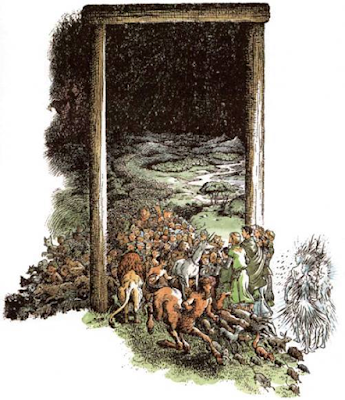
Post-mortal, pre-resurrected, spirit life is analogous to dreaming sleep


From The Last Battle by CS Lewis - Lewis's vision of the choice confronting post-mortal spirits


After mortal life we die and become spirit-beings - and it is these post-mortal spirits who may choose to become resurrected. 

What is life like as a post-mortal spirit? What will you and I be like at the time when we are confronted by the chance and choice of resurrected eternal life? 


The condition of post-mortal souls seems to have been accessible and known in ancient times; and in the years before Christ; the ancient Greeks left us with descriptions of Hades, while the ancient Hebrews described much the same condition as Sheol.  

The condition of such spirit life can be described in terms of a state of 'dementia' or 'delirium'; but is perhaps most easily comprehended in terms of dreaming sleep. 


During dreaming sleep; our spirit is cut-off from the body, and from the environment. That is, in general; we lose sensations of what is going-on inside us, and in the world around us. 

Our spiritual self mostly breaks free from the body - but in sleep the spirit does not wholly break-free, because the spirit must return to the body on awakening - and therefore there must remain a connection, and this residual connection of spirit with body can be greater or lesser. 

When the connection is greater, then the body and/or the environment around the sleeping body can influence the dreaming spirit; and we find some degree in which the physical shapes our dreams. For instance, a stomach pain or a ticking clock may be taken-up in the dream, and (in part or in whole) become part of a dream. 

But sometimes the connection between spirit and body is diminished to the merest thread; and to the extent that the spirit does break free; we are then in a similar state to post-mortal spirit life. 


What are the characteristic experiences of this kind of dreaming sleep, in a qualitative and formal sense? 

In dreaming we retain our sense of 'self', of being an individual with a personal persepctive, and we remain who-we-are; but the quality of experience changes. 

The typical mood of dreaming is one of perplexity - a sense of insecure grasp of the situation; of our understanding continually slipping-away. 

We forget important things in the dream, and then later in the dream they are recalled with a sense of puzzlement: how could I have forgotten that? Or else we may discover major things of great importance in the dream that, somehow, (in real life) we had never noticed before. 

In the dream we may take-for-granted bizarre situations that we (somehow!) find ourselves in; or conversely, may find ourselves unable to comprehend and function in situations that we would normally find routine. 

Recognition of people and situations is unmoored - much as the spirit is unmoored from the body. For example, we may recognize someone familiar who then turns-out 'really' to be someone else; or else it turns-out that a stranger in the dream is 'really' someone familiar (although they may look and behave completely differently). 

(These dream experiences are very similar to delusional misidentifications observed in psychoses.) 


These kinds of dreaming experiences derive, I believe, from the greatly diminished connection between the spirit and the body during dreaming sleep. If we can imagine this disconnection becoming total and potentially 'permanent'; then we may have some idea of what it may be like to be dead - but not resurrected. 

And it may be from such a dreamlike state - or perhaps more exactly from a temporarily lucid dream state (made possible by divine intervention) - that we make the choice about resurrection. 

That is; a state when the dream situation becomes suffused by an increased self-consciousness and ability to choose; when (perhaps) the dream-self becomes more detached-from dream-experience - and knows it as "a dream" - in other words, knows the reality of the situation. 

Then, it may be, we are confronted by the decision of whether to follow Jesus Christ through the process of transformation that is resurrection, to render us eternally incarnated, and to continue into Heaven.  


Perhaps this transformation can itself be imagined, as if from a dream; as our spirits meeting with Jesus Christ and knowing Him to be Jesus Christ - standing as the Good Shepherd in front of a portal, a doorway - the entrance into the 'sheep fold' that is Heaven. 

We are granted the comprehension that we may choose to follow Jesus through that doorway; and the knowledge that if we do so - as we are solidifying ('condensing') into eternal bodies - we will be taking with us only that which Good; only that which is Love - Love of God, of fellow Men, of divine creation... 

Also, if we choose to pass through that doorway; all that is of sin, death, corruption - will be left-behind. 


What I would emphasize here, is that when we make that decision; it will be from an experienced-situation that is somewhat like a dream, and the decision will be made by selves that are somewhat like our dream selves...

But a dream-like-state that we know to be reality; and the choice will be made by what we then-know to be our real, eternal and divine self.


Monday, 28 November 2022

Christianity is (or should be) a religion of inequality

Equality is supposed to be 'a Good Thing', but isn't; as William Wildblood demonstrates in a forthcoming book - which I have had the privilege to read in manuscript.

As well as equality being a Bad Thing to aim-at; indeed, equality is not even a real thing. 


The word and concept of equality is, of course, very vague in terms of its actual (i.e. rhetorical) usage, which resembles an hypothetical black box, more than a useful category; but 'equality' can usually validly be reduced to an assertion of sameness... 

Either an assertion that some-particular-things are, or ought to be, The Same. 

But are things ever the same? 

Well, in some sciences, especially the physical science, science there has been an assumption of sameness among things like particular chemicals or atomic particles. Yet even here, the progress of science has usually been towards finding differences among things that were originally assumed to be the same: for instance all atoms were originally assumed to be identical - even between different elements and substances. And in biology, an assumption of sameness is much less frequent, and soon breaks-down, the closer we look. 

Perhaps the only genuine sameness is in mathematics (and formal logic), where the sameness is axiomatic and wholly abstract: a matter of definition. 

But mathematics is not the real world. 


What about in religion? Well, so far as I know, there has never been any actual, viable religion where all people are judged to be the same. 

In the past, human differences were often simplified (for practical purposes) into categories, or classes of Men - but even there, there was always provision for making distinctions. 

e.g. Priests may have been in a different category than non-priests; but priests were internally differentiated in many way - even down to the individual level.  

But what of a divine level? Again, it seems there has never been equality of divine regard of Men - but sometimes this has been simplified into categorical levels of classes of divine esteem; which often reflected social organization.  


So where does the idea of equality come into religion? Well, sometimes there is an equality of 'destination' in terms of post-mortal, afterlife fate. In some religions it seems that all Men will (sooner or later) end-up in the same situation. 

For instance, the Ancient Greeks and Hebrews seem to have regarded the afterlife of all Men as a an underworld of demented ghosts: Hades/ Sheol. 

Or the Eastern Religions Hinduism and Buddhism have sometimes envisaged all Men as sharing the same fate of eventually (after varying numbers of incarnations) being re-absorbed back into the divine, from which they came - at least, that goal was the same for all Men. 

Christianity has always divided the destinations between at least two (not-equal) possibilities: Heaven and Hell; and this has sometimes been elaborated by additional possibilities such as Limbo and Purgatory; and by differentiation of fates and roles within both Heaven and Hell (e.g. the circles of Hell, or the layered Mormon 'Heavens') - sometimes differentiation by categories of people, sometimes at the individual level. 


The main assertion of, and emphasis upon, 'equality' in Christianity is almost-wholly modern (coming after the emergence of political leftism, with is promiscuous talk of actual or aspirational 'equality'), and is related to God's supposed attitude of Love to all Men being absolutely 'equal'. 

But God's 'equal' love can only be entertained as a possibility either if Love is regarded in an extremely abstract way (because in real life, including in the Bible itself, love is always differentiated and selective) -- and/or if equality is redefined into a very vague notion that because God Loves all His children, this 'must' (or should) mean that God (somehow, for some reason) loves all his children in exactly the same way and to exactly the same degree...

This supposed 'equality' has been spun into highly abstract assertions of God's absolute and unconditional - therefore equal - Love; rather as if God's love was an evenly-distributed gas, or a radiation of completely equal intensity that bathed all Men without distinction. 


To my mind, this (frequent) attempt to express God's Love as equal and unconditional is probably an alien import to Christianity; either derived from politics; or apparently derived by back-projection from the (not Christian - but nonetheless held by some self-identified Christians) idea of post-mortal Men all returning to be assimilated-into the divine...

Maybe the argument hinges on the idea that if all Men end-up equally, then this happens because God regards all Men as the same. 

At any rate, these two ideas of the supposedly unconditional and universally-equal Love of God, and a Nirvana-like life after death destination of all Men - seem to go-together. 


For a Fourth Gospel derived and focused Christianity; I would regard it as obviously wrong to regard equality in Christianity as a Good Thing. 

Christians ought instead to be trying to understand God's plans for men in the most differentiated and individualistic way possible; much as the ideal attitude of earthly human parents to their children is one that recognizes each child as individual, unique; and needing (ideally) to be regarded as such in terms of their destined and best path through mortal life and beyond. 

Ideal earthly parents would not love all their children 'equally'. Neither would they love their children in a rank-order. Instead they would 1.) love all their children, and 2.) love and value each child in a particular and unique way to correspond with his or her individuality.  


In other words, it is high time Christians set-aside 'equality-talk'; and began to recognize that the traditional categories and classes of past-Christianity were an imperfect representation of what is actually - from God's point of view - an individual-level scheme of Man's salvation and theosis.  


Tuesday, 22 February 2022

Why is it so difficult to repent in Hell? A speculation

It seems to be accepted that it is either impossible, or at least rare and difficult, for a soul in Hell to repent and then be resurrected into Heaven.  

I don't have a solid or fully-articulated understanding of this; but it seems that incarnation makes choice easier and more possible, compared with living as a disembodied spirit. 

To put the same thing differently - the major benefit of incarnation is that agency (i.e. free will) is enhanced - which probably has something to do with the boundaries of 'he self' being more defined. 


I don't think there is anything that prevents a spirit from exercising agency; indeed I regard all living beings as having some degree of agency, and I regard divine creation as consisting of living beings (even the 'mineral' world). 

But agency is somehow much weaker and slower in a spirit than with an incarnated being - perhaps because incarnation is the physical expression of spiritual separation. 

A spirit - who is not spiritually separated from other beings - probably finds agency much weaker and slower to operate. Or perhaps agency in a spirit is more easily confused by 'interference' from the cognitions of other beings? 

In other words; a major benefit of incarnation is the enhancement of agency. And this is - presumably - why Jesus was resurrected as he became eternally-divine; and why men are offered resurrection as the path to eternal divinity as sons and daughters of God.  


Pre-mortal spirits live as not-fully-separate beings, immersed-in an environment that is permeated with God's goodness. Pre-mortal spirits therefore find it difficult Not be be aligned with God.

The existence of demons (pre-mortal spirits that have chosen to leave Heaven and reject mortal incarnation) seems to shows that strong hatred of God can still be formed and expressed as a spirit. But my assumption is that only the most evil (the most innately hostile to God and creation) of pre-mortal spirits are able and willing to make the choice permanently to reject both God's creative will and the chance of  mortal incarnation. 

In other pre-mortal spirits - hatred and rejection of God and creation only becomes clear after incarnation - as we observe with the most innately and deeply evil of Men on earth. 

After death of the body, those who then reject resurrection and remain as spirits - but self-excluded from Heaven; presumably return to this feeble and slow form of spirit agency, exacerbated by the maiming effect of having lost their bodies. 


But are post-mortal spirits necessarily maimed? This is suggested by the accounts of the inhabitants of Hades and Sheol as shades, who do not know their own identity - 'demented ghosts'.

Pre-mortal spirits (before mortal incarnation) are complete beings. Incarnated mortals are also complete being - albeit temporary. 

But a spirit that remains after mortal death of the body is probably not complete. After all, the body and the soul are integrated and not separable during mortal life, therefore biological death of the body probably has a maiming effect on the spirit that remains. 


Such maimed post-mortal spirits then presumably find themselves in some kind of Hell: a God-hostile environment, permeated with many evil cognitions from other beings. 

I therefore think it may be that repentance after death is very difficult and rare for at least three reasons:

1. Being a spirit - hence intrinsically less agent.

2. A maimed spirit - hence incomplete. 

3. Dwelling in an evil (God-hostile) environment - living among other beings that have also rejected resurrection into Heaven. 


In sum; the spirits 'in Hell' could in principle repent their sin and choose resurrection into Heaven (certainly, God would be delighted if they did so). But in practice, and for practical reasons; repentance is much slower and more difficult, thus less likely, than in mortal incarnate life on earth. 

Monday, 21 February 2022

Jesus as an addition to pre-existing religion - who then transforms what went before

It is interesting to try and understand the essence of 'Christianity' - the single main thing that Jesus did, if you like - and when you do, it seems that there are actually quite a wide range of answers. 

My own (Fourth Gospel derived) idea is that Jesus brought the new possibility of eternal resurrected life in Heaven to those who followed him. 

Others regard the coming of Christ in terms of setting up a new religion - and then participating in the prescribed activities of that religion. Or a changed relationship between Man and God. Or provision of a source of guidance for (this mortal) life. Others focus on a change in 'reality' in the totality of the universe - an 'evolutionary' view. Others take a morality-focused view; which see immorality/ 'sin' as The Problem, and Jesus offering a solution. There are also other ideas - a surprisingly large number!

But if my own understanding of Christianity as "following Jesus to Heaven" is accepted (as a thought experiment, if nothing more) then it is interesting to consider what happened during the years of Jesus's ministry when a Jew or a Roman Pagan decided to 'convert', to become a spiritual follower of Jesus - to consider what this meant in terms of their pre-existing religion. 


My understanding is that - initially - a belief in Jesus was understood in terms of an addition to what was already believed. The Jew added a belief in Jesus to his pre-existing religion, and the Roman likewise. 

In other words, the new thing about becoming a follower of Jesus was the expectation ('hope') of eternal resurrected life in Heaven - to come after this mortal life and after death; and that this resurrection was to be attained by following Jesus. 

'Following' involved having faith in Jesus (in his being the Son of God, thus divine - therefore able to do what he claimed) - and 'faith' meant something like loving and trusting him. 


I think this - specifically about the Jews - is what Jesus meant in those passages of the Gospels where he implied that no aspect of 'being a Jew' needed to be changed in order to become one of his followers. 

It also fits with the miracles of faith; where the miracle happens in someone who 'believes-on' Jesus - specifically, personally; without regard to the nature of his specific religious life - which might be Jewish, Samaritan, or any type of Pagan. 

This idea of 'Christianity' as pre-existing religion-plus, fits with the observation of people who seemed to be (to to believe themselves to be) Christians and Jews, or (presumably) Christians and Samaritans, or Christians and Roman or Greek Pagans. 

It happens because the original Christianity was actually composed of "pre-existing religion"... and then 'adding Jesus'. 


This idea of Jesus as 'an addition' to religion is quite different from - almost the opposite of - 'syncretic' ideas of a religion formed from combining aspects of "Christianity" (as it later became) and "some other religion". 

The idea is instead that Christianity has an essence - which is the following of Jesus to resurrection - and this essence can be added to almost any other "religion". 

But of course, adding Jesus does not leave the pre-existing religion untouched, unchanged! Far from it! In the first place, the Christian idea of death as followed by resurrection (for those who believe-on Jesus) must displace whatever description of death was given by the pre-existent religion. 

So the expectation of Heaven needs to replace Sheol, Hades, paradise, reincarnation, annihilation or whatever was previously expected. 


Furthermore, adding-Jesus inevitably works-back on the pre-existing religion. 

In other words, the expectation of immortal life in Heaven affects the understanding of mortal life on earth - affects it in innumerable ways. 

I suppose that this was the basis for the development of the various Christian churches - these are the various consequences of the expectation of Heaven, on Man's understanding of life on earth. 

And the churches vary because the order and priority of these changes strikes people differently. Since the changes in mortal life are secondary consequences of the primary reality of resurrection; there will often be disagreement as to which ought to come first, which ought to be most enforced. 


But our situation here-and-now, in 2022, is that of no pre-existing religion. "Following-Jesus" cannot easily or obviously be added to Zero - not in the way Jesus could be added to Judaism or Paganism. 

Atheism is the - increasingly mandatory - basis of all serious social life and discourse. Religion is everywhere subordinated to ideology - and that ideology is top-down, imposed, and evil. 

Our rituals and rules are secular (i.e. Satanic in nature and by intent) - not divinely-attributed. 

Jesus is not believed in his promises because he 'cannot be' divine, because 'the divine' is seen as untrue, mistaken, a lie - and indeed impossible. 

Resurrection and eternal life are seen as sheerly incoherent in a materialist world where spirit and the soul are seen as merely mythical, pathological or manipulative.  


Such is our situation. Men of 2000 years ago (and much more recently) were able to understand what Jesus meant easily and quickly. They could become 'Christians' (followers of Christ) almost instantaneously; simply by understanding that Jesus offered something more than their existing religion, and by experiencing the spiritual conviction (faith) that this offer of resurrection was real and possible. 

The offer still stands, and can still (in principle) instantaneously be accepted - and then the expectation of Heaven can still begin its inevitable (but unpredictable, because so wide-ranging) working-back to transform a Man's pre-existing convictions... 

Yet the Good News of Jesus Christ cannot nowadays simply add-onto and re-shape existing religious convictions because there are none, and even the basis for religion is destroyed and replaced by a secular, materialist, leftist ideology*.

(An ideology which is in-actuality a mostly-covert Satanism - not neutral but evil.)

The potential follower-of-Jesus ("convert") must also choose to reject many foundational modern metaphysical assumptions concerning the nature of reality; and choose instead to adopt beliefs within-which Christianity makes sense, and can do its work. 

And against the background of evil materialistic nihilism - this must indeed be a conscious choice; and (because the world of institutions and rules opposes it) this conscious choice must be personal - that is, individually-motivated. 


The essence of Christianity remains the same as ever - what makes a huge and adverse difference is that Modern Man is deeply damaged by this-worldly materialism, a nihilism that is deep and habitual, and by a tacit-and-denied allegiance to the evil agenda of Satan. 


*Note: This is why I regard it as a misleading error to call the global, mainstream modern ideology of 'leftism' (or political correctness, or 'woke') "a religion" as so many of those who oppose it do. Despite some superficial resemblances, the leftist ideology is not a religion, it is instead anti-religion - the negation of religion. This is proved by the fact that it cannot (like Judaism, Greek or Roman Paganism etc) be added-to by Jesus, to make someone a real Christian. Precisely because leftist-ideology is Not a religion; if you "add Jesus" to leftist ideology you merely get a fake-Christianity. You get that Christianized-leftism of the kind propagated by the leaders of the major Christian churches and denominations. 

Tuesday, 5 October 2021

Merlin, the Celts and Albion's native Christianity

It seems possible that Christianity came very early to Britain, shortly after the ascension of Christ, and probably to Glastonbury; at the time of the native Celtic Britons. 

Perhaps because of this, and for many centuries, there was historically very little conflict in the British Isles (and no recorded conflict at all in Ireland) between Celtic paganism and the new Christianity.

This had a lasting effect. Because the new Christians were not persecuted by pagans, when Christians became dominant they did not persecute the pagans but assimilated them. Churches were deliberately built on the pagan sacred sites. 

And the old pagan deities were downgraded rather than suppressed; to be named among ancient kings, mythic heroes, or even being transformed to saints.  


Also Britain was the centre of druidism, the place where continental Celts sent their druids for a very prolonged and difficult education - presumably in colleges of some kind; all this knowledge being memorized and never written (although there was perhaps a written language at the time, using ogham letters)

Druids were leaders of the Celts; with, apparently, a wide-ranging role including ritual, scholarship, divination, healing and warfare. They conducted sacrifices, including human. And these druidic pagans were exceptional in the known world for their strong belief in a personal afterlife - an afterlife in which Men retained their individual identities. 

That this belief in an afterlife was strong is evidenced by Julius Caesar, who gave it as the reason for the exceptional courage in battle of the Britons; that it involved retained personal identity may be inferred from the Ancient Briton's practice of guaranteeing loans (IOUs) to be paid-off in this afterlife. 

Both of these imply that the Celts knew a lot about the afterlife - in that they had apparently rather exact expectations of what it would be like. 


The Celtic expectation of eternal life contrasted with the Greco-Roman and Jewish belief in a afterlife as merely depersonalized ghosts in Hades/ Sheol. The Greco-Romans apparently interpreted the Celtic belief as reincarnation - like the Pythagoreans - but it was more likely a belief in Paradise: Men living eternally in an ideal kind of society and situation (on a magical island to the west, for instance).  

This means that when a pagan Celt converted to Christianity and a belief in Heaven it was qualitatively different from the situation for a Roman or Jew. The Roman or Jew expected annihilation of the self - while the Celt expected preservation of the self. 

Therefore, for the Roman or Jew Christianity Heaven offered a qualitative transformation of the self, whereas for the Celt it was more like a quantitative enhancement - a divinization - of the self.


I would speculate that this difference in pre-conversion expectations may have led to a difference after conversion. The Greco-Roman or Jew perhaps focused on the new fact of eternal life - and was therefor almost exclusively concerned with salvation. While the Celt would have been more impressed by the enhancement of the self towards becoming a god: a 'Son of God', much like the ascended Jesus - and therefore more focused on theosis - on working to become 'more divine' during mortal life. 

At any rate, mainstream Roman/ Western Christianity was rather vague (and indeed uncertain) as to the details of the afterlife; at least until the Mormon revelations from 1830, which began to provide a much more detailed description - and expectations. 

But I would guess that the Celtic Christians would have had similarly detailed expectations of Heaven, inherited from their pagan predecessors. 


In terms of its organization, Celtic Christianity resembled Eastern Orthodoxy much more than Roman Christianity. Whereas the Roman church was dominated by Bishops and Priests; Orthodoxy is spiritually dominated by Abbots and Monks - and with semi-autonomous hermits inhabiting remote 'desert' regions and performing heroic acts of asceticism (fasts, vigils, prayer), often at the summit of holiness. 

But Celtic Christianity was substantially cut off from Constantinople, as well as Rome; and developed along the native lines established very early. These included a great emphasis on mysticism (communion with God) and miracles, with most of the Saints being wonder-workers (most famously Cuthbert).

Although normal in Eastern Orthodoxy, given the pagan assimilation this mysticism may also link up with druidic initiation, which went through many rigorous levels and aiming at spiritual powers that were regarded as magical. 

In particular; it may be that the folk heroes of the British may be traced back to those ancient Celtic Gods, assimilating into Christianity. According to the work of Geoffrey Ashe (e.g. Avalonian Quest); Arthur may have derived by many steps from the original primordial titan that was assumed (in the oldest chronicles) to be the ruler of England when it was invaded by Men originally from Troy. This character reappears as the giant Albion in William Blake's prophecies. 

Merlin (originally Myrddin) may go back even further, to an even more ancient God who ruled the island of Britain originally. Merlin was originally a place-name for a fortress - but became a personal name. The first recorded name for Britain can be translated as Merlin’s Precinct, or enclosure. The Merlin of literature could have been derived from this ancient god. 


By Geoffrey Ashe's account in Merlin: the prophet and his history; the Merlin that we know from literature seems to be derived from a title, role or nature of a person - probably one with prophetic and magical abilities, due a relationship with the ancient god - perhaps as a reincarnation or by divine inspiration.

This led to the the first two known historical Merlins - Ambrosius/ Emrys, the Welsh magician prophet Merlin who mostly contributed to the Arthurian mythos via Geoffrey of Monmouth's History; and Lailoken the later mad prophet Scottish Merlin - who is represented in Geoffrey's later Merlin poem, and who features in the stories of the Scottish Saint Kentigern/ Mungo (the first Bishop of Glasgow, and a missionary of major historical importance). 

Another 'Merlin' may have been the Welsh bard Taliesin, author of the oldest surviving native poetry; he is recorded as a companion of Lailoken-Merlin, by Geoffrey.    

The Merlin of literature (and his descendants among many other wizards) exerts a continued - perhaps increasing - fascination in Britain (and the Anglosphere more generally). This may have spiritual significance, as some kind of folk-memory of the Celtic Merlin god, via the historical-and-legendary Merlins of the Dark Ages - as assimilated and transformed by the unique nature of Celtic Christianity. 

It may even be that - to the Romantic Christian imagination - Merlin is a Celtic name for the archangel of Albion: the angelic being who has been responsible for that ancient and indomitable spiritual reality which underlies modern 'Britain'. 


Why is Christianity universal? William Wildblood answers

This vital question is given an excellent answer by William Wildblood in his post today Edited excerpts follow - but read the whole thing...


People often question what there is in Christianity that is not in other religions since many of the moral teachings are very similar and some even pre-date the birth of Christ. This is missing the point. 

What there is in Christianity that is nowhere else is Christ himself. The actual person of Christ who through his crucifixion and resurrection transformed the whole world, even those parts of it that had no conscious knowledge of him. 

He changed the spiritual goal fundamentally, opening up the Kingdom of Heaven to all who accepted him whereas before there were only states analogous to Limbo, Hades, Sheol, Bardo and the like for most souls with Nirvana as a possibility for those who were able to detach themselves completely from identification with their created selves. 

But the new reality of Heaven (new as far as human beings were concerned) meant that the fallen self could now be redeemed and transformed into a being of light. For Heaven involves the union of spirit and matter instead of their separation. It's a marriage not a divorce. 

Prior to the actual Incarnation the spirit of Christ will have begun to permeate the higher worlds, affecting all those able to respond to it on that level. Thus, the teachings of Christ will have begun to be established in the world. A similar thing happened after Christ's death and means that all spiritual forms in the world that were open to it, whether ostensibly Christian or not, will have begun to be influenced by what we can call the Universal or Cosmic Christ. 

Christianity is the religion in which Christ is most fully present but surely you did not think he could not manifest himself and be present as a spiritual force and influence in other religions? He is primarily a spiritual being and as such can be present everywhere to those who are open to him. Such people may not know him by the name Jesus Christ but they can know his spiritual presence and that is what really counts.


I would add that this explains why it is the almost-exclusively materialistic, this-worldly, assumptions of modernity that has made it so difficult for modern people to understand Christianity; and led to misunderstanding Jesus as essentially a 'moral teacher', or a societal-transformer. 

But the essence is that what Jesus did was indeed Cosmic; he transformed the nature of reality and thereby made new possibilities - everywhere and for everybody; which is why Christianity is universal.


Saturday, 2 October 2021

The fear of death is spontaneous and natural - and the best possible basis for belief in Christ

 As a young child, aged about five or six, I quite suddenly became afraid of death. That is, I became afraid of other peoples' death - I became afraid that someone I loved, among my family, relatives and close family friends - would die and be lost to me. 

At this point in my life I was not an atheist; but neither was I a Christian. I was, indeed, somewhat hostile to Christianity as it was taught me. And I was (as perhaps all Men are) a natural pagan; therefore I did not love the gods, and I assumed that the gods did not love me; but instead they wanted propitiation, worship, sacrifice. They did not want to be 'asked', but needed to be begged. 

Thus I prayed - whenever the thoughts of death came to mind - with desperate pleading and multiple repetitions. I prayed for the preservation of those I loved; that they would not be taken from me and lost from my life. 


Death seemed like the greatest disaster that could befall me - but at that point I could hardly comprehend my own death; so the worst I could imagine was to be left bereft, unprotected, in a world of strangers who were probably indifferent and uncaring at best; and some were spiteful, hostile, nasty. 

I realized, with perfect truth, that to live within the loving warmth of family was the greatest possible benefit the world had to offer; and that death threatened this happiness and security more - and more irreversibly - than anything else. 


In general; I think that these spontaneous and natural beliefs of early childhood are truths - truths implanted by God or known from our pre-mortal lives. Therefore, not only truths about this earthly mortal life; but eternal truths. 

...Yet, of course, truths as understood by the mind of a child. 

Therefore, our best goal as adults to to return to these spontaneous childhood beliefs, but this time consciously and by choice; and understanding what they really mean in an eternal context. 


I now understand my young-childhood fear of death to be representative of the real terribleness of death when (as naturally) understood as an end to mortal life with loss of the self - loss of what makes each person who they are. 

It is this legitimate fear that Jesus Christ came to save us from. A child could understand it - and indeed a young child is nowadays more likely to understand what Jesus offered than almost anyone else. 

A child's fear comes from the fact that he knows, deep down, that the death of our loved ones in mortal life can only be delayed - and that sooner or later everyone will die. It is indeed, the awareness of death that triggers this stage in childhood. 


Spontaneous human thought (among children, and those whose minds are child-like) cannot get further than this the fear of death and the desire to delay death. The child cannot see past the fact of death. Neither, apparently, could the ancient Hebrews of the Old Testament who regarded all Men's lives as terminated in Sheol, nor the Ancient Greeks who regarded all lives as terminated in Hades - both of which entailed loss of the self. 

The dead were not the people they had been in mortal life; and so there was no consolation in their persistence as 'ghosts'.   

Nonetheless, a Christian knows that he has been instructed Not to fear, that fear is a sin - and this prohibition on fear includes death. So for a Christian the fear of death is just the beginning of the matter - not its end. 


As an adult we can and should realize that the best (and only) possible gift to address this childhood fear of death would be that this mortal life would be followed by an immortal life in which were still our-selves, and could (potentially) live forever with those that we had loved in mortal life. 

In other words, The Answer to death is: that-Heaven promised by Jesus Christ - that Heaven (I would add) particularly as clarified by more recent, more detailed Mormon revelations concerning the nature of Heaven and the continued existence and importance of the family*. 

Unlike paganism; Heaven is not a spontaneous insight of childhood. Its necessity - as the only solution to the problem of death which answers to the desires of a loving young child - could perhaps consciously be derived from the conviction that the Christian God the creator is our loving parent (thus very far from the gods of paganism, and from the abstract deities of some philosophies and religions). 

But the Christian Heaven - that is, of resurrected Men living eternally as 'children of God' (ie. as ourselves creative gods) and in familial 'brotherhood' (i.e. in families and divine friends) and knowing the ascended Jesus... such a Heaven could not realistically be inferred by a child. The child would need to be told; and then he might - or might not - believe Heaven was true. 

I decided (as child of about six, a while later than the above-described stage) that the Heaven I was told-about was not true, but was made up from manipulative motives... 


I would still agree - that Heaven as it was told me (or, as I understood it) was Not true; and that the description had been contaminated by this-worldly motives related to making me behave in certain ways. 

Yet I erred in throwing-out the whole idea of Heaven; rather than (as I should have done) thinking more deeply about Heaven, aimed-at discerning how Heaven really was. 

I disbelieved in the Heaven that I was told-about - but I should have believed in Heaven as it really is; and I should have made it my life's task to comprehend that that real Heaven offers the only full and satisfying answer to the problem of death. 


My suggestion is that others should do the same. You should think upon the idea of Heaven, and how Heaven would need to be in order to answer the problem of death. 

Only when you have grasped what Heaven really would answer that problem, have you discovered what it is that Jesus is asking you to believe... Or, more exactly, what Jesus is offering to those who want Heaven.

And you will find that when the problem of death has been answered; then the fear of death - I mean that inescapable existential angst - is indeed cured. 

At least, such fear is cured whenever we have Faith and Hope based upon Love (or 'Charity'); and even when we don't experience the cure, we can know that restoration of that Faith, Hope and 'Charity' will drive-out our fear. 


*I regard mainstream Christianity as having lost sight of some of these key revelations about the nature of God, Heaven and the Family - which was why I believe that Joseph Smith and some of the other Mormon prophets were inspired to articulate these vital truths in a new, radical, and superior metaphysical theology. This appears in the work of early Mormons and some recent writers - along with other non-essentials and errors; therefore requiring, as always, discernment. But these truths having been articulated was of great value to me. Instead of having to work them all out, I was more easily able to recognize intuitively their truth, beauty and virtue; then (without too much effort) to organize them in my understanding.