Showing posts sorted by date for query Neolithic. Sort by relevance Show all posts

Friday, 11 November 2022

Megalithic Meanings - Stone circles


The Swinside stone circle, near Ambleside in the Lake District


Stone circles were of primarily religious significance, clearly; and there is a strong tradition of assuming that they were usually 'sky temples' - which seems likely given their locations and the 'feel' of them. 

I accept that there is an element of astronomical alignment with some of these circles, such as the ability to indicate sunrise at summer solstice (as at Stonehenge) - but I believe that any such measurements could only be approximate - given the very various shapes and sizes of the stones. 

Such stones are not at all well-suited to the purposes of precise measurement - if that has been the purpose surely something with a distinct point, more like an obelisk would have been employed. Also, (nearly always) the lack of a central stone in circles seems to make the use of circles as highly-accurate calculators less likely.  

When I visited Swinside (above) I was struck by the variety of shapes and sizes, to the point that I felt that each stone had an individual character; and it struck me that this may imply that each stone represented a particular person

I could imagine the circle makers of neolithic times, being alert to such correspondences; and finding a particular, distinctly shaped and sized, stone; that they intuited had a one-to-one relationship with some (probably deceased) individual; presumably someone regarded as important or worthy - who deserved, or needed, such a monument.

Or, indeed, each stone might represent an anthropomorphically-conceived god from the (presumed) pagan pantheon. Or stone corresponding gods may be have been ex-humans - whether deified or avatars. 

The point is simply that each stone's shape was related to its identity as a personage - as well as the placement of the stone having a function related to alignments.   


Therefore I envisage these circles being added-to, incrementally, over generations - as suitable stones were found, and perhaps modified. When circles were being used for religious rituals, the participants would also (simultaneously) have regarded themselves as surrounded by spirits of specific, venerated ancestors... Again able to contact them - whether, from love, for guidance, or for propitiation.    


Wednesday, 22 June 2022

Land of Druids

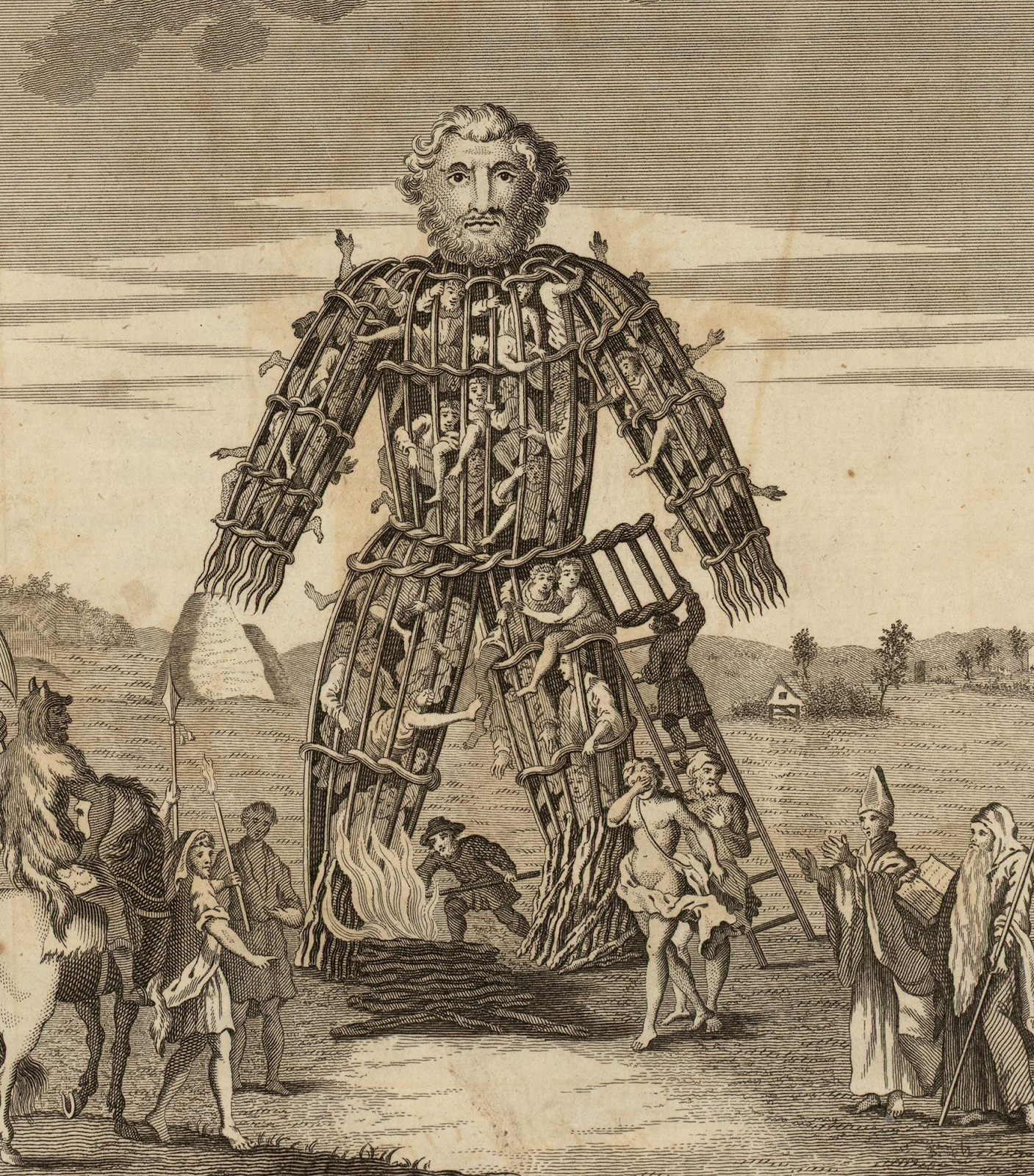
They weren't all Mr Nice Guys - Druids probably performed human sacrifices as well as the good stuff

There is a famous passage in Julius Caesar's Gallic Wars, where he discusses the Druids; and describes their relationship to Britain:


Throughout all Gaul there are two orders of those men who are of any rank and dignity... But of these two orders, one is that of the Druids, the other that of the knights. The former are engaged in things sacred, conduct the public and the private sacrifices, and interpret all matters of religion. To these a large number of the young men resort for the purpose of instruction, and the Druids are in great honor among them. 

For they determine respecting almost all controversies, public and private; and if any crime has been perpetrated, if murder has been committed, if there be any dispute about an inheritance, if any about boundaries, these same persons decide it; they decree rewards and punishments; if any one, either in a private or public capacity, has not submitted to their decision, they interdict him from the sacrifices. 

This among them is the most heavy punishment. Those who have been thus interdicted are esteemed in the number of the impious and the criminal: all shun them, and avoid their society and conversation, lest they receive some evil from their contact; nor is justice administered to them when seeking it, nor is any dignity bestowed on them. 

Over all these Druids one presides, who possesses supreme authority among them. Upon his death, if any individual among the rest is pre-eminent in dignity, he succeeds; but, if there are many equal, the election is made by the suffrages of the Druids; sometimes they even contend for the presidency with arms. 

These assemble at a fixed period of the year in a consecrated place in the territories of the Carnutes, which is reckoned the central region of the whole of Gaul. Hither all, who have disputes, assemble from every part, and submit to their decrees and determinations. 

This institution is supposed to have been devised in Britain, and to have been brought over from it into Gaul; and now those who desire to gain a more accurate knowledge of that system generally proceed thither for the purpose of studying it.


From this reference, and other evidence; Britain was the centre of the Druids and their religion of eternal (probably reincarnating) life. It was the main place where Druids were trained by a complex and prolonged process of education and initiations - all done by word of  mouth and memorization, because writing this secret knowledge was forbidden. 

And the Druids were a problem for the Romans, because they organized and inspired the fiercest resistance they encountered in their invasions and eventual conquests of Gaul and Britain. Caesar comments that the druidic beliefs inspired the Britons with exceptional personal courage in battle, since they did not fear death. 

In Claudius the God, Graves makes the destruction of druidry the major objective of the inclusion of of Britain in the Empire - despite that Augustus had originally made it a principle that the boundary would be Gaul. So long as Britain existed to train and export Druids, then Gaul could never be securely subjugated. 

After the conquest, it was a major priority to extirpate the Druids and break their power; which is exactly what the legions were doing, a couple of decades later, in North Wales and Anglesey (as described by Tacitus) - when Boudicca mounted her massively destructive rebellion in the opposite corner of the country.   


Whether or not these Celtic Druids were in any way descended from the Neolithic/ Bronze Age priesthood who created the vast sacred landscape of southern England around the megalithic monument of Avebury, it is not known. 

But it seems clear that  there were several times in history - up to the 'Oxford Movement' of the 19th century - when the British Isles has been a major focus for religion, with international significance.

However, Britain was also the place where the industrial revolution began - and the way of thinking we could call 'positivism' or materialism began to be established, and where this eventually achieved perhaps its most thorough triumph; with, here-and-now, the all-but eradication of religion as a powerful motivator in human lives. 


Positivism has a fascinating role in the history of human consciousness, if we regard positivism as a development in human thinking - rather than as a response to changed conditions. In other words, if we regard the industrial revolution as a product of positivistic thinking (i.e. Not the cause of positivism). 

We need to recognize that positivism was - at first - experienced as a great liberation of the previously-passive human individual from the oppressive constraints of... well of all forms of communal immersion and control (good and bad). 

Positivism meant that its adherents felt able to think for themselves for the first time in history - and to experience life from a centre in the individual; and from this centre to evaluate and choose-between the ideas and instructions of the rest of society.

Positivism activated Men's thinking, and grounded it in his self.  


Of course we are now at the incoherent, alienated, and self-destroying end-stage of this process - and Britain has become (under the recent domination of its diaspora-nation the USA) an originating and generative centre of materialistic global totalitarianism and (therefore) evil.

But this has been our choice, and the choice of our ancestors

Exactly because of our individualistic consciousness, we could have chosen otherwise - and still can do - if we wished.  

Positivism is not necessarily evil when it is known to be what it was intended (by God) to be: a transitional phase of human consciousness. 


If the people of Britain had instead chosen to root their knowledge, lives, culture in God and the spirit - then we could have taken a very different and better path - and so could the rest of the world, if they too had chosen.

It is not a matter of eradicating the mind state of 'positivism' and trying (but failing) to go back to an earlier phase of consciousness; instead we ought to use our innate capacity (and doom) of individual knowing, evaluating, and choosing to create (because this freedom is precisely a form of creation) a world rooted in the spiritual, in God, in context of a perspective of resurrected eternal life - made possible by Jesus.

Consider; in the world here-and-now people believe/ know/ live-by all kinds of weird, nonsensical and evil stuff - and our communal, institutional world therefore operates on the basis of these beliefs; and (by our choice) forces them back upon us. 


If, instead, we choose to believe/ know/ live-by that which is true, beautiful and good; then... our world and the communal world would begin to operate on those beliefs. 

...It really is as simple, and as difficult, as doing that


Note added: Another way of thinking about this matter is that Positivism - as such - was actually an expression of divine destiny, and an intended aspect of that line-of-development initiated by Jesus Christ. Its many evils are a consequence of being cut-off from Christianity on the one hand; and also because the Christian Churches cut themselves off from the implications of this new mode of thinking - initially by the Churches excluding and resisting individualism and a spirituality rooted in originative intuition, later (and now) by these same Churches accepting and assimilating-to atheistic-positivism.


Saturday, 31 August 2019

Long Meg and her Daughters - a Cumbrian stone circle


Long Meg and her Daughters is a surprisingly large Neolithic stone circle in Cumberland, near Penrith; which we visited recently. It was an enjoyable experience - as others have found.  The site originally will have had a very broad 360 degree view to distant hills and horizons; and it slopes slightly toward the Pennines, as if the shape was intended to be visible from the flanks of Cross Fell and thereabouts.

It has several special features - first is Long Meg herself - a red sandstone pillar with 'rock art' concentric circular symbols still visible on one face (archaeology suggests there was originally another similar pillar, making an 'entrance); and the main circle of her daughters - made of grey stones; through which a small road goes.

Of the circles I have visited, it is most like Avebury, although smaller. The Daughter stones vary a lot in size - reinforcing my idea that each stone probably symbolically represented (was 'like') an individual person (or deity). Also the Daughters are spread-out, with no impression of ever having been contiguous. This differs from other Cumbrian circles such as Swinside and Castlerigg, which look as if originally the stones were placed close together, contiguously, to make an enclosing-excluding 'wall'.

A similarity with Castlerigg is that there is an area that looks as if there are extra stones that perhaps originally made a 'sanctuary' or 'chapel' jutting-in from the perimeter. 

From the fact that so many survived 4000 years plus; the British Isles must once have been covered in these and similar structures in the late Neothlithic-Bronze Age - I find it quite a remarkable thing to imagine moving through such a 'ritual landscape'. The stone circles are associated with other features such as pathways, parallel ditches (cursus), and various types of burial (some long barrows predate the stone circles).


The circles themselves seem like sky temples to me. I am impressed by the fact they don't have anything at the centre - just like the sky; but I don't believe that most of the stone circles have significant astronomical alignments. They are just not sufficiently regular geometric structures - the stones are very rugged and various in size and shape - and most are not even true circles. (e.g. LM and her Ds is flattened on one side).

My current guess is that the circles were dedicated to the sky god/s and stones were added to after the deaths of significant persons - or perhaps to represent gods. But they were clearly very important indeed - the sheer size of some stones is evidence of the work required to make them. The positions are distinctive and rare. They are part of complexly-shaped landscapes.

Probably, this was a literate society (the 'rock art' being the remnants of their 'writing'); and the number of these temples suggests a large pantheon, or in some way different functions of different temples (as with the much better documented and contemporary Egyptian religion).

I get the impression of life lived in this context; of life being a movement-through these sacred landscapes - perhaps following narratives of divine history; people continually reliving the primal stories of their gods.


Monday, 25 February 2019

Notice of a new blog about exploring ancient archaeology

Notice of a new blog - maybe weekly? - recording the mostly-prehistoric archaeological explorations of me and my wife around Northumbria:

https://northumbrianarchaeology.blogspot.com/

This first episode is about an apparently unrecorded example of neolithic/ bronze age 'rock art' we stumbled across a couple of days ago, while looking for something else...


Sunday, 17 February 2019

William Wildblood on the spiritual value of prehistoric monuments

From Albion Awakening...

...This is Maumbury Rings, a Neolithic henge. Here's an aerial photograph.


We have returned to the oval area enclosed by a ditch. That is to say, there would originally have been a ditch, formed by the construction of the outer banks, but that has long since been filled in. But still the basic layout of an oval demarcated by a border remains. 

Now, forgive me, but what does this remind you of? All I can say is that I have to assume it was constructed as a sacred space dedicated to the Mother Goddess. In its time it's been a Roman amphitheatre, a fort in the Civil War and even an execution ground in the 18th century during the Monmouth Rebellion, not to mention farmland and a place of assembly. But it is over 4,000 years old and its original purpose would have been religious. 

Archaeologists frequently say of ancient things when they are not sure what they are for, "used for ritual purposes" and I expect they are often right in that, but this clearly was a sacred space used by the local tribe for their most profound encounters with the numinous. When I used to go there 30 odd years ago it still had a feeling of peace and stillness, and there was also a sense of being safe and secure. 

Is it too fanciful to think of it as a kind of spiritual womb? Rites of death and rebirth are among the oldest and most widespread forms of human spiritual activity, and I think that is what Maumbury Rings would originally have been associated with...


Thursday, 7 February 2019

Gods under the ground, in the sky, in consciousness...

There are many prehistoric monuments in England - the earliest seem to be under the ground - such as West Kennet Long Barrow of some five and half thousand years ago, perhaps the centre of the religious landscape of that time...


While somewhat later are the more famous stone circles such as Avebury (near to West Kennet, and part of the same 'ritual landscape')


In general, through human development it has become more and more difficult to contact the divine. And this may be related to the assumed whereabouts of the divine.

Probably (there are no records), the earliest humans lived always 'in' the divine world - there was no separation between divine and mundane. Later, among the recorded simple hunter gatherers - contact with gods and spirits was more difficult; only attainable intermittently by a minority of specialist 'shamans' - who had to undergo some training, or else learn to use altered conscious states.

I would guess that the next stage - after the development of agriculture, and corresponding to the early Neolithic as at West Kennet - involved a professional priesthood, each of whom would experience a prolonged initiation. And also sensory deprivation and isolation - hence the underground sacred places.

(The Pyramids of Ancient Egypt are likely a highly developed version of this - the inside of the pyramid being the sacred space.) 

Under-ground was also the place of the divine - corresponding to the intuition that the divine was 'within' everyone and every-thing.

The monument Seahenge had an upside-down oak tree at its centre - roots above the surface, trunk and branches projecting deep into the earth - perhaps linking the divine underworld with this mundane surface world...


In the later neolithic, and into the bronze age - it seems likely that the contact with the divine became even more difficult - such that the gods were no longer experienced 'inside' - but in the sky, far away, imperceptible - and only indirectly and abstractly contactable by such methods as divination.

Hence the great stone circles (and pyramidal 'mounds' such as Silbury) were 'sky temples' - astronomically-shaped and aligned. I also assume that there was a supreme single god, by this time (henotheism); corresponding to centralised priestly government. 'Heaven' also means sky.

(The gods-under-ground, and god-in-the-sky temples seem to have co-existed for a long time - perhaps catering to different types of person; but the distinct impression is that the sky temples to the supreme god had the highest status, at least among the ruling group - since the greatest efforts were put into these structures.)

By this point, the kind of knowledge-based, abstract, priest-led religion was established which survived (gradually changing, becoming more theoretical and less direct) right through to the Reformation, and (somewhat modified) into modernity - after which it declined.

Until, from the advent of modernity (?1500s) increasing up-to nowadays, most people cannot contact the divine at all, under any circumstances - and deny its reality.

The idea of Romantic Christianity is that - starting with a few people from about the middle 1750s, and increasing, modern people are implicitly aware of the divine in a different, and individual, way; but which is not recognised as divine contact.

This is the process of conscious intuition, which I have often tried to describe on this blog. My understanding is that it happens to many (or most) people - but that nearly-always its validity is denied, and it implications ignored.

The modern sacred space is each Man's consciousness.

Note: If you are interested by the above line of argument, although not the specifics, you can find it superbly explored in Jeremy Naydler's The Future of the Ancient World, 2009.

Tuesday, 27 November 2018

The numinosity of hilltop tree clumps


This landscape feature is one that much appeals to me, and which seldom fails to induce a yearning kind of numinosity.

I realised recently that the interest and feeling probably came from the cover of my teenage-bought edition of Alfred Watkins's The Old Straight Track.


So that is the (suggested) link between such tree clunps and ancient landscape features - they are supposed to mark 'ley lines', which - according to Watkins - were Neolithic pathways criss-crossing Southern England.

I heard about Watkins's book from the references at the end of The Moon of Gomrath by Alan Garner - and found a copy in the Bristol City Library; Garner has the Old Straight Track as a magical path visible only at full moon, as the moon rises - it plays an important part in the story, and provides its most memorable scene.

Later, John Michell (in A View over Atlantis) took Watkins's Ley Lines and made them into lines of spiritual power - but I knew nothing of this during my teens.

Anyway, all this seems to have left me with a particular sensitivity to a particular landscape feature. The Hundred Acre Wood in Winnie the Pooh is also sometimes depicted like this - which may have been a further latent aspect of my interest; as also a very good children's book called Borrobil by William Croft Dickinson (1944) - a kind of neo-pagan precursor to Narnia, and also written by a Professor.