Owen Barfield claimed not to be very clear about the nature of that Final Participation which he saw as the destiny of human evolution of consciousness.
(Original Participation is that immersive and unselfconscious living in-the-world of hunter-gatherers and similar tribal peoples, and modern man is detached from the world, and even his own thoughts, in the Consciousness Soul).
But I think that sufficient clarity can be arrived at by considering the phases of human love through human life as an analogy (or rather, as more than an analogy - since the one is an example of the other).
Infant and young childhood love is an Original Participation; immersive and undifferentiated - the child is hardly aware of himself as distinct from his parents and family; his experience of the world is of a world alive and sentient because he is himself a part of everything he perceives. Love is everywhere (in an ideal childhood) like a sea in which everything is immersed, or like a gas in which each individual thing is merely a slight concentration of the element. We know everything, but we hardly know our-selves, and everything blurs into everything else.
With adolescence comes self-consciousness, which intensifies until the Self experiences itself as detached from the world. Indeed the Self experiences most mental activity as detached from itself - our Selves are cut-off from all experience, looking out upon the world, such that they world seems uncertain and unreal (how do we know that it is real), and indeed the Self is also experienced as perhaps unreal - since it changes, and can only rely upon itself for validation.
The point of Consciousness soul is 'freedom' in the sense of agency: to be free we need to be able to live from our-Selves (our true Selves). The consciousness soul is the condensation and concentration of the self, such that we can work from it. This is, indeed, a divine state of being - and that is what this phase is necessary to human spiritual progression.
To evolve towards a fully divine state of being, we must pass-through the Consciousness Soul. But it is meant to be a transitional phase, a short-lived phase - a phase we merely touch upon in passing...
This Consciousness Soul state of consciousness is also the state of modern culture. Modern culture is stuck, arrested, in stasis in the consciousness Soul - so intensely subjective that subjectivity itself is destroyed - experiencing the external world only via perceptions and instruments, and unsure about the reliability of these senses and mechanisms... THE problem being epistemological - how do I know if I really know? No answer forthcoming (because the assumption is of a gulf between the self and the world) and Modern Man is stuck in Consciousness Soul - held, trapped, imprisoned by the assumptions of modern culture.
Modern Man is stuck in Consciousness Soul - and that was not, and is not, meant to be - the CS is meant to be just a phase (albeit a necessary phase) on the way to Final Participation. Being stuck in the Consciousness Soul is a precise analogy to being stuck in adolescence, unable to grow-up, paralysed in that state of alienation, in which uncertainty erodes all potential solutions - and unable to move on.
Final Participation is like the ideal of spouse - indeed married love is a type of Final Participation.
In married love at its highest, each individual retains the full self-consciousness of the Consciousness Soul, but has a certainty of contact with another, distinct, self-conscious human being. There is no problem of communication, indeed there is a certainty of communication. Each party is not trapped in the nutshell of their own skulls but is able to share, participate in the life of the other, but with full self-integrity and self-awareness.
On the one hand individuality is assumed and valued, and is part of the essence of married love; on the other hand there is no problem of communication between these individuals - because the universal immersive state of Original Participation still is real and exists as much as it ever did. We are still part of each other and of everything - but with Final Participation our individuality, our Self, has been clarified, strengthened... has become a free, autonomous agent.
Final Participation is Original Participation plus the Consciousness Soul - it is the sea of infant family love, plus the individual island of adolescent self-awareness.
There is no desire among loving spouses either for a return to the detachment of the Consciousness Soul (the state before love) or to return to the immersive and undifferentiated love of childhood family. They have the best of both worlds. The differentness and individuality and self-awareness of the other is essential, and so is the given background of universal communication.
In conclusion, when married love works as it is meant to, then it is a species of Final Participation - which is to say a state beyond Consciousness Soul, a moving-forwards and not a regression (or atavism).
Culturally, human destiny is to have an analogous relationship to ideal married love, but inclusive of all reality - and that is what Barfield meant by Final Participation.
Showing posts sorted by relevance for query final participation consciousness. Sort by date Show all posts
Showing posts sorted by relevance for query final participation consciousness. Sort by date Show all posts
Thursday, 4 August 2016

Wednesday, 4 May 2016
Final Participation as the theosis of the future - Owen Barfield's scheme given its full Christian context
It was seemingly difficult for Owen Barfield to express clearly what he meant by Final Participation of human consciousness - indeed I think he exhibited a reluctance to be explicit on this point.
I now feel I have sufficiently understood Final Participation to re-explain it in my own words; but in doing so I take a step further than Barfield was willing to go in most public fora; and I think I can understand why.
To make Final Participation clear involves acknowledging its basis in Christianity - which has a tendency to alienate non-Christians; while at the same time claiming to move-forward-from, and in that sense 'supercede' Historical Christianity - which would tend to alienate most Christians: thereby leaving Barfield with only a very small audience!
Anyway, whether or not the above understanding is a correct guess: here is my understanding of the assumed historical sequence of Original Participation - going through various phases to our current almost wholly-alienated Modern Western Consciousness Soul - to Final Participation.
The key concept is theosis, which is the process of becoming divine. The consciousness of theosis therefore clearly depends on the concept of the divine: in becoming like-god it depends what we understand by god.
Original Participation was the situation of the first Men - who lived in hunter gatherer societies. They understood the divine to be something like energies in a process of circulation and transformation. Theosis was therefore the living daily experience of participating in these energies and transformations. The system was closed, all is as it was and ever will be. Man is part of the divine, but not a separate self.
This was the childhood of Man.
Then came the start of an increasing degree of self-consciousness, of Man as aware of Himself as an Agent with 'free will'; which brought with it an increasing sense of separation from the divine. At first the separation was only temporary and could be overcome by the activities of priest, performing rituals, in temples - and the ultimate aim was to restore each man into the divine. Mundane life was an exile - the aim was reabsorption of the individual self-consciousness back into the divine consciousness. Man conceived himself as as 'a worm', with the merest glimmer or vestige of autonomy - and that autonomy essentially wicked.
By stages, over many centuries, the separation of self-consciousness and awareness of the self as unique increased until it became almost (but never fully) complete; so that now and for many generations Man regards himself no longer as a worm, but as the only god - which either leads to absolute (but brittle) pride at his self-creation of his own reality out of nothing; or (and eventually) to despair at his belief that therefore reality depends on his own continuous creation and is therefore feeble and temporary and doomed to end with death - Man regarding himself as something even-less-than a worm.
At this stage theosis has stopped, is no longer a purpose, life has no meaning outside of the contigent and ephemeral and private subjective consciousness.
This is the adolescence of Man.
Final Participation is the renewal of a new kind of theosis in which God and the Self are both regarded as real (eternally real) - and there are many selves, each on the path towards divinity. So the aim is not immersive participation in divine energies; it is not reabsorption into the divine; but the aim of Final Participation is instead to participate in the process of ever more, and ever more loving and creative, relationships between the many eternal selves of Men on the one hand and God (in divine multiplicity) on the other hand.
Final Participation is Final because the system is no longer closed (as it was in Original Participation) but open-ended and capable of eternal expansion, as we as individuals each and collectively grow towards a divinity of the same kind and level as God - but an unique, and continually added-to divinity; and with many others (being added-to) all around us, in relationships with us, who are doing the same.
To move towards Final Participation we need to consider the nature of our relationship with the divine - and that we are to understand ourselves as immature and very-partial divinities - but that God has a loving and paternal relationship with us; so we need have nothing to fear from him and an attitude of trust and confidence in him as he will always want the best for us and work for that end.
For Final Participation, therefore, we need to see God as a person and a personal friend; and not somebody or some-thing vast and mysterious to be awed by and needing to be appeased, not somebody to be pleaded-with, nor an alien and incomprehensible being to be worshipped - and not an abstract infinite perfection which we seek to 'lose ourselves' into. At least, such attitudes cannot be foremost and regulative of our relation to God - but only background, exceptional and temporary.
Of Course, God condescends greatly to meet us at our level, and for that we should be grateful; but having said that we just need to put aside that fact and get on with the relationship at our own childish or adolescent level (just as a child knows that the adult is condescending to play, but the play cannot be play unless that condescension is 'forgotten' while the play is in progress). Respectful friendliness, trust, confidence - and an 'equality' which (like the child's in play with parent, as he grows) is not less real for continually being superceded by higher levels of maturing and diminishing magnitudes of difference.
Barfield - following Coleridge - saw reality in terms of distinguishable, dynamic but not separable polarities. The Polarity of Final Participation may be between God as an eternal and fully-divine person; and each of ourselves as eternal and partially-divine persons. The poles never to be united, but always bound-together in dynamic process, energized by that thing we could call Love - so long as we are clear that Love contains many positive aspects such as creativity, intelligence, power...
In sum - the movement from Original to Final Participation (leaving-out the long transitional state that occupies recorded history, and in which we still seem to be 'stuck') is therefore centred on the work of Christ; understood as enabling the change from theosis as loss of the self and reabsorption back-into the divine - to theosis as a stronger and maturing self-awarness and consciousness; closer and closer towards the adulthood of a full friend-like relationship between the personal loving God and his growing-up child.
It is the lived experience of this theosis which is Final Participation.
*
Note added: Having posted the above I almost immediately came upon an explicit confirmation of my interpretation on page 154 of What Coleridge Thought by Owen Barfield:
...The polarity God [polar-with symbol] Man is the basis of all polarity, in nature and elsewhere.
This leads to my final summary:
Original Participation = Divine Unity
Consciousness Soul = Human Separateness
Final Participation = Divine-Human Polarity
I now feel I have sufficiently understood Final Participation to re-explain it in my own words; but in doing so I take a step further than Barfield was willing to go in most public fora; and I think I can understand why.
To make Final Participation clear involves acknowledging its basis in Christianity - which has a tendency to alienate non-Christians; while at the same time claiming to move-forward-from, and in that sense 'supercede' Historical Christianity - which would tend to alienate most Christians: thereby leaving Barfield with only a very small audience!
Anyway, whether or not the above understanding is a correct guess: here is my understanding of the assumed historical sequence of Original Participation - going through various phases to our current almost wholly-alienated Modern Western Consciousness Soul - to Final Participation.
The key concept is theosis, which is the process of becoming divine. The consciousness of theosis therefore clearly depends on the concept of the divine: in becoming like-god it depends what we understand by god.
Original Participation was the situation of the first Men - who lived in hunter gatherer societies. They understood the divine to be something like energies in a process of circulation and transformation. Theosis was therefore the living daily experience of participating in these energies and transformations. The system was closed, all is as it was and ever will be. Man is part of the divine, but not a separate self.
This was the childhood of Man.
Then came the start of an increasing degree of self-consciousness, of Man as aware of Himself as an Agent with 'free will'; which brought with it an increasing sense of separation from the divine. At first the separation was only temporary and could be overcome by the activities of priest, performing rituals, in temples - and the ultimate aim was to restore each man into the divine. Mundane life was an exile - the aim was reabsorption of the individual self-consciousness back into the divine consciousness. Man conceived himself as as 'a worm', with the merest glimmer or vestige of autonomy - and that autonomy essentially wicked.
By stages, over many centuries, the separation of self-consciousness and awareness of the self as unique increased until it became almost (but never fully) complete; so that now and for many generations Man regards himself no longer as a worm, but as the only god - which either leads to absolute (but brittle) pride at his self-creation of his own reality out of nothing; or (and eventually) to despair at his belief that therefore reality depends on his own continuous creation and is therefore feeble and temporary and doomed to end with death - Man regarding himself as something even-less-than a worm.
At this stage theosis has stopped, is no longer a purpose, life has no meaning outside of the contigent and ephemeral and private subjective consciousness.
This is the adolescence of Man.
Final Participation is the renewal of a new kind of theosis in which God and the Self are both regarded as real (eternally real) - and there are many selves, each on the path towards divinity. So the aim is not immersive participation in divine energies; it is not reabsorption into the divine; but the aim of Final Participation is instead to participate in the process of ever more, and ever more loving and creative, relationships between the many eternal selves of Men on the one hand and God (in divine multiplicity) on the other hand.
Final Participation is Final because the system is no longer closed (as it was in Original Participation) but open-ended and capable of eternal expansion, as we as individuals each and collectively grow towards a divinity of the same kind and level as God - but an unique, and continually added-to divinity; and with many others (being added-to) all around us, in relationships with us, who are doing the same.
To move towards Final Participation we need to consider the nature of our relationship with the divine - and that we are to understand ourselves as immature and very-partial divinities - but that God has a loving and paternal relationship with us; so we need have nothing to fear from him and an attitude of trust and confidence in him as he will always want the best for us and work for that end.
For Final Participation, therefore, we need to see God as a person and a personal friend; and not somebody or some-thing vast and mysterious to be awed by and needing to be appeased, not somebody to be pleaded-with, nor an alien and incomprehensible being to be worshipped - and not an abstract infinite perfection which we seek to 'lose ourselves' into. At least, such attitudes cannot be foremost and regulative of our relation to God - but only background, exceptional and temporary.
Of Course, God condescends greatly to meet us at our level, and for that we should be grateful; but having said that we just need to put aside that fact and get on with the relationship at our own childish or adolescent level (just as a child knows that the adult is condescending to play, but the play cannot be play unless that condescension is 'forgotten' while the play is in progress). Respectful friendliness, trust, confidence - and an 'equality' which (like the child's in play with parent, as he grows) is not less real for continually being superceded by higher levels of maturing and diminishing magnitudes of difference.
Barfield - following Coleridge - saw reality in terms of distinguishable, dynamic but not separable polarities. The Polarity of Final Participation may be between God as an eternal and fully-divine person; and each of ourselves as eternal and partially-divine persons. The poles never to be united, but always bound-together in dynamic process, energized by that thing we could call Love - so long as we are clear that Love contains many positive aspects such as creativity, intelligence, power...
In sum - the movement from Original to Final Participation (leaving-out the long transitional state that occupies recorded history, and in which we still seem to be 'stuck') is therefore centred on the work of Christ; understood as enabling the change from theosis as loss of the self and reabsorption back-into the divine - to theosis as a stronger and maturing self-awarness and consciousness; closer and closer towards the adulthood of a full friend-like relationship between the personal loving God and his growing-up child.
It is the lived experience of this theosis which is Final Participation.
*
Note added: Having posted the above I almost immediately came upon an explicit confirmation of my interpretation on page 154 of What Coleridge Thought by Owen Barfield:
...The polarity God [polar-with symbol] Man is the basis of all polarity, in nature and elsewhere.
This leads to my final summary:
Original Participation = Divine Unity
Consciousness Soul = Human Separateness
Final Participation = Divine-Human Polarity
Thursday, 17 October 2024
Laeth on the evolution of consciousness and the Final Participation of Jesus
Edited from this post and its comments:
...‘wrt. the evolution of consciousness’ and "final participation"...
The first bit that seems important to me is that [modern consciousness] is not a general state, by which I mean, it’s not defined by the age but it depends on the people. Not every human alive during the European middle ages had a medieval mindset, not every human alive during the axial age had an axial age mindset - but rather, specific places and specific peoples influenced by specific individuals varied greatly.
And similarly, and more importantly, this is still the case, and is yet another challenge and part of the satanic plan to prevent modern consciousness from emerging from its womb: the majority of the world’s current population does not, in fact, have a modern mindset.
As moderns we have to deal with this, in several different ways; though of course without the recognition of different types of consciousness, past or present, it is impossible to.
Equally important, from my perspective, is this: I am very much convinced that the greats of the past and present, be they saints or prophets or artists, operated in a more evolved state of consciousness than their surroundings, and thus their work can help to bring our own consciousness forward.
On the flip side, in every age there are those who, even though they have a more advanced consciousness, try to pull it back: in our case, the traditionalists are precisely that, and whether they are aware of it or not, and most are not, they are doing the bidding of hell.
As a paramount and primary example of the positive side, I am convinced Jesus was, not only very well advanced in consciousness compared to his milieu, but really the only man to achieve Final Participation while in this life, and the raising of Lazarus is directly related to this.
Final Participation will be a sort of synthesis of Original Participation, which was very much an embodied experience, and the disembodied experience of Mind that modernity achieved. so basically, we will have a body of flesh, but also the powers of 'the air', so to speak.
The raising of Lazarus seems to me to be that: Full Mind raised in Full Flesh. that Jesus was able to do it before he himself resurrected tells me that he had already achieved Final Participation in life, but then went through death to open the door for the rest of us, otherwise he would have to do it personally for each one, like he did with Lazarus, which is definitely not the way.
Why did he do it for Lazarus then? First because he was his friend and he loved him, and second because, speculating here, he had a specific mission for Lazarus.
**
I would only add, by way of explanation, that the evolution of consciousness can be understood as a development, analogous to the development of a human being from childhood through adolescence to maturity (with this scheme mapping onto human history, and the current "modern" consciousness as the adolescent phase".
As with the development of a human being, such evolution is not a matter of improvement in goodness. Clearly, many (most?) people are "better" as children, especially as young children, than they are as adolescents.
Yet we can, nonetheless, see that adolescence is a further ("higher" development than childhood, in terms of becoming more self-aware, which is a step towards higher agency and (however abused in practice) the possibility of greater freedom.
We could say that a young child is immersed in his environment; and if this is a loving and "good" environment, then the child will spontaneously, passively (ie. by outer-influences) be substantially (but not completely) aligned with divine creation.
In other words, a young child originally "participates" in creation - hence this developmental stage of consciousness is called Original Participation.
The adolescent, by his greater self-awareness, has the potential for greater independence from his environment; and this archetypally goes to the point of ceasing automatically to accept much of that which he absorbed as a child (good, as well as anti-good: that is, evil).
To become an adult in Final Participation of consciousness, the adolescent should voluntarily and consciously affirm the love, goodness, and truths which as a child he knew only unconsciously. He should, in ultimate terms, voluntarily and consciously choose to align himself - commit himself - to love of God, divine creation, following Jesus Christ to resurrection.
Clearly, this desirable state of affairs is not achieved by everybody, and those who achieve it do so only intermittently and partially - except for Jesus Christ, who achieved it completely and permanently (in the three years of ministry, after his baptism, at any rate).
Unlike the earlier stages of the evolution of consciousness (i.e Original Participation, and "modern consciousness" - also called the Consciousness Soul); to be-achieving Final Participation is therefore understood as an intrinsically good state.
Final Participation can be achieved in this mortal life only-when - and always-when - we are consciously and voluntarily motivated by Christian love. This happens permanently after death, by resurrection, for those who choose that path.
Another way of thinking of Final Participation is therefore that it is the divine mode of consciousness; divine in its many and unique forms of each particular Being (unique because shaped and constrained by the attributes of that Being, at any particular point in time, and its development).
Tuesday, 28 March 2023
Mystical-Peak experiences of two kinds - Original- or Final-Participation in Colin Wilson's Super Consciousness (2009)
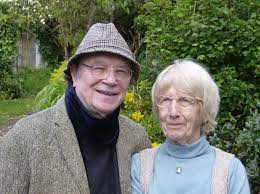
Colin Wilson, and his wife Joy, in 2009
I am re-reading Colin Wilson's last substantive book - Super Consciousness: the quest for the peak experience (2009) - which serves as a summation of this area of his interest that began with The Outsider (1956). Wilson cites and describes a 'variety of religious experiences' - or Peak Experiences, in Abraham Maslow's terminology - in which there was an alteration of consciousness and a feeling of well-being, elevation, understanding.
Looking at Wilson's accounts of these experiences through the perspective on the evolutionary-development of consciousness that I have derived from Owen Barfield; I see the reports can be understood as beginning with our normal, everyday, mundane, socially-functional "Consciousness Soul" state of feeling cut-off from reality, alienated and trapped in superficiality.
Consciousness Soul is the implicit baseline from-which Peak Experiences/ religious-mystical experience emerge.
From this baseline, and despite that Wilson did not recognize this distinction; these mystical/peak experiences of positive 'Super Consciousness' can be understood as falling into Barfield's two categories of Original Participation and Final Participation.
Most of the mystical experiences described can be regarded as a kind of functional impairment, and these seem like a reversion to the Original Participation of early childhood and tribal-Man, by a selective suppression of those (more recently developed) parts of the body (especially brain) needed for the manifestation of self-awareness in the Consciousness Soul stage.
In other words, this kind of mystical experience deletes consciousness of 'the self' as a separate entity from 'reality'.
Examples include those reported experiences of William James and Ouspensky which were triggered by nitrous oxide (laughing gas); and the same applies to other consciousness-altering drugs.
Others were associated with dream-like passivity; stasis of the body, fainting, or sleep - and mentally there are descriptions of becoming blissful in emotion yet unaware of any thinking (stopping the exhausting and futile treadmill of thoughts, worries, plans...); the apprehension of Time is suspended or deleted.
The kitchen and garden were filled with golden light. I became conscious that at the centre of the Universe, and in my garden, was a great pulsing dynamo that ceaselessly poured-out love, This love poured over and through me, and I was part of it, and it wholly encompassed me. (Cited pages 54-5)
In this Original Participation mystical state; problems are not solved so much as dis-solved; it is not a matter of 'knowing everything' so much as recognizing that knowledge does not matter.
Other, less common, reports of higher consciousness states sound more like Final Participation. In this state, the description is of thinking not stopping, but conversely having vastly greater power and comprehensiveness, such that the experience is one of 'knowing everything' - of direct-knowing without need for perception or for reasoning.
My train of thought accelerated and vastly improved in quality... New and convincing ideas came into my mind in a steady torrent, flaws in my existing ideas were illuminated, and as I made mental corrections to the the diminishing gaps in the logical sequence were filled by neat, brand-new linking concepts which made a beautiful logical pattern. (Cited page 56)
I interpret this difference as being due to the Original Participation being what Rudolf Steiner called an 'atavistic' state, that is a reversion to an earlier developmental-state (childhood, 'tribal' Man) which is being-induced by a lowering of consciousness,; resulting in a temporarily 'delirious' impairment of brain function (by drugs, drowsiness, hypnosis, illness etc).
While Final Participation is an enhancement of consciousness, the next 'evolutionary step' towards a more-divine, and more free and independent, mode of thinking; in which thinking is clarified and strengthened; and increases in scope and validity.
This relates to the 'flow state' Wilson describes earlier from the work of Csikczentmihalyi; which is associated with increased, indeed the highest, levels of functionality.
For instance; when people such as creative artists, artistic performers, athletes, and craftsmen sometimes attain their supreme performance. Sometimes called being 'in the zone' - they find themselves unerringly doing things they could not usually achieve, and with total confidence.
Thus Original Participation reduces functionality, and constitutes 'time out'; whereas Final Participation is associated with the highest, most creative and adept, levels of functionality.
Yet these two Super Conscious states - Final and Original: the one thinking, the other a cessation of thought; the one knowing without constraint, the other an indifference to knowledge; the one a flow, the other a suspension of time and movement; the one cognitive, the other contemplative... these states are not usually distinguished, are indeed generally conflated.
I do, however, regard Original Participation as potentially-valuable - but mainly as a glimpse of alternatives, a 'holiday', a recharging process, a therapeutic rest.
While Final Participation is - I hope - the ultimate state of God-like, Christ-like, divine consciousness in which - eventually - Christians will spend most of our post-mortal resurrected lives.
As for the Consciousness Soul in which we Modern Men spend most of our mortal lives, trapped and cut-off form living and reality - I regard it as merely a transitional phase between Original and Final Participations - much as adolescence should be a swift transition between childhood and maturity; therefore I expect that 'mundane' consciousness will very seldom be experienced in Heaven - although it may be normal, or at least common, in Hell.
Monday, 20 October 2025
Distinguishing Final Participation from Original Participation
It was Owen Barfield who defined Original Participation - characteristic of young childhood and the early states of Mankind's development of consciousness (roughly, the nomadic Hunter Gatherer stage); and Final Participation - which was the divinely-intended future development of consciousness that was posited to come after the modern alienated consciousness which is cut-off from participation.
But Barfield perhaps never made it really clear how one might distinguish these types of participation - at any rate, confusion on this matter seems to be rife; and it seems usual, in my experience, for those who have encountered Barfield to list instances of what is actually Original Participation, with the claim that these are Final Participation.
Here is my understanding of the distinction, as these states occur in modern Man:
Original Participation is experienced as a stillness, dreamlike, a trance-state - as if time is slowed or stopped or the individual has moved out of time into eternal simultaneity.
As immersion in "the world" or divine consciousness - with loss of boundaries between individuals.
As a blending into "being-ness" - during which the individual "self" dissolves-into the larger or other consciousness.
Ultimate reality is felt to be a state of oneness, unity; variation is only superficial because the deepest truth is singleness.
For Original Participation we seem actually to inhabit an ocean of one-consciousness; from-which our individual consciousness sometimes emerges, briefly; rather like a crest among swirling waves that randomly gets shaped into a degree of illusory and temporary distinction and self-awareness - just long enough to realize this, before again dissolving-into the infinite sea.
Final Participation is a dynamic state of consciousness, associated with directionality and movement of thought.
The "self" is intensified, thinking is afoot; and consciousness absorbs into itself awareness of "the world", other people, other beings.
Awareness becomes wider and deeper - and this is awareness of other and different consciousnesses.
Ultimate reality is - at its best and highest - a state of friendship, harmony between different beings; between different but allied consciousnesses.
Final Participation is likely to happen when we are enacting some strong and good inner motivation. When we are propelled by a creativity that is aligned and affiliated with divine creation. Perhaps while we are gathering insights that are being intuitively confirmed; or when actively-engaged in enchanted doing, or making.
In summary - for us modern people: Original Participation happens in a state of rest or stasis, while Final Participation happens when mentally active; OP includes a loss of the sense of self, while FP includes an intensification of self; OP leads towards a sense of oneness and timelessness, while FP is a dynamic and connected form of "ongoing" consciousness.
Tuesday, 29 June 2021
Overcoming the division of sleep from consciousness (my speculation on ideas from Owen Barfield and Rudolf Steiner)
It is interesting to consider how the relationship between sleeping states - deep sleep and dreaming sleep - and the awake state may have changed through the evolutionary development of Men.
If we start with the historical (and early childhood) conscious state termed Original Participation by Owen Barfield; then it was a striking idea of Rudolf Steiner that this is characterized by what we would consider a less complete difference between sleep and waking. The awake person was not so fully awake is the case now; and aspects of deep and dreaming sleep remained active throughout the daytime.
This would be a more passive and unconscious form of waking; whereby we were involuntarily influenced by the sleeping states; immersed-in them. In Original Participation Man's consciousness was integrated, but dominated by sleep.
A suggestion is that the sleep states are (in some fashion) in communication with the divine and spiritual world; and therefore in Original Participation awake Man has direct experiential knowledge of the gods and spiritual reality. This may be why all early Men and all young children assume the reality of gods and the spiritual realm - because the experience and know it; not just when asleep but all of the time.
The idea is that, as Man's consciousness evolved through history, the division between sleeping and waking states became more distinct; until with modern Man it was complete (the phase called the Consciousness Soul). We are not aware of our sleeping and dreaming consciousness while awake (although they continue); and indeed we almost never remember anything from deep sleep, and even dream memories tend to be absent, partial or uncertain.
It struck me that presumably the same applies in the opposite direction: that waking consciousness has probably lost access to deep and dreaming sleep. Perhaps in earlier phases, waking consciousness could affect dreaming sleep, and even deep sleep; and therefore in original Participation these sleeping states were more conscious, more subject to waking motivations, and probably more memorable.
Whereas nowadays (for many people) dreams are characterized by their own crazy illogic and irrelevance; perhaps for early Men they were coherent, useful, memorable - by the waking Man. And maybe something analogous applied even with the slower, simpler, 'tidal' consciousness-world of deep sleep.
(Steiner suggests that in dreaming sleep, ancient Man - and children - are in communion with the lower angelic powers; and in deep sleep, the higher angels - or, I would guess, perhaps even the simple and basic aspects of the knowledge of God, Jesus Christ and/or the Holy Ghost.)
So, modern Man's consciousness states are not integrated; but instead divided, alienated, encapsulated.
And what of the goal of Final Participation? We might assume that the division between sleeping and waking would again become crossable, 'permeable' - but this time dominated by waking consciousness and by its capacity for free agency, for conscious choice.
Thus we may be able to choose to bring our waking consciousness and cross into dreaming, and even deep sleep; there to both gain conscious control of these states, and to remember better what happens in them.
So we may again become integrated in our consciousness; but this time with awakeness dominating.
However, this state is voluntary - not automatic; conscious not unconscious; and is subject to the constraints of Final Participation - which is, after all, an attainment of divine consciousness (albeit usually partial and always temporary) even when we are mortal on earth.
Therefore, we might be able to choose to bring awake consciousness into dreaming and deep sleep; but only insofar as we our-selves are aligned with God's purposes, meanings and mode of thinking.
If a person has chosen the side of Satan against God, then Final Participation is not (at that time) possible.
Furthermore sin interferes with Final Participation. Un-repented sin blocks FP in the long term (because we are not aligned with the divine); while currently-active sin in thinking will curtail FP for its duration; which is surely one reason, albeit not the only reason, why Final Participation is always temporary - indeed usually very brief.
Nonetheless, even with all these provisos, this gives an idea of what to aim for in Final Participation how to go about it; and how to know when it has happened. That is, we can aim towards more frequent and fuller integration of the waking and sleep states; do so consciously; and within a Christian context.
Friday, 21 January 2022
"Training the mind" - double-edged effect at best, and preventive of Final Participation
The Romantic will always come-up against the fact that for most of the time he is mundane. Of course, life and (especially) surrounding people are often a real drag upon any aspirations to Higher Consciousness.
After all, our world is built upon assumptions of anti-God, anti-spirit materialism - and when we are engaged with the world, our minds are entrained to this pervasive mundanity.
Yet, even with as near a perfect 'environment' as this mortal world offers; the Higher Consciousness of intuition/ heart-thinking- mysticism that is desired sought by Romanticism; is always an intermittent state - and often disappointingly infrequent.
Indeed, some Romantics have ended-up being more distressed by the evanescence of Higher Consciousness, than encouraged by the occurrence of such states.
Especially; if one is aiming at Final Participation as the goal of consciousness - the destined and necessary stage in human evolutionary development - then there are neither methods nor training to achieve it.
It is tempting, indeed usual, for serious Romantics to try and escape this - apparently - unsatisfactory situation of endemic failure, by some or another method of 'training the mind'.
This is what lies behind the grades of initiation beloved by some esoteric societies, the prolonged and daily practice of meditation; and external aids such as ritual, script, music, architecture.
There seems little doubt that these are at least somewhat effective in training the mind; the question is: what is the effect of such training?
My distinct impression is that all methods of training the mind that are aimed at Higher Consciousness will fail.
Either they will just 'not work', will fail to achieve anything sufficiently powerful and lasting to make a significant different to the problem of mortal life; or else (more insidiously) they will succeed in imposing a System upon thinking.
And this System will either become unconscious and habitual, thereby subjecting thinking to uncontrolled lower consciousness (while terming this state 'higher'). This would apply to Jungian-derived methods; based on lucid dreamlike trances; and also to meditation practices that aims to eradicate 'the self' or 'ego' or discard 'thinking' itself.
Or else, it will subject thinking to the conscious will, yet this conscious will is merely ordinary mundane consciousness - and subject to the external influences of mundane consciousness. This would apply to the types of meditation that focus on training concentration, imagination and 'visualization' - such as those of ritual magic societies and Steiner's Anthroposophical 'exercises'.
The apparent 'success' of training may generate increased gratification in life (make people 'feel better' in some way) - but do not achieve the objective of Final Participation.
Both the System and the training in 'concentration' may be effective in producing change - but they are not effective in encouraging Final Participation. And, in failing, they lead to that contamination of genuine insight and achievement with confident error and vast delusion which has been so characteristic of those who aim at Higher Consciousness.
The limitation is a consequence of Final Participation being a participation in divine creation; which can (for obvious reasons) only happen when a Man is fully aligned with divine purposes of creation.
This alignment with God happens seldom and briefly, is easily blocked or reversed; which limits the frequency of this state of consciousness.
But when a Man is fully aligned with God's creation - what a man is following his destiny and that of providence; then Final Participation will happen - spontaneously, without effort or intent.
Our main job is to recognize when this is-happening and recall when it has-happened.
And for the Romantic Christian these are the key moments of our mortal life - vital life lessons from which we ought to learn.
So; these Final Participation experiences will not happen often, and we cannot 'make' them happen by training.
Attempts at training and beliefs that training is efficacious are, indeed, counter-productive.
But we can notice Final Participation states, value them, learn from them.
Wednesday, 16 November 2016
Original Participation - the spiritual life of hunter gatherer Man (and ourselves as young chidlren)
Over the past couple of years I have fully engaged with the writings of Owen Barfield, and incorporated some of his key ideas and perspectives into my thinking; one of these is dividing human consciousness into three phases: Original Participation, the Consciousness Soul and Final Participation.
This sequence is primarily concerned with human society, or civilisation through hunter gatherer, agrarian and industrial phases and pointing at the destined future - but also corresponds to the development of Man from birth to mature adulthood.
Thus the consciousness of Original Participation can be seen both in the 'childhood of Man' (the earliest, simplest and most spontaneous society: the hunter gatherer life), and also in each Man's childhood.
*
I became extremely engaged with understanding the hunter gatherer mind some twenty years ago - by immersion in all sorts of books on the subject; both by leading twentieth century academics (mostly anthropologists) who lived among such people (or among those who had recently been hunter gatherers) and also by looking at some examples of 'first contact' literature from previous centuries when a variety of people - e.g. explorers, missionaries - described their encounters with hunter gatherers.
My interest was then focused on spontaneous animism; or the way in which hunter gatherers - and young children - interpreted the world 'anthopomorphically', or socially; in terms of being a collection of person-like agents. So large animals (such as the bear) or environmental objects both living (such as a tree) and 'non-living' (such as a mountain) would be understood as persons, each with a character, motivations, desires and intentions.
Thus, for the hunter gatherer the whole world was social; a web of relationships. And if we can remember and introspect about our own early childhoods, we can perceive that it was the same situation for each of us; we used to see the world as social, as full of living and conscious entities.
(This may also re-emerge in altered states of cosnciousness - such as the 'paranoid' delusions of self-reference in psychotic illnesses, or in some types of brain pathology, or some types of drug intoxication. The social perspective seems to be something of a default.)
*
The perspective of Barfield brings a further aspect to this subject; which is to notice that for the hunter gatherer the Self was much less developed and distinct than it is for us (living at an advanced stage of the Consciousness Soul); the individual hunter-gatherer is not, therefore, very aware of himself as an individual - does not perceive a line of demarcation separating himself and 'the world' (when 'the world' includes both the society of other people, and the society of significant entities in the environment - bear, tree, mountain etc.).
The hunter gatherer participates in the world because he perceives no separation between himself and the world; and much the same applies to young children even nowadays. But as civilisation developed, grew, became specialised... each Man separated from the world, and perceived life as himself one one side of a line, and everything else on the other side - losing the sense of participating in the world, and feeling more-and-more like a detached observer.
Indeed, matters have reached such a point, that we even feel detached from our own thoughts - that is, the thought in our minds are not regarded as the same thing as our-selves.
The disadvantages of the modern condition are obvious enough - alienation from life, and despair. But the advantages were also perceived by Barfield, drawing from the early work of his master Rudolf Steiner. The key word is freedom. By separating our perceived self from the world, the self becomes free.
The hunter gatherer is hardly free, because he hardly feels himself separate from the flow of the human and other environment in which he lives; and much the same applies to the young child. Modern Man in the Consciousness Soul phase is, by contrast, in a position in which he may becomes free, may be able to stand apart from the influences on his life; and consciously, deliberately, in full self-awareness exercise his divine creativity as a source of original thought, and potentially other actions as well as thought (although Steiner clearly described that it was in Thinking that Man primarily was free).
The equivalent phase to the Consciousness Soul for the developing Man is adolescence; when a man becomes conscious of himself (self-conscious) apart from other people - and this becomes 'a problem'.
As for growing-up into Final Participation; Barfield (and Steiner) would say that this seldom happens in the way that it should - it happens to few people (and only partly and intermittently) and has not yet happened to any human society. Final Participation would be a state of consciousness which retains the autonomy and freedom of The Self (which emerged during the consciousness soul) but returns to a felt-participation-in The World; but a participation of a new type.
*
The way I envisage Final Participation is that we participate in The World through loving relationships; in the sense that only an autonomous self, distinct from other selves, can love. And this means that in order to participate we must (again) recognise the world as wholly alive and conscious - just as was the case when we were young children, or as did hunter gatherers.
So, we have much to learn from hunter gatherers, and from young children - but not so as we can go back to that form of consciousness, but so that we personally - and also our modern societies - can go forward to Final Participation in which we would have 'the best of both worlds': both and simultaneously the felt-and-lived engagement with the world typical of hunter gatherers and children, and also the freedom and distinct individuality of the Consciousness Soul.
Final Participation, I would therefore regard as the destiny of each Man, and of Mankind as a whole - if we choose to accept it.
This sequence is primarily concerned with human society, or civilisation through hunter gatherer, agrarian and industrial phases and pointing at the destined future - but also corresponds to the development of Man from birth to mature adulthood.
Thus the consciousness of Original Participation can be seen both in the 'childhood of Man' (the earliest, simplest and most spontaneous society: the hunter gatherer life), and also in each Man's childhood.
*
I became extremely engaged with understanding the hunter gatherer mind some twenty years ago - by immersion in all sorts of books on the subject; both by leading twentieth century academics (mostly anthropologists) who lived among such people (or among those who had recently been hunter gatherers) and also by looking at some examples of 'first contact' literature from previous centuries when a variety of people - e.g. explorers, missionaries - described their encounters with hunter gatherers.
My interest was then focused on spontaneous animism; or the way in which hunter gatherers - and young children - interpreted the world 'anthopomorphically', or socially; in terms of being a collection of person-like agents. So large animals (such as the bear) or environmental objects both living (such as a tree) and 'non-living' (such as a mountain) would be understood as persons, each with a character, motivations, desires and intentions.
Thus, for the hunter gatherer the whole world was social; a web of relationships. And if we can remember and introspect about our own early childhoods, we can perceive that it was the same situation for each of us; we used to see the world as social, as full of living and conscious entities.
(This may also re-emerge in altered states of cosnciousness - such as the 'paranoid' delusions of self-reference in psychotic illnesses, or in some types of brain pathology, or some types of drug intoxication. The social perspective seems to be something of a default.)
*
The perspective of Barfield brings a further aspect to this subject; which is to notice that for the hunter gatherer the Self was much less developed and distinct than it is for us (living at an advanced stage of the Consciousness Soul); the individual hunter-gatherer is not, therefore, very aware of himself as an individual - does not perceive a line of demarcation separating himself and 'the world' (when 'the world' includes both the society of other people, and the society of significant entities in the environment - bear, tree, mountain etc.).
The hunter gatherer participates in the world because he perceives no separation between himself and the world; and much the same applies to young children even nowadays. But as civilisation developed, grew, became specialised... each Man separated from the world, and perceived life as himself one one side of a line, and everything else on the other side - losing the sense of participating in the world, and feeling more-and-more like a detached observer.
Indeed, matters have reached such a point, that we even feel detached from our own thoughts - that is, the thought in our minds are not regarded as the same thing as our-selves.
The disadvantages of the modern condition are obvious enough - alienation from life, and despair. But the advantages were also perceived by Barfield, drawing from the early work of his master Rudolf Steiner. The key word is freedom. By separating our perceived self from the world, the self becomes free.
The hunter gatherer is hardly free, because he hardly feels himself separate from the flow of the human and other environment in which he lives; and much the same applies to the young child. Modern Man in the Consciousness Soul phase is, by contrast, in a position in which he may becomes free, may be able to stand apart from the influences on his life; and consciously, deliberately, in full self-awareness exercise his divine creativity as a source of original thought, and potentially other actions as well as thought (although Steiner clearly described that it was in Thinking that Man primarily was free).
The equivalent phase to the Consciousness Soul for the developing Man is adolescence; when a man becomes conscious of himself (self-conscious) apart from other people - and this becomes 'a problem'.
As for growing-up into Final Participation; Barfield (and Steiner) would say that this seldom happens in the way that it should - it happens to few people (and only partly and intermittently) and has not yet happened to any human society. Final Participation would be a state of consciousness which retains the autonomy and freedom of The Self (which emerged during the consciousness soul) but returns to a felt-participation-in The World; but a participation of a new type.
*
The way I envisage Final Participation is that we participate in The World through loving relationships; in the sense that only an autonomous self, distinct from other selves, can love. And this means that in order to participate we must (again) recognise the world as wholly alive and conscious - just as was the case when we were young children, or as did hunter gatherers.
So, we have much to learn from hunter gatherers, and from young children - but not so as we can go back to that form of consciousness, but so that we personally - and also our modern societies - can go forward to Final Participation in which we would have 'the best of both worlds': both and simultaneously the felt-and-lived engagement with the world typical of hunter gatherers and children, and also the freedom and distinct individuality of the Consciousness Soul.
Final Participation, I would therefore regard as the destiny of each Man, and of Mankind as a whole - if we choose to accept it.
Friday, 1 August 2025
Final Participation is a conscious consecration of this-moment to our eternal resurrected life
For the past decade or so, I have been trying (in multiple ways) to understand the implications of Owen Barfield's concept of Final Participation - as being the destiny and proper aim of our spiritual life.
Some modern people seem wholly enmeshed in mundane materialist thinking and feel detached and alienated from the living world - trapped inside their own heads. Their only relief is temporarily to forget this in sleep, intoxication, psychosis - and in occasional moments when there is a resurgence of a child-like sense of belonging and involvement.
These brief times are what Barfield calls Original Participation, because they were our original state of consciousness as young children, and also (it is believed) the normal state of the earliest ancestral Men.
Original Participation is - pretty much - the same as Novalis's Sehnsucht and CS Lewis's Joy; Gurdjieff's self-remembering, Maslow's Peak Experience, or Csíkszentmihályi's Flow state are psychological reductions of the experience.
Such moments may be pleasant, indeed there have been times and places (e.g. some of the Romantic movement around 1800, or the 1960s counter-culture... still ongoing) when many people aspired to abandon modern consciousness and return to Original Participation.
Although this return to the spontaneous, natural, child-like, primitive, here-and-now consciousness is powerful and alluring to many people; it has always failed - and must be assumed impossible (except briefly).
However it makes a difference how we regard these brief moments.
If they are regarded as merely pleasant psychological states, then Original Participation can only be therapeutic - like taking a short holiday from the "real world" of mundane materialism.
Yet Barfield asserted that Final Participation was not just a pleasant interlude; but in some deep sense absolutely necessary - necessary if we personally, and our society as well, were to avoid being overwhelmed by evil.
However, Barfield was vague about how this might be achieved (he usually advised consulting his mentor Rudolf Steiner's work - but Steiner's techniques seem obviously ineffective, and Barfield never claimed that decades of practicing Steiner medications had led to any very significant effect on Barfield's own thinking in terms of Final Participation.
Indeed, it seems that FP is not really achievable in a lasting and dominant way.
So we seem rather to be trapped between impossibilities! We cannot go back, cannot stay as we are - yet the destined path forward seems blocked...
Yet anyone who conceptualizes life as bounded by conception and death will find himself bounded by exactly such impossibilities. We cannot escape the constraints of entropy (and death) and evil.
But this is forgetting the reality that we are eternal Beings, and this mortal life can be (should be) seen as a finite transitional phase between eternities before and afterwards.
Furthermore (and here I depart from Barfield, with his ideas of multiple future reincarnations) a Christian sees his eternal future as including resurrected Heavenly life, following after this mortal life.
My idea of Final Participation is that it is the conscious choice to consecrate those moments of Original Participation.
So that when moments of OP happen; we choose to regard them as sacred.
In such a "consecration"; the momentary experience of OP is consciously recognized as being of potentially eternal significance to divine creation - and is actively taken-up into ongoing thinking.
This contrasts with, say, the sixties counter-culture response - which is to stay inside those OP moments, and perpetuate them or as long as possible.
I would regard this as akin to a religiously-contemplative response to Original Participation. Contemplative because it is deliberately passive and self-negating. The moment is primary and we intend to stay with it, dissolve-into it.
This is analogous to the contemplative kind of meditation where people seek a "blissful" state of consciousness and try to maintain it for as long as possible.
The ideal is of stasis in perfection.
But Final Participation is active and creative - hence is is both dynamic - like divine creation; and aspires to join-in-with and influence ongoing divine creation.
And all this is a choice, not a surrender. It is an affirmation of the self, not an attempt to lose the self.
It is the choice to be a Son of God, a sibling of Jesus; one who want to join with God in the work of creation, and add to to that creative work whatever is unique in himself.
So, Final Participation is an active self-confidence; confidence that by the "process" of resurrection after this mortal life we can be transformed such as to be able, worthy, and trust-worthy of eternal participation in creation.
Thus, FP is a state of being only achievable permanently (as a normal state) after our death, and only among those who have then chosen to follow Jesus through resurrection to everlasting Heavenly life.
But Final Participation does have a vital role in this mortal life; because it is when we can add to our resurrected life.
FP represents our choice to learn from experience in such a way that our immortal soul is permanently transformed.
We are talking about our immortal souls, not the conditions of our mortal lives on earth - so the fact that our modern experiences of participation may be relatively few, infrequent, brief - does not invalidate these experiences...
FP experiences are of permanent value not because they last a long time; but so long as we choose to consecrate them.
Consecration would go something like this:
1. Original Participation happens.
2. We recognize that it is happening.
3. We acknowledge that this happening is of potentially permanent importance to our resurrected Heavenly self.
This needs to be done when Original participation happens - Now: here-and-now.
Not put-off until later.
If we do not do it at the time of Original Participation - it will (probably) not be done.
However... An intense imagined re-living of the moment, could also be used to consecrate that moment retrospectively. Because then the moment is not merely "retrospective" but a re-experiencing here-and-now - which is perhaps one reason why we may recollect and meditate on such moments... Why they may last so tenaciously in our memories. The experiences may be re-presenting themselves for consecration.
Maybe, if we do this on principle and habitually; then this will act as a positive feedback and establish a "spiritual reward system" - so that such opportunities will become more frequent?
The thing is: we modern Men are terribly demotivated, prone to despair - and any spiritual advice that diminishes or delays our gratification seems doomed to fail*.
Consecrating our moments of Original Participation generates an immediate spiritual reward as well as a hope-full anticipation.
Instead of OP being a tragic joy; doomed to be short-lived, doomed to be forgotten and lost by age, disease, death... Instead of this; the act of consecration transforms it into a moment of permanent and positive significance.
As far as I can understand; only a follower of Jesus Christ who lives in confident expectation of resurrection can do this; and it will not "just happen" but must be done by conscious choice.
All then depends on making that choice.
NOTE: It may be objected that because Original Participation is spontaneous and natural, it is not necessarily good. This is true; and if an OP experience is not good, then it cannot and shall not be consecrated to resurrected eternal life - so any such attempt will fail. Christian discernment - knowledge of good and evil, God and that which opposes God; is a necessary part of Christian life - and always applies.
* The mass of people are (quite literally) spiritually-dying of despair, for lack of any genuinely positive purpose in life. It seems obvious that the double-negative (e.g. therapeutic) values that are exclusively propagated, including by nearly all religions (eg religions rooted in avoidance of default divine punishment), including most Christian churches - are simply ineffectual; leading to short-termist this-worldly hedonism now, and ultimate despair eventually.
Sunday, 10 April 2022
The waning of Original Participation in my life - the later development of Final Participation

Are we doomed to dwell always on the surface of life?
Looking back, I can now perceive that Original Participation provided an unconscious and spontaneous direct-link with The World, and other people and Beings, until late in my twenty-second year.
Through childhood, adolescence, and up to that point, there was a baseline (albeit dwindling) sense of 'belonging in the world' that sustained me, and enabled me to connect with nature and life; despite that I had developed extreme atheist and materialistic (scientistic, positivist) philosophical assumptions.
But from that point I began to feel alienated, cut-off from things, trapped inside my head, unable to 'lose myself', forget myself, or stop thinking; except when intoxicated in one way or another, or passively-immersed in music or literature - which was presumably a temporary illusion...
At any rate it could not be sustained and was incompatible with the business of mundane living
My reaction was partly to accept the situation, and adopt an 'hedonic' approach to my life; in hope that continuous pleasurable activities (and maximum freedom from suffering) would suffice. The aim was to live well until, at some point, I died - preferably instantly, without realizing it.
Life was something to be got-through - as pleasantly as possible. Nothing more.
But as the years rolled-by, nostalgia for the lost Original Participation became stronger, and I developed a very powerful (including scholarly) interest in the disenchantment of life, alienation - and yearned for the immersive animism I regarded as normal for our ancestral hunter gatherers - as well as young children.
Yet such a state was seldom, and mostly weakly attainable by even my best efforts.
In the middle of this I became a Christian; however, at first this conversion did not significantly provide an answer to the problem of alienation - because mainstream Christianity barely recognizes, and does not address, the problem. However, it does uniquely provide the potential to do so - if one is prepared to venture beyond the orthodox.
It was not until about 2014 that I began to be aware that there was another way of organizing my efforts in life. The choice was not only between an immersive and unconscious absorption into living versus the typically modern and alienated detachment... There was also what Barfield Termed Final Participation.
It took me a while to grasp what this meant; and to do this I needed to tackle the daunting business of reading Rudolf Steiner's early philosophical works focused on a kind of thinking in which Final Participation was (implicitly) achieved.
I also, by providential synchronicity, rediscovered William Arkle - who approached this same matter from the different angle of levels of consciousness; and the possibility of attaining (for periods) a level of consciousness in which thinking was real and creative.
And finally came the understanding that this mortal life was a time for learning (learning needed for our for resurrected eternal life); so that what mattered was learning-from experiences - rather than trying to attain and stay-in any particular state.
The fact that it was impossible to live always (or even mostly) in a state of Final Participation did not detract from the value of those times when FP was possible, and did happen - so long as we learn from them. It is the learning that can be permanent!
This is where Christianity comes in; because this mortal life is (among other things) a learning phase before eternal resurrected life - and Final Participation is the divine way of thinking and being.
(That is why it is correctly termed 'Final' - because divine living is what is aimed-at.)
So to participate 'finally' - in thinking - was both a foretaste and a preparation for Heaven; therefore an extremely important life-experience to learn-from.
That is - broadly - how matters stand. Romantic Christianity has emerged as a term to describe that Christianity in which participation is regarded as crucial, and taken with primary seriousness.
In other words, Christians need to acknowledge and overcome alienation; and work to experience the world, other people and Beings directly; in thought. And know that that thinking is reality.
What I have observed in myself in recent years, is that the surface of thinking - with thoughts rapidly changing and lasting from fractions of seconds to a few seconds - is not much different from what it always was. There is a constant and superficial play of images and ideas - which are heavily influenced by immediate concerns, the environment, and System manipulations.
The Real Self experiences this level of consciousness as if a pond skater moving across the surface of water that is constantly changing its colours and patterns - but which can never be penetrated; can only be known indirectly and by observation and reasoning...
But as well as this there is a participative thinking, which moves more slowly (minutes, hours, days...). This is like the flow of a stream, and the thinking of Final Participation is not on the surface of, but instead a part of this flowing stream yet capable creating and of adding to the flow - something from itself.
Final Participation is unimpeded by the surface of the stream; because it operates at the level of consciousness that includes air, surface and water - yet we, as incarnate Beings, remain many and distinct - loving and creative - selves.
So, although surface alienation remains, moment by moment; there is an underlying direct participation which lies on the edge of my consciousness, and of which I can become aware at (almost) any time; but which, even when not actively attended-to - constitutes a healing of the rift between my-self and the world which opened up some months before my twenty-second birthday.
Monday, 8 February 2016
The relationship between evolution of human consciousness and reincarnation - a consideration of Steiner and Barfield
The idea of an evolution of human consciousness throughout history has been a part of spiritual thinking for more than a century - I know it mainly through considering the work of Rudolf Steiner, Owen Barfield and William Arkle over the past couple of years.
(I encountered the idea over thirty years ago summarized in the work of Colin Wilson, but did not then pay much attention.)
The idea of an historical evolution of consciousness seems to go-with a belief in reincarnation, because reincarnation allows each person to participate in the different stages of evolution that are aiming-at a fully divine form of consciousness.
Steiner and Barfield describe this aimed-at state in some detail - in essence it combines on the one hand a direct involvement with, and participation in, reality such as was characteristic of early man and remains characteristic of early childhood; with, on the other hand, a fully alert, self-aware, purposive and analytic consciousness which is characteristic of the adult consciousness and the modern phase of Western history.
So, the idea is that I am personally experiencing the distinctive modern, alienated consciousness now - including the knowledge and aspiration towards a future state; however, in earlier lives I have also personally experienced, and benefited from, earlier phases of human consciousness. At some point later this life, and perhaps further lives, I may incrementally, a step at a time, learn how to combine the positive qualities of all phases. This aimed-at fully divine conscious state is what Barfield calls Final Participation.
According to Steiner and Barfield, these earlier life phases include non-incarnated lives - lives when we were conscious but had no body. So the theory is really one of multiple lives, rather than re incarnation.
Therefore the human spirit or soul (i.e. that entity which is reincarnated) is here conceptualized as undergoing an educational process toward which each life is contributing.
Repeated lives, many lives, seem to be necessary in order to allow for the very large amount of experience and learning required to bridge the gap between being a man and becoming a god. Certainly, one mortal life seems grossly inadequate for this, especially given that most human lives in history were terminated either in the womb or in early infancy - a small minority of humans have reached adulthood, and even fewer of these have had a full experience of marriage, family, maturity and growing old etc.
So, evolution of consciousness and reincarnation seem to make a neat package. However, this package is, if not incompatible with Christianity, at least somewhat alien to the structure of Christianity; which places a great deal of emphasis on the individual life which we are experiencing now, and sees 'this life' as having potentially decisive consequences for eternity.
And certainly, while reincarnation seems to described in the Bible - most notably in the case of John the Baptist apparently being a reincarnated Prophet Elijah - there isn't any scriptural description of a scheme of reincarnation as the norm. And especially not of multiple lives.
My interpretation is that ancient Christianity saw reincarnation as true, but as an exceptional possibility, done in exceptional cases and for specific purposes - rather than as the standard procedure for the majority of people.
Does an exclusion of reincarnation then rule-out the evolution of consciousness throughout human history? No, but denial of reincarnation with multiple lives does limit the role of evolution of consciousness in the lives of individual spirits or souls - it breaks the link between the evolution of consciousness in history and the evolution of my consciousness and the specific consciousnesses of every other individual.
Put differently, the arguments which (in particular) Owen Barfield makes for different types of consciousness in human history, such as his insights into the changing scope and meaning of words, may well be true; but they lose their relevance to the evolution of my consciousness and your consciousness if we were not present (in earlier lives) actually to experience the several stages of this historical evolution.
In sum, the historical evolution of consciousness is a matter of historical but not personal interest, if we ourselves were not present during that history.
My own belief is therefore that I accept Barfield's description of human consciousness having changed throughout history and in broadly the way he describes; and I also accept that we are meant (or destined) to achieve that mode of consciousness Barfield terms 'Final Participation'. But I do not accept that the two are causally linked - for instance I do not believe that I have, myself, personally participated in the historical phases of the evolution of consciousness during previous lives.
Rather, I see the evolution of consciousness as a sequence which is recapitulated in different scales in different situations: e.g. through human history, in each person's individual development from childhood to maturity, and also in the largest cosmic scale of our salvation and divination across eternity.
(To clarify this last point: the Barfieldian sequence of Original Participation, the Consciousness Soul and Final Participation can be mapped onto the Mormon theological sequence of pre-mortal spirit life, mortal incarnate life, and post-mortal eternal incarnate life.)
I therefore would modify the Steiner/ Barfield model, since I regard this evolutionary sequence of consciousness as a basic and necessary process in terms of Man as a whole and also individual men working towards fuller divinity. And I think it is because the process is basic and necessary that we see it appearing and re-appearing here and there throughout reality; operating at many scales and across many time-frames.
Note: Previous posts on reincarnation
http://charltonteaching.blogspot.co.uk/search?q=reincarnation
(I encountered the idea over thirty years ago summarized in the work of Colin Wilson, but did not then pay much attention.)
The idea of an historical evolution of consciousness seems to go-with a belief in reincarnation, because reincarnation allows each person to participate in the different stages of evolution that are aiming-at a fully divine form of consciousness.
Steiner and Barfield describe this aimed-at state in some detail - in essence it combines on the one hand a direct involvement with, and participation in, reality such as was characteristic of early man and remains characteristic of early childhood; with, on the other hand, a fully alert, self-aware, purposive and analytic consciousness which is characteristic of the adult consciousness and the modern phase of Western history.
So, the idea is that I am personally experiencing the distinctive modern, alienated consciousness now - including the knowledge and aspiration towards a future state; however, in earlier lives I have also personally experienced, and benefited from, earlier phases of human consciousness. At some point later this life, and perhaps further lives, I may incrementally, a step at a time, learn how to combine the positive qualities of all phases. This aimed-at fully divine conscious state is what Barfield calls Final Participation.
According to Steiner and Barfield, these earlier life phases include non-incarnated lives - lives when we were conscious but had no body. So the theory is really one of multiple lives, rather than re incarnation.
Therefore the human spirit or soul (i.e. that entity which is reincarnated) is here conceptualized as undergoing an educational process toward which each life is contributing.
Repeated lives, many lives, seem to be necessary in order to allow for the very large amount of experience and learning required to bridge the gap between being a man and becoming a god. Certainly, one mortal life seems grossly inadequate for this, especially given that most human lives in history were terminated either in the womb or in early infancy - a small minority of humans have reached adulthood, and even fewer of these have had a full experience of marriage, family, maturity and growing old etc.
So, evolution of consciousness and reincarnation seem to make a neat package. However, this package is, if not incompatible with Christianity, at least somewhat alien to the structure of Christianity; which places a great deal of emphasis on the individual life which we are experiencing now, and sees 'this life' as having potentially decisive consequences for eternity.
And certainly, while reincarnation seems to described in the Bible - most notably in the case of John the Baptist apparently being a reincarnated Prophet Elijah - there isn't any scriptural description of a scheme of reincarnation as the norm. And especially not of multiple lives.
My interpretation is that ancient Christianity saw reincarnation as true, but as an exceptional possibility, done in exceptional cases and for specific purposes - rather than as the standard procedure for the majority of people.
Does an exclusion of reincarnation then rule-out the evolution of consciousness throughout human history? No, but denial of reincarnation with multiple lives does limit the role of evolution of consciousness in the lives of individual spirits or souls - it breaks the link between the evolution of consciousness in history and the evolution of my consciousness and the specific consciousnesses of every other individual.
Put differently, the arguments which (in particular) Owen Barfield makes for different types of consciousness in human history, such as his insights into the changing scope and meaning of words, may well be true; but they lose their relevance to the evolution of my consciousness and your consciousness if we were not present (in earlier lives) actually to experience the several stages of this historical evolution.
In sum, the historical evolution of consciousness is a matter of historical but not personal interest, if we ourselves were not present during that history.
My own belief is therefore that I accept Barfield's description of human consciousness having changed throughout history and in broadly the way he describes; and I also accept that we are meant (or destined) to achieve that mode of consciousness Barfield terms 'Final Participation'. But I do not accept that the two are causally linked - for instance I do not believe that I have, myself, personally participated in the historical phases of the evolution of consciousness during previous lives.
Rather, I see the evolution of consciousness as a sequence which is recapitulated in different scales in different situations: e.g. through human history, in each person's individual development from childhood to maturity, and also in the largest cosmic scale of our salvation and divination across eternity.
(To clarify this last point: the Barfieldian sequence of Original Participation, the Consciousness Soul and Final Participation can be mapped onto the Mormon theological sequence of pre-mortal spirit life, mortal incarnate life, and post-mortal eternal incarnate life.)
I therefore would modify the Steiner/ Barfield model, since I regard this evolutionary sequence of consciousness as a basic and necessary process in terms of Man as a whole and also individual men working towards fuller divinity. And I think it is because the process is basic and necessary that we see it appearing and re-appearing here and there throughout reality; operating at many scales and across many time-frames.
Note: Previous posts on reincarnation
http://charltonteaching.blogspot.co.uk/search?q=reincarnation
Wednesday, 20 September 2017
Seeing spirits - Knowing spirits (more on Final Participation and Primary Thinking)
In some situations such as a ritual, the entirety of a tribe may see spirits - but the modern Western anthropologist who is also present sees nothing. Are spirits really there?
Most Western people would say no; and they would explain-away the observing of spirits as some kind of group hypnosis, or wishful thinking, or a conjuring trick of the shaman... or something. Because modern people know (or rather assume as a metaphysical certainty) that spirits don't exist - therefore it doesn't matter what people say or claim: there were no spirits.
Yet, of course, everything we know about everything depends on no more than a consensus among people who report it; or perhaps a consensus among people in some restricted category - sensible people, intelligent people, adults, calm people...
Implicitly, therefore, the modern Westerners claim that all people who see spirits are unreliable, and over-emotional, gullible, unintelligent, immature, dishonest - or something of the kind. When whole tribes or societies claim see spirits - then this is exactly how modern Western people actually, in practice, regard them (although of course they are too afraid, or feel to guilty, actually to say so).
Yet there is something different about spirits... The Western anthropologist and the tribe he is studying all see most things in common - they see the huts, the spears, the food, the animals... but when it comes to spirits the tribe see them and the anthropologist doesn't.
There is something different about spirits - are the really there?
One thing than can be suggested is that there has been a change in human consciousness between the traditional Tribal Man and the modern Western Man. Tribal Man may regard stones as alive and plants as conscious... and he sees spirits.
All true - consciousness differs; but since we are not postmodern relativists - we can still ask what is really going-on. When Tribal Man sees a spirit - is there an object there, or not?
My understanding is that the seeing of spirits is an example of what Owen Barfield calls Original Participation. There is a spirit, but there is no object because it is immaterial - and the evolution of consciousness includes that Modern Man cannot perceive the immaterial...
Why is this? The given answer is that by Not seeing the immaterial, Modern Man is made free.
That which we perceive makes us passive - it is given, we are not free not to respond to it - because the mechanism by which we know it is unconscious. Tribal Man sees spirits, and spirits dominate him in the same way that Modern Man is dominated by whatever he sees.
Where Modern Man goes wrong is is asserting that because he cannot perceive spirits (and neither can he detect spirits with any technology), the spirits are not there: typically, Modern Man claims that the imperceptible does not exist.
The way ahead is to Final Participation; so, what would a Man in Final Participation experience in the situation described? Would he see spirits? No - but he would know the spirits were real. Instead of perceiving, he would know directly.
A Man in Final Participation would consciously know that spirits were present, would know about them (what kind of spirits and where) - but he would not see, hear, touch smell or taste spirits. What is the advantage in that? The answer is Freedom - the answer is Agency.
In Final Participation knowledge is in conscious thinking (i.e. 'primary thinking') - hence all knowledge is thinkable, all thoughts are inter-relatable.
All (primary) thinking (in FP) is real and true.
But the perceiving of Tribal Man is Not real and true - because perceptions are not complete; because all perceptions need to be interpreted. Tribal Man may see spirits, but he must still make sense of what he sees, and there is no guarantee that he will understand spirits correctly - indeed different people in the tribe will probably interpret what they have seen very differently.
Seeing is Not believing; because seeing is incomplete.
It is better Not to see, but instead to know directly - because what is known directly is true. That is why Final Participation is 'final' - because it is true; and it is also Final because it is divine. God knows by Final Participation - once FP is attained, there is nowhere further to go: it is indeed final.
Tuesday, 21 May 2024
Final Participation needs to aim at participation in Divine Creation, not "The World"
It has often been recognized that modern Man is alienated from life, feels cut-off by his consciousness from both the divine and from the "Spirit World".
A desire to alleviate this alienation is behind a lot of spiritual activity, and many of the spiritual "movements" of the past couple of centuries.
The problem was incisively analysed by Rudolf Steiner and Owen Barfield: both were clear that we should not, and indeed could not effectively, "go back" to earlier modes of unalienated consciousness.
Instead we need (and must, unless we are not to suffer spiritual death and self-chosen damnation) to move forward to a new kind of integration with the divine and the spirit world: this desired state Barfield termed Final Participation.
(Named on the basis that participation-in the world is the opposite of alienation-from it.)
Steiner believed (or, at least, asserted) that Final Participation could be attained by spiritual exercises in a new kind of meditative practice, and made schemes of such training - but after a century of near-total failure, it is reasonable to conclude that such techniques/ methods/ training don't work - or don't work well enough to make a significant difference.
I think the reason that Final Participation cannot be achieved by such procedures is partly that FP must be part of a Christian life and operate in that context. Christianity is necessary, and must come first.
(A fact sometimes apparently denied, and often backgrounded or down-played by Steiner and Barfield - certainly it was not clearly explained in terms of God's motivations.)
And also that this kind of participating consciousness requires to be motivated by Love. And Love cannot be attained by techniques, nor can it be had simply by deciding.
It is false to try and make ourselves love this or that (or everything).
Therefore, Final Participation needs to begin from actual Love; and build from that.
I now strikes me that this also makes sense from the perspective of what exactly is is that Final Participation should desire to participate-in.
We should not - as Christians - desire to participate in The World, not the entirety of reality - because this includes evil. The attempt to participate in "everything" is not Christian, but part of oneness spirituality - which has a very different aim than salvation*.
Instead; we should aim to participate in Divine Creation. That is, we should aim to participate in that of this world (and only that) which is a "product" of Love.
Not try to participate in the whole world, but to align myself with Divine Creation... I find this insight to be clarifying!
(Whether the insight will lead to greater success in my seeking of Final Participation remains to be seen.)
*Note added. To clarify - those who wish to participate in the world, the whole world; do so on the basis that all is one - and the distinction between good and evil is illusory because this mortal world is illusory. I would have thought it fairly obvious that this is not what Christians believe; despite that many who call themselves Christian espouse it. Christians should (surely?) believe that evil is real, not illusory. Although - in this mortal life - we cannot help but be involved in evil, this ought to be discerned, and repented. So it does not make sense to have an an ideal participating in everything that goes on in this world. Our hope is to be resurrected to eternal life in Heaven, where everything may be participated, because all derives from love.
Monday, 5 February 2018
Renaming Barfield's categories for the developmental-evolution of human consciousness
I have very often used Owen Barfield's categories to describe the evolution of consciousness over the past three years. These are Original Participation (OP), the Consciousness Soul (CS) and Final Participation (FP).
However, I have not been happy about the actual names, which are partly uninformative and, as I now have come to feel, somewhat inaccurate.
Original Participation is not truly a participation in reality and creation because it is a passive and unconscious state. The Consciousness Soul (this term comes from Steiner, rather than Barfield) is simply uninformative. And the term 'Final' in Final Participation is not descriptive - but rather it informs us that this is the qualitative mode of divine consciousness, and therefore no further evolution (except quantitatively) is possible.
So I will be trying-out a new set of terms: Original Immersion, Detached Agency and Agent Participation.
This refers to the original state of consciousness for Man. Original in the sense of its being both the mode of consciousness of young children, and also of early tribal man - foragers/ hunter-gatherers.
It is a state of passive and unconscious immersion in reality - 'animistic', regarding the world as alive and conscious.
There is little in the way of a separate self - therefore little in the way of agency. The content of thought is mostly caused.
The child's thinking is therefore essentially a consequence, rather than being internally-generated. So, the child is not 'creative' - does not originate or generate thinking.
It is also something of a 'twilight' state, in some ways intermediate between the awake and asleep state of modern Western adults - and a modern adult can experience Original Immersion in some altered states of consciousness such as trances, delirium and certain 'drugged' states and psychosis (for example).
This refers to the characteristic state of consciousness of an awake, alert, modern Western Man.
Our self is detached from the world, observing it through the senses; and we are strongly aware of this separate self and its agency in thinking.
The evolutionary step is in agency - thinking becomes a primary cause, self-caused: thinking emerges-from the self intrinsically. Thinking need not be a consequence of external factors.
With detached agency, Man becomes creative - originates thinking. However, this thinking is at the level of ideas and imaginations. These thought must be translated into the external world - by 'actions'. And actions are known only via sensory perceptions.
Therefore in the stage of the process is indirect. Thinking does Not participate in reality
Initially the self may feel cut-off, and doubt the reality of the world ('solipsism'); and ultimately - by inference - may doubt its own reality.
The agent self experiences the world as perceptual/ sensory input that is made-sense-of by reasoning - i.e. a matter of facts and theories. Thus is it is literalistic, scientistic, materialist and reductionist. Reality is dead/ not-alive.
There is no experience of objective meaning nor purpose nor relationships: these are just theories.
Subjectivity is the dominant experience; objectivity is conceptualised sensation.
The thinking of the creative and agent self participates in reality - directly. This is the divine mode of thinking.
That is, thinking is real, and reality is thought - and there is a unity, no separation - therefore reality is changed (expanded) by thinking.
So, with Agent Participation, the Man directly knows reality - not indirectly via senses and reason or facts and theories. Direct knowing means there is no mediation, which means that there is unity.
For a divinity, reality is 'made' by thought; and known directly because the reality is the divine thought.
However, Agent Participation is partial, from a perspective. Thus some of reality is known directly, and creativity has also a limited scope.
Thus, in Agent Participation, everything than can be thought is real - but only some things can be thought. Everything than can be thought is known - only some things can be thought.
And in Agent Participation with respect to creativity: everything that can be thought is original, uncaused and self-generated (although, naturally, it may and probably will use the existing knowledge of that self).
Everything that can be thought is participated-in, and therefore this thinking is directly creative (without mediation) - but only some things can be thought and only some kinds of creativity are possible.
The idea is that scheme describes the (ideal) development of a child to an adult who is divine - being a son or daughter of God: Original Imersion being young childhood, transforming to Detached Agecy at Adolescence. Most modern men are arrested at this adolescence of consciousness, but almost all will have periods of Agent Participation - even though they may be brief, feeble, and not taken seriously.
The scheme also describes the development of human society from earliest Man through modern Man to the divinely destined future of man. And it describes states of consciousness which we each may move-between - even during one day of our lives.
But the main 'lesson' or value of these categories is that Agent Participation is what we ought to - and need to aim at in our lives - as indeed the primary aim of a Christian.
In other words, these categories are a description of spiritual progression, theosis, sanctification or divinisation. Therefore, Agent Participation cannot be achieved except insofar as a person is Good and motivated by Love.
Because to participate-in creation is to participate in the loving work of God, it is the most profound alliance-with God.
Hence the absolute nature of the first and second commandments: Love of God, and of Neighbour (our neighbour being our co-participant). Only thus may creation proceed.
Note: These three states are - strictly speaking - 'polarities' in the sense that although they can be objectively distinguished (as above) they cannot be fully separated or detached one from another. For example, even a young child is not fully without agency or creativity; and certainly some hunter gatherers display these traits at some times.
In other words, these are extremes or emphases of a unitary process of human consciousness. Any categorical scheme, when applied to a process, can only result in such polarities - because ultimately the unity cannot be divided without destruction of its nature.
However, I have not been happy about the actual names, which are partly uninformative and, as I now have come to feel, somewhat inaccurate.
Original Participation is not truly a participation in reality and creation because it is a passive and unconscious state. The Consciousness Soul (this term comes from Steiner, rather than Barfield) is simply uninformative. And the term 'Final' in Final Participation is not descriptive - but rather it informs us that this is the qualitative mode of divine consciousness, and therefore no further evolution (except quantitatively) is possible.
So I will be trying-out a new set of terms: Original Immersion, Detached Agency and Agent Participation.
Original Immersion (this was OP)
This refers to the original state of consciousness for Man. Original in the sense of its being both the mode of consciousness of young children, and also of early tribal man - foragers/ hunter-gatherers.
It is a state of passive and unconscious immersion in reality - 'animistic', regarding the world as alive and conscious.
There is little in the way of a separate self - therefore little in the way of agency. The content of thought is mostly caused.
The child's thinking is therefore essentially a consequence, rather than being internally-generated. So, the child is not 'creative' - does not originate or generate thinking.
It is also something of a 'twilight' state, in some ways intermediate between the awake and asleep state of modern Western adults - and a modern adult can experience Original Immersion in some altered states of consciousness such as trances, delirium and certain 'drugged' states and psychosis (for example).
Detached Agency (this was CS)
This refers to the characteristic state of consciousness of an awake, alert, modern Western Man.
Our self is detached from the world, observing it through the senses; and we are strongly aware of this separate self and its agency in thinking.
The evolutionary step is in agency - thinking becomes a primary cause, self-caused: thinking emerges-from the self intrinsically. Thinking need not be a consequence of external factors.
With detached agency, Man becomes creative - originates thinking. However, this thinking is at the level of ideas and imaginations. These thought must be translated into the external world - by 'actions'. And actions are known only via sensory perceptions.
Therefore in the stage of the process is indirect. Thinking does Not participate in reality
Initially the self may feel cut-off, and doubt the reality of the world ('solipsism'); and ultimately - by inference - may doubt its own reality.
The agent self experiences the world as perceptual/ sensory input that is made-sense-of by reasoning - i.e. a matter of facts and theories. Thus is it is literalistic, scientistic, materialist and reductionist. Reality is dead/ not-alive.
There is no experience of objective meaning nor purpose nor relationships: these are just theories.
Subjectivity is the dominant experience; objectivity is conceptualised sensation.
Agent Participation (this was FP)
The thinking of the creative and agent self participates in reality - directly. This is the divine mode of thinking.
That is, thinking is real, and reality is thought - and there is a unity, no separation - therefore reality is changed (expanded) by thinking.
So, with Agent Participation, the Man directly knows reality - not indirectly via senses and reason or facts and theories. Direct knowing means there is no mediation, which means that there is unity.
For a divinity, reality is 'made' by thought; and known directly because the reality is the divine thought.
However, Agent Participation is partial, from a perspective. Thus some of reality is known directly, and creativity has also a limited scope.
Thus, in Agent Participation, everything than can be thought is real - but only some things can be thought. Everything than can be thought is known - only some things can be thought.
And in Agent Participation with respect to creativity: everything that can be thought is original, uncaused and self-generated (although, naturally, it may and probably will use the existing knowledge of that self).
Everything that can be thought is participated-in, and therefore this thinking is directly creative (without mediation) - but only some things can be thought and only some kinds of creativity are possible.
The idea is that scheme describes the (ideal) development of a child to an adult who is divine - being a son or daughter of God: Original Imersion being young childhood, transforming to Detached Agecy at Adolescence. Most modern men are arrested at this adolescence of consciousness, but almost all will have periods of Agent Participation - even though they may be brief, feeble, and not taken seriously.
The scheme also describes the development of human society from earliest Man through modern Man to the divinely destined future of man. And it describes states of consciousness which we each may move-between - even during one day of our lives.
But the main 'lesson' or value of these categories is that Agent Participation is what we ought to - and need to aim at in our lives - as indeed the primary aim of a Christian.
In other words, these categories are a description of spiritual progression, theosis, sanctification or divinisation. Therefore, Agent Participation cannot be achieved except insofar as a person is Good and motivated by Love.
Because to participate-in creation is to participate in the loving work of God, it is the most profound alliance-with God.
Hence the absolute nature of the first and second commandments: Love of God, and of Neighbour (our neighbour being our co-participant). Only thus may creation proceed.
Note: These three states are - strictly speaking - 'polarities' in the sense that although they can be objectively distinguished (as above) they cannot be fully separated or detached one from another. For example, even a young child is not fully without agency or creativity; and certainly some hunter gatherers display these traits at some times.
In other words, these are extremes or emphases of a unitary process of human consciousness. Any categorical scheme, when applied to a process, can only result in such polarities - because ultimately the unity cannot be divided without destruction of its nature.
Monday, 29 October 2018
Original versus Final Participation - and the Consciousness Soul (which we currently inhabit)
Owen Barfield's terminology of Original and Final Participation represents an important distinction, whether by that name or some other.
Original Participation happens in early childhood (and early in human pre-history); reality is unconsciously and spontaneously apprehended; reality is obvious - it is 'out-there'. We see or hear, and we just-know what everything is and what it means.
In OP we are immersed-in reality, and just accept it as obvious, without thinking about it. We are in creation, directly in-contact; and we are swept-along by creation.
It was our unconsciousness and our lack of agency that made this immersion-in-reality possible.
In the stage of Consciousness Soul - now; we still suppose that reality is out-there, but we must consciously construct its meaning using logic, science... by abstraction and system-building. This, obviously, involves thinking - but that thinking is not a part of the abstraction and system building (unnoticed, ignored, denied).
So we are conscious of reality as a problem, and because conscious we are 'free', 'agents'; yet our consciousness of our-selves knows-itself to be cut-off from reality - because reality is out-there, and we are in-here.
In-here is experienced as real, yet out-there is supposedly the only reality...
We, in-here, can only make theories, have hypotheses, build 'models', about what is out-there - hence the ubiquity of alienation: we know we don't have direct access to reality.
In the end, nothing seems real - neither the self in-here, nor 'reality' out-there
Final Participation 'notices' that thinking is always and necessarily used in understanding reality; therefore reality is both in-here and out-there - reality is, in actuality, located in the process of thinking.
But not, obviously, in all kinds and instances of thinking... For example, the thinking of Consciousness Soul is not about reality (just theories, models, hypotheses); but the thinking of the Original Participation was about reality... however it was unconscious and passive and didn't know explicitly...
So... Final Participation is the same spontaneously apprehended reality as Original Participation - but conscious of itself.
And, being conscious of itself, it is an active participation; it participates in the creation of reality.
In other words, Final Participation is divine thinking.
Original Participation happens in early childhood (and early in human pre-history); reality is unconsciously and spontaneously apprehended; reality is obvious - it is 'out-there'. We see or hear, and we just-know what everything is and what it means.
In OP we are immersed-in reality, and just accept it as obvious, without thinking about it. We are in creation, directly in-contact; and we are swept-along by creation.
It was our unconsciousness and our lack of agency that made this immersion-in-reality possible.
In the stage of Consciousness Soul - now; we still suppose that reality is out-there, but we must consciously construct its meaning using logic, science... by abstraction and system-building. This, obviously, involves thinking - but that thinking is not a part of the abstraction and system building (unnoticed, ignored, denied).
So we are conscious of reality as a problem, and because conscious we are 'free', 'agents'; yet our consciousness of our-selves knows-itself to be cut-off from reality - because reality is out-there, and we are in-here.
In-here is experienced as real, yet out-there is supposedly the only reality...
We, in-here, can only make theories, have hypotheses, build 'models', about what is out-there - hence the ubiquity of alienation: we know we don't have direct access to reality.
In the end, nothing seems real - neither the self in-here, nor 'reality' out-there
Final Participation 'notices' that thinking is always and necessarily used in understanding reality; therefore reality is both in-here and out-there - reality is, in actuality, located in the process of thinking.
But not, obviously, in all kinds and instances of thinking... For example, the thinking of Consciousness Soul is not about reality (just theories, models, hypotheses); but the thinking of the Original Participation was about reality... however it was unconscious and passive and didn't know explicitly...
So... Final Participation is the same spontaneously apprehended reality as Original Participation - but conscious of itself.
And, being conscious of itself, it is an active participation; it participates in the creation of reality.
In other words, Final Participation is divine thinking.
Monday, 18 April 2016
Romanticism comes of age... Owen Barfield's insight
Romanticism Comes of Age was the title of a collection of essays published by Owen Barfield in 1944, and also of the biography of Barfield by Simon Blaxland-De Lange in 2006.
This matter of Romanticism is one of Barfield's major statements with relevance to our times - he is saying that Rudolf Steiner's core insights are the completion of what began with the Romantic movement, and they are a necessary next step for human spiritual evolution (ie. the divine destiny for Man).
I will summarize my understanding of this matter, including adding my own framework.
1. In ancient times, especially during the hunter gatherer era, Man lived undivided from, immersed in, his perceptual environment - and mostly lacked self-awareness or a sense of separate consciousness. This was termed Original Participation by Barfield.
2. From the 1700s there was a new era of alienation for Western Man - in which consciousness becomes isolated from perception; heralded by the work of Descartes and Newton, and implemented by the Industrial Revolution. Barfield subdivided this according to the stages of its gradual increase - but sometimes termed it the era of Observing Consciousness - because Man seemed to himself to be cut-off-from and observing 'the world' - and eventually even his own thoughts.
3. At the same time, the means for healing this dichotomy by moving forward to a new era of consciousness - what Barfield terms Final Participation. This impulse, mostly unconscious, began to emerge in the Romantic movement - associated with such English poets and thinkers as Blake, Wordsworth and (especially) Coleridge - this rapidly spread to Germany via the likes of Herder and Goethe - and then to the USA with Emerson and the circle of New England Transcendentalists.
4. The unconscious impulse towards Final Participation strengthened the longer it was resisted or, often, perverted into a regression to the previous phase of Original Participation - with notable Romantic Revivals in the late 1800s-early 1900s, then again from the 1950s culminating in the middle-late 1960s.
5. The current phase is one of un-integrated oscillations (within individuals, and within culture) between the deal bureaucratic official world of alienated Observing Consciousness and regressive, instinctive, attempts at Original Participation (often by inculcating altered states of semi-awake consciousness with dreamy trances, intoxications, sexuality as a focus for life, and other types of regression).
6. This has led to the characteristic pathologies of our time; including in Christianity which is mostly divided between Observing and Original Participations.
7. What is needed, ever more desperately, is to move forwards into Final Participation - but this must (according to both Steiner and Barfield) be within the context of a truly Christ-centred Christianity (no matter how 'heretical' or unorthodox - Christianity must be Christ centred as its primary reality).
So this is the challenge, the necessary dual destiny, both for non-Christians and Christians - to adopt Christianity as the primary framework and within that to move towards Final Participation.
This matter of Romanticism is one of Barfield's major statements with relevance to our times - he is saying that Rudolf Steiner's core insights are the completion of what began with the Romantic movement, and they are a necessary next step for human spiritual evolution (ie. the divine destiny for Man).
I will summarize my understanding of this matter, including adding my own framework.
1. In ancient times, especially during the hunter gatherer era, Man lived undivided from, immersed in, his perceptual environment - and mostly lacked self-awareness or a sense of separate consciousness. This was termed Original Participation by Barfield.
2. From the 1700s there was a new era of alienation for Western Man - in which consciousness becomes isolated from perception; heralded by the work of Descartes and Newton, and implemented by the Industrial Revolution. Barfield subdivided this according to the stages of its gradual increase - but sometimes termed it the era of Observing Consciousness - because Man seemed to himself to be cut-off-from and observing 'the world' - and eventually even his own thoughts.
3. At the same time, the means for healing this dichotomy by moving forward to a new era of consciousness - what Barfield terms Final Participation. This impulse, mostly unconscious, began to emerge in the Romantic movement - associated with such English poets and thinkers as Blake, Wordsworth and (especially) Coleridge - this rapidly spread to Germany via the likes of Herder and Goethe - and then to the USA with Emerson and the circle of New England Transcendentalists.
4. The unconscious impulse towards Final Participation strengthened the longer it was resisted or, often, perverted into a regression to the previous phase of Original Participation - with notable Romantic Revivals in the late 1800s-early 1900s, then again from the 1950s culminating in the middle-late 1960s.
5. The current phase is one of un-integrated oscillations (within individuals, and within culture) between the deal bureaucratic official world of alienated Observing Consciousness and regressive, instinctive, attempts at Original Participation (often by inculcating altered states of semi-awake consciousness with dreamy trances, intoxications, sexuality as a focus for life, and other types of regression).
6. This has led to the characteristic pathologies of our time; including in Christianity which is mostly divided between Observing and Original Participations.
7. What is needed, ever more desperately, is to move forwards into Final Participation - but this must (according to both Steiner and Barfield) be within the context of a truly Christ-centred Christianity (no matter how 'heretical' or unorthodox - Christianity must be Christ centred as its primary reality).
So this is the challenge, the necessary dual destiny, both for non-Christians and Christians - to adopt Christianity as the primary framework and within that to move towards Final Participation.
Saturday, 10 August 2019
Projecting an earthly mortal society of Final Participation
If I am correct that the development of human consciousness will compel the collapse of civilisation, then it should be possible to say something about the kind of society that would eventually follow. In other words, I will project the nature of a society - here on earth, and with mortal Men - of Final Participation.
The present stage has been called the Consciousness Soul; and it is intensely individualistic compared with the societies of the past. In particular, our evaluations will be, need to be, and ought to be coming from our true selves; by intuition, primary thinking, direct knowing.
In the past, Group Selection of Men was a reality - we lived and died by virtue of our membership of groups; and this groupishness was an objective psychological reality. We could not help but regard ourselves as primarily members of a group - more exactly of nested groups: family, clan, nation etc.
Groups that evoked the most powerful and courageous motivations would tend to prevail over the long term.
But in the modern era (beginning over the past few hundred years, and especially since about 1800) a new felt and experienced detachment developed (the evolution, from within, according to divine plan; of the Consciousness Soul).
Bottom-up, group-selected groups crumbled, because the mechanism that enabled group selection was removed. Modern groupishness is therefore top-down, necessarily coercive and imposed; it is totalitarian.
Therefore the war for the Consciousness Soul is between totalitarianism imposed-on the CS; and the stage that follows the CS - which is Final Participation. However, totalitarianism is self-destroying; so it will not last. We are concerned with what will come after.
This means that the future of society will be based upon the cohesion of love: which means real, actual, effective, en-couraging love - of specific persons: family primarily, secondarily real and committed friends (currently so rare as to be almost extinct).
The society that emerges from such a bottom-up situation will presumably be the same in its structure as the societies that came before agriculture and civilisation. Low technology, probably illiterate, without strategic planning, no government, little differentiation of function except for that deriving from individuality, sex and age... Short lifespan, low density population, an immediate return economy of hunting, gathering and making for imminent use. In sum, a society much as (is believed to have) existed in the paleolithic era.
What would be different is that while past societies were based upon the spontaneous, unconscious, groupishness of Original Participation; a state of 'immersive Being' --- the society of Final Participation would be one based on the experienced conviction that reality is to be found in the universality and objectivity of conscious thinking.
If the ancient paleolithic Original Participation society was based on instinct; the future society of Final Participation would be based on intuition.
There seem to be problems with this vision of the future. There is an economic problem, since efficient extraction of food and resources seems to be precluded. Hence the necessarily low density of sustainable population. Problems would be solved on a case by case basis, in accordance with individual circumstances - location, season, personnel etc.
But in FP, there would be no system or formula - answers would Not be the same every time, nor the same for all people. People would Just Know what specifically to do here and now and for the best; whereas in OP people Just Did what needed to be done; without knowing why. All decisions would be made on this intuitive basis.
To move to this society can be resisted. It is a basic social situation that may (by the collapse of all possible alternatives) be imposed on an unwilling population who deny intuition and who damn themselves.
Or such a society may arise quite naturally from Romantic Christians doing the right things, making the right evaluations on the right basis; and rejecting the side of evil.
The present stage has been called the Consciousness Soul; and it is intensely individualistic compared with the societies of the past. In particular, our evaluations will be, need to be, and ought to be coming from our true selves; by intuition, primary thinking, direct knowing.
In the past, Group Selection of Men was a reality - we lived and died by virtue of our membership of groups; and this groupishness was an objective psychological reality. We could not help but regard ourselves as primarily members of a group - more exactly of nested groups: family, clan, nation etc.
Groups that evoked the most powerful and courageous motivations would tend to prevail over the long term.
But in the modern era (beginning over the past few hundred years, and especially since about 1800) a new felt and experienced detachment developed (the evolution, from within, according to divine plan; of the Consciousness Soul).
Bottom-up, group-selected groups crumbled, because the mechanism that enabled group selection was removed. Modern groupishness is therefore top-down, necessarily coercive and imposed; it is totalitarian.
Therefore the war for the Consciousness Soul is between totalitarianism imposed-on the CS; and the stage that follows the CS - which is Final Participation. However, totalitarianism is self-destroying; so it will not last. We are concerned with what will come after.
This means that the future of society will be based upon the cohesion of love: which means real, actual, effective, en-couraging love - of specific persons: family primarily, secondarily real and committed friends (currently so rare as to be almost extinct).
The society that emerges from such a bottom-up situation will presumably be the same in its structure as the societies that came before agriculture and civilisation. Low technology, probably illiterate, without strategic planning, no government, little differentiation of function except for that deriving from individuality, sex and age... Short lifespan, low density population, an immediate return economy of hunting, gathering and making for imminent use. In sum, a society much as (is believed to have) existed in the paleolithic era.
What would be different is that while past societies were based upon the spontaneous, unconscious, groupishness of Original Participation; a state of 'immersive Being' --- the society of Final Participation would be one based on the experienced conviction that reality is to be found in the universality and objectivity of conscious thinking.
If the ancient paleolithic Original Participation society was based on instinct; the future society of Final Participation would be based on intuition.
There seem to be problems with this vision of the future. There is an economic problem, since efficient extraction of food and resources seems to be precluded. Hence the necessarily low density of sustainable population. Problems would be solved on a case by case basis, in accordance with individual circumstances - location, season, personnel etc.
But in FP, there would be no system or formula - answers would Not be the same every time, nor the same for all people. People would Just Know what specifically to do here and now and for the best; whereas in OP people Just Did what needed to be done; without knowing why. All decisions would be made on this intuitive basis.
To move to this society can be resisted. It is a basic social situation that may (by the collapse of all possible alternatives) be imposed on an unwilling population who deny intuition and who damn themselves.
Or such a society may arise quite naturally from Romantic Christians doing the right things, making the right evaluations on the right basis; and rejecting the side of evil.
Sunday, 12 December 2021
My special gratitude to Owen Barfield

When I encounter a special author, I will initially hurl myself into trying to understand him - read many books, think a lot, take notes (in a meditative fashion); and often talk and write about these experiences.
After a while, when I have become surer of what they mean and have a fairly sold grasp on it; I find that what I have learned amounts to some particular things; but I then need to detach these specifics from the whole of the writer's assertions - because I have never found any writer whose views I can endorse or believe fully.
Eventually, I get to a point where I have (more or less) obtained 'what I needed' from a writer; and may (more or less) cease to re-read or explore actively that author's works.
I have, at this point, built-into my own philosophy of life, some elements from the special author; and from then onwards, these ideas may undergo further development and refinement - and may indeed end-up by being very different from how they are in that author's own work.
So, the end result is that I retain a special gratitude to the author for insights that I needed; but I have ceased actively to engage with that author, and am then often more aware of my points of disagreement with him, rather than agreement.
Yet the core debt remains - I have been changed, and for the better, by the encounter.
I have almost reached this stage with Owen Barfield. I do continue to engage with his writings; in a cyclical fashion - but his importance to me has by-now been fed-into my own philosophy-of-life, and they have interacted with other ideas from elsewhere; have been modified; and have developed in (sometimes) different directions.
Looking back; what I got from Owen Barfield - in a general sense - was a positive and hopeful attitude to life, deriving from his articulation of Final Participation.
Until I encountered Final Participation, I could not see any positive direction for human life - here and now. I saw life as a binary choice between the present and the past; a present which was alienated and increasingly evil - and a past which seemed both irrecoverable and harmful to try and recover.
It was as if an adolescent hated being an adolescent, and yearned for childhood - but knew that childhood could not be recovered - so that this mortal life had no real hope within itself: no real positive purpose.
But through his concept of Final Participation; Barfield made me realize that there was a third possibility. Barfield terms the 'childhood' state Original Participation and the adolescent state Consciousness Soul; and he analyses how the one derived from the other through a process of unfolding development of consciousness, that stretched across different generations and historical eras.
The 'original' participation was an immersive, passive, unconscious sense of being part of the world and knowing the spiritual; while the consciousness soul was that active, self-conscious way of thinking that finds itself cut-off - alienated - from the spiritual, and indeed from the world.
I personally have found (since adolescence) this cut-offness, this being an 'observer' of life, trapped inside one's head - locked into one's thinking; to be appalling. It removed depth and meaning from experience, it dissolved all sense of purpose.
This was a demotivating and depressing situation - which recurred daily, almost hourly, and needed always to be fought; but where the fighting seemed to provide no more then a subjective and ephemeral amelioration.
For me alienation was The Problem of my adult life - and I was always seeking solutions; but never found any that were convincing, effective, strategic.
Barfield convinced me that this development pointed forward to Final Participation which was an active, chosen, conscious state of being part-of the world; and of contributing creatively to the world.
I realized that many of my best and most hopeful experiences in life could be seen as glimpses of this Final Participation state, but without Barfield's insights I could not make sense of them - could not learn the lessons they had to teach...
Instead I merely treasured these 'moments' (epiphanies', 'peak experiences'. moments of 'joy'); held onto them, and tried to seek them out - but with small and dwindling success... And the treasuring of these moments was itself alienating - given their temporary and very partial nature.
But now, with Barfield's analysis to help; these moments could be seen in terms of a developmental process, a growing towards a future and better state - and this future and better state could be recognized as resurrected eternal life in Heaven.
Having been given certain analytic tools and deep insights by Barfield; I was then starting to use them in a Christian context that I had already in-place, but which was deficient in exactly the areas that Barfield supplied. I began to see - more and more clearly - my path to the Romantic Christianity that I had always implicitly wanted but had not been able to articulate.
That is; a Christianity that supplied the Romanticism which could cure my alienation, cut-offness, trapped-in-the-headness which had been left almost untouched (or even exacerbated) by mainstream Christianity.
I found (I find, now) that I was was going beyond Barfield, and into areas where he would very probably not have followed; but I could not have done so without Barfield's help.
So, now I find myself having integrated Barfield into my own thinking; having changed some of his core ideas in the process - yet I know the Barfieldian provenance of my situation; and that he ranks as one of a handful of vital sources in my own deepest convictions.
Subscribe to:
Posts (Atom)