Showing posts sorted by date for query Fool. Sort by relevance Show all posts

Tuesday, 1 September 2026

The Bible is ultimately (just) a means to the end of understanding Jesus (and Christianity)

How should we read The Bible? 

All possible answers to that question are necessarily based upon non-Biblical (extra-Scriptural) assumptions - and yet how* we read the Bible tends to determine, or at least substantially shape, the nature of a person's Christianity. 

(*And there are many ways of reading The Bible - see the beginning of my Lazarus Writes - even currently among Christians; as well as among the much greater numbers of pseudo-Christians and not-Christians.) 

My conviction is that we ought to read The Bible as a means to an end; and that "end" ought primarily to be: to know and understand Jesus Christ, what he did for us - and what this implies for me. 


I say this in context of an overall belief that some of The Bible was written with the help of divine inspiration; and that this (by my judgment, and for people such as me) especially applies to the King James or Authorized Version (which is therefore significantly autonomous in relation to the versions from which the KJV was "translated"). Divine inspiration makes the source potentially more likely to be valuable to my personal quest - but is not an absolute; and cannot be.   


In other words; we should (and I do) read The Bible as a source of ideas, rather than a set of instructions; nor is The Bible an objective and imperative historical account that of itself is supposed to tell us who Jesus was and what he did - and what we ought to do about it.

The Bible does Not of-itself answer such fundamental questions - and clearly cannot, because communication entails interpretation. 

What reading it may (or may not!) do is provide us with some ideas, some accounts, possible descriptions, concepts etc; any of which we may personally use (or reject) as leading us towards a state of understanding and personal affiliation. 

The bottom-line is Not The Book, nor any particular translation of The Book, nor any particular set of theological expositions of how to read The Bible, and descriptions what it means... 

Instead the bottom-line is what we feel convinced about, what our deepest and most considered intuition tells us actually is the case, here-and-now, and what we personally want and need to do about it.    


Otherwise stated; we are personally responsible for whatever truth we get from reading The Bible; we therefore use The Bible as a means to the end of getting an understanding that we personally can take responsibility for. 


The obvious objection to this is that surely this is compatible with reading-into The Bible whatever we most want to find in it. 

Lots of people have done, and continue to do, this - indeed to anyone who disagrees with a Biblical interpretation, this seems very obviously to be whatever the other person is asserting. 

For instance: Conservative Evangelicals see Liberal Christians as reading-into The Bible modern left-wing political ideology; while the Liberals see the Evangelicals as using The Bible to justify conservative social attitudes. 

How can we avoid mere self-gratifying wishful thinking? 


The fact is that if we want to fool ourselves, if we want to discover that The Bible (in the way that we choose to read and understand it) merely confirms what we believe for other reasons and from other sources - then fool ourselves is what we will do

If we want The Bible to justify our primary allegiance to a social institution (such as a church or denomination), or a political ideology, or an academic specialism - then that is what we will do. The Bible will be read such as to accomplish this over-arching goal. 

Yet, anyone who fools himself thus, will have to contend with the fact that he is fooling himself. If that is all that is wanted, then he will get what he wants. 

And he will not be guided by The Bible, but instead by the primary allegiance that shapes his reading of The Bible. 


But if you are instead someone who wants to know the truth about reality and to live in accordance with it - then there would be no point in fooling oneself

Indeed, the reason for taking personal responsibility is precisely to escape the knowledge that other people are trying to foist their own (often self-interested) Biblical understandings upon us, for their own reasons. 

Perhaps for reasons of what they regard as a better society; or maybe they want to fool us, manipulate us - for their personal benefit. 


There are some matters upon which we do not want to trust anybody else - and this, for me, is one of them. 

This is my life, and I shall be the one to take the consequences of my decisions. Therefore, I will take responsibility for my understanding of Jesus, and for deciding how to read The Bible. 

Why on earth should I want to hand-over such matters to... somebody else, anybody else? 

To a church, or other institutions; to historians and linguists, to past "authorities" (whom I only vaguely know, and at second-hand or worse). 


No: I must myself be satisfied, ultimately. All else is a help, or a hindrance, to that goal.  


**


In particular, I regard it as unacceptable for my faith to be built upon the shifting (and mostly secular) sands of historical/ palaeographic/ linguistic/ cultural scholarship; theology and philosophy or the like. It is vital that I can reach behind such distortions and contingencies, to discover, devise, experience what I need to know - and that I do this ultimately for myself.  


It is my job to seek my salvation, and I read The Bible in that spirit; evaluating and selecting on that basis. 

In practice I have found great help from reading the (King James translation) Fourth Gospel, called "The Book of John" - but it has been a help, a source of ideas, a basis for further consideration - it has not been regarded as something that told me what to believe and do. 

It is not so much a matter of being selective about the IV Gospel; as that there are parts of it that I evaluate as untrue (for whatever reason, and there might be many reasons). 

Furthermore, there are many vital truths (as I regard them) unsaid in this Gospel, or anywhere in The Bible (or, indeed, anywhere in any of the Christian churches that I know of). 

On the other side; as for the rest of The Bible. I have found very little positive in the Old Testament; aside from phrases of wonderfully evocative poetry (in some of The Psalms, for example) and copious accounts of wrong-headed and mistaken things that I ought to avoid.  


In sum; The Bible is not essential to understanding or knowing Jesus - nor to salvation  - nor to living well in this mortal life. 

The Bible is "just" a potential source of information and ideas; that in principle might be found elsewhere or discovered for oneself.  

And the same applies to all other external sources: to the churches, traditions, theories and whatever. These are all sources to be used - not authorities to which it may be expected that I hand over responsibility for my life, my soul, and my eternal future. 


Friday, 31 July 2026

The weakening effect of metaphysical mismatch (when you *know* something, but cannot explain it)

There are many situations in the modern world where people are in a situation that they know something, but cannot explain it; they cannot justify this "knowing" in terms of their underlying assumptions - their "metaphysics". 

In such situations, their knowing is weakened to the point that it is usually overcome easily, and the person is unable to resist the corrupting effect of immediate and chronic societal and personal pressures. 

Such a mismatch between metaphysical assumptions and intuition is one of the most significantly malign factors in the world today. It therefore ought to lead to an examination of the assumptions, but it almost never does - for a variety of reasons. 


To clarify; I mean the situation when a thing is asserted or proposed, and initially we experience a clear and deep (and true!) intuition that X is wrong. 

But then we find that our scheme of explanation fails to provide us with sufficient understanding of why or how X is wrong. 

And the consequence is that we assume that X must be okay after all... we go along with X; and maybe end by supporting X - if that is expedient. 


It works the other way around too, and with just as bad results. 

Someone or some-thing that our hearts - at first - tell us is of great and profound positive value* is challenged, is threatened... We would tend to defend this vehemently. 

But then we discover that our basic assumptions do not allow us to explain or grasp why this has such extreme importance. We realize that cannot justify its importance on the basis of fundamental metaphysics! 

*(A clear example is music, visual art and architecture. People may love some piece of music, greatly value a picture, building, landscape - or they may viscerally be morally-revolted or aesthetically-repelled - but they cannot find any fundamental reason why even such strong positive or negative feelings should be regarded as important.)

Lacking fundamental understanding; therefore our defence is enfeebled, at best; and often we are are crippled from defending that we value - even to ourselves! 

The threatened Good Thing is allowed to disappear without dissent, without resistant, without a fight...


Modern Man was thoroughly set-up for this situation by mainstream modern atheistic materialism; which inculcated the idea that metaphysics (the examination of fundamental assumptions) was meaningless nonsense. 

Instead our beliefs ought to be based on "evidence" and pragmatism - what is "helpful" and what "works"... 

This is a thoughtless, stupid or dishonest philosophical assertion; because what counts as valid or compelling evidence - what is regarded as helpful or working-well - are concepts embedded in fundamental assumptions. 

And this should be evident when people with different metaphysical convictions argue; the same "fact" means something different to each, because interpreted differently. 

But such is the ignorance-of, prejudice-against, or incompetence-at metaphysical reasoning; that such fundamental differences in assumptions are instead interpreted as moral differences (as in "anyone who disagrees with me must do so because he is a fool, insane, or a bad person"). 


Sometimes, especially in the past, such a mismatch did not matter too much; in the sense that people could recognize and defend goodness (and vice versa) despite the lack of metaphysical foundations. 

But, as CS Lewis said, what characterizes this current era is that "things are coming to a point", or, more exactly, this has already-happened. 

And one consequence is that metaphysical mismatches are now being exposed and probed as never before. And (by no coincidence) at just the time when we are less capable of metaphysical reasoning than ever before. 

This has fundamental Christian implications - implications which are generally denied, precisely because of our modern tendency to be ignorant of, or denigrate, or be unable to examine and analyse our fundamental assumptions. 


The most important of these is in relation to Jesus Christ, and why he is essential. 

In the past, justifying and explaining this did not seem so pressing; and the fact that classical theology cannot provide a clear and direct answer did not seem to matter - Christians were simply absorbed in the demanding and complex business of obeying their church and being-a-Christian (as defined by their particular church) to "bother" about metaphysics. Leave that to the experts! 

Consequently, yet astonishingly; the failure to explain metaphysically why Jesus is essential persisted through the Great Schism, the Reformation and the Mormon Restoration and up to now!   

But to the modern mind, a failure to explain simply and clearly why Jesus is necessary means that Jesus is not necessary, is inessential; hence Jesus is seen as ultimately disposable. 

This is one deep reason why so many modern people see nothing distinctive or definitive about Christianity, and no essential difference between the major religions. 


Another, for Catholics, is related to Mary, Mother of Jesus. 

In many times and places of the past, and especially Medieval England, Mary was venerated at the core of Christian practice - but not of Christian theology. 

Yet, in the past the inessential nature of Mary to theology, demonstrably comfortably coexisted with her centrality to devotional practice.  

But nowadays this just will not work. Nowadays it seems clear that if Mary is fundamentally inessential to theology, then this means she is optional: which boils down to Mary being no-more-than a personal lifestyle preference. 

Quite a change and come-down from the last days of Constantinople! When Mary united Eastern and Western Christians; and was the motivation for thousands of men courageously to fight to the death in defence of the city. 


With Mary; I mention a Catholic example, because intellectual Catholics are so devoted to logic. But there are innumerable other examples. 

The point is that there are many and vital instances where our intuitive knowledge is contradicted by our fundamental metaphysical assumptions: when we know but cannot explain. 

I regard it as imperative that we, each of us as individuals, are able to support our fundamental heartfelt convictions with deep metaphysical reasoning. 

This is a must because without the underpinning of a fundamental understanding and ability to explain-to-ourselves; all our convictions are built upon sand, and shall be swept away by the next flood of Establishment propaganda and public pressure or immediate expediency - as became all-too-obvious in 2020.  


And unless these mismatches are sorted-out - by discovering and analysing the validity of our assumptions, and bringing intuition into harmony with metaphysics - then we shall continue fatally to be enfeebled, and controlled by malign powers.  


Tuesday, 30 June 2026

Becoming more divine? Poetry as an example of theosis

If, in a simplified way, if salvation is the purpose of this mortal life, then theosis is the meaning of it. In other words: theosis - i.e. becoming more divine - is what we are supposed to be doing on a daily basis. 

But what this means is far from clear. To say that Love is primary, and we should become more loving is true; but somehow too abstract - and in a way too "static": it doesn't provide much of an idea of what we ought to be trying to do now - this minute, in a few hours; and over the next days, months, years. 

I find that creativity is as aspect of love, an overflow of love - such that God's divine creation can be understood as a manifestation of God's love


But what is creativity as we know it and do it in mortal life? 

Well, there are serious problems with the way we think about creation. 

Two of these problems are that - first - we we regard creativity as associated with specific activities - especially the arts - which means that creativity is defined externally, by human institutions. 

Secondly (and linked to this); we regard this externally-defined creativity as needing a minimum threshold of ability and achievement.   


Take the example of poetry. Poetry has long been socially defined as a creative activity, intrinsically - we assume that "a poet" is creative. Traditionally, the status of being " a poet" must be conferred-upon a person. 

However this "poet" status requires some external and "objective" criteria to be satisfied...

Publication of your poetic work - perhaps specifically publication by a high status publisher, or attracting a paying audience to readings, or being employed as a teacher of poetry - are examples of how the claimed status of "a poet" is accredited. 

These are assumed to be measures of writing what is regarded as real poetry (e.g. a shopping list or a bureaucratic memo does not count as "a poem"), while also achieving the minimum necessary poetic ability. 

Thus (traditionally) "a poet" is one who has produced work of a type and standard worthy of being called poetry. 


This is because writing poetry is so easy and so common that otherwise the status (and it is a status, a socially sanctioned role) of "poet" could, and probably would, be claimed by something approaching the majority of the population! 

But this is to treat poetry as a social function and privilege - not as a spiritual activity. 

Insofar as poetry is treated as a profession, it is not a valid mode of theosis. 


However; the alternative to having external standards of definition for poetry and poets; would seem to be reducing the whole things to meaninglessness and futility. If poetry is "just" whatever-people-say it-is, and poets are whoever wants-to-claim-the-name, then the concept has no function. 


The answer seems to be that poetry as a creative spiritual activity needs to be removed from the external and public sphere of definitions and evaluations. 

And when this is done, poetry ceases to be regarded as an intrinsically-creative activity: such an understanding means that poetry is no more creative of-itself than any other activity a person might engage in - such as preparing food, gardening, or humming a tune.

The evaluations and definitions of spiritual creation then become a matter between the individual person and God - sidestepping society and institutions altogether. 


Of course, people can and will be dishonest with themselves, will fool themselves - but then this is subject to spiritual feedback. 

By pretending to be creating but not really doing it, people are only harming themselves - spiritually. 

If someone desires theosis, desires to participate in divine creation; then it is up to that individual - and nobody else - really to do just that; to the best of his knowledge and ability; calibrated by the most fundamental discernments of which that person is capable.


With spirituality and "this world" we cannot have it both ways. 

If poetry is being done for spiritual reasons, as an aspect of theosis; it ought to be kept separate from the social system that defines and evaluates poetry - and which allocates status on that basis.

The "spiritual poet" is engaged in activity related to participation in divine creation - and there are no external objective sources that have the authority to determine such matters over and superior to our own best evaluation of the matter. 

A spiritual poet is someone who finds that doing something he himself honestly regards as being rather like what-gets-called poetry, is a good way to pursue creativity and theosis. 


Such an activity will not be recognized or rewarded socially, nor will it be accorded a higher status than any other of the thousands of alternative ways in which a person might be creative.  

What then is the reward? 

The reward of creating is twofold: immediate and post-resurrection. 

The immediate reward is that creating is satisfying, profoundly satisfying, to a Christian - because by it he joins with God and Jesus Christ in the work of divine creation. 


But such rewards are temporary in this mortal life; so creating is not cumulative (or not necessarily, and seldom cumulative) during mortal life.

I mean that the benefits of theosis do not (or only seldom) accumulate incrementally during mortal life: we don't get more-and-more "divine" as mortal Men by our creativity.  

That is: Creative accumulation is spiritual, not material. 


What happens is that we do get a benefit from each and every creative activity, and it does build-up; but lasting benefit comes after death if/when we are resurrected.

The more creatively we have lived as mortals, the more divine shall be the form in which we are resurrected...

Just as it true for Loving - which is not separable from creating: the more loving our lives, the more divine we shall be as we commence eternal life in Heaven. 


Wednesday, 22 April 2026

Jesus's gift to mankind was to make our lives be about aspiration, not circumstances

Jesus's gift to mankind was (or rather, included) to make life primarily a thing of insight, commitment, and hope - rather than being about material achievement or personal reform. 

Life is about what we most value and most want; rather than that to which we can personally attain. 

The Christian life* can be pursued just as much among children as adults; among the foolish as the sensible; among the dumb as the intelligent; among the sick as the healthy; among the insane as the sane; among unfree slaves as among powerful rulers...

Indeed, there are potential advantages (potential advantages, note) in being a child, a fool, dumb, an invalid, crazy and captive -- in the sense that we may then be more likely to recognize that ultimately we are not victims of circumstance, but masters of our fate. 


*i.e. The choice to follow Jesus to resurrected eternal life in Heaven. 

Sunday, 8 March 2026

Escapism is a good thing - so long as we follow-through...

Escapism is a good, and perhaps spiritually-necessary, basis for Life. 

The desire to escape, the evaluation that escape from this actual-Life is needed, is an aspect of any person of depth and wisdom... 

Which implies that not to be an escapist is to be a shallow, dishonest fool (and there are plenty of these!).   


To be an escapist is to recognize and to feel that Life - as it actually is - is tragic; such that if there were nothing better to hope for, then we need to escape Life. 


The mass majority of mainstream modern materialists - the people who affect to despise escapism, and who pose as hard-nosed realists that revel in sordid cynicism - are all In Fact and ultimately escapists; but escapists of the worst kind. 

Such people, most people, deny the reality of the spiritual; and want death of their own body to be followed by total annihilation of themselves. 

In other words; such people, and I mean most people, so much fear and loath actual Life, that they desire complete and irrevocable and inevitable escape... Not only complete escape from Life, but total escape from them-selves.  


Thus; even though escapism is "a good thing" (and in a sense an inevitable thing for any honest Being capable of Love); escapism is not necessarily a good thing - consequently; there are bad, because dishonest, because half-baked, forms of escapism. 

Having discerned that escape from Life is desirable; the dishonest escapist then tries to ignore the fact - not to think about it; and instead tries lose-himself in Life by attempts at distraction. 

Yet no matter how strongly distraction is sought (e.g. by wishful-thinking, media immersion, immersion on social interaction or sex, extreme busyness, or obliteration of consciousness through intoxication) - all such are half-baked - because partial or temporary. 

Although common, this strategy is incoherent and self-defeating - because it tries to escape the innate tragedy of life, by attempting total immersion in the business of Living. 


Unsurprisingly; all such dishonest or half-baked escapism gravitates towards the desire of permanent annihilation: that mainstream modern death-wish that underpins the suicidal self-hatred of contemporary Western Civilization: a yearning for death-as-the-end. 


Honest and rigorous escapism - on the other hand - leads the escapist towards God and Jesus Christ... 

Towards acknowledging that we inhabit a created reality, made by a personal and good God; therefore escape from the tragedy of this-Life is both meaningful and possible. 

And towards to the possibility of an eternal and complete "escape" from the innate tragedy of our present mortal Life within creation - an escape by following Jesus Christ to resurrection in Heaven. 


Note added: I am not saying that everybody will eventually choose the salvation of Jesus Christ. For a start, Heaven has no interest for those incapable of Love. And Heaven does not appeal much to those who have some other and higher-priority than the divine principle of "loving-creation" that is the necessary eternal commitment for those Beings who choose Heaven. 

However; I do think that many people who acknowledge the primacy of the spiritual and the need for escape; will choose Heaven, when it comes to the point. 

For example, some of those who in their earlier lives declare a preference for reincarnation into a future series of mortal lives will change their minds. When a post-mortal spirit looks back at the totality of his mortal life, including the immediate pre-death experiences, and considers the prospect of more-of-the-same - for many people the prospect of reincarnation will be much less appealing than it seemed in their busy and pleasure-dominated early- or middle-lives. The here-and-now prospect of instead choosing resurrected Heavenly life may be much more attractive!

Those who expressed a desire to discard the incarnate body, and become "pure spirit" - perhaps to live in contemplative bliss, or become assimilated into the divine; may feel differently when the alternative is a resurrected body; and when Heavenly life is known to be the escape from both evil and "entropy" (loss/ sickness/ degeneration/ death).  

Similarly for the long-term atheist-materialist. When faced by a choice between on the one hand (apparently) eternal extinction of his self, his consciousness, all potential for experience... And on the other hand the real possibility of a living world of love and creativity; and in a world perhaps inhabited by some of those he most loved and who loved him? 

I am not saying - and I do not believe - that all will eventually choose salvation. Not least because I assume every human (and every other being) is unique. But I do believe that when the prospect of salvation is known to be real, understood, and constitutes a genuine possibility - even lifelong expressions of intention may change.    

Wednesday, 4 February 2026

What's the difference between a fantasist and a liar? Self-deprecating versus self-aggrandizing.


Michael Green: self-deprecating comic fantasist - 1927-2018


People who are untruthful in a character-driven way, whose discourse (spoken or written, or perhaps visual) is not aimed-at correspondence with reality - seem to fall into two categories: fantasist and liar. 


A fantasist is not truthful because he is not aiming at truth, but at something else - perhaps entertainment, humour, or even art. 

Humour is a good example - a good "raconteur" tells anecdotes of his life; but these stories do not attempt to describe accurately the individual's past experience. 

Instead, some aspects or fragments of past experience are used as the basis for elaborating a fantasy - and the aim may be humour, or to thrill, to horrify - or otherwise engage with his audience.  


The liar, on the other hand, is untruthful for his own benefit

If a liar tells an entertaining story, its subtext is intentionally (whether by conscious intent, or by sheer habit) self-aggrandisement. 

The liar's untruthfulness is motivated by self-interest: the lie is to serve a selfish agenda. 

When there is anecdote, when the liar spins something that seems like a fantasy; the underlying objective is always to impress the audience with a conviction of "Nonetheless... What a fine fellow he is!"


The true fantasist can be distinguished by the self-deprecating nature of his stories.

I used to know a vastly entertaining Welsh chap, who spontaneously extemporized hilarious stories of his own experiences (to the extent of making me cry with helpless laughter) - and always with the assumption of himself as a hapless character, his own worst enemy. 

Of course these stories were 95% untrue in a literal sense - yet, they always had some actual observation or event as a trigger, and evoked a surreal sense of reality that made them compelling, and almost wise. 


Of course, to be able to tell funny stories against oneself requires a deep self-confidence, which is attractive. 

And in a deeper sense, the successful fantasist does project a positive image; at least some of the audience will assume that anybody who is so confident that he can afford to run himself down continually, must underneath it all be pretty confident after all. 

This applies even when a self-deprecating fantasist really is a kind of walking disaster zone IRL; as seems to have been the case with Michael Green, author of "The Art of Coarse..." series of books (e.g. Coarse Rugby, Acting, Sailing, Drinking etc) and his two excellent autobiographies*.

By all accounts, Michael Green really was a kind of walking disaster area, a bit of a "dope"; and continually self-sabotaging. He was, therefore, just the kind of well-meaning but hapless innocent that he described himself to be. His fantasies seem to have had a higher-than-usual percentage of literal factuality!

Yet of course Green was also a successful and much-loved humourist over several decades - therefore clearly an unusually competent kind of "fool".

When you laugh at Michael Green's crazy exploits, it is Michael Green who is making you laugh. 


By contrast, the liar's aim is to manipulate his audience in ways that benefit himself. 

Sometimes this is crudely done, a Hard Sell, that brow-beats and wearies his audience. 

(As when the liar is so insecure that he cannot bear, even for a moment, to threaten his own precious self-image.) 

Or sometimes the liar may seek to emulate the self-deprecation of a fantasist - taking the long-termist and Soft Sell approach to marketing. 


But whether Hard of Soft, the Liar is always selling himself -  because, at root, "himself" is the only thing he really cares about.


**


*The boy who shot down an airship (1988), and Nobody hurt in small earthquake (1990).  

Friday, 5 December 2025

How can modern people becomes sure enough about their beliefs, for this to be strongly motivating? Example from my earlier life as a scientist

We need to be sufficiently sure of our bottom-line convictions that they will serve strongly to fuel our personal motivation - so that we have the clarity and courage to aim at good; and to discern and navigate through life. 

But we modern people, in this modern world, find it very hard to believe in - anything!

At least, we moderns don't believe in stuff strongly enough that we can be truly free, and choose God and divine creation, and have the courage to stick with this --- in the face of a world that continually subverts, ridicules, suppresses, persecutes... and even inverts such intentions. 


We need true beliefs - i.e. beliefs that reflect reality (divine reality); and we also need to be subjectively sure about these beliefs in order that they can be positively motivating.

So how can we discover, and become sufficiently-convinced, by such things?  

The short answer is "intuition" - but I need to explain what I mean by intuition. 

For this I will here use the example of my earlier life as a scientist. 


When I began learning science, in the "early" phase;  it was learning "about" science; and I learned it in just the same way that we learn most other things about this world: we are told it we absorb it in terms of the assumptions that lie behind the functioning of our world. 

And we generally believe what we are told, especially when it comes from socially-defined authority figures.


But such "early" learning is superficial and passive - and such beliefs are not strongly held, not least because they have never really been understood, and we have never invested anything very personal into them. 

Consequently, these early beliefs concerning science were easily revised, modified, even reversed - when some "higher" authority said so. 

So: this early kind of passive and external belief about science was only very weakly inwardly motivating, and was unstable.

The same applies to all such beliefs - and this accounts for almost all proclaimed political, social and religious beliefs. They are shallow, impersonal - and very easily redirected or reversed by a change in what "authorities" are currently-saying. 


When I became a professional scientist, and began to do research; I entered an intermediate phase. I soon became much more discerning about what I believed, and more active in choosing who I would personally regard as authorities.  

My own understanding became deeper; albeit in externally derived terms. 

The doing of science became much more selective - but what I selected-from, and the criteria for regarding something as true; was something I assembled from that selective sample of what "authorities" stated.

I was not doing original or creative work in science; rather I was trying to be more professional, more discerning, and to do my work at a higher level than others. 


At this intermediate level; the work I was doing was not really anything to do with "reality" - rather it was dictated by the scientific literature - and was a matter of filling in gaps, extrapolating from what had already been done - and refuting pieces of established science that were (I believed) refuted by better authorities. 

It could be said I had "faith" in science as a process, as a social activity. This is analogous to most Christians "faith" in their church. 

I changed my mind less often than in the early phase, because I was more motivated - but this motivation was very much bound-up with and shaped-by the professional scientific environment - which was regarded as the ultimate arbiter. 


So, at this intermediate level; science was what the best scientists were saying (or had said) - and the intent was to become one of these "best" - and this was determined by the higher professional structures. 

Such a vision of science is this-worldly, and its standards and motivations are of this-world - even if rather idealized within this-world.

The motivations are stronger, because of the personal investment in the process; but the motivation is still ultimately external - and when the external consensus of those I regarded as "best" scientists changed, then so would my own purposes and motivations. 

I could (I hoped!) stand in a select company which I had partially chosen to ally-with; but I could not stand alone.  


The highest level of science was concerned by transcendental ideals that looked beyond the scientific milieu; ideals to do with reality (not just the relevant scientific literature) and truth (not just professional standards. 

At this highest level I was compelled to take personal responsibility for my beliefs; and might therefore need to "stand alone" when I thought that "the external world of science" (even of the best scientists, and by my evaluation) was wrong and misguided. 

For these evaluations to become beliefs that were strong enough to motivate; I needed to have criteria for conviction that went beyond my interpretations of the external world of the professional scientific literature. 


At this point, as may be clear, I had actually moved outside of the professional system of science. 

I had come to recognize that science had its assumptions that were not really true; that it was a matter of models not reality; and that for science to be true and real, required that science be understood in terms of ultimate reality...

Which included God and divine creation, and myself as having some personal significance in this.  

This was the point at which I developed sufficiently strong a personal motivation that I could, where I regarded it as necessary, maintain my convictions and direction without support from other scientists. 

I was, in other words, innerly-motivated, and also (consequently) more strongly motivated. 


This stronger inner motivation came from a different quality of conviction concerning what was true. 

At the early and intermediate levels of science; I was dependent on external authority as expressed in external communications and externally-validated interpretations of these communications - i.e. my belief (hence motivation) was rooted the observations and theories to be found in some selective sample of the scientific literature...

To reiterate - this understands science as communications that are externally derived and externally validated. 


At both early and intermediate levels; my convictions could be no different-from, deeper-than, or more-solid-than these external factors.  

And when these external factors vacillated, or even apparently reversed - then there was no alternative but for me to revise my convictions. 

This situation is demotivating! - especially when, by criteria external to science (and to do with truth and reality) science is being corrupted, as was very obviously the case.

(Science began explicitly to serve the needs of bureaucracy, careerism, politics etc. I could not fool myself other than that this really was corruption!)   


For me to have a personal conviction and motivation in science; I needed to have an inner sense of truth and reality; what is more this inner sense needed to be direct, not a communication; needed to be self-interpreting - not dependent on observations and theories. 

In other words "intuition". 

Actually, I have put matters the word way around; because it was only after I had recognized that intuition was and ought to be the root of science, that I moved to the higher level. 

What happened was that I would be thinking about something, working on something; when I realized that "this was it". 

From the stream of superficial thinking and doing, there sometimes emerged, there was discovered, a solid sense of conviction and surety; a "this is it".  


After a while, the intuition of "this is it" became the final validator of my work - unless I got it, and unless the sense of this-is-it was solid enough to survive repeated consultations; then I was not convinced. 

Lacking such an intuition; I remained unsure. 

I knew that "more work was needed". 

But with this intuition, and so long as it lasted and was operative - I was highly motivated, and could withstand any amount of external contradiction. 


To generalize from this specific experience; when we regard the external world as corrupt, and increasingly taking the side of evil; then unless we are to be drawn-into that; we need to move "above" considerations of the external, the communicated

We need, I think, to operate from the kind of deep intuition I eventually found in doing science...

Because only this intuition can be the basis for us to be free and positively-motivated by something outwith "society" that is both solid and potentially real.  


Thursday, 14 August 2025

Is it difficult and complicated to discern the reality behind official propaganda and the mass media deception? No. It is easy for The Good.

Those who urge modern people to look behind the deceptions and manipulated of the totalitarian system we inhabit, usually make the process of discerning truth in a world of lies to be terribly difficult and complicated - almost a life's work. 

But this is not so. The problem is not of that kind. It is not a matter of increasing effort and expertise. 

The root of the problem is that Modern Man is easily fooled because he is not good, and does not even want to be good.


Discerning that we are being lied-to and manipulated all the time is something that any Good Man (Jesus, for example) would find utterly obvious: a simple matter.

It could be summarized as the obvious sense of not-believing the words of known liars, combined with noticing that we are being asked to share inferences and interpretations of people and events that lack innate common sense, and are indeed inversions of The Good.

It is because Modern Man has chosen (and keeps choosing) to discard innate common sense, and to believe those he knows to be liars; that he makes-himself so extremely susceptible to propaganda, so extremely resistant to de-programming.    


There are many reasons of expediency (of short-term self-benefit) why so many people choose to believe officialdom, corporate and educational pronouncements, the mass media etc. 

There are extreme social and psychological pressures to conform with these beliefs. 

But... We also know, without needing to be told, that all these pressures to conform and believe are actually powerful reasons why we must therefore doubt the truth of such coerced belief.   


A Good Man would not be so easily, so eagerly, fooled as we are - because a Good Man would know that a system of idea enforcement by manipulation of personal expediency, has nothing to do with reality and truth - but implies exactly the opposite.

It is the powers and servants of evil who claim that coercion and appeals to selfish and hedonic expediency are reality and truth. 

(And this applies also when the coercion and appeals to hedonic expediency come from within religions, including from within Christianity.)


It is Modern Man's lack of Goodness, our lack of commitment to live in accordance with divine creation; that makes us so very easy to fool, and so very resistant to undeception.   


Wednesday, 13 August 2025

"As a dog returneth to his vomit..." Why plans for making people happier/the world better - inevitably go nowhere

 As a dog returneth to his vomit, so a fool returneth to his folly. 

Proverbs 26:11. 


Every day our speech and writing, our conversations and media; the world of academia, medicine, officialdom, news and education... are such all replete with analysis, reforms and strategies for making the world "a better place", or making some class of people happier, or less miserable - or whatever...


Oh so many "good intentions" from so many directions, and unrelenting. 

Yet it all adds-up to a Great-Big Nothing-Burger...    

Indeed, things overall keep getting worse, the decline being actively fuelled by the endless affected-attempts at betterment.


Why? 

Because our fundamental understanding of the world is false. 

In other words: 

When our basic understanding of the nature of life and the universe is qualitatively-wrong; then no amount of quantitative activity will make a dent in things.


When deep understanding is wrong; then our sense of the purpose and meaning of life will be wrong, feeble... or (mostly) absent. 

Socio-psychological therapy and reform constitutes no more than patterns of evanescent ripples that sweep and swirl across the surface of an oceanic swell. 

When our basic understanding of oceanic reality is that the universe is purposeless, meaningless, and (mostly) dead - then this underpinning assumption is the vomit to which the dog shall inevitably return; again, and again, and again


When Men have become such fools as to pretend that they can have purposeful and meaningful mortal lives without anything to underpin this in fundamental and ultimate reality; such folly will always  undercut all and any superficial efforts at betterment.


Friday, 20 June 2025

All US Presidents are now Big Liars because they are all themselves A Total Lie

The US President is - and leaders of all Western-orbit nations are and long-have-been an intrinsic lie - a lie in-and-of themselves - consequently we observe that they are all untruthful all the time and about everything. 


It is several or many cycles since the US President has been anything more substantial than (to put it kindly) a puppet; more accurately a human autopen - when it comes to the issues regarded as important by those who hold the real material power of this world.  

If this wasn't obvious by the contrived election and four-year term of a dementia victim; then it is surely obvious now. 

The "President" has presided over two gratuitous war-acts of gross wickedness (and, for what little it's worth nowadays, treachery and illegality) - first against the Fire Nation the second against modern Zoroastria. Either (but especially the first) might well have, and I believe were intended to, precipitate all out world war.


And this outcome is very might a live and continued possibility. 

And it is clear either that the President foreknew and approved, and lied about this at the time; or did not know or approve beforehand, and then lied about that. 

And either way - the operations originated before the President, were conducted by other persons and institutions; and would very probably have happened whether or not Presidentially approved. 


Both of these supremely significant events were planned and executed on a timescale which spans US Presidents, and in collaboration with institutions of other "nations" -- and the planning, execution and decision to implement were very clearly indifferent to whoever might currently be acting the role of US President. 

So, for those who are actually making and executing these supremely significant plans - why bother with a President at all? 


Well, we can see the reason - in that the vast news and social media coverage and discourse is almost-exclusively about... the US President: what he has or has not said and done; what decision he may or may not make; whether he approves or not... and the rest of it.

(We have often seen the same puppet show focused on UK and EU "leaders" wrt each increment of the Western-derived anti-Fire Nation escalations over the past three years.)  


In this media circus; the US President plays a role analogous to the proxy-nations used by The West (= US = ultimately the demon-serving globalist-totalitarian Establishment) in warfare. 

I mean proxy-nations such as CHOAM or the corn-growing Western region of the Fire Nation. These nations have been armed, trained, equipped, and resourced to go to war against current enemies of the globalist totalitarians - to take the bulk of battle casualties, provide a focus for retaliation, and absorb most of the damage. 

And in process, often be destroyed as (even potential) nations. 


US Presidents, British PMs, EU Presidents and the like are in a closely analogous position. 

As proxy agents in the war of demonic evil against God and Creation, such pseudo-leaders may be rewarded lavishly in the short-term - but ultimately they are disposable tools; that will inevitably (later if not sooner) be disposed-of. 


So why do these pseudo-leaders make so much noise; why lie all the time and about everything? 

Why don't they just shut up? 

Well, firstly in order to serve as a focus. 

A focus for idealism, discourse, and dissent - just as the nation proxies and their "leaders" are admired and loathed, praised and criticized, sympathized-with and blamed - for doing... whatever it is that their totalitarians masters tell them to do.

We all keep our eyes on the puppets and their antics, seldom asking who is working them.  


More extremely, these leaders are like mass media commentators; whose job is to observe whatever happens, and cheer it or boo it according to editorial instructions. 

They have no control of what is happening, and indeed are often not even officially informed of what has happened - but they passionately desire to sustain the illusion that they are significant. 

So they lie. They pretend that they have personal power over the most significant events - when in reality they are victims of these events...

The most expert politicians are like surfers, riding the breakers of whatever is happening - but nobody with sense would suppose that the surfer actually makes the ways - whereas a majority are deluded that the US President is the ultimate wave-maker.  

Meanwhile; those with real power are willing to let Presidents act Presidential roles; and provide them with the needful pomp and circumstances; because the real-rulers put the Presidents in place to do exactly this. 


Sometimes a President knows explicitly that a puppet-role is what he does and must do; sometimes (apparently) a President convinces himself he is a real and significant origin of power. 

The inverted-beauty of the scheme is that it works either way!

Whether the President is a sincere fool, a conceited bloviator, or a self-aware and evil-embracing slimeball - doesn't matter to the effectiveness of the system. 


So long as people are looking at, talking-about, and treating seriously the cut-out cardboard-leader - then they aren't thinking about and recognizing the reality of a world so deluded that we never even ask who is making the major decisions - and what They really want, what Their motives really-are. 


Note added: These thoughts were crystallized by some of the analysis of Brian Berletic at the New Atlas vlog channel. BB's analysis is (I believe) correct at the supra-national geopolitical level - but he does not consider the ultimate spiritual war of this world; therefore his understanding of the ultimate motivations of geopolitical power is incorrect. 

Friday, 4 April 2025

PSYOP Thought Experiments: How would you react if you learned that a sad and beautiful poem that touched you deeply had been written by a computer?

You may think she's cute - but she's a replicant, you fool!

Thought experiments are usually pretty evil mind manipulations, as I've said before

The thing is that in order to respond to thought experiments, you must allow yourself to admit them as possible, as potentially real. 


I got the title of this post from an advert for an NYT "Best Selling" book of such questions - which provides a clear example of the PSYOP nature of Establishment-allowed and Mass Media-publicized thought experiments. 

"How would you react if you learned that a sad and beautiful poem that touched you deeply had been written by a computer?" compels us to admit (for the purposes of argument, in our own understanding) that the very highest realms of human creativity can - in principle - be replicated by computers. 

Of course there is no instance of any such creativity from a computer ever; for the good reason that it is impossible - impossible in principle, not in practice.

But we are supposed to take it seriously, and in doing so we take it seriously - and thus genius-level computer creativity becomes a social reality, even when a real impossibility. 


One could extend the thought experiment (and of course this has been done, is being done, on a near daily basis in the media and elsewhere); to even more subversive questions as: 

"How would you react if you learned that your deeply loved wife of twenty years was in fact a robot"? 

Or the Philip K Dick story The Electric Ant, in which the "how would you react" is to learning that you yourself were a robot*.   

Focusing on "how would you react" is a classic way of smuggling assumptions; of the "do you still beat your wife" type, or implicit character-assassinations like asking "what made X become such an murderous psychopath?". 

(Of course, PKD is the genius-originator of this line of thought-experiment; with a difference that he really lived it.)


The PSYOPS give-away is that this kind of supposedly-free-thinking-radical, subversive, confusing, delusion-inducing, doubt-generating, demotivating thought experiment is media mainstream - often mandatory in schools and colleges; and indeed currently a Major (Trillion Dollar) part of public funding, strategy and propaganda... 

Is actually located in an Establishment monitored and controlled public discourse; in which innumerable and ever-increasing everyday and obvious experiences and observations are treated as hate-facts: taboo, suppressed, slurred, dishonestly-denigrated, excluded, and increasingly punishable. 

This kind of detailed, long-term manipulation of discourse - such that the impossible must be taken seriously and the true must be regarded as a lie - is clearly intentional and strategic... Global and totalitarian PSYOPS, in other words. 


Tuesday, 28 January 2025

Current-wave AI ("Artificial Intelligence") is just simulated humanness

The current wave of Establishment-styled AI ("Artificial Intelligence") is a fake and a cheat, designed and implemented for the malefit of Men - as must be the case given its provenance.

(i.e. Given the sources that have funded, devised, advertised and imposed these technologies). 

Current-wave AI is not, of course, intelligence; but what is its relationship to intelligence? 

Current-wave AI is a simulation of human intelligence, it is a set of computer programming technologies specifically designed to mislead human beings into supposing they are dealing with another human being. 

Current AI is, in other words, designed to be a way of successfully cheating at the Turing Test.  


But for current-AI to be an effective simulation, for it to fool humans as successfully as it does; entails that humans are operating in such a pervasively reductionistic and computerised environment that this cheating becomes almost undetectable; and that such humans have habitually assimilated computer-like patterns of thinking*

The success of AI entails that the full scope of the natural human world has become stripped-down to such a minimal level - for instance; that the fullness of Man's sociality has become brief and hurried interactions with de facto strangers on restricted themes, via type-written media. 

So impoverished, so unnatural, have become our worlds, our relationships with other people and with nature and the cosmos; that within-this-context, it is possible for the outputs of computers to be indistinguishable from the real people who are hamstrung in multiple directions, by the compulsion to operate in such constricted and artificial situations. 


As a thought experiment, imagine current AI technologies being introduced to historical societies - even just a few generations ago, but more obviously some centuries in the past - and then ask yourself whether in such a total-context AI technologies would have been able to pass for human beings? 

Of course they would not; and considering this fact brings to the surface the extremity of reductionism of culture, within which current AI is making its claim of intelligence.   


*See Jeremy Naydler's In the shadow of the machine

Tuesday, 30 July 2024

1. Destruction really is much easier than creation. 2. Destruction is what "They" are aiming at.

I know, I know - I've said it all before; but people really need to grasp what is going-on in the world of Geopolitics and Global Strategy... 

People need to grasp what is the core aim of the top-level leadership of those who control the major Western nations and the international/ multinational groups such as the UN (WHO etc), EU, and NATO. 

That aim is destruction


But that isn't enough: People need to grasp that destruction is easy - much, much easier than positive creation. 

I regard this as a profound insight into our reality. 

As mortal Men; we live in a material world where entropy is at work everywhere, and death has the last word. In this world, order must be continually rebuilt against the tendency towards chaos; creation is continually being dismantled, even while it is being created. 


Those who seek to destroy have innumerable options; while those who wish to create do not. 

Only a minority of trained and competent people, with much time and effort, can make a piece of complex machinery - but any destructive-fool can wreck it.

Indeed, the destructive-fool can (and does) use complex and intricate technical creations to wreck each other - thereby increasing the rate of destruction - as happens in war.

Actually, because entropy never sleeps; complex and functional stuff (including humans, animals, plants) - needs constant and appropriate maintenance; so that creation can be destroyed without effort - simply by neglect.   


So when we analyse the two sides in war, or politics, or anywhere... 

And when these two sides correspond to good and evil: to creative and destructive strategies...

Then we will find that the good side wil move relatively slowly and is often forced into a reactive stance, across a wide range. In contrast, the side of evil has so many options and such an easy job because They are working-with entropy and chaos.


The people (the "beings" I should say) who are trying to destroy England; are have scores of lines of simultaneous attack, that are pursued 24/7 - and via multi-national and national politics, the mass media, and all the major institutions. 

Internationally, wars are provoked, sustained and escalated by bribing and blackmailing the leadership class - meanwhile these same nations are being internally destroyed.

Because destruction is the aim and destruction is easy; They are (in effect) simultaneously crippling and poisoning the people of the world - while getting them to fight each other to the death.   


OK - but it should be asked - if evil is aimed-at and easy then why hasn't the world already collapsed and everybody died?

The short is that until recently the ruling classes were Not aiming at destruction. They were aiming at various things - some relatively few had good and creative aims. Others wanted evil - yet not primarily destructive - things; such as conquest, wealth, personal power and so forth. 

Until recently those with most power and wealth were not intending generalized destruction. 

But they are now...  


If not all of them - but mainly those in the West and multi-national institutions - yet given the relative easiness of destruction; They will "win".

If only because for them everyone losing is what They regard as "winning".  

Therefore; even though led by the one genius among the global leadership class, and with a far more strongly motivated - because genuinely Christian - country; the Fire Nation cannot truly win the current war so long as the Sorathic Western Leadership class ("They") remain in power. For Them; every defeat of anybody is a victory, all destruction is a triumph

And They can and will keep-it-going for as long as they are in a position to do so; which is, until they are physically removed, and the epidemic spiritual infection of totalitarian-secular-leftism that They have released and promoted - has been decisively rejected.   


Since They are so powerful, dedicated to destruction, and destruction is easy; the only way they can be held-back and defeated (temporarily), would be if their evil-destructiveness was opposed by sufficient positive-creation; such that They were substantially removed from power. 

I see no sign of this At All. The masses are not as bad as their Leadership class; but the mass of Men utterly lack the motivations needed for positive creative Good. 

Therefore, as things stand, as the odds are stacked: the powers of destruction will prevail in this mortal world. 


To recapitulate: 1. Those with greatest power in the world, now, have the aim of destruction; 2. Destruction is easy. 

Hence; I regard these as the End Times; a qualitative end to this era of the world, of civilization, happening already and unrolling every year/ month, week - even despite local (and hard won) roll-backs of the power of destructive evil and beginnings of new creation.

Destructive evil can only be held back by constructive (creative) Good; and there just isn't enough of it, or strongly-enough of it, to overcome the advantages of destruction - at the large scale.  

As usual (as always?) we are thrown-back onto The Personal and The Spiritual: which is not only the best option, but increasingly the only realistic option. 


Monday, 1 April 2024

Romanticism is the best life. Or, pretense without participation - failing to fool yourself

Looking back and surveying memories; there are periods of my adult life when I seem never to have experienced participation. 

I mean those memories (characteristic of childhood, especially) that have a special and "romantic" quality. For example the visual memories that of are surrounded by a literal hazy glow; that seems to represent the experienced reality of us being part of the scene. The haziness represents that entities are not separate objects, but entities are instead concentrated or condensed from a single reality-field. 

(You might say barriers between entities are "permeable" or that entities are "connected" - but actually it is more that entities were not separated in the first place - that it is the separation which is secondary and illusory.) 


But it strikes me that there were long periods (extending up to a few years) throughout  my adult life when my memories indicate that I did not experience this - when my memories are wholly mundane. 

It is as if I remember that something happened, but in memory I am observing from the outside, as a mere description - I am not "in the scene", and indeed memory says I was not really in my life at these times. 

And these periods when genuine participation was apparently absent, now seem in retrospect to be times when I was off the "destined" spiritual path of my life. 


Analyzing the phenomenon; I seem to need both to personally to have the right attitude, and to be in the proper situation. 

When I was not in the proper situation - for instance when I was pursuing the wrong aims or with the wrong people, or in the wrong place - then no amount of striving was able to induce that sense of participation. 

In a basically-wrong situation - the harder I tried to attain romantic participation the more mistakes I made, the wronger the things I did. 


Furthermore; even when I was in the right situation and properly aimed; there were situation in which I was deluding myself... 

I mean, the things I "wanted" would need that I be an impossibly different person; or would need to inhabit a non-existent place or time (maybe somewhere else I could not go, or a time in the past and gone)...

For example; after becoming a Christian, I was sometimes drawn to types of Christianity that were fundamentally alien to my nature; that were, it now seems, based on a fantasy about what kind of person I would like to be but was not, and life-circumstances that I felt would be preferable but did not actually exist (and in which, even if they did exist, I would not be able to function). 


All this has to do with a lack of intuition - to do with a superficial and external scheme of myself and the world; a fantasy scheme that, while appealing in a day-dreaming way, lacked positive and deep inner endorsement. Also, for which a deep inner endorsement simply could not be manufactured; instead only a kind of fake conformity and public support.

I seem to detect exactly this faked inner-endorsement in most of what I read from most self-identified Christians. 

I do not believe that they intuitively believe that which they publicly affirm. It rings false. I infer they life in the same kind of superficial conformity to external structures and systems that I myself professed, and which memory now reveals was inauthentic.  


I suppose that some people must live for such long periods (maybe all their adult lives?) without that "romantic" quality of experience I describe above. Maybe this happens because they have the wrong aims, or are in the wrong place, or among the wrong people... 

Whatever the cause; because they are off the proper path of their spiritual destiny, they are like I was for those months or years in which memory indicates that I was not really "in" the world. 

Perhaps they rationalize this situation as Real Life, or Necessary, or even as Best? 


This may explain the active hostility to romanticism that is so prevalent.

The idea that romanticism is either outright evil, or at least liable to lead to evil: the insistence that the Good Life - the Christian life - ought to be lived at the secondary level of my memories "about" things, and to eschew those hazy, participative memories of being "in" my life and world.

Or that romanticism is deluded, a day-dream, people fooling themselves...

Whereas my memory tells me that it is romanticism that is reality, and the mundane is when people are fantasizing and telling themselves lies...  


Self-lies which, deep down, they don't themselves believe, and which consign them to the mundane and the secondhand in life. But they dishonestly respond to their endemic and self-inflicted alienation by refusing to acknowledge their own unbelief - and by scorning the romantic.   


I can't think of any arguments that would persuade such people. As usual - it is down to intuition applied to fundamental assumptions. Either we intuitively know that romanticism is right and best - or we don't. 


NOTE ADDED: Why is this important? Well, it is not necessarily important too all people, all of the time; but it becomes important for some people when (on the one side) their faith is not strong enough to resist the many temptations from all around, to put the values of this world above eternal resurrected life in Heaven - or (on the other side) to regard this mortal life as ultimately futile, or essentially negative in its potential.  

Monday, 31 July 2023

What happens after death to those who reject resurrection?

What happens after death to those who reject resurrection? 

I find this an endlessly fascinating question, and one I feel impelled to return to; especially when I remember to take into account that everybody is, ultimately, an unique individual; and there is no reason why all unique humans should fall into a fixed number of categories. 

As I have often said; the first approximation is that what happens after death depends on what we want and choose. God "gives us what we want". 

But this applies primarily to our subjective experience after death - i.e. it is our post-mortal subjective experience that God gives us. 


So that those who want not-to-exist, that is who want to have themselves annihilated (as is the case for many atheists), will have that experience of annihilation. 

In other words, they will cease to be aware of their own existence; despite that (as I assume) beings are eternal and cannot be annihilated (although they can and do change, transform).

Those do not want to be resurrected (and dwell in the state of Heaven); but want to remain self-aware as spirits; will (I think) get what they want. But then the question arises as to where they go as spirits, and what they do?  

Some spirits become demons, and return to earth to do that stuff. Others seem to reject leaving earth in the first place, and after death of the body voluntarily remain 'attached' to the material in some way as what we call ghosts


Others who choose to reject resurrection and remain as spirits; seem mainly to be motivated by a desire to avoid all suffering, to rule-out all negative experience - they seek 'peace', 'bliss', non-being yet not to the degree of annihilation of awareness. They often also seek a kind of universal awareness (oneness), of a contemplative and passive kind; such that ideally they want to experience everything as Good, but not intervene, and not create (because that would be to add something from oneself, and would imply that reality was ultimately incomplete). 

My guess is that they would gravitate towards some kind of impersonal and abstract communion with God the Creator; but not recognizing God as a person; instead regarding God as a deity - as abstract tendencies and properties. In other words, these souls would take the side of creation (and therefore oppose Satan and the demons) - but by regarding creation as an abstract direction. 

Such an idea lies behind Platonism, Neo-Platonism (and their descendants) and the Life Force (and other names) which was popular among some intellectuals of the late 19th, early 20th century; and was seen as embodying positive values such as consciousness, intelligence, creativity - but in an abstract and impersonal way that 'used' Beings, and ultimately would discard Beings such as to exist in a purely spiritual, immaterial, ideal way. 


Then there are those who choose to be reincarnated, for what are apparently quite a wide range of reasons. By their own accounts; some who choose reincarnation just don't want to die from mortal life, and therefore they just want to repeat the experience of living. While others seek further mortal experiences, with the hope of learning more by having different kinds of experience. 

Some would-be reincarnators apparently regard reality as a test; and each incarnation as imposed upon them; as punishment from failure or a challenge to do better. Such a reality/ universe may be unchanging - or else cyclical  

By contrast; from what is known of hunter-gatherer tribal peoples; they seem to want to be reincarnated within a known circle of beings that include humans (mostly genetic relatives) and also some kinds of animals - or maybe even other more remote kinds of being (what we would term' vegetable' or 'mineral'). 

This comes from a perspective that sees the world, reality, as a fixed thing within-which energies cycle and Beings transform, so there is never an exact repetition yet everything - overall- remains the same. 


I have classified people above, but my exact understanding is that individual persons may want individual outcomes. Within these many and various individual outcomes there is the great division between those who take the side of God and creation, and those who oppose them. 

Christians are those who both take the side of God and creation; and also choose resurrection into Heaven. So, this means that in principle there are (many) ways of being on the right side, but not being a Christian.

But that is in principle, and not in practice. In practice - it seems to me that people are lying to themselves, and trying to fool themselves on a massive scale. They are telling other people, and glibly reassuring themselves that Of Course they want X - yet their lives and opinions suggest that they really want something else altogether. 

In particular, it seems to me that extremely few people really want the Christian destination of resurrection into Heaven. 


We first need to be honest with ourselves about what we really want - in an unconscious and habitual way.

And then - having brought to conscious and explicit awareness what has previously been unconscious and implicit  - we further need to decide whether that is really what we want for our-selves - on a timescale of eternity

Sin often deceives us by short-termism, and selfishness; and the deception works by an unexamined and automatic assumption that what we want in the short term will be what we want forever; and by the assumption that gratifying our purely selfish pleasures and personally avoiding suffering, will suffice as an entire way of living.


With this situation, it is a very pure and ideal form of choice we will make - it is not a matter of what we can manage to achieve among the problems and limitations of mortal life. It is simply a decision. 

Decisions rely upon motivations, and motivations are a fact. In this mortal life, weak motivations are useless - our behaviours is a product of strong motivations.  

But in eternal life; we may choose to endorse and live by our weak motivations: this is part of the gift of Jesus Christ.

Jesus made it so that we can choose our weak motivations as the basis for eternal life. We may be (most people are) dominated by sinful motivations, by selfishness, hedonism, spitefulness... But we can choose to recognize these as sins and repent them; which means that we leave them behind at resurrection, discard them in order to enter the state of Heaven.   


This, then, is something we can do now, with some reasonable hope that it will effect our 'final' decision after death. We can see our situation clearly - both in terms of the possibilities, and in terms of our real selves, and across the open-ended timescale of eternity. 

The powers of evil, that are hostile to divine creation, operate by keeping us unconscious of such distinctions, by inducing people to regard their own here-and-now inclinations as the best guide to eternal choices. 

And then the powers of evil work (tirelessly, across many human generations) to fill our unconscious motivations and habits with a mish-mash of selfishness, impulsivity, hedonism, fear, resentment, despair and all manner of 'sins' which share the tendency to make that 'final', post-mortal choice one that will serve the agenda of evil - and not what would be best for us in an eternal timescale. 


So often in modern life, the crucial requirement is to become aware of that which is unconscious, and to understand matters from the proper and larger perspective - in a situation where the opposite is encouraged and enforced.  

Such a framework will then interact with our own individual real nature; such that it is hardly to be expected that everyone will make the same choice; or that everyone will choose resurrection. 

Yet it may be that many of the other choices are being made on the basis of misunderstandings, or of too short-termist and selfish a consideration; without adequate thought: that is, on the basis of wrong understandings, from incomplete and false information. 


God will - broadly speaking - give each Being what he wants after death: where 'wants' is understood in personal-experiential terms, and so that it does not interfere with the salvation choices of other Beings. 

Yet that question of "what we really want", includes considering whether we really want it; and whether it is really 'us' that wants

This is where our hard spiritual work ought to be focused - in terms of conscious clarification and truthful consideration. And this is something that cannot be imposed, only encouraged; but we can only do this voluntarily, by and for ourselves.  


Tuesday, 30 May 2023

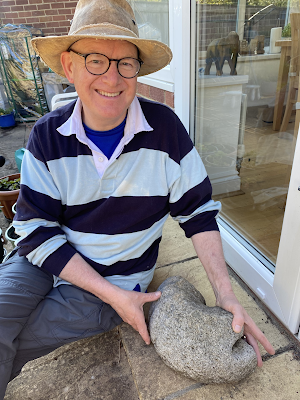
An archaeological artifact


Not me, you fool! - I mean the broken-in-half Roman rotary-quern. 

Such a quern works as described in this video. When complete, this stone would have had a hole in the top, and a hole in the side (you can see two-thirds of it at the point of breaking) which would have had a horizontal stubby stick inserted. 

Wheat, barley or rye would have been dribbled down the hole while turning this upper-part of the quern on a flat stone base, probably incised with lines to collect and channel the resulting flour. The flour came out all around the edges and was collected onto something like a leather hide underneath the quern, a flat board, or a larger flat stone. 

It was a very slow method of grinding, taking (I believe) more than an hour of hard work to grind enough grain for a loaf. 

This object we inherited from an ancient relative, who lived in West Northumberland in the vicinity of many Roman Ruins - which is why we believe it is Roman. 

But to be honest, I can't identify it with any degree of confidence. You might be able to see that it is fluted with vertical hollows - and I haven't been able to find any other similar-looking quern online in order to try and get a better date. 

Anyway, it's very old, and an impressive chunk of masonry. 


Tuesday, 31 January 2023

An example of specific divine guidance in my life

I do not like blogging about my own spiritual experiences; partly from reticence and partly because spiritual guidance is designed for the benefit of the recipient not as general teaching. 

Furthermore, each experience of personal miracles, or of the guidance of the Holy Ghost, has been so different in its specifics; that the major lesson for me has been that there is no method for such matters. 

(Indeed, to teach or assume generic methods for the Christian life, or to convert personal mystical experiences into advice, seem likely to do more harm than good.) 

On the other hand; it may somewhat encouraging for other people to know that a long-term and deep personal question for which I sought a response for some years did, in the end, receive an answer - albeit slowly and by a very indirect and not-replicable route.


I am not going to discuss the answer I was given; but I will describe something of the strange and unexpected way that an answer was communicated to me - in such a way that the process got past my fundamental misunderstandings and false pre-conceptions, and convinced me intuitively of its validity. 


I have often observed that when a question does not get an answer from divine sources; this is almost always because the question is ill-formed, and contains fundamentally wrong assumptions. These are why God cannot answer us - despite His vast resources. 

Furthermore; we are (nearly always) looking for the wrong kind of answer - and often something which is self-gratifying, or perhaps fits with false ideas of our own nature and destiny. 

This may explain why I was not able to get an answer of value or validity to the question oft what I ought to be doing in my life. I had too many fantasies and day-dreams that blocked my understanding. 

So, God's problem, in trying to help me, was to work past a great mass of such preconceptions, false understandings, wrong notions of the kind of thing I sought; and the tendency to ignore the true answer if given me straightforwardly, because the simple truth 'wasn't what I wanted to hear'... 


The only positive thing I was able to do to assist the process was to maintain my intent to find an answer over a period of years. I didn't give up. 

Admittedly I wasted considerable time, money and effort on dozens of false leads; but I kept plugging away - and followed hunches. 

What proved essential in the end; I let myself pursue lines of enquiry that had some kind of here-and-now interest to me; even when these appeared 'rationally' to be dead-ends, or trivial. 


Thus I have recently been re-reading around the subject of Christian 'ceremonial magic' - in particular the books of Gareth Knight and Dion Fortune, who I regard as admirable people. But I had already read these authors in the past couple of years, and had become clear in my mind that such a ritual and symbol, organized, approach to Christian living was now obsolete: it simply does not work anymore. 

I have also been re-reading Jonathan Strange and Mr Norrell, and focused on the episode when Childermass uses his 'Cards of Marseilles' (i.e. Tarot cards) to tell the fortune of Vinculus, and later to discern dishonesty and theft by Lascelles. 

Such reading led me to re-watch some DVDs of a nostalgic children's TV series from the early 1970s called Ace of Wands; which featured the hero 'Tarot' - a professional stage magician who also had some psychic powers such as telepathy, remote visualization and telekinesis. 

Having enjoyed this; I then got-out my Rider-Waite Tarot Card pack, which had featured in the TV programme; and looked-through some of its pictures.

Having replaced the cards, I absent-mindedly attempted to place it on a table; when the pack accidentally fell to the ground, and two cards jumped-out - and lay face down on the floor.  

It then came to my mind that these two cards would answer my question about what to do in my life.


I immediately thought that this was stupid, because (no matter how valid the process) I would always read-into the cards whatever answer I wanted: in other words, I would fool myself, and therefore the exercise would be useless. 

I don't believe in fortune telling; I don't believe that divination works (nowadays - although it did work in ancient times - up to the early years of the Roman Empire); and I certainly was not seeking 'guidance from the cards'.  

Nonetheless, I picked-up the cards one by one; and immediately recognized that the first card depicted myself and my condition: not as I fondly imagined myself, but as I actually was. 

This came as a shock, and I turned over the second card with some curiosity. 

The second card was one of the Greater Trumps, and I did not know its (supposed) meaning; so I looked it up in the leaflet provided - all the while thinking that it would be futile, because the descriptions are (like newspaper horoscopes) always so vague and ambiguous that they cannot possibly be sufficiently specific to serve as clear guidance for life...  

I read the sentence describing what the card meant, then - after a couple of seconds of dawning recognition - I realized that this was exactly the answer I needed and it was true

The generic phrases each and all had specific relevance to my condition.


The answer was obvious, banal, simple - and it was clearly the truth; yet I had missed it and missed it, for a very long time. 

I had to be set-up for this knowledge, in the right frame of mind and expectation; and I had to be surprised by the answer. 


What I think can be learned from the above is that if we persist in seeking an answer to an important question; then God can and will find a way to get that answer to us; and will prepare us to receive that answer

And God can do this even when we are (as I was) asking almost exactly the opposite question to the one we needed to ask; and when the mind is clouded and confused by innumerable wrong notions and hopes. 


Therefore; don't give up, and be prepared to follow where inner promptings indicate - even when these are pointing in apparently trivial or useless directions. 

And I think it is worthwhile to recall that the answer will be personal, very exactly tailored to you as an individual and your circumstances.

Also; the method by which God works to deliver the answer will be... Whatever does the job - and that method, too, will be one-off, unique - hence completely unpredictable.  

Which is exactly what is necessary. 


Tuesday, 27 December 2022

The Jennings books by Anthony Buckeridge


When I was a later childhood/ pre-adolescent (aged c.10-12), among my very favourite books were the Jennings series by Anthony Buckeridge

These were popular among my circle, to the extent that we adopted several of the slang terms used by Jennings and his friends Darbishire, Temple, Venables etc. For example calling a rubber eraser a "bungee". 

The books are set in a preparatory boarding school, which would take boys from age about seven at the youngest, up to about twelve, when they would go on to a 'public school' or a private grammar school.

I was myself state school educated, and always at co-educational schools - and I had a fairly strong dislike of boarding school stories and comic strips - such Billy Bunter. The idea of actually being sent-away to live in a boarding school - apparently populated by bullies, thieves and liars - was, for me, the stuff of nightmares, rather than of yearning day dreams. 

Yet the Jennings books completely overcame these preferences and prejudices, because they were so high-spirited, were populated by benign and likeable people; and were so true to my experienced-life among boys (at its best) - and because they were so funny.  


Like most of the best English humour, the funniness comes from a combination of witty usage of language, combined with embarrassing situations - especially when somebody is trying (and failing) to deal with a mishap, conceal something, or - in general - trying to stay out-of-trouble, or escape from it.

As for language, the quality of writing is very good - clearly influenced by PG Wodehouse, but with its own flavour - especially deriving from the aforementioned slang. 

My own experience is that there is some degree of spontaneous linguistic creativity in any group of boys or young men; tending towards nicknames, catch phrases, and in-group terminologies. This is taken to extremes with Jennings. 


The nicknames (again true to life) all have a reason, but a reason impossible for the outsider to unravel. Jennings's friend Temple is nicknamed Bod; because his initials are C.A.T., which goes to Dog, which was 'shortened' to Dogsbody; which was too-much of a mouthful for daily usage, and therefore shortened to Bod. 

The school caretaker is called Old Pyjams because the school nightwatchman was nicknamed Old Nightie - which went to Old Pyjams - short for Pyjamas. 

The school teacher Mr. Carter is called "Benedict" by the boys, although that is not his given-name - because of the short Latin Grace before meals: Benedicto benedicatur... Benedicatur = Benedict Carter.  


The slang is often modelled on RAF (Royal Airforce) slang of the Second World War - because boys of Jennings era (and even my own) were often fascinated by aeroplanes. 

The RAF had several clever and amusing slang usages - for instance a Penguin was a senior officer that had a pilot's license, but had become "chairborne", "flying a mahogany Spitfire" (i.e. a desk) - because a Penguin has wings, but does not fly*.

"Wizard" was a common term of approbation with the officers among RAF fighter pilots; and Jennings and Co. therefore use "Ozard" as an adjective of dis-approbation - from the Wizard of Oz, presumably. 

There are dozens of others; many of which seem to have been invented by Buckeridge; most famously the exclamation Fossilized Fish-hooks! This goes with a tendency to call people variations on "prehistoric ruin", "ancient relic" and the like. 


Similarly, the catch phrases often incorporate RAF terminology, in a loose sense, as when Jennings says 

"It's the Archbeako's garden [i.e the Headmaster's - schoolmasters in general being "beaks"]. 

"He attacks at zero feet with all ammo blazing, if he finds anyone in here." 

That is when the boys are not actually impersonating aircraft - or machine guns, space ships or racing cars - as they move through the corridors and traverse the staircases between classrooms.   


For me; the funniest 'set pieces' are of the 'cross-talk' variety, when there is some difference of apprehending the nature of a situation or topic; and two people are persistently misunderstanding each other. 

These often attain surreal heights, and are capable of making me laugh aloud. For example:


Background: Jennings and his sidekick Darbishire are trying to find a goldfish that they believe to have been drained from a swimming pool into a ditch in a field; but Old Wilkie, the short-tempered teacher, is seen approaching; and they try, but fail, to hide from him in a tree. 

Jennings never lies, so when asked what he is doing; from up in the branches - he tries to explain that they were looking for a goldfish.

At which Wilkie 'explodes' with his characteristic expression Corwumph! and demands they immediately report to the staff room for some kind of judgment... 


Darbishire said: "You are a fool Jen!"

"Well, it wasn't my fault, " his friend defended himself. "We really were looking for a fish."

"Yes, but you put it badly. Even Old Wilkie knows fish don't live in trees, unless you're speaking alley - er, alley-something." 

"Alibi?"

"No, allegorically, that's it: it means saying something that sounds quite crazy, but it's all right really, because everyone knows what you mean."

"Do they? That's more than I do!"

"Well, it's like that chunk of English we had to learn for Mr. Carter, about sermons in stones and books in the running brooks."

"You're bats!" Jennings retorted. "There wouldn't be any books in the brook unless someone had put them there."

"That's exactly what I mean. There wouldn't be any fish up a tree either because they can't climb. At least," he went on, "if one did climb a tree it'd be all over the newspapers. Big headlines: Goldfish's Amazing Feat!

"Yes it would be, if it had any, wouldn't it?"

"Wouldn't it what?"

"It'd be amazing if a goldfish had got any feet."

Darbishire began to realize that they were talking at cross-purposes. Curtly he said: "No, you ancient relic, I didn't mean that sort of feet."

"For heaven's sake stop talking nonsense," Jennings answered. "There's no point in arguing about what sort of feet it's got, if it hasn't got any."

(From Jennings' Little Hut, 1951)


*Note: Getting your wings was RAF slang for gaining the pilot's license, because this allowed you to have the coveted double-wings symbol applied to the uniform. Aircrew who were not pilots - initially observers (who were, at the start of WWI, actually of higher status, and often higher rank, than pilots) had a single wing attached to a circle with an O - or later other inital/s - in the middle. Consequently, these were sometimes nicknamed, by pilots, "the flying arseholes".