Showing posts sorted by date for query gareth knight. Sort by relevance Show all posts

Friday, 24 July 2026

Positive Greatness is non-transmissible. Religions, Ideologies, Systems are useless - when it comes to yielding Good consequences

I find it recurrently very striking that although I may admire, study, reflect upon individual persons (my "mentors"*) - my strongly positive feelings about such people almost-never extend beyond that specific person; almost-never includes even their close associates, disciples, heirs... and almost-never include the religion, ideology or (generically) the "system" that the admired individuals propagate. 

(Negative harm and evil can indeed be encouraged and propagated, as we see all around us; but this does not seem to apply to the positive and Good.) 

In one sense this is obvious and to be expected - and yet it is not what most people, including myself, tend to assume. 

On the contrary, we assume that there is something transmissible about positive goodness and greatness: that the idea of a Great and Good Man will tend to promote greatness, that the associates, disciples, followers, heirs of a GG Man will share - or at least significantly-encourage - the same positive greatness. 


Again and again I find that The Great and Good Man's positive-greatness may be real and strong; and yet the people associated are either mediocre and ineffectual; or else overall malign and negative in their nature and tendency. 

Furthermore, and something harder to grasp: The GG Man's own account of what is necessary and desirable for Goodness and positive change is also wrong!

The Great and Good Man's religion/ ideology/ System of understanding and explanation, his System for working to generate positive change - also shares this quality of being - in actual practice - ineffectual and useless at best; but often and with apparent ease readily made into a mechanism for the pursuit of evil. 

The people who are supposed to continue the work of the GG Man do not do so: they either degenerate into a relatively harmless but ultimately useless-for-Good pastime/ hobby/ club/ lifestyle choice...

Or else they become actually negative and harmful in their intent and outcomes; a vehicle for the pursuit (whether directly, or by lending support) of evil ends. 


Examples of the futility and/or malignity of Systems associated with those I regard as my mentors and Great and Positive persons abound, indeed it is exceptions that are hard to find. 

Most significantly, I have come to believe that this is true even of that greatest of men: Jesus Christ. 

With the single exception of the author of the Fourth Gospel; I do not find the same greatness in any of those who were associated with Jesus, or who propagated what they believed to be The System that Jesus seemed to be recommending/ commanding. 

And I find the usual mixture of ineffectuality and tool-for-net-malignity in The Systems attributed to Jesus, and allegedly associated with Jesus. 


What does this mean? 

The conclusion would seem to be that Institution and System are intrinsically useless at best, but actually net-harmful in practice. 

Perhaps we can only get benefit by direct inner-contact with the spirit of the Great and Good Man himself - because we ourselves are unlikely to do good by attempting to propagate this Greatness. 


When it comes to the good and the positive in this life; maybe we can actually do little more than point at a Great and Good Man, with a personal recommendation; and maybe also give an account of our own experience of such contact? 


*Some of these recent mentors who are writers, who have had a positive impact (as I judge), and who I have often blogged about are ST Coleridge, Rudolf Steiner, Dion Fortune, JRR Tolkien, Owen Barfield, William Arkle, Gareth Knight. Several of these taught a System - and all of these came to seem wrong and net-harmful. They had associates, followers, disciples etc - and unless the individuals were independently Great and Good themselves; such persons have always proved disappointing, exerted a net-negative influence, and often (I judge) were/are of bad intent. 

wrt Tolkien and Barfield - see the comment by AnteB, and my reply. It should be noted that a GG Man may have other GGMs in his circle - but their greatness is, essentially, independently achieved rather than derivative. For instance, and contrary to what he himself asserted and probably believed; Barfield's greatness was essentially independent from that of Steiner. GGMs are not reliable witnesses when it comes to their own special qualities.    

Sunday, 10 May 2026

Fascinated by "magic"... But only a small bit of it

I have been reading magical fiction and fantasy since discovering Tolkien in 1972, and continued with a (partly academic) study of animism and shamanism in the early 2000s; but I began reading about 20th century magic at the start of 2020. 


In this I was, belatedly, following-up a recommendation by William Wildblood to read The Magical Battle of Britain by Dion Fortune edited by Gareth Knight. 

Since then I have read, and often re-read, scores of such books - nearly-all by Dion Fortune and Gareth Knight, and their close associates.

This; despite that I have near-zero interest in practicing ritual magic of any kind, and even less in participating in the kind of formal, initiating magical group that DF then GK were trained-in and led - this sustained interest in magic is strange, even to me.

Indeed, I soon concluded that this kind of ritual magical society has become nigh impossible nowadays - or, at least, it is now very weak in the pursuit of positive spiritual development, whether of individuals or (even more) of society. 


Clearly, I have got, am getting, significant satisfaction from at least some of this reading. 

But what? I would characterize it as a kind of enchantment that (sometimes) comes over me while I am reading - of a similar nature to that when reading a good fantasy novel, when encountering elves or entering faerie.

However, it is significant that DF and GK were both explicitly self-identified Christian - albeit of a very different kind than me (but then that applies to almost everybody, anyway). 

Even during the active lives of DF, and even more so GK, there were relatively few ritual magicians who considered themselves Christian. 


Nowadays; it seems that those who practice magic are almost all "neo-pagans" of one sort or another; and those that I have encountered express "anything but Christianity" at best, but are mostly (and often vehemently) anti-Christian.

(This opposition usually boils-down-to an opposition to the constraints that Christian churches have placed on sex and sexuality - i.e. they hate what they regard as Christianity "because" they support some aspect of the sexual revolution of which they desire to avail themselves.) 

While several neo-pagan magical writers seem like decent people in themselves, and surely no worse overall than many/most devout Christian church-members; I cannot shake off a solid awareness of a kind of shadow that lies behind, motivates, and tends to corrupt neo-paganism - whether magical or any other kind.

Consequently I have little interest in the present day practitioners of ritual magic - and very seldom find myself "enchanted" by their work -- indeed more often I experience the opposite: a repulsion.


So my conclusion is rather like Sturgeon's Law: probably 99% of Ritual Magic is crap - but then 99% of all actual Christian Churches (including the best) is crap. In this actual world, here-and-now, 100% of most institutions is crap. If we find something that contains even one percent that is good; then we should cleave to that tiny proportion, and set-aside the rest. 


But experiencing such repulsion when sensing the deep motivations of modern people is actually the norm for me. 

And, on the other side, I find the underlying personal character of both Dion Fortune and Gareth Knight to be very appealing and indeed inspiring; even when I regard them as mistaken or on the wrong track in many specifics.

I find that I am less and less impressed by superficial agreements or disagreements with those who I read; more and more my discernments of good and not-good people, seem to be rooted-in (what I infer to be) some much deeper level of character and attitude. 


This is yet another way in which I find myself at odds with traditional, group-based, external-authority-rooted ways of understanding the purpose and meaning of life; and of the Christian Life specifically. 

It seems to me that anybody - including those corrupted, or even of of deeply evil nature - can make public affirmations or rejections of whatever checklist of doctrines or dogmas will get them accepted by some kind of institution or social group. 

This kind of stuff (which is 99% of "religions") is nowadays (it was not always so) just about gatekeeping, boundaries, gang-membership - in short: attempts to increase this-worldly power. 

And therefore it already-is, or soon-becomes, assimilated to the aims and methods of the ruling totalitarian System; which is why in 2026 all institutions (including all churches) are converged or converging with the evil-strategies of atheistic-materialism.  


On the other side; I am both interested and grateful when I encounter a person (alive or dead) whose motivates are genuinely good; and who is working, in his inner life, for positive and spiritual goals.

I believe these to be the truest followers of Jesus; in the sense that such people are much the most likely to desire, accept, and embrace Christ's offer of post-mortal, resurrected eternal life in Heaven.  

And with such rare people, I will take them where I find them and enjoy the experience, and try to learn from it - whether such individuals are located in or out-of the institutions of ritual magic, or elsewhere.    

Wednesday, 25 March 2026

ETs - the question of contact with Extra-Terrestrial humanoid life forms


Much as with UFOs; I have read a fair bit about ET contacts (and viewed documentaries or videos); and various of my penfriends have described their own ET contacts - so my attitude has been somewhat open to the reality of such things. 

But this openness-in-principle has been modified by an underlying lack of interest in the subject; which is itself a reaction against the enormous (sometimes cosmically vast and spiritual) claims of significance made by ET proponents; whether positive or negative. 

Furthermore, there is the problem that I don't believe most of the claims - or at least, I am not confident of their validity. 

Some reports seem to be lies, while other experiences seem to be self-deceptions due to illness or stupidity - while other people seem to reporting genuine spiritual or paranormal experiences, but may be misinterpreting other kinds of experiences as ET contacts. 

In particular, to believe ET reports requires for me a confidence in the discernment - including spiritual discernment - of the witness, and up-until-now I had not come across any ET reports that ticked all the necessary boxes. 


This has changed since I read To Think Without Fear: the challenge of the extra-terrestrial (2015), by Anthony Duncan (1930-2003) - which has convinced me of the validity of his report of ET contacts happening to himself and family, in the middle 1990s in Northumberland, where he was an Anglican priest. 


Although, as a Church of England Vicar of several parishes; at times AD lived near to me and I walked past his churches frequently; I never met him and did know know about him (indeed, I did not become a Christian until after he had died). 

I came across Duncan rather vaguely at first through an interest in "Celtic Christianity" (a subject about which he wrote several books); but mainly through my reading of Gareth Knight. And esepcially Kiight's superb autobiography: I called it magic (2011).  

Duncan and Knight met when AD was curate at Tewksbury Abbey while GK lived in the town; and AD prepared Knight for confirmation into the CofE. They rapidly became friends and then complementary collaborators; ultimately leading AD to an interest in the Qabalah that eventually bore fruit in Duncan's The Christ, Psychotherapy and Magic (1969); which fed-into Knight's restoration of Christian ceremonial magic in Experience of the Inner Worlds (1975). 


Duncan was a natural, spontaneous, psychic and mystic - who had paranormal as well as supernatural experiences throughout his adult life' He was an officially-recognized exorcist in the Church of England - and became a Canon of Newcastle Cathedral. 

I read GK's memoir of AD (Christ and Qabalah - 2013) and then several of AD's books and a recorded lecture; before tackling To think without fear TTWF. So I already liked and respected Duncan, before reading the ET book. 

However, it needed two attempts to get-through TTWF; because of the rather unfortunate way it is structured. The key parts that actually convinced me of the validity of his interpretations of his experiences - the descriptions of his ET experiences; come at the very end of the volume, in the Appendices. 

...Before which I needed to wade through a great deal of complex, abstract, and (from my POV) theologically-unconvincing explanations and justifications of the reality of ETs from the context of mainstream-orthodox Anglican philosophy and doctrine (with various eclectic additions). 

There are, however, many important insights scattered throughout these rather turgid early parts - and the effort of penetrating these chapters surely prepared my receptivity for the simple and clear expositions that came at the end.   


Despite all its defects, what made this the only account to convince me of the reality of an ET experience was that background of already knowing and respecting Duncan; plus my confidence that he was able - from considerable experienced reflected-upon - to discern the provenance of strange experiences.  

In other words, Duncan, had throughout his adult Christian life, experienced many contacts and "communication" involving angels, demons, ghosts and the like - and therefore he was exceptionally well-placed and able to discern that these ETs were... what they "said" they were.

AD was also well-motivated, i.e. not trying to gain personal advantage from reporting ET contacts. Indeed he did not share the experiences described in this book outside the circles of his friends: and this book was not published until a decade after his death. 


In brief; the nature of the ET contacts (confirmed by two other people) was a non-visual but definite sense of presences (various numbers, and of various types of personage); and a direct, usually non-verbal, mind-to-mind telepathic (back-and-forth, Q&A type) understanding.


So, having been convinced - what then?

For me, nothing much more than an expansion of metaphysical possibility: I remain largely uninterested by such contacts - and have no significant desire to share them. 

The claims variously made in other books etc of a strategic importance of ETs for Mankind, material and or spiritual, seem to me to have been refuted by the passage of decades. Such discussion is contaminated by "geopolitical" forms of thinking about civilizational purposes, clashes, alliances and the like. 


I think the real significance (and this seems to be the opinion of AD) is interpersonal. The significant depends on the actual parties involved - the specific human and the specific ET (who seem to vary in kind and motivation) - and the quality of what happens between them. 


Contact with ETs is therefore as important, or as trivial, as contact with other kinds of living Beings - whether living or dead, material or spiritual. 

That is to say - genuinely loving contact between Beings (if this develops) is eternally-significant and of positive value to divine creation...

Whereas contacts that have an instrumental purpose (in which one or both parties are attempting to use the other for some benefit, or from mere curiosity, or operating under orders) are net-harmful interactions; but usually just insignificant, in the wider scheme.  


Thursday, 26 February 2026

The re-enchantment of the world - a matter of direct spiritual contacts

Since the emergence of Romanticism in the late 1700s, the "disenchantment" of our modern world has been a constant cultural theme; and there have been may analyses of its cause; and suggestions concerning the possibilities for re-enchantment. 

I have, over the past half century, read many books and essays on this theme; and I observe that more continue to be published. 

In recent years I have expanded my explorations to include the tradition of Christian ceremonial magic, in particular the works of Dion Fortune and Gareth Knight. Knight, in particular, confronts this issue head-on, especially in his autobiography "I called it magic" (2011) - which describes the (almost) life-long quest for re-enchantment of his life. 

What follows derives from such considerations; and takes the form of notes-to-myself, as a kind of aide memoire concerning a partial crystallization of ideas. 

++

In our world, here and now, the proper aim of magical activity is to establish the greatest possible range of loving contacts

By which I mean, in particular, direct inter-Being contacts of a spiritual kind

By "direct" contacts I mean mind-to-mind - therefore unmediated; not-perceptual, not symbolic nor linguistic.  

By "Beings" I mean any of the primary units of reality - because I regard reality as consisting of eternally existing and developing, Beings: that are alive, purposive, and (to some extent) conscious.


Therefore; re-enchantment is not about abstractions or atmospheres; nor particular qualities of consciousness or thinking. 

Re-enchantment is concrete and specific - like the interpersonal relationships with those we love.  

Re-enchantment is about an expanded awareness-of and interaction-with many Beings of many kinds; and especially awareness of those entities that are (by mainstream modern ideas and ideologies) considered to be imaginary, not to exist, to be unalive/ dead, or not-to-be-Beings/ never-alive.  


Re-enchantment is piecemeal and quantitative; because expanded awareness could include so many contacts with so many Beings of so many kinds. 

Here is an incomplete list of the kind of contacts that constitute re-enchantment.:

Telepathy with living human beings.

So-called dead people - resurrected Men

Pre-mortal spirit humans

Animals, plants, and mineral-beings

Nature spirits

Fairies

Divine beings (including the Holy Ghost)

Planets and stars


The scope of "magical" contacts, is as wide as the nature of Beings. 

To simplify somewhat; these contacts are what is missing from the alienated, materialistic and mundane life of Modern men; and a person who lived in continuous contact with all these kinds of Beings (and other Beings) would be living the "enchanted" life.  


But more needs to be said, and that includes that the contacts be of the right quality; which is to say loving

The point is Not (as so often has been sought) to make contact with Beings in order to "use" them to seek power/ wealth/ sex/ status; nor to get information from them; nor to be healed by them; nor to get guidance from them...

If other Beings are regarded as means to an end, any relationship will be dis-enchanted. 


An enchanted relationship cannot be instrumental

The "point" of these contacts is the value of loving relationships in and of themselves.

The point of these contacts is expanded awareness.  


However, contacts are not static nor merely contemplative; because contacts are two-way, they are dynamic, developmental. 

Beings in a loving relationship therefore aspire to a active relationship. 

The interaction of Beings - their mutual influencing - is the context of creativity

Creation (for an individual) is actively participating in the "web" of his relationships - by this activity he "makes a difference" to divine creation. 

In sum: Contemplation is a passive participation in relationships on one side; however, Creativity is active participation on both sides. 


Re-enchanting the world is thus about restoring and gaining the fullest range of contacts. 

And, for the seeking of loving-contacts to be a meaningful activity in our actual lives (not to be regarded as trivial, nor explained-away in materialistic terms); we need to be able to explain to ourselves how this really happens, and why it is really significant in terms of eternal creation. 


Sunday, 21 December 2025

Experiencing Winter Solstice in magical imagination


I regard the Winter Solstice as a phase of the year lasting about a week, rather than today specifically.

Because day length barely changes for several days - even up here in an extreme latitude (55 degrees north), on either side of an astronomical solstice. 

The solstices have the slowest rate of day-to-day change in day-length of any time of year, just as the equinoxes have the fastest. 


Such an insight means that one can (more often) legitimately mark and celebrate the solstice at a time when the skies are clear, and in places where ravening hordes of noisy and crusty neo-pagans are absent!

Or, even better - at least for me, and people like me - is to create the event in active imagination, from memories and previous imaginings.  


Such was what the great Christian occultist Gareth Knight recommended: that when we visit enchanted or sacred sites, we are only seldom in an exalted mood (we may be ill, frazzled, distracted), and the situation may not be conducive to a here-and-now spiritual experience (adverse weather, intrusive crowds). 

But we should be attentive, observant, give the place a chance to soak-into us...

And then use these memories - and other memories of a personal, literary, artistic, imagined etc. nature - to re-create and synthesize an ideal experience; at some time later - in meditation. 


In other words, we can follow the advice of William Wordsworth in that classic statement of Romanticism: the preface to Lyrical Ballads

I have said that poetry is the spontaneous overflow of powerful feelings: it takes its origin from emotion recollected in tranquillity: the emotion is contemplated till, by a species of reaction, the tranquillity gradually disappears, and an emotion, kindred to that which was before the subject of contemplation, is gradually produced, and does itself actually exist in the mind.


We need, therefore, to put aside notions that meditative re-creative imagination is a second-hand or second-rate experience...

And realize that this is the definitive mode of enchantment, or participation, for people like us, here and now.   


Sunday, 8 June 2025

Review of The Occult Battle of Britain - by Paul Weston (2019)


For the last couple of weeks, I have been reading a fascinating book called The Occult Battle of Britain - History, Magic, Mythology from the 19th century to 1946, by Paul Weston and originally published in 2019. 

The book can be considered as an extensive background to the similarly titled The Magical Battle of Britain, by Dion Fortune and edited by Gareth Knight, which I've previously mentioned. 

Dion Fortune (a woman I both like and admire, and who I regard as a genius) is perhaps the central character. 

The climax is the magical activity in which she was engaged before and during the Battle of Britain - and the timeline ends with her death in 1946. In broad terms the book is about the intersection of occult thinking with the rise of National Socialism in Germany, and its opposition from within Britain - culminating in the Battle of Britain and its aftermath. 

The method is chronological. Starting in the late 19th century, with the international spread of spiritualism; then HP Blavatsky and the (extraordinarily influential) rise of Theosophy; and the Golden Dawn and similar revivals of ritual magic (magic both white and black in nature) - Weston notes some of the main characters involved, and what was happening in Germany and in England - but especially in relation to Glastonbury and its "Avalonians". 


As well as Fortune; Avalonians Wellesley Tudor Pole and Ronald Heaver are followed; since they had a complementary role to play in the occult side of events of 1940. Also; both TP and Heaver were long-term involved in military intelligence; as were many others from both sides of that apparent divide. 

Heaver was heavily involved in the (seemingly) utterly bizarre British Israelite movement - about which I previously knew almost nothing - and it has now disappeared from public consciousness. Yet, although the assumptions and goals of the BIs strike me as almost incomprehensibly strange and misguided; this was clearly a strong movement within the British ruling class - including intelligence services - up to a high level, and had a role to play in global geopolitics.   

With the notable (and noble!) exception of Dion Fortune herself; it seems that the occult-military nexus was so common as to be normal. On the "darker side" of things; Aleister Crowley and Dennis Wheatley were also spooks. 

But some of the most significant British military people were also occultists - most notably Air Marshal Sir Hugh Dowding, head of Fighter Command up to and during the Battle of Britain, the architect of the integrated home defence radar system - and very plausibly the saviour of his nation. 

Dowding was heavily involved with spiritualism (publishing articles and a major book on the subject) and other esoteric subjects - e.g. he regarded fairies as a real and important influence on human life. 


The other side of the book charts the development of the spiritual side of national Socialism from its 19th century origins, and which reached a formalization with Himmler and the SS, and their cathedral like castle of Wewelsburg. But much of this requires to be disentangled from the distortions and fictions that have been widely propagated by early books such as The Morning of the Magicians (1960), and The Spear of Destiny (1972). 

Nonetheless, after the falsehoods have been set aside there seems little doubt of the fact and significance of occultism in National Socialism - and that there was indeed a Battle of Britain which operated purposively at this occult level - whether this phenomenon is interpreted spiritually or materialistically in terms of psychology. 

What is, for me, an open question - is the nature of the military-occult synthesis that Weston describes; not just for WWII, but extending back to encompass aspects of the First World War. 

There was surely a large element of intentional PSYOPS about the manipulations of public opinion (some very successful, both for good and ill) of British intelligence - yet there were also many instances of (apparently) sincere occult belief and activity among a surprisingly high number of very important personnel of both sides. 

The 21st century mind (from its assumption of innate moral superiority and greater insight) is spontaneously inclined to explain-away all this; as merely a mixture of cynical manipulation with the stupidity (and evil) of those unenlightened (sexist, racist etc) people of the past. 

And if this attitude is taken, there is nothing more to be said! But it is all based on assumptions about "our" modern superiority to every previous generation: assumptions that are arbitrary and without any coherent objective basis.  


Much of the fascination of this book is in the range of information provided, including aspects either neglected or passed-over by conventional histories. 

I was especially interested by the accounts of the Phoney War period from September 1939-May 1940 - and the ways that the British people were "prepared" for war. From Weston's account; the mood of the nation at this time (officially partly-feared, partly-seeded and encouraged) was very different in some respects from how it is usually portrayed - with a rampant paranoia concerning spies (leading to executions of the innocent), and wholly-imaginary fifth columnist activities by saboteurs, paratroopers, and sleeper agents. 

I was also impressed by Weston's discernments in relation to the side of the Allies. He is scrupulous about taking into account alternative interpretations - e.g. of the role of Winston Churchill, and the significance of the Battle of Britain. The he makes his decision among possibilities and explains his own assumptions. 


Therefore, Weston regards the "mythology" of the Battle of Britain as basically true, and that it was indeed a battle - spiritual as well as military - between good and evil. Consequently, after the Battle was won, there was a recognition of spiritual growth and commitment to the side of Good; and sincere hopes for a better world - spiritually better that is - to follow the war. 

Yet, Weston also feels that the purity of motive that Britain achieved in 1940, was significantly dissipated and corrupted throughout the course of the war. The alliance with the USSR was a significant downward step (Churchill explicitly likened it to a Faustian pact with the devil, yet embraced it nonetheless). 

The scale, priorities, purposes, and methods of Bomber Command (under the genuinely-delusional Arthur "Bomber" Harris) was another massive military error (a colossal misapplication of resources, causing gross neglect of more necessary and effective strategies); the whole increasingly fuelled by dark, sometimes evil, motives. 

Weston also notes that the strategic destruction of British and European geopolitical power was a sub-theme of US involvement. As was the in-practice building-up of the USSR as a world power, including by open-ended and unconditional "free gift" provision of materiel (in contrast to the sales and loans to the UK, with the consequential crippling war debt entailed). 

In some respects; by the end of the war there was a change of sides by the Allies - so that as the war progressed, not just Britain but also the real victors (ie the USSR and the USA) were spiritually, overall, also on the wrong side. 

And Dion Fortune's hoped-for beneficial spiritual outcomes of the Magical Battle of Britain... therefore didn't happen.    


The Occult Battle of Britain is not an easy read, and I spent many hours reading it; but this was mainly because I found I didn't want to miss anything. I found it to be original, gripping, and very stimulating - with implications that I need to think about much further. 


Friday, 23 May 2025

Occult and Esoteric - what do they mean? How to approach them?

Occult means hidden, and often refers to hidden knowledge. Typically, this is knowledge that has been kept secret (e.g. by being sustained in a closed society) - or perhaps knowledge encoded, so that only those who know the code can discover it. 

But hidden knowledge may instead be clear and simple, not secret but instead "hidden in plain sight" - not encoded but simply ignored by the majority. 

Ignored perhaps because it is no interest, in some way unwelcome (opening a "can of worms" they'd rather not deal with); or indeed so clear and so simple, that most people regard it as necessarily wrong, because the knowledge strikes them as embarrassingly childish and simplistic. 


Esoteric means "for the few" - and mostly refers to groups to human societies. The term often refers to exclusive groups characterized by rigorous selection and prolonged training; and typically includes groups that claim to posses secret occult knowledge or the keys to understand encoded occult knowledge. 

But, analogously with the possible meanings of occult; esoteric groups "for the few" as such are not confined to the holders of occult knowledge; but characterize almost many types of functional human institution - such as some universities or colleges, and legal and medical professions - and these also implicitly claim to possess occult knowledge which is not understandable except by those who are trained, and have the "keys".

More significantly; there is the question of why some groups are "for the few" - which might be because only few regard the matter as real and important, or who have an active interest. An esoteric grouping may happen (or be attempted) because "the many" are indifferent or hostile to the subject. 

When the majority believe that which is false, and are evil-affiliated; then the possibility of allying with good is necessarily restricted to "the few" - or even to a single person.   


When it comes to evaluating occult knowledge or esoteric groups, it seems evident that the terms are descriptive rather than intrinsically evaluative. 

As usual; the valuation depends primarily on matters such as purposes and motivations, and whether these are on the side of God and creation - or against them. 

Whether the real and underlying motivation is for this-worldly power, wealth, sex, success and the like - or to manipulate others and nature? Or instead to seek potentially good-aligned goals such as self-knowledge, experiential understanding of reality, encouragement in pursuit of salvation etc.  


It seems to me that (as of 2025, in The West) most of the people who are explicitly involved in esoteric groups and engaged with occult knowledge are badly-motivated: they are on the wrong side of the spiritual war of this-world. 

But the same applies to most Christians; and to most Christians in any particular church or denominations: they are badly-motivated. That is most self-identified Christians are (overall) on the side that opposes God in the spiritual war. 


In this mixed world, by its very nature; all Men are sinners, all groups are corrupted and all knowledge is impure. 

It is not our task to attempt the impossible of redeeming, or even reforming, The World; but to navigate our way though our life by discernment and in accordance with our intuition and divine guidance; as we desire and commit to following Jesus Christ.

This may (and it seems likely, given the nature of the world, en masse, here and now) lead us at some point to some degree of engagement with explicit or implicitly occult knowledge and the esoteric: 

So be it.  

**


Note: The above was stimulated by re-reading Gareth Knight's biography of his great friend the Reverend Canon Fr. Anthony Duncan: Christ and Qabalah: or, The Mind in the Heart (2013).

Thursday, 16 January 2025

Dion Fortune's description of Direct Knowing, from the 1930s

I have quite often tried to describe what I call Direct Knowing, which I regard as the most fundamental form of understanding, the bottom line, the ultimate (and divine) way of knowing. 

Yesterday I found a passage of writing which seems to describe how Direct Knowing feels and operates, written in the 1930s by Dion Fortune

She says there are three basic ways that the mind works: in words, in picture images; and a third and higher type of mentality, "which comes to all of us occasionally at times of stress". 


This is a thinking in terms of pure idea, in which the idea arises in the mind complete and does not have to be thought out; but comes in a flash of realization which we apprehend in a sudden glimpse of insight; which will then gradually unfold and realize in all its implications. 

Edited from page 21 An Introduction to Ritual Magic by Dion Fortune - edited by Gareth Knight, 1997/2006.   


Wednesday, 15 January 2025

"The hand follows the eye" - To navigate life, we need to look where we are going

The only way to talk with the subconscious mind is through the pictorial imagination, because it has a very archaic mode of mentation that developed before speech had been thought of. It is unresponsive to logic, or argument, or appeals to its better nature. But show it a picture, and it understands and is only too ready to cooperate - now that it knows what is required of it. 

This is an exemplification of the well known maxim that the hand follows the eye.

If you look over the hedge when driving a car, you will end up in the ditch because, all unconsciously, you will steer in the direction in which you are looking. 

The novice keeps his eye on the kerb in order to avoid running into it, and follows St Paul's example in doing the thing he would not. 

The expert looks where he wants to go, and gets there

Edited from page 21 An Introduction to Ritual Magic by Dion Fortune - 

edited by Gareth Knight, 1997/2006 

**

This is a metaphor for the role in our mortal life; "where we want to go" means our desire for, and confident belief-in, salvation. 

The hand follows the eye... "The hand" is what we do in life - all that complex and potentially bewildering combination of attitudes, and knowledge, and actions. 

"The eye" is what is the subject of our attention. 


If we "look over the hedge", looking around instead of looking ahead; we shall be distracted by the temporary contingencies of mortal life, and will end up in a ditch... 

If our attention is focused on the close-up and specifics of life - such as the avoidance of sins, or doing particular good works - then we will drive into the kerb... 

We need instead to focus on where we want to go. 

And for a Christian: where-we-want-to-go comes after death: and is Resurrected Eternal Heavenly life.  


When we know where we want to go, are confident that we can get there; when we look at it and keep this vision before us - then we will get there


Sunday, 8 December 2024

"Those who prefer security to freedom have lost both" - Dion Fortune writing during the Battle of Britain

From a letter of August 4th 1940 

There is something very strange about this war. The nations that have been subjugated were not beaten in the field, they fell to treachery and internal corruption; to lack of morale and lack of the will to victory. 

The key to their fall may be found in the words: "he who would save his life shall lose it, and he who will lose his life for My sake shall find it."

Those who prefer security to freedom have lost both. 

England stands alone and happy. All war gloom has gone. There is confidence in the future and pride in the present. Power is rising within us like a tide. The inflowing of a new life impulse is making itself felt. 

**

Letter 36 from The Magical Battle of Britain, by Dion Fortune. The war letters of Dion Fortune, edited by Gareth Knight.  

**

This insight of Dion Fortune referring to a very particular and unusual time and place has general validity. After the Second World War, there was a massive and (so far) irreversible collapse of Christianity in Britain. It was replaced by an overwhelming focus on this-worldly and material matters - i.e. what DF here terms "security". 

Nothing mattered to post-war people except security, happiness, prosperity, comfort, convenience and diversion. 

And, as predicted, this has led to the erosion, and incipient near-complete loss, of all of these - but especially security. 

Dion Fortune was talking about nations - but the same applies to individuals. 

Although we all (to some extent, sooner or later) crave security: there is none to be had in this mortal world; and the attempt to ensure it will bring the opposite - because by seeking security primarily, we will become oriented away-from reality. 

Unless the material is located in the spirit, unless the mundane is situated in the divine, this-world in eternity - then the material, mundane, this-worldly Goods will not merely be lost - but thrown-away. 


Thursday, 14 November 2024

"Contacts" seem to be the potential basis of experiential understanding; as well as participation in the world of spirit

For the past couple of years I have been reading considerably about what Dion Fortune and Gareth Knight (and other ritual magicians of their kind) call "contacts" - or sometimes "Masters". The experience is of individual communication, or sharing of consciousness, with a spiritual being. 


The phenomenon seems various in its details, and may occur in a full trance (i.e. when the human becomes unconscious, and speaks or writes without awareness of what is being communicated). Or it may happen in more alert trance states, with awareness of what is going-on. This is apparently broadly the same as "channelling" (i.e. what is channelled, is "a contact"). 

And contacts seem to underlie, and blend-with by degrees, much commoner and more normal phenomena such as an intense fascination, empathy, communion with some not-present personage; who might be alive or dead, real-life or fictional. 

Contact may be sensory (in the form of spoken words or conversation (clairaudience), of visual (clairvoyance - perhaps of visions, symbols, written words); or non-sensory - as what I call "direct knowing". 

What seems to be the essential common factor is experienced person-to-person (or person-to-being) contact. 


Having read quite widely on this subject, it has become clear that (contrary to common claims, and despite that contacts are often sought purposively as a path to knowledge and guidance) such contacts are not necessarily, indeed only seldom, the basis for accurate or valid information

This is obvious from the apparent wrongness of much specific (and indeed abstract and generalized) information of this kind; but it must be true from the wide range of contradictory information cited between different (but apparently honest and competent) people; and the same person at different times. 

So I have concluded that contacts ought Not to be regarded as a pathway to factual or conceptual knowledge or true guidance. 


On the other hand; I have concluded that experience of contacts are not only of potentially primary personal significance; but are probably necessary to the development of true knowledge. 

In other words, unless we experience a phenomenon that could be characterized as a contact, we shall never really understand anything


I concluded this from examining my own work in science and literature, as well as theology, philosophy, and mystical religious experience. Even from when I was an atheist - from more than a decade before I was a theist, or a Christian; I never really understood the meanings of things until I had had this kind of contact experience. 

For instance, if I was working on theoretical science; it was all just a matter of "comparing models" - an activity that had no end, and brought no sense of validity - until I had reached an empathic contact with those scientists (living or dead) whose work I was critiquing or using; and the same applied when I had developed a theory that I regarded as valid. 

Truth needed to be "checked" by a very inner process, much as I later called heart-thinking; and until a proposition had passed this "test" I was never confident of it. 

True knowing needs to be known in the heart, and no amount of head-knowing (logic and "facts") can replace this requirement.  


Something closely analogous seems to be at work when I am trying to understand a writer. Unless and until I can attain an inward sense of contact and communion with that person; then I never really feel I know what they are saying. 

For instance; it took me about a decade before I "got" Owen Barfield, and felt that I really understood what he was thinking and asserting - and this understanding came as a consequence of getting onto his wavelength by a kind of sympathetic resonance, by thinking "with" him as I read his words or contemplated his writings. 

Much the same applied with William Arkle; I had to immerse into his writings for some years before, quite suddenly, I "contacted" his spirit and had the basis for understanding. 

But with other authors - such as ST Coleridge - I have never attained this sense of contact, therefore I have never (so far) been confident of understanding him: it is all second-hand, hearsay, "models" of what he was doing. 


It is certainly Not the case that contact leads to correct understanding. Contact with Barfield and Arkle was just the basis for understanding them. I needed to study, read, re-read, and think hard. 

So having experienced "contact" should Not be used as a "proof" that one's understanding is correct. 

But without that contact, there never would have been genuine understanding.


Furthermore, once one has attained contact, and followed it with serious study; one can recognize when others have not attained contact; and are merely parroting and playing-with second-hand summaries and models.  


Contact therefore seems to be necessary but not sufficient to knowing

Contact is also perhaps one of the commonest and most readily available modes of direct spiritual experience: a kind-of evidence of the reality of the spirit world.  

And this is just how things would be expected, in an animated, living reality - in this created universe ultimately composed of Beings in relationships


In sum; I conclude that he ways that contacts are usually regarded, seem to be mistaken. It is usually an error to seek contacts as a source of factual information. 

However, contacts - properly regarded - can be an experience of the living world of spirits, an active participation a world of conscious Beings: recognition of a relational world, in which we are never alone. 

And a way of inhabiting a world where we can truly understand purposes and meanings - at least to the extent of our individual cognitive capacities, biases, defects and particular perspectives.

All this depends on our regarding it as metaphysically possible - that is, our fundamental assumptions need to allow for such potential: we need to realize that this fits how reality is structured and operates. 


Friday, 17 May 2024

The spirit world, and what to do about it?

There is the physical or material world inhabited by incarnated mortal Beings (i.e. the only world acknowledged as real by the modern mainstream ideology). This contains a mixture of good and evil, some Beings on the side of God and divine creation; other Beings opposed to this - and all mortal Beings are some mixture of these motivations. The material world is subject to entropy - subject to change, decay, disease, degeneration, and death - the irrevocable dissolution of physical forms. 

Then there is the Divine World - "inhabited" by God, the ascended Jesus Christ/ The Holy Ghost. And also - since the work of Jesus Christ, the divine world is inhabited by the denizens of Heaven - resurrected Men (and, presumably, other Beings). It is a realm entirely of Good, that is to say that all is motivated by love. It is also an eternal realm, without entropy. 


But there is another realm: the underworld/ dream-world realm of spirit Beings

The spirit world

For ancients, this was the realm of dreams, the place where souls went after death (perhaps being reincarnated from there). 

A wide range of Beings have been supposed to inhabit this "psychic" realm: gods, angels, demons, nature spirits, chthonic monsters, ghosts, non-human sentient spirits of many kinds and degrees.

Like the physical realm the "underworld" is mixed; with Beings that contain both good and evil motives - and including Beings affiliated to the agenda of evil. 

However; this realm, like the physical realm, will also be "visited" by the wholly-good denizens of the Divine Realm.  

The spirit realm is like the physical world in being also subject to entropy - in that, although spirits do not "die" in the way that physical Beings die; they are subject to destructive change - to degeneration, disease, loss of self... 


The spirit world is a fact of life. It is "all around" us, always, and wherever we happen to be; and has influences. 

This means the spirit world is (like the physical world) differentiated, heterogeneous, varied by time and place.

Thus the spirit world (whether we are aware of it or not) will affect us - somewhat like geography, climate, seasons and weather affect us. At some times and/or some situations the spirit world will be benign and helpful, maybe enjoyable. 

But in other circumstances, the spirit world will be net hostile, fear- or misery-inducing perhaps, or having evil influences - therefore hostile in specific ways.  


The striking fact of modern life for Men - including most, not all, Christians - is that we have all-but lost any spontaneous consciousness of the spirit realm. We live "in" it, but unaware, typically denying its reality. 

It is as if we wandered from the Arctic to the Sahara, while unaware of the differences, and taking no account of them in our lives. 

This is part of our alienation: modern Man is cut-off from a multitude of relationships with the world. These relationships are potentially bad and good both, as with the physical world: but most importantly they are real and unavoidable. 


The consequence is that we "miss" the spiritual realm - and (even if unconsciously) we know that our experience and knowledge of reality is incomplete. We are, to that extent, maimed. 

Further: this situation is made worse by many Christians, who regard the spirit realm as nothing but a threat, a spiritual danger, the domain of demonic temptation - that must be avoided. They regard the underworld as at best inessential, at worst a constant threat. 

More moderately, but with the same result; Christians regard the spirit world as an "optional extra" for life; something that we do not need, and is therefore best avoided because of its spiritual hazards. 

This is one way in which mainstream, orthodox, traditional Christianity has not just failed to meet the challenge of modernity; but has indeed worsened the situation. 


But suppose that we do - as a matter of fact - both need the spirit world, just as we need the physical world; and anyway cannot avoid it - even when we want to? 

We may fence ourselves in - but we cannot fence the spirit world out. We can only make ourselves unaware of it, and explain away its effects. 

What then?

Well, in my judgment there are no really good models from the past, that work for this present among Western people, no good models concerning how we ought to regard and relate-to the spirit world.  


There are, of course, plenty of people who - even nowadays - are aware of the spirit world in some way - "clairvoyants" or "psychics" of many kinds. Maybe they have visions of spirits, converse with spirits; and seek-out such contacts. 

The problem is that these are mostly Not wise or knowledgeable people. They are often silly, or motivated badly. By my evaluations; their knowledge (apparently derived from contacts with spirits) is unreliable, and often incoherent nonsense, or rather blatant self-gratifying fantasy. 

They often seem to be seeking spirits to help them gain worldly gratifications (health, sex, power status - the usual stuff). 

Or, on the other side, they seem to be seeking to surrender to the world of spirits, to be overpowered and controlled by the spirits they encounter. Self-annihilation... Not good.  


At any rate, the "fruits" are often bad - in that a majority of those who are (or claim to be) in contact with the spirit world are (to me) unimpressive, and usually have taken the side of evil in the spiritual wars. But then again, so have most self-identified "Christians", and those of other religions! 

(There is no "safe" path to salvation and theosis that can be objectively described or externally imposed - and the greatest danger is for those who believe there is.)   

To me, "the Spiritual" are mostly unimpressive... and yet not always! 


While - like all mortal Men - mixed-Beings who are prone to errors and being misled; there have been some people (and in the "modern" era) such as William Blake, Rudolf Steiner, Dion Fortune, and Gareth Knight - who seem in important ways to have benefitted from their contact with the spirit realms. These I like, respect and admire. 

Nonetheless, we cannot assume that any of these people are themselves a model for other people differently constituted, and belonging to later generations, whose consciousness is different. Nor (whatever they may have claimed) can we assume that such past-exemplars were able to describe a general model by which other people can (or should) attain a positive relation with the spirit world. 

In particular; I am increasingly convinced that past attempts (and maybe successes) in positively affecting human society (e.g. nations, or relations between nations) are not possible here-and-now - due to the change in human consciousness. 

Those same changes that have made spontaneous spirit awareness so rare, have also enhanced the potential human spiritual autonomy and individual agency. Past human consciousness was social, pooled, in ways that is no longer the case. 

Our situation is different. What was effective and good then, is often feeble and harmful now.  


As so often nowadays, external influences are overwhelmingly likely to be bad; so we need to (and should) rely on our personal judgment and take spiritual responsibility for our choices. 

My own notions are as follows:

We should be aware that there is a spirit world of Beings, that it is real and important. 

And, on general principles in this era, we should strive to become aware of whatever is real; so, in some fashion, it is good to become conscious of the spirit world as it is affecting us "here-and-now"; and where possible be prepared to act on the implications of that effect. 

(Maybe avoiding situations in which the spirit world is exerting a malign influence - or continuing a life-path that seems to be sustained by that which is good in the spirit world.)  


What about developing personal relationships with specific spirit Beings? 

Well; many spirit Beings are benign; and some of these are likely to have a positive and personal interest in ourselves. 

For instance, there may be deceased and resurrected relatives or close friends whom we loved, or willing "spiritual mentors".  And such Beings may be in spiritual-proximity ("near") to us in the spirit world, and maybe be actively-desirous of aiding us in particular ways. 

My best guess is that such potential relationships with spirit Beings, are good and perhaps necessary. 

How to develop such relationships, while avoiding deceptions and temptations, and shallow or wishful thinking; is, in principle, a problem not different from the same question about our social relations among human beings in the physical realm. 


We cannot plan a good human-social life in the physical world - and rules or blueprints for good relationships are a misguided or malign attempt to subordinate the personal soul to inhuman materialistic-bureaucratic thought processes. Same for the spirit world. 

What is needed is realistic assumptions about the nature and purpose of life, then a secure rooting in personal intuition and responsibility - with a willingness to recognize and repent our errors.

Since, as Christians; we know that we inhabit a divine creation within-which we have a personal destiny; and that we are God's children capable of valid judgment, and that the guidance of the Holy Ghost is always available when required...

Knowing all this, and if our attitudes can also be grounded in such knowledge; there is every reason to suppose that we will be able to navigate the spirit realm in such a way as will benefit us spiritually - now and in the context of eternity.  


Friday, 1 December 2023

A comment for GunnerQ on "esotericism"

I cannot induce GunnerQ's Substack blog to accept an extended comment on his recent posting; so I shall reproduce it here:


@GQ - 

You seem to be working something out at present, using over-inclusive and scattergun principles and arguments that (I predict!) you will discover fail to discriminate between what you value/ want to preserve and what you (IMO rightly) abhor and wish to exclude. 

Thus, I think you are painting yourself into a corner; as you will realize sooner or later! 

And I am confident you Will realize this, since you are clearly honest and well-motivated. Nonetheless, speaking from experience, this "painting oneself into a corner" is sometimes the best way to learn - learn deeply, that is. 

I painted myself into a very terrible corner in the early 2000s (eg in my book The Modernization Imperative) but it was, apparently, necessary for me to plumb materialism to the very dregs before I could recognize its innate nihilism - and could choose to become a Christian. 

More generally, that has been the usual way for me to learn - throw everything in, trying to make something work, and only when it has collapsed (collapsed, that is, from my POV) will I abandon it. 

Anyway; I certainly agree that there is a kind of black magic cult near the top level of totalitarian control in the world - mostly western world. This is very important to recognize. I've written about this variously: https://charltonteaching.blogspot.com/search?q=steiner+brotherhoods

But you notice that these insights came from Rudolf Steiner, who himself had an esoteric (albeit not secret) society - and, IMO, one with not a few undesirable aspects. 

(Plus, ninety-something percent of what Steiner wrote is, so far as I can tell from the large but minority sample of his writings I have read, completely - and sometimes perversely - wrong!) 

My point is that there is (I have found, and continue to find) a good deal to be gained from reading Steiner and other occultists who are on the Christian side, the side of Good (Dion Fortune, Gareth Knight) - while avoiding, completely - or almost so, those on the dark side, the Left Hand path. Indeed, these are some of only a handful of authors I would regard as personal mentors, to a greater (Steiner) or lesser (DF and GK) extent. 

Reading, as always, must be with discernment - because (speaking personally) there is nobody, not one single individual*, in the whole world, past or present, whose core views I accept in toto - and typically I reject (later, if not sooner) most of what anybody writes. 

In conclusion, occultism and esoteric organization is a method, not a goal; a means not an end; and well-motivated and real Christians may (or may not) choose to engage with esoteric/ occult material and methods according to preference. 

As always, motivation is primary, and discernment is necessary - because discernment is just another name for taking the fullest possible personal responsibility for our spiritual life. 


Esoteric/ occult activity is neither more, nor less, dangerous than the far more pervasive and equally-deadly literalism/ Pharisee-ism and institution-worship/ obedience; to which too many Traditionalist Christians are not just prone but explicitly dedicated.  


*(Not even the Fourth Gospel, that greatest of all Christian texts... greatest of All texts, do I accept in its entirety - because I'm sure there are errors and later alien additions - even in the divinely-inspired "King James" translation.)

Monday, 20 November 2023

Somerset Spirituality in the late 20th century


Although born in Devon; I spent all my school years living in a village in north Somerset. But, because I was (mostly) a rationalistic atheist, I was almost unaware that during this time, as well as for some time afterwards, Somerset was a centre for some of the best exponents of spiritual (including Christian) thinking - several of whom lay within a bicycle ride of my own house. 

Somerset was indeed the residence of several people who since become some of my most important spiritual mentors.  

Mostly, this Christian spirituality was a subset of the fact that (outside of London) the main place for New Age thinking was (as described by historian of paganism Ronald Hutton - who has himself been at Bristol University since 1981) an isosceles triangle with its base cornered by Bristol and Bath, and its point at Glastonbury. 

My lack of interest in this kind of thing - at the time - is evidenced by the fact that I did not visit Glastonbury until after I had left school, and the family was was just about to move to Scotland!

Nonetheless; I believe that spiritual influences of place do have an effect; sometimes all the more powerful for being latent and unacknowledged; and in later life these influences began to pile-in upon me. 


Terry Pratchett (among other things) wrote superbly on aspects of Southern English folklore; and he was living not far away in in tiny Mendip village of Rowberrow, practicing "self-sufficiency", beginning his publishing career, and absorbing the same Electric Folk influences (especially Steeleye Span with their interest in supernatural ballads) that so much dominated my teenage years. 

John Michell - Christian Platonist and Geomancer - was another inhabitant of this region; living in Bath; which city also housed (for a while) our-very-own William Wildblood

Then there was Geoffrey Ashe. He was the only one of these people of whom I was aware at the time; because he was well known as an advocate of South Cadbury Hill Fort as the location of King Arthur's "Camelot". I even visited this impressive earthwork one gloomy Sunday afternoon with my Dad, and felt some of the site's presence. 

William Arkle actually lived in Backwell, the same village as myself ; albeit up on top of Backwell Hill. I knew nothing about him until a few months before I left school, when there was a local BBC TV documentary programme about him. I was intrigued, and tried (without success) to find out more; but was put off making contact by my reflective anti-Christianity (in the programme he talked about God in a manner that I found off-putting). I could very easily have visited and met him - especially since my sister knew the family to talk to, via an interest in ponies - but I didn't...

Another Glastonbury resident in his later life (and a frequent visiter to nearby Winscombe as a child) was Stanley Messenger, an unusually thoughtful and independent-minded Anthroposophist. 

[See note added]


All of the above people have, in different ways and to various degrees, been important to me in my spiritual life and development. All have significant Somerset connections, and all (except Stanley M, I think) overlapped with my residence of the county, and were indeed situated nearby. 

This now strikes me as quite remarkable - because the above names constitute a large proportion of the authors, thinkers, lecturers - learning from whom has led me to where I am now. 

Clearly, Somerset set its mark upon me; and that influence has continued to grow in the 45-plus years since I moved away.  


Note added 5th December 2023: I have just discovered that the folk musician Bob Stewart (expert Psaltery player) and scholar of folk mythology (Where is St George? - recommended!) was living in Bristol and Bath from the late 1960s and into the 1980s. He later went on - renamed RJ Stewart - to become associated with Gareth Knight, a prolific and influential author of books on ritual magic, and workshop leader. 

Tuesday, 19 September 2023

What makes a successful pilgrimage, and why?


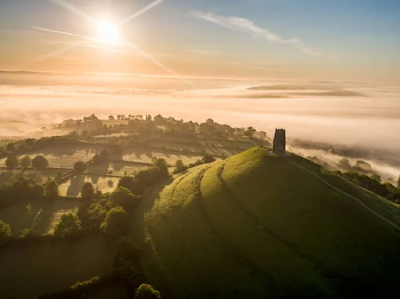
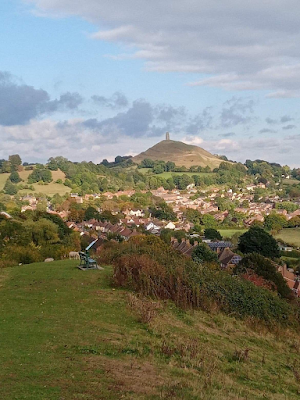
View of Glastonbury Tor from Wearyall Hill (where boats would arrive when Avalon was an island) 

In relation to my post from earlier today, which emphasized the role of individual, autonomous thinking in the world; a recent visit to Glastonbury seems relevant. Glastonbury has unsurpassed importance in the deep (and mythical, as well as historical) nature of Christianity in the British Isles. 

Yet since the 1970s, it has become a magnet for a New Age neo-paganism that is "anything-but-Christianity" in its basic stance. 

This -- even when New Age neo-paganism weaves-in versions of Christian legends about Jesus visiting Somerset as a child; the site of the first Christian church in Britain (and perhaps the first outside Palestine); a foundational role of Joseph of Arimathea; and the influences of the Holy Grail (also, perhaps, the Spear of Destiny). 

Thus, many of the people encountered in and around Glastonbury are on the anti-Christian side in the spiritual war of this world. 

On the other hand, Glastonbury was the chosen residence (and spiritual focus) of the recently deceased writer Geoffrey Ashe - which counts for something positive in my book. 


So, the situation is that the surface and social aspects of Glastonbury are mostly hostile and aversive to my kind of Christian spirituality; while the depths and resonances are tremendous. 

A visit therefore depends (even more than visits usually do) on the attitude we bring to the place. I think this is the case now days, with our autonomous consciousness, than it was in the past. For example, in ancient times and into the middle ages, it seems that a place of Holy pilgrimage would have an objective and essentially-irresistible beneficial effect on the pilgrim. 

But, even if so, that is certainly not the case anymore: to physically move oneself to what was called the Holyest Erthe in England is no longer beneficial unless one brings the right frame of mind. So much is clear from observing modern 'pilgrims', or hearing them talking about their experiences. 


This recent visit was with my brother; and focused on the ruins of Glastonbury Abbey, seeking books by Dion Fortune and Gareth Knight in the esoteric bookshops, the Chalice Well, and the Holy Thorn on Wearyall Hill. 

For, no doubt, a combination of reasons; our visit to Glastonbury was successful in terms of pilgrimage. We were able to see through whatever was aversive about the surface and many of the people; and experience what lay deeper. 

The question that comes to me now, is whether this benefit was wholly explicable in terms of perceiving the past shining through the present. And I think not. 

I think that the past as such has not this power; and what we are actually experiencing in such situations is the effect of living thinking of the alive (and the so-called dead) people for whom Glastonbury is a living spiritual resource. 


In other words; perhaps we are dealing with something much like what ritual magicians term 'thought-forms', or something like Jung implied by Archetypes. The positive, holy, creative thoughts of Christians have made a living, always-present spiritual resource that may be tapped-into by those who share such motivations. 

To tap-into such thought-forms does not require geographical proximity; yet the complex of attitudes and actions required to place oneself in Glastonbury, and to move around it in an attitude of expectation, can shape the mind to become especially receptive.

And, not only receptive. Having linked to a thought-form, our own thinking will (to some extent) modify, add-to, enhance that thought-form; and it is our experience of this participation that is exactly what makes a pilgrimage special and beneficial. 


Saturday, 12 August 2023

The sacred kingship of Arthur, and the role of Merlin (from Gareth Knight)


Having magically engineered his conception; Merlin carries Arthur, son of Uther and Igraine, into hiding.  

From The Secret Tradition in Arthurian Legend: the archetypal themes, images and characters of the Arthurian cycle and their place in the Western magical tradition. Gareth Knight, 1983. Excerpted from pp 123-4.

In the matter of Britain the days of the dawn of our epoch, man was far less individualized than he is now. Man was more group-minded and open to inner plane influences. Those who could best guide the destiny of their particular group were those who could be most readily receptive to teachings of a higher order of consciousness from the inner planes. 

Certain blood lines had a natural clairvoyance which was an important corollary of power and vision. This was the foundation of the concept of aristocracy and the 'divine right of kings' - a concept so deeply ingrained in human consciousness that Charles I was proud to be a martyr in defense of it. 

The importance of this sacred kingship, and our inherited ease of contact with the inner planes, is clearly demonstrated in the Arthurian legend of Arthur's conception and birth, which reveal a specific policy of genetic engineering on the part of Merlin. 

Arthur, according to Merlin's intention, was meant to be a priest-king in the ancient tradition of Atlantis, chosen before birth, as a result of a mating carefully planned in the light of esoteric genetic considerations. 

Merlin chose the two parents with great care. Arthur's father was to be Uther Pendragon, of the ancient British royal lines. On his mothers side, Arthur had the blood of an Atlantean princess, Igraine. She was one of the Sacred Clan, who had come to Cornwall and become the wife of the local chieftain; known as Gorlois, the Duke of Cornwall or Duke of Tintagel.

**

Gareth Knight was a scholar of Owen Barfield, and aware of the idea that human consciousness had developed through the centuries, in a particular direction from groupish to individualized, from obedience towards freedom; and in accordance with a 'divine plan'. Here he explains and imagines this in terms of the Arthurian legendarium - with the purpose of using the result as a focus for ceremonial magical activities. 

In particular, GK homes in on the transitional stage of human consciousness - the 'classical and medieval' centuries which came in-between the remote era of immersive and unselfconscious groupishness of tribal Man, and the current individualism of modern Man. 

This was a time when group-identity and clairvoyance could be found most strongly in certain blood-lines of inheritance; and when contact with the spiritual world was still achievable - but only by such people, and/or by the use of initiation, ritual, symbol and other 'technologies' and disciplines. 


This passage triggered thoughts of the English then British monarchy, and the occasional rulership of monarchs who - to some degree - approximated to the 'priest-king' ideal. There were several such in the Anglo-Saxon era - most notably Alfred; but the Norman invasion, which was an alien and hostile takeover, caused a considerable disruption. 

Not until Henry II (the first Plantagenet) do we find a monarch that might be supposed to have had some 'magical' attributes - mainly by the female influences of his mother Matilda (who was descended from the Saxon kings) and his wife Eleanor of Aquitane (who had many of the attributes of an fairy enchantress). 

From then, through to the end of the Stuart line (with the death of Anne), there were from time to time English kings or queens with a touch of magic about them, and an apparent capacity sometimes to connect 'clairvoyantly' with higher guidance: e.g. Richard I, Edward III, Elizabeth I.   


By my understanding, this form of natural magic gradually but inexorably dwindled, but persisted as at least a possibility into the 20th century - however it is now so weak a stream that it has become ineffectual. 

Such is the nature of these times, and of our predicament. 

There are three basic possibilities: 

We can yearn for, and try to restore, ancient ways -including the group-ish enchantment of those times; including to hope for the restoration of a sacred monarch, with divine right and naturally 'clairvoyant'  who serves his people by his own subjection to divine guidance. 

We can (and this has been the response of our official and mainstream culture) dispense altogether with the magical and spiritual aspects of life - except maybe as a hobby and lifestyle choice that does not affect our primary motivations (and these motivations are some mixture of political ideology with whatever is currently hedonically-expedient: i.e. the bureaucrat-careerist archetype). 


Or... we can look forward, through, and beyond the present aspiritual, mundane, ideological and hedonic world; and consciously seek as individuals for a qualitatively-different kind of spiritual knowledge and guidance. 


Wednesday, 2 August 2023

Ritual-Ceremonial Magic is nowadays (yet) another externally-imposed and institutional belief-set - hence probably net-evil

I continue to be intrigued by 'ritual' or 'ceremonial' magic, which in the UK was,  I believe, often (in the practice of such as Dion Fortune and Gareth Knight) a valid means of Christian living - up into the middle 20th century. 

But (I think) is nowadays insufficiently-effective (that is; insufficient to resist the strategic evils of our society and civilization) - or net-malign an influence (i.e. when it has 'converged' with the values of globalist-media-totalitarianism). 


This is because ritual magic was (it seems) rooted in the learning and repeated practice of directed imagination. Initiates were trained by being told what to do, and what to think about or imagine: what to visualize and to feel - while doing prescribed rituals or exercises. 

And the rituals or exercises were repeated multiple times; so that performing them either in real life, or in imagination, would lead to these inner sensory and emotional outcomes. At the end of such training, initiates were able to control their own responses to rituals, symbols, narratives ("path-workings") so as to experience them intensely. 

Beyond this, magic works by making 'contacts' with spiritual beings; and these beings were traditionally specifically named and sought - although in later years there was also the possibility of seeking a contact, making contact, and then (perhaps) finding out who that was (to a greater or lesser degree). (By this stage, Magic had begun to overlap substantially with New Age "channeling", in its various manifestations.) 

The purpose of these spirit contacts was perhaps instructional - intended to get information from the contacts; and partly the actual process of interaction with a contact may itself provide intense experiences of consciousness.  


So, for its adherents, magic could provide information about the nature and functioning of the world; and enable the initiate to have experiences of more intense consciousness - imaginations that are visual, auditory or via any other perceptual sense; and accompanied by strong emotions. 

Consequently, the motivational power of a magical kind of Christianity could be enhanced - in directions that depended upon the content of material that was being inculcated, top-down; by the magical society or individual leader.  


This type of Magical practice recognizes that Modern Man can and does (unavoidably) 'make his experienced-reality'; which is the 'reality' he knows and lives-by. Magic responds to this, by attempting to train people to make a more-or-less standard particular and desired reality for the members of a particular magical group. 

In other words; reality is given to magical adherents in a top-down fashion, analogous to the situation ins a traditional church. 

And this is exactly why I believe that ritual/ ceremonial magic has become essentially obsolete. 


Almost all institutions and formal groups have nowadays become converged with the secular-leftist materialism and its Litmus Test issues via which this agenda-of-evil is being pursued throughout Western civilization, and the places and people influenced by it. 

Since organizations are compulsorily politicized by bureaucratic means and through relentless mass-social media pressure (and usually politicized willingly, enthusiastically; since this evil corruption is so widespread among the masses); then this will affect more and more of the activities of ritual magic - the content of which is more and more leftist hence evil. 

In other words; ritual-ceremonial magic is susceptible to exactly the form of corruption that are the "Christian" churches; and for the same reasons. 


Men make their own experienced-reality - but the only true reality corresponds with that of God's creation. All others oppose created-reality, and lead away from resurrection to eternal Heavenly life. They lead, indeed; to self-chosen, self-made, self-imprisoning hells - of various kinds. 

I believe that already and increasingly; all forms of top-down influence are net-evil (that is, they contain some Good, because all that is created contains some Good - but overall and by motivation they are evil); that is. they are encouraging and enforcing one or many of the false realities in opposition to divine creation. 

As of 2023, these top-down experienced-realities are not just destructive of truth and Goodness; but often invert real values: therefore the methods of ritual magic, insofar as they retain effect, will tend to be dishonest and enforcing of lies; will tend to support and promote sin; will call ugliness beauty and reject the truly-beautiful as being ugly and oppressive.  


My conclusion is that here-and-now we cannot trust the content or motivations of any external sources - including magical traditions or societies; because they will very probably, implicitly if not explicitly, be training us in ways-of-being that net-oppose divine creation and serve the powers of evil.  

Group-ish and top-down (e.g. initiatory) practices that were possible, effective and overall Good just a century ago, or eve more recently; now almost always are the opposite; and are either merely ineffective or feeble, or else their power is harnessed against the divine and transcendental values. 

Like it or not; we are forced back upon our own powers of discernment; and the taking of active personal responsibility for our beliefs and practices.

And - as part of this - a recognition that our defense against corruption and possibility of pursuing Good is almost always by becoming aware-of, and actively-choosing-of, much that used to be unconscious, passive, taken for granted, taken on trust. 


Wednesday, 24 May 2023

Gareth Knight - Romantic Christian

In 2011, Gareth Knight (1939-2022) published an autobiography titled I call it Magic which is easy and enjoyable to read on the surface; yet contains several deeper layers of implied content that have only revealed themselves on re-reading.

Of particular interest was his account of the transformation in his own 'magical life' throughout his adult life; especially the changes in what he 'called' magic, the means by which he reached the state of enchantment or poetry, and the actual content of these magical-states. 


Knight began as a formal ritual magician, ascending through the prolonged training and initiatory steps of the Society of the Inner Light (founded a generation earlier, as a Christian organization, by Dion Fortune); he went on to found his own ritual magic group - on similar, though looser, lines; then to 'staging' much larger annual weekend events (almost 'happenings') at an anthroposophical centre called Hawkwood. 

By Knight's own account, in the 1970s to the early 1980s, these weekends attained a very powerful level of magical activity among the participants (who had been trained in the requisite methods of concentration and visualization). He then stopped doing this, and moved on to less formal and more improvisatory styles of magic either alone, with his wife and daughter, or in small and private groups. 


After the turn of the millennium his magic practice had changed further. In December of 2004 he was invited back to the Hawkwood weekend; which had changed considerably over the previous couple of decades (the following quotations are from Chapter 31 of I called it Magic) :

The occasion was a jolly romp, with the place filled to capacity, and a rich variety of activity. [But] Power was not ramped up to the degree that it had been in the early Hawkwood days...   

In other words, the experience was less-strongly magical, less enchanted than it had been. In other words; this corresponds to my observations on the declining power of symbolism and ritual through the late 20th century.  


Knight does not draw attention to the meaning of these changes for his inner life; but describes how in fact his practices changed - in the direction of becoming more individual, personally based, and exploratory (rather than relying-on an established and quasi-objective system of symbols, rituals, and group activity). 

Rooted in his study of French language and literature (in which subject he did a degree in later life); Knight embarked on an engagement with the medieval French Arthurian poet Chretien de Troyes:

I took upon myself the task of going through each of Chretien's romances as if both he and I were present, travelling through the whole scenario from start to finish as a kind of directed visualization, and writing it all down...

It then filtered into my head the realization that much that I had witnessed in this was was not chivalrous knights going to the aid of damsels in distress but accounts of their initiation into fairyland - for there was a strong case for seeing the principal female characters as faery rather than human. 


This led on to what Knight termed faery 'contacts' - which then led to writing several books deriving from these contacts. What this meant he explains further: 

It dealt in imagery but with a philosophical intent, yet a wisdom expressed more through the medium of a story than by intellectual definitions. To make the contact it was necessary to build a scenario [i.e. in imagination] something like a questing knight discovering a castle in a particular symbolic shape, and then entering into it... with a ... direct feeling of relationship with the fabric of the building itself. 

After further description of his imagined but real-seeming experiences; Knight elaborates the resulting new and deeper engagement with nature:

This kind of thing was at a different level from local countryside experiences where contact was virtually devoid of intellect but impacted more on the emotional and etheric levels... Along with contacts... came a greater sense of presence and communion with the world of nature, and particularly trees...

It may well be that experience and wisdom of this nature comes with age, which is [an] aspect of the Merlin and Nimue story... But there is no real need to await one's dotage for a realization of these things.


What Gareth Knight seems to me to be describing here, is a kind of recapitulation of Rudolf Steiner and Owen Barfield's scheme of the development of consciousness. The ritual magic was the Intellectual Soul era, characteristic of classical and medieval culture. 

Contact bears some relationship to 'channeling' of spiritual Beings - which he also did for example in a channeled series of direct communication (much like taking dictation) of 1993, published as The Abbey Papers

But 'contact' comes across to me as much more of a two-way interaction between himself and a spiritual Being - and not necessarily in words, nor in images - i.e. more direct than language- or symbol-mediated. 

Knight then moved towards what sound very much like Final Participation - which is something like a recapitulation in conscious thinking of what was a much more passive and unconscious in the spontaneous animistic Original Participation of early childhood and tribal Man. 

Animistic, because it recognizes the world as consisting of living, conscious Beings with which one may have relationships and communication. Knight also seems to be moving towards a communication less based on perceptions and visions, and more a matter of what I have called Direct Knowing: that is direct, wordless and imageless communication in thinking. 

In other words, a direct communion between Beings, such that the thinking of one is participated-in by the thinking of another. 


Once Gareth Knight had reached this kind of 'magic' I think he has largely left-behind the formal and institutional roots of his practice, and indeed its 'objective' aspects, where experiences were shared via a common language and symbolism that could be relied-upon to evoke the same inner states in its participants.

It seems he has - in practice, if not in terms of theorization - fully Romantic Christian; in that he takes an inner, intuitive and personal responsibility for whatever 'methods' he uses to attain magical states of mind (within the over-arching and primary Christian metaphysical framework).   

Knight puts this change down to his own personal development, experiences, expediency, and ageing - but such is the generality of such a development that I interpret it as driven by inner and divinely-destined changes in the human consciousness of Western Man. 


What all this seems to mean is that (here and now) we cannot rely upon external and institutional forms of spirituality to attain 'participation' in the world; and the language of 'objective' communication of spiritual experiences has weakening and withered. 

Yet, on the positive side, we can develop distinctive (perhaps unique) personal 'aids' and methods (i.e. 'contacts' occurring inside thinking, rather than as external 'events), that will achieve the participation which is natural, good, and divinely-intended. 

Also, that strong forms of achieved participation are likely to be more animistic and personal - engagement with particular Beings - than the abstract forms of earlier symbolism. 


Whether Gareth Knight would have agreed with my interpretation of his life and development is perhaps doubtful... 

It does rather involve a cutting-off of the branch upon which his life's work rested: that is, the general validity of some particular kinds of ritual, symbols, group-activity; and the communication of these in abstract and written forms, and by speech. 

But his desire to use more narrative story-like communications; his primary mode of magic in later life being a personal, inter-Being and two-way 'contact'; and the continually-evolving nature of the subject matter and formal techniques of his magic - all suggest that there was exactly such an evolution; and that Gareth Knight's life ended with him being implicitly a genuine and fully-realized Romantic Christian.