Showing posts sorted by relevance for query glastonbury. Sort by date Show all posts

Tuesday, 19 September 2023

What makes a successful pilgrimage, and why?


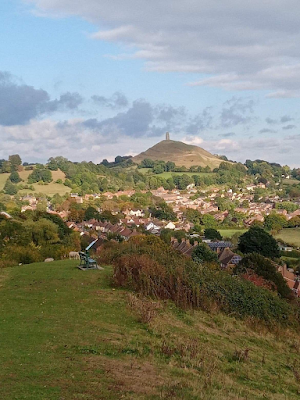
View of Glastonbury Tor from Wearyall Hill (where boats would arrive when Avalon was an island) 

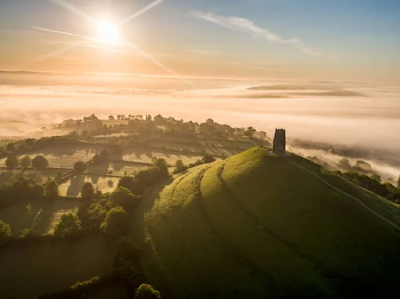
In relation to my post from earlier today, which emphasized the role of individual, autonomous thinking in the world; a recent visit to Glastonbury seems relevant. Glastonbury has unsurpassed importance in the deep (and mythical, as well as historical) nature of Christianity in the British Isles. 

Yet since the 1970s, it has become a magnet for a New Age neo-paganism that is "anything-but-Christianity" in its basic stance. 

This -- even when New Age neo-paganism weaves-in versions of Christian legends about Jesus visiting Somerset as a child; the site of the first Christian church in Britain (and perhaps the first outside Palestine); a foundational role of Joseph of Arimathea; and the influences of the Holy Grail (also, perhaps, the Spear of Destiny). 

Thus, many of the people encountered in and around Glastonbury are on the anti-Christian side in the spiritual war of this world. 

On the other hand, Glastonbury was the chosen residence (and spiritual focus) of the recently deceased writer Geoffrey Ashe - which counts for something positive in my book. 


So, the situation is that the surface and social aspects of Glastonbury are mostly hostile and aversive to my kind of Christian spirituality; while the depths and resonances are tremendous. 

A visit therefore depends (even more than visits usually do) on the attitude we bring to the place. I think this is the case now days, with our autonomous consciousness, than it was in the past. For example, in ancient times and into the middle ages, it seems that a place of Holy pilgrimage would have an objective and essentially-irresistible beneficial effect on the pilgrim. 

But, even if so, that is certainly not the case anymore: to physically move oneself to what was called the Holyest Erthe in England is no longer beneficial unless one brings the right frame of mind. So much is clear from observing modern 'pilgrims', or hearing them talking about their experiences. 


This recent visit was with my brother; and focused on the ruins of Glastonbury Abbey, seeking books by Dion Fortune and Gareth Knight in the esoteric bookshops, the Chalice Well, and the Holy Thorn on Wearyall Hill. 

For, no doubt, a combination of reasons; our visit to Glastonbury was successful in terms of pilgrimage. We were able to see through whatever was aversive about the surface and many of the people; and experience what lay deeper. 

The question that comes to me now, is whether this benefit was wholly explicable in terms of perceiving the past shining through the present. And I think not. 

I think that the past as such has not this power; and what we are actually experiencing in such situations is the effect of living thinking of the alive (and the so-called dead) people for whom Glastonbury is a living spiritual resource. 


In other words; perhaps we are dealing with something much like what ritual magicians term 'thought-forms', or something like Jung implied by Archetypes. The positive, holy, creative thoughts of Christians have made a living, always-present spiritual resource that may be tapped-into by those who share such motivations. 

To tap-into such thought-forms does not require geographical proximity; yet the complex of attitudes and actions required to place oneself in Glastonbury, and to move around it in an attitude of expectation, can shape the mind to become especially receptive.

And, not only receptive. Having linked to a thought-form, our own thinking will (to some extent) modify, add-to, enhance that thought-form; and it is our experience of this participation that is exactly what makes a pilgrimage special and beneficial. 


Tuesday, 2 September 2014

Glastonbury versus Wells

*
Glastonbury

Wells

Glastonbury and Wells are adjacent towns in Somerset, England - I visited both recently, and they make an interesting comparison.

Glastonbury is world famous as the centre of legendary Britain: the place where Jesus visited with Joseph of Arimathea ('And did those feet in ancient times walk upon England's mountains green?'), and/or where Joseph of Arimathea visited after Jesus's Ascension to set-up the first Church in Europe; and the Island of Avalon where Kind Arthur went at the end of his earthly life, where Arthur's tomb was discovered.

More prosaically, in Medieval times Glastonbury had at times perhaps the greatest, most scholarly Abbey in England. And A Glastonbury Romance by John Cowper Powys is considered one of the greatest-non-canonical novels in English Literature.

And so on.

*

But more recently (since the mid 1970s), Glastonbury has become the undisputed centre of New Age spirituality in Britain - and the venue for the biggest and lamest pseudo-sixties annual pop festival.

It is, to be candid - a seedy place, inhabited by a distinctly mixed population. Quite a lot of shabby weirdos, burnt-out cases and doormats and (presumably living-off them) and quite a lot of hard-eyed exploiters.

The ruined abbey is prohibitively expensive to visit and completely obscured by high walls to ensure nobody can get a free look.

In sum, with the exception of the magnificent Tor (well worth a climb) and a few decent shops (like Gothic Image); modern Glastonbury is peculiarly characterless, yet also an oppressive and sinister place - and a clear and unambiguous demonstration of why New Age can never be a proper or good religion.

*

Wells, on the other hand - just a few miles down the road - is the smallest city in England (that is: the smallest place with a cathedral) - a tiny gem of medieval and other old architecture. It has a happy and somewhat magical feel about it - probably leaking out from the stones.

Although the Church of England is now spiritually almost moribund and increasingly openly anti-Christian - it still has perhaps a decade or two of inertial 'Barchester'-like beauty and elegance to run; and the Church has, over the centuries, kept the place beautifully - as has the Wells Cathedral School (derived from the choir school) whose boarding kids apparently inhabit all manner of delightful old buildings dotted around the place.

So - if you happen to be in that particular part of the Kingdom - I would advise making Wells your priority. Glastonbury is not all bad - but on the whole it is a lesson rather than an example.
*

Friday, 26 December 2014

Supposing King Arthur really *was* buried at Glastonbury?

*
So far as I can tell, modern historians and neo-pagans seem united in regarding the 1191 discovery at Glastonbury Abbey of King Arthur and Guinevere's tomb as a fraud.

But the evidence that it is a fraud is itself very tenuous - and the matter in reality hinges upon prejudice applied to what would seem to be inevitable minor discrepancies in the scanty records.

*

Modern historians and neo-pagans are mostly very different people, but they are united in prejudice against the medieval monks; and effortlessly assume that they fabricated the whole discovery for cynical and materialistic reasons.

On the other hand, if we assume the Abbot and monks were honest and true (but fallible), then it is reasonable to assume that they did indeed discover Arthur's tomb; and certainly that is what everybody believed for the next few hundred years during which Glastonbury grew to become one of the largest, finest most visited Abbeys in Britain, with a magnificent library.

When the Religious Houses were robbed and destroyed by Henry VIII, Glastonbury Abbey and its monks were treated with exceptional brutality, and the place was looted by the authorities and then the locals who benefited from robbing the sites for a considerable time.

Along with the library, Arthur's tomb, which has been the centrepiece of the Abbey, disappeared (apparently) without trace. Somerset became strongly anti-Catholic - and since the early twentieth century the town of Glastonbury has been dominated by a socialistic, neo-pagan, Gnostic, syncretic - in a word 'anti-Christian' - sensibility.

*

But suppose that Arthur's tomb really was discovered and restored and revered in Glastonbury Abbey - that leads to a rather different narrative than the usual one; and one that is far less flattering to the post-Catholic authorities and Somerset locals.

If we were prejudiced in favour of Medieval Catholicism and the Abbey, rather than the modern Leftist establishment and post-modern New Age 'counterculture'; then we might see Glastonbury and its history as a horribly cynical example of victim-blaming - in which vilification of the monks was used to justify murder, wrecking and looting; and history was re-written from the perspective of these self-serving lies.

Modern Glastonbury would then be the degraded consequences of the systematic destruction of ancient, legendary Britain - including her most potent hero, Arthur - and the severing of our magical and mythic links with that era; while falsely posing as a continuation of the very same legendary tradition which it in reality destroyed

If we add to this, the that the legend that Glastonbury (by Joseph of Arimithea) was actually the very first Western Christian community was also true - then the whole story takes on an epic and tragic form.

*

So much hinges on our interpretation of that 1191 discovery of Arthur's tomb. If it was not the fraud, that 'everyone' now believes it to be - if it was real; then an extraordinary 'alternative history' opens back onto a lost inheritance of mythic history.

The matter of Britain, and her once and future destiny, take on a very different complexion.

*

Monday, 18 August 2014

The Old Straight Track

*

When I read Alan Garner's Moon of Gomrath fantasy novel

http://charltonteaching.blogspot.co.uk/2013/10/review-of-alan-garners-weirdstone-of.html

it was about 1974 - and therefore the wonderful description of The Old Straight Track was something arcane.

The end of the book referenced this idea to Alfred Watkins book of the same name; and my history teacher told me that the OST idea was unproven, but not disproved either.

*

The OST idea was that English people of ancient prehistory, probably neolithic, had made long distance, straight roads across the landscape, using a simple surveying method requiring just sticks - and navigating from one sacred point of high ground to another.

These points could be identified by the presence of ancient landscape features such as burial mounds, stone circles, and - it was said - the site of old Christian churches (which were assumed to have been built on these same sites).

The tracks could therefore be located using 1 inch to 1 mile maps (supplemented by two and a half inches to the mile detailed maps) - by trying to find straight lines that joined ancient landscape features, especially on hill tops.

A minimum of three 'points' was needed - but the more the better. Then you were supposed to walk the track, preferably with a camera, to look for other features and assess plausibility.

*

So I started hunting for Old Straight Tracks, using an Ordnance Survey maps of the Mendip Hills in Somerset - I just found this actual map a few days ago, and it is covered in neat pencil circles drawn with a compass around ancient sites and churches, and with a cross-cross of straight pencil lines trying to join them. The Mendip Hills are extraordinarily rich in these sites, so I managed to find a few possibilities.

What is interesting about this episode are the negatives.

I was looking for prehistoric Old Straight Tracks - and not 'Ley Lines'.

I don't think I had ever heard of Ley Lines. But Ley Lines are not exactly the same as The Old Straight Tracks, as originally described by Watkins; because he was talking about roads, while Ley Lines were/are conceptualized as primarily energy/ spiritual phenomena.

*

The second negative is related to this. My Mendip map included Glastonbury, and it would now seem blatantly obvious that Glastonbury - especially the Tor - ought to be a major focus for Old Straight Tracks or Ley Lines - yet I did not circle it!

This is because in the middle 1970s, Glastonbury had not become the nationally/ internationally known focus of New Age people and ideas it has since become. Or more exactly, the status of Glastonbury as a spiritual/ religious centre was only just coming out of a rather low ebb of a few decades - because it had been well known in the 1920s and 30s as evidenced by the early Glastonbury Festivals of Rutland Boughton and associated mysticism, and the great mega-novel A Glastonbury Romance by John Cowper Powys - but both of these were pretty much unknown (The reviving Picador paperback reprint of GR came only in 1975).

*

So my annotated map of Old Straight Tracks is something of an historical artefact. If it had been done just a few years later, I would have had to accept a spiritual dimension (or baggage) along with the Old Straight Tracks, and I would probably have assumed that any valid STRs in Somerset would be converging-on or radiating-out-from Glastonbury.

By the way - I personally no longer think it plausible that the ancient English did use straight roads, and in official circles the idea is nowadays generally regarded as untrue and having no significant support.

Which is a bit of a shame. However, among the New Age spiritual folk, in the form of Ley Lines, OSTs are sometimes a major focus of belief; and are referenced in dozens of books as the major theme, and hundreds or thousands of books as a significant phenomenon - being applied internationally and not just to Brtain.

'Ley Lines' is now almost a household word - albeit in a rather low status and 'flaky' kind of way.

So Alfred Watkins speculations have been a spectacular success - but in an extremely different domain of knowledge from that he envisaged when he wrote The Old Straight Track in 1925.
*

Monday, 23 June 2014

Why I am fascinated by William Arkle

*

Why am I fascinated by William Arkle's work - why have his writings (and also paintings) hit me like a bolt of lightning? 

There are two answers - 

First: That what Arkle has to say is important and relevant to current cultural needs; and has validity because (I believe) it comes from well-motivated and genuine mystical-experiential insights. 

Second: I can perceive - in retrospect - that I was 'meant' to be doing this many, many years ago - and have been ignoring strong 'hints' to this effect since the mid-1970s...

*

1. As a teenager I lived in the same village (Backwell) as William Arkle - probably overlapping for about a decade; and my sister knew his wife and daughter (via an interest in horses).

2. I used to be close friends with Arkle's next door neighbours - visiting often and staying as a guest a few times. And these were 'neighbours' in the sense of being two of only three residences - the other was a farm - on top of a hill and with no other houses for a radius of about a mile in all directions!

3. I saw a BBC television documentary program about Arkle in about 1976, and was both amazed and reluctantly fascinated by the idea of a spiritual 'guru' living so near-by. 

4. I read his book Geography of Consciousness in 1978, having I discovered a copy in the Edinburgh City Library after my family had moved from Somerset to Scotland. The introduction to GoC led me to read Colin Wilson, and from then on I read a lot of CW - however, I tended to regard Arkle as essentially a Wilsonite; an influence on CW, rather than a thinker in his own right. 

5. Nonetheless I loved the first section of GoC about awakening in the morning, throwing back the curtains etc. It stuck in my mind and fascinated me - so from 1978 I was looking-out for a secondhand copy of the book. I would often check for this whenever I went to a secondhand shop. I never found a copy anywhere. 

This led to the most clear-cut example of synchronicity of my whole life. 

I was walking through the Bloomsbury area of London, near the British Museum, sometime in the mid-1980s when I saw an unusual-looking little bookshop (it may have been an Eastern Religious or Anthroposophical shop, I can't recall); and it came into mind that they may have a copy of Arkle's book - or perhaps that they did have a copy. I walked into the shop, and straight to an upper shelf (no looking around) where there was the book - apparently waiting for me. 

6. I even visited William Arkle's house (in about 1982-4) and spent an excellent evening with his son Nick (an electronic music composer - he was showing me around his studio). During this visit I actually saw William Arkle, and said hello to him. But I didn't take things any further. 

7. In early 2008, just before a visit to Glastonbury, I discovered the web pages http://www.billarkle.co.uk and discovered that the Arkle family had relocated to Glastonbury before Arkle died in 2000. While I was in Glastonbury, I asked a couple of people if they knew about him (in a cafe and a book shop), but drew a blank. 

8. However, it was only after the death of Colin Wilson earlier this year that I read, and really engaged with, and finally understood William Arkle.  

*

The significance of all this is that, in retrospect, it is clear to me that I was supposed to meet Bill Arkle, or at least to engage fully with his ideas, for several decades before I actually did so. 

And by 'supposed' I think I mean by some kind of divine providence - because nobody else could have laid-on all these encounters. 

*

My understanding (and I don't much care what other people may think about it! - after all, synchronicities are not designed to be any kind of scientific proof or legal evidence or public rhetoric) is that this was a path set out for me to take, for my own good - but a path that I resolutely and repeatedly avoided treading. 

I was given chance after chance, hint after hint - all of which I rejected. 

Who knows what might have happened has I taken notice of these chances and hints - but I did not!

*

So I start from where I am, belatedly.

Perhaps I was not ready earlier, because it was not until 2008-9 that I became a Christian and open to the reality of the divine, and then it took longer before I felt able to discern when someone was a real mystic - speaking with the validity of direct personal experience, and probably I also needed to understand and align-with Mormon theology to appreciate Arkle's particular contribution.

Or perhaps I would have been ready earlier if I had taken notice of the chances and hints. 

Anyway, that is why I am now reading and thinking about William Arkle with such intensity. 

*

Friday, 13 August 2021

Christianity in England - deep past, and the present


My understanding is that Christianity came to England very early, within not-many-years of Jesus's death - to Glastonbury in Somerset - and western parts of England have been continuously Christian since. Whether Christianity was brought by Joseph of Arimathea (as legend states) or by someone else, I don't know - but I think it arrived very early. 

England has therefore been continuously Christian for a very long time - perhaps about as long as anywhere outside the Holy Land. 


Christianity stayed in England after the withdrawal of the Roman Empire in 410; initially through the whole country, but later it was pushed westward by the Anglo-Saxons - who arrived from 449 and were pagans. 

This 'Celtic' Christianity had the characteristics of the early church, which was much like Eastern Orthodoxy - that is, it was based around ascetic monks ruled by Abbots in rural settings (rather than Roman Christianity which dominated the rest of Christian Western Europe was based on priests ruled by Bishops, and mostly rooted in the urban cathedrals). 

It took the Saxons a long time to get as far as Glastonbury in 658 - and by that time, the Saxons were already Christian. Therefore at Glastonbury there was an amicable transition-fusion of the residual Celtic Christianity of the Ancient Britons and the newly-converted Anglo-Saxons, which (in the South) was more Rome-influenced via St Augustine. 

At the same time, Celtic Christianity had been converting the northern Anglo-Saxons, coming from Ireland, via Iona, reaching England from St Aidan at Lindisfarne - the Holy Island off the coast of Northumbria.  

By the middle 600s the dividing line between Celtic and Roman Christianity was within Northumbria - with St Cuthbert of Lindisfarne in the northern part and St Bede of Monkwearmouth (who became Cuthbert's biographer) about 50 miles to the South. Relations were mostly amicable. 

But gradually the Romans imposed their system (and their more astronomically accurate calculation of Easter - accomplished by Bede) on the whole nation starting from the Synod of Whitby in 1664. Cuthbert became bishop of Hexham further South in Northumbria, where the Abbey was at that time the largest stone building west of the Alps, and a centre of Roman Christianity. 


My point is that the deep history of Christianity in England is very deep. While at the same time, the leftism that has proved to be Christianity's most successful foe (and Satan's most useful and strategic stalking horse) also substantially had its roots in England. 

England has therefore been one of the leaders of Christian apostasy - and the faith is by now very weak both numerically and in terns of strength of conviction (2020 revealing the situation as even worse than almost anyone would have expected, when some of the most apparently devout Christians were revealed to be more profoundly leftist than Christian.   

In sum - England has been a place of major contention in the escalating spiritual war of these End Times. Although it would superficially seem that the battle of Christians has long since been lost - the roots go very deep; and the continued special attention paid by the Satanic forces to England suggests that things are not yet done-and-dusted, not yet over-and-done-with. 

'They' clearly perceive a potential threat from England to Their evil plans.  


England still has a part to play in the End Times - if we Christians so choose, one way or the other. And, although events are desperate here-and-now for the followers of Jesus - they are not quite so bad as they were this time last year. 

Which I find surprising and encouraging. 


Monday, 20 November 2023

Somerset Spirituality in the late 20th century


Although born in Devon; I spent all my school years living in a village in north Somerset. But, because I was (mostly) a rationalistic atheist, I was almost unaware that during this time, as well as for some time afterwards, Somerset was a centre for some of the best exponents of spiritual (including Christian) thinking - several of whom lay within a bicycle ride of my own house. 

Somerset was indeed the residence of several people who since become some of my most important spiritual mentors.  

Mostly, this Christian spirituality was a subset of the fact that (outside of London) the main place for New Age thinking was (as described by historian of paganism Ronald Hutton - who has himself been at Bristol University since 1981) an isosceles triangle with its base cornered by Bristol and Bath, and its point at Glastonbury. 

My lack of interest in this kind of thing - at the time - is evidenced by the fact that I did not visit Glastonbury until after I had left school, and the family was was just about to move to Scotland!

Nonetheless; I believe that spiritual influences of place do have an effect; sometimes all the more powerful for being latent and unacknowledged; and in later life these influences began to pile-in upon me. 


Terry Pratchett (among other things) wrote superbly on aspects of Southern English folklore; and he was living not far away in in tiny Mendip village of Rowberrow, practicing "self-sufficiency", beginning his publishing career, and absorbing the same Electric Folk influences (especially Steeleye Span with their interest in supernatural ballads) that so much dominated my teenage years. 

John Michell - Christian Platonist and Geomancer - was another inhabitant of this region; living in Bath; which city also housed (for a while) our-very-own William Wildblood

Then there was Geoffrey Ashe. He was the only one of these people of whom I was aware at the time; because he was well known as an advocate of South Cadbury Hill Fort as the location of King Arthur's "Camelot". I even visited this impressive earthwork one gloomy Sunday afternoon with my Dad, and felt some of the site's presence. 

William Arkle actually lived in Backwell, the same village as myself ; albeit up on top of Backwell Hill. I knew nothing about him until a few months before I left school, when there was a local BBC TV documentary programme about him. I was intrigued, and tried (without success) to find out more; but was put off making contact by my reflective anti-Christianity (in the programme he talked about God in a manner that I found off-putting). I could very easily have visited and met him - especially since my sister knew the family to talk to, via an interest in ponies - but I didn't...

Another Glastonbury resident in his later life (and a frequent visiter to nearby Winscombe as a child) was Stanley Messenger, an unusually thoughtful and independent-minded Anthroposophist. 

[See note added]


All of the above people have, in different ways and to various degrees, been important to me in my spiritual life and development. All have significant Somerset connections, and all (except Stanley M, I think) overlapped with my residence of the county, and were indeed situated nearby. 

This now strikes me as quite remarkable - because the above names constitute a large proportion of the authors, thinkers, lecturers - learning from whom has led me to where I am now. 

Clearly, Somerset set its mark upon me; and that influence has continued to grow in the 45-plus years since I moved away.  


Note added 5th December 2023: I have just discovered that the folk musician Bob Stewart (expert Psaltery player) and scholar of folk mythology (Where is St George? - recommended!) was living in Bristol and Bath from the late 1960s and into the 1980s. He later went on - renamed RJ Stewart - to become associated with Gareth Knight, a prolific and influential author of books on ritual magic, and workshop leader. 

Thursday, 3 March 2016

New Age spiritual people - sordid shenanigans are not a good advert for their beliefs

Before I became a Christian, there was a period of about a decade when I was very interested in what might be termed New Age spirituality - I was one who could describe himself as Spiritual but not Religious.

I don't reject this tradition in toto, nor deny that there is value in it; and indeed a vital implicit message for Christians which is that alienation is probably the main disaffection of the modern world. Christians would do well to address this more up-front and focally - since it is a more acute form of angst nowadays than, for example, the consciousness of sin.

But for all my interest, I never joined any New Age group or organization, and the reason was that I found the individuals involved to be off-putting. Indeed, among the scores of authors I encountered -set aside cnsumers, there were barely a handful I found tolerable as persons or whose lifestyle seemed admirable (in so far as I could discover this): they were and are not an impressive bunch (at least, not to me).

This was confirmed by two visits to Glastonbury spaced out over six years - this town being the centre of all that is New Age spirituality in Britain; and a place that has had more hyperbolic praise for its special and wonderful atmosphere than perhaps anywhere else.

(Glastonbury is, indeed, one of the most significant places in the history of Britain and indeed the world - and I think, believing the legends as I do! - perhaps a place Christ visited as a young man with Joseph of Arimathea before commencing his ministry, and probably the site of the first Christian church outside the Holy Land.)

However --- I found Glastonbury as it is now at best underwhelming; but in fact mostly somewhat unpleasant - with a seedy, fake and slightly sinister feel about it; and (with a few exceptions) a much higher than usual head count of apparently damaged, emotionally-desparate or exploitative people.

This contrasts with my experience of (real, not liberal) Christians, where (without going over the top about it) there are located some very decent and trust-worthy people, the general atmosphere is considerably more wholesome than average, and there is a fair bit of courage, integrity, beauty and a lot more altruism than I myself am capable of. Something to look up to.

A lot of this boils down to s-e-x (variously extra-marital, promiscuous, unconventional, experimental) - I strongly suspect that the usual, mainstream secular and materialist motivation of sex is powerfully at work on or just below the surface of New Age spirituality - and there are very few who are exempt. This means that whatever spirituality is on-the-go is - in practice - put into a subordinate place; and the spiritual side really doesn't work as the primary motivator.

It would be going too far - but not much too far - to suggest that New Age spirituality in real life (as opposed to in theory) seems to operate like a gigantic rationalization for aspirational sordid shenanigans!

Thursday, 25 June 2015

Spiritual corruption of Glastonbury

Glastonbury was one of the most spiritually significant places in Britain; now we can be sure that it is one place from which a renewal of spirit is excluded.

The town was first corrupted from a great Christian site into a seedy maelstrom of evasive, collaborative New Age mutual exploitation. Then the Festival usurped the town; and then the BBC usurped the Festival.

Glastonbury now exemplifies everything that is most wrong with Britain - the confluence of finance, bureaucracy and the mass media; wrapped in fake robes fashioned from past greatness.

Tuesday, 25 February 2025

The current orgy of virtual Schadenfreude


The current online orgy of virtual Schadenfreude - triggered by media reports of the activities of the new US Presidential administration - is a dismaying spectacle in many ways, from my Christian perspective.

"Schadenfreude" describes the (spiteful) emotion of gratification at the (real or imagined) sufferings of others - typically of one's enemies. "Real or imagined" is relevant, since the current sufferings are substantially imagined, being learned-of via news-media reports and governmental/ bureaucratic announcements. 

That is why I inserted the word "virtual" - because the information on the sufferings is substantially indirect, secondhand, and obtained via mass/social media and from State sources. 


At least two things should be said about this online delight. 

The first is to clarify that reports of sufferings will almost certainly be misleading. 

The second, and more important, that the reported activities being celebrated are almost-wholly negative and destructive in nature - therefore not driven by any explicit and conscious, positive Christian motivation.


I have been deeply suspicious of claims of destruction of the managerial bureaucracy, since I had inside experience of such events about thirty years ago, within the UK National Health Service. 

The government of that era claimed to be determined to "cut red tape", including severely reducing the particular layer of bureaucracy within-which I was working. 

Official announcements from the specific layer of NHS bureaucracy also claimed (and complained) that it was being reduced severely. About 150 jobs were supposedly to be cut from a single office complex where I worked - and official returns to this effects were submitted. 

The news media duly reported the 150 jobs cut. 


Yet those on the inside knew that this was a kind of theatre for public consumption. 

In reality, hardly any jobs were cut - and these were almost exclusively among those who wanted to leave anyway and were grateful for severance pay. 

Nearly all of the 150 sacked/ let-go were redeployed within the larger organization; and/or rehired into almost the same jobs, shortly after the big announcement of cuts. 

The message is that, when you hear or read about job-cuts, layoffs, closures etc; all this kind of stuff may quite easily be faked - but faked in a way that is not detectable without detailed inside knowledge. 


The deeper problem with this current celebrations of destruction, is that of the underlying motivation. (Because the difference between virtue and sin, between good and evil, is essentially that of motivation - rather than specific action). 

A motivation for destruction as such, is anti-divine-creation, hence an evil motivation - and therefore leads to more and greater evil. 

And this applies pretty much for anything that might be destroyed - almost regardless of how useless or evil it is. 


An historical comparison could be the Dissolution of the Monasteries that happened in England under the rule of Henry the Eighth. 

The Roman Catholic Church itself, and its religious orders in particular - monasteries, friaries, priories, nunneries - owned a vast and still increasing proportion of the national wealth (from memory, something between a third and a half of the land). 

Church abuses were rife and widely experienced by the English population; there was a good deal of exploitation, luxury, self-indulgence, and political activity; and apparently much less (although certainly still a significant amount!) of asceticism, scholarship, piety, charity, and virtue. 

Therefore, there was no shortage of those among the English who celebrated (even when they did not personally benefit from) the truly colossal appropriation, violence and destruction that followed. 

My impression is that there was a good deal of tacit, if not active, public support for the Dissolution - as well as senior political, and a large segment of religious, leadership involvement. 


A great deal, therefore, of Schadenfreude was evident in the Dissolution. 

For instance; when the last major Abbey, in Glastonbury, was closed and demolished, and the greatest monastic library in England was destroyed; and its Abbot and two other senior clerics were publicly hung on top of Glastonbury Tor - it seems that the local population were pleased to observe their ex-landlords get "what was coming to them". 

Yet the Dissolution of the Monasteries was a national catastrophe, especially for the middle and poorer classes, from which it took England generations to recover - if indeed it ever did recover. More than a century of terribly destructive religious wars and exterminations were initiated. For many decades, there were almost no schools or hospitals, and no organized provision for relief of the poor.  


My simple point is that when goals are negative and destruction is the primary aim - and when this is unacknowledged, un-repented; spiritual disaster will surely ensue. Because this is, in effect, a celebration and endorsement of evil. 

No amount of negative action ever amounts to a positive strategy - and almost all current self-styled positive motivations are merely double-negative simulations. Or else, like Western "nationalism" as of 2025; almost wholly wishful, conjectural - hence in practice very secondary to other motives, and far too feeble to be effectual. 

With respect to the native populations of Western nations in 2025; any motivation that is truly good, positive, virtuous; absolutely needs to be consciously chosen and a grass-roots/ bottom-up phenomenon. 

Because, however differently things were in the past, good cannot now be done covertly nor in a top-down fashion. 

So that all fantasies of covert positive top-down agendas among the ruling elites are impossible, as well as unreal.   


In sum - the current orgy of online Schadenfreude may concern much that is merely virtual; and by its celebration of negative and destructive motivations, is very likely (from a Christian point of view) to prove multi-valently corrupting of those who engage in it. 

(As, indeed, seems to be the case.) 


Monday, 21 November 2016

St Michael and Britain - from William Wildblood

The patron saint of England is St George who was a Roman soldier of Greek origin born in Palestine, a strange choice for a national hero you might think. However Edward III adopted him for his courage in combating adversity and as an example of the triumph of good over evil, demonstrated by his killing of the dragon. Now the only other saintly dragon killer I am aware of is St Michael who crushed Satan and threw him down to earth after the great rebellion in heaven. So I am led to wonder whether St George is actually a human representative of the archangel and whether England might not, in some way, be also under the patronage of St Michael. Of course, many other places would be too but Michael was apparently the most popular saint in medieval England after St Peter, and before the Reformation many churches were dedicated to him, often on hilltops such as the one on Glastonbury Tor.

http://albionawakening.blogspot.co.uk/2016/11/le-mont-saint-michel.html

Friday, 3 October 2025

Magical duels between early Christian missionaries and Druids of the British Isles


In the Roman and post-Roman era; the early Christian missionaries to the British Isles were highly successful at converting the Druidic pagans. 

This may suggest a basic religious compatibility; such that Christianity may have seemed like a natural extension or complement of the Druidic religion. 

For instance; according to Julius Caesar, the Celts of Gaul and Britain seem to have been exceptionally courageous in battle because they did not fear death; being convinced that they would personally survive death in some mode of reincarnation back into this mortal life. 

In a context where personal survival was already an established conviction; the Christian missionaries promise of resurrected eternal life in a Heaven, rather than merely returning to re-live "more-of-the-same", may have been regarded as a significantly better prospect. 


But, even if the post-mortal Christian outcome was better than what Druids could offer; there was the problem of establishing the missionary's authority to promise it. 

After all; why should a Celtic tribal King believe the word of some foreign priest who turned-up at his hall telling a story about the afterlife?  

A Christian missionary would therefore need to establish his own divine authority; and this would usually (it seems) be done by performing "wonders" with divine aid: wonders such as miracles, and also defeating the existing priesthood in trials of spiritual-strength.

This was done to prove the new God was stronger than the old ones, and prove that the new kind of priest spoke with divine authority.   


One such trial of spiritual strength was some variation of the magical duel - analogous to that in the Old Testament (Exodus 7: 8-13) between Aaron and the Pharoah's magical priests - the episode of the magical staffs and the snakes. 

It is important to recognize that the magic of Pharoah's wise Men is depicted as real; but weaker than the magic of Aaron and Moses.

Much the same things were reported in the evangelization of the British Isles, as John Michell summarizes in his 1990 book New light on the ancient mystery of Glastonbury ( pp103-4: I have condensed this passage):   

The great mystery behind early Christianity in Britain is how the first missionaries managed to persuade the chiefs, nobles and Druids to lead their people in converting to the new faith of Christ. Certainly there was opposition, but there is no record of violence or bloodshed. 

Contests between the rival men of religion took place on a professional level, as trials between rival magicians. We only hear about those engagements where Christians won, but it appears that their magic was generally superior to that of their opponents. 

Thus St Patrick prevailed over the Druids of Tara, St Columba defeated the Druids of Bruidh, and St David won a contest with the magician Boia. 

In times when the outcomes of battles were largely determined by the powers of the Druids on each side, a compelling inducement to accept Christianity was that Christian magic proved more effective than that of the pagans.  

The arts of ancient magic are no longer known and it is impossible to say by what combinations of psychology, conjuring, weather control, and elemental invocation; prehistoric battles were conducted. 

It is clear, however, that (unlike Christian magic) the magic of tribal shamans was ineffectual against outsiders of a different religion.


My understanding is that in ancient times magic was real and powerful, and could (in some civilizations) reliably be deployed as required (for instance, to build the pyramids). 

Nowadays, I think magic is still real, still happens; but evidently it is weaker and much less reliable than in the past. Thus; magic cannot nowadays be commanded in ways that seem to have been normal (at least for suitable gifted and trained persons) in Biblical times, or in the early centuries AD.

Nonetheless; it seems only honest to recognize that (bowdlerisations aside) early Christians used magic, as well as other types of miracle, to establish their credentials as speaking with authority on behalf of Jesus. 

Indeed; the remarkable effectiveness of early British missionaries (including those who later became Saints) was sometimes due precisely to the greater effectiveness of the new Christian magic, as compared with the old magic of rival pagan priests.  
 

Thursday, 29 September 2016

Geoffrey Ashe from 1982 on the pre-requisites of spiritual awakening

At the end of Avalonian Quest, an insightful book on Glastonbury as a phenomenon, Geoffrey Ashe closed with some wise words on what was needed (cica 1982) for there to be a spiritual awakening. 34 years on, it has not yet happened - but his words remain true:

http://albionawakening.blogspot.co.uk/2016/09/geoffrey-ashe-1982-on-spiritual-rebirth.html

Tuesday, 5 October 2021

Merlin, the Celts and Albion's native Christianity

It seems possible that Christianity came very early to Britain, shortly after the ascension of Christ, and probably to Glastonbury; at the time of the native Celtic Britons. 

Perhaps because of this, and for many centuries, there was historically very little conflict in the British Isles (and no recorded conflict at all in Ireland) between Celtic paganism and the new Christianity.

This had a lasting effect. Because the new Christians were not persecuted by pagans, when Christians became dominant they did not persecute the pagans but assimilated them. Churches were deliberately built on the pagan sacred sites. 

And the old pagan deities were downgraded rather than suppressed; to be named among ancient kings, mythic heroes, or even being transformed to saints.  


Also Britain was the centre of druidism, the place where continental Celts sent their druids for a very prolonged and difficult education - presumably in colleges of some kind; all this knowledge being memorized and never written (although there was perhaps a written language at the time, using ogham letters)

Druids were leaders of the Celts; with, apparently, a wide-ranging role including ritual, scholarship, divination, healing and warfare. They conducted sacrifices, including human. And these druidic pagans were exceptional in the known world for their strong belief in a personal afterlife - an afterlife in which Men retained their individual identities. 

That this belief in an afterlife was strong is evidenced by Julius Caesar, who gave it as the reason for the exceptional courage in battle of the Britons; that it involved retained personal identity may be inferred from the Ancient Briton's practice of guaranteeing loans (IOUs) to be paid-off in this afterlife. 

Both of these imply that the Celts knew a lot about the afterlife - in that they had apparently rather exact expectations of what it would be like. 


The Celtic expectation of eternal life contrasted with the Greco-Roman and Jewish belief in a afterlife as merely depersonalized ghosts in Hades/ Sheol. The Greco-Romans apparently interpreted the Celtic belief as reincarnation - like the Pythagoreans - but it was more likely a belief in Paradise: Men living eternally in an ideal kind of society and situation (on a magical island to the west, for instance).  

This means that when a pagan Celt converted to Christianity and a belief in Heaven it was qualitatively different from the situation for a Roman or Jew. The Roman or Jew expected annihilation of the self - while the Celt expected preservation of the self. 

Therefore, for the Roman or Jew Christianity Heaven offered a qualitative transformation of the self, whereas for the Celt it was more like a quantitative enhancement - a divinization - of the self.


I would speculate that this difference in pre-conversion expectations may have led to a difference after conversion. The Greco-Roman or Jew perhaps focused on the new fact of eternal life - and was therefor almost exclusively concerned with salvation. While the Celt would have been more impressed by the enhancement of the self towards becoming a god: a 'Son of God', much like the ascended Jesus - and therefore more focused on theosis - on working to become 'more divine' during mortal life. 

At any rate, mainstream Roman/ Western Christianity was rather vague (and indeed uncertain) as to the details of the afterlife; at least until the Mormon revelations from 1830, which began to provide a much more detailed description - and expectations. 

But I would guess that the Celtic Christians would have had similarly detailed expectations of Heaven, inherited from their pagan predecessors. 


In terms of its organization, Celtic Christianity resembled Eastern Orthodoxy much more than Roman Christianity. Whereas the Roman church was dominated by Bishops and Priests; Orthodoxy is spiritually dominated by Abbots and Monks - and with semi-autonomous hermits inhabiting remote 'desert' regions and performing heroic acts of asceticism (fasts, vigils, prayer), often at the summit of holiness. 

But Celtic Christianity was substantially cut off from Constantinople, as well as Rome; and developed along the native lines established very early. These included a great emphasis on mysticism (communion with God) and miracles, with most of the Saints being wonder-workers (most famously Cuthbert).

Although normal in Eastern Orthodoxy, given the pagan assimilation this mysticism may also link up with druidic initiation, which went through many rigorous levels and aiming at spiritual powers that were regarded as magical. 

In particular; it may be that the folk heroes of the British may be traced back to those ancient Celtic Gods, assimilating into Christianity. According to the work of Geoffrey Ashe (e.g. Avalonian Quest); Arthur may have derived by many steps from the original primordial titan that was assumed (in the oldest chronicles) to be the ruler of England when it was invaded by Men originally from Troy. This character reappears as the giant Albion in William Blake's prophecies. 

Merlin (originally Myrddin) may go back even further, to an even more ancient God who ruled the island of Britain originally. Merlin was originally a place-name for a fortress - but became a personal name. The first recorded name for Britain can be translated as Merlin’s Precinct, or enclosure. The Merlin of literature could have been derived from this ancient god. 


By Geoffrey Ashe's account in Merlin: the prophet and his history; the Merlin that we know from literature seems to be derived from a title, role or nature of a person - probably one with prophetic and magical abilities, due a relationship with the ancient god - perhaps as a reincarnation or by divine inspiration.

This led to the the first two known historical Merlins - Ambrosius/ Emrys, the Welsh magician prophet Merlin who mostly contributed to the Arthurian mythos via Geoffrey of Monmouth's History; and Lailoken the later mad prophet Scottish Merlin - who is represented in Geoffrey's later Merlin poem, and who features in the stories of the Scottish Saint Kentigern/ Mungo (the first Bishop of Glasgow, and a missionary of major historical importance). 

Another 'Merlin' may have been the Welsh bard Taliesin, author of the oldest surviving native poetry; he is recorded as a companion of Lailoken-Merlin, by Geoffrey.    

The Merlin of literature (and his descendants among many other wizards) exerts a continued - perhaps increasing - fascination in Britain (and the Anglosphere more generally). This may have spiritual significance, as some kind of folk-memory of the Celtic Merlin god, via the historical-and-legendary Merlins of the Dark Ages - as assimilated and transformed by the unique nature of Celtic Christianity. 

It may even be that - to the Romantic Christian imagination - Merlin is a Celtic name for the archangel of Albion: the angelic being who has been responsible for that ancient and indomitable spiritual reality which underlies modern 'Britain'. 


Wednesday, 3 October 2018

Isolated, focal Good attracts the demons

It is a problem of traditional concepts of Christianity that it tends to set-up very focal and specific centres of Good - and these are easily subverted. If there is an especially holy place, person, ritual - then it gets noticed, labelled, publicised - and will attract concentrated demonic attention. Goodness comes under siege, is forced to defend and defend, and - sooner or later - the defence is breached.

This is what has happened about sacred places and site of pilgrimage - the more they are identified and discussed, the more that demonic persons will swarm to them. Glastonbury is a clear example. The mainstream churches another. The reputations of great and good persons or events is another. 

It happens with everything, because when there isn't much goodness, overwhelming force can be brought to bear - while if goodness is common and dispersed, then this takes much longer to defeat - the forces of evil must act serially, and move from one target to another.

This was, we can now see in retrospect, what was happening through the 1800s into the middle 20th century - individual instances of goodness were identified and - in series - attacked, corrupted, subverted, destroyed or inverted.

But nowadays, when good places, people, things are rare - they can all be simultaneously outnumbered and simultaneously besieged (if they do not crumble instantly in the face of overwhelming force). For example, there are only few people of leadership calibre in any specific domain of human activity, and only a few of these natural leaders are good people - yet when a good leader emerges anywhere, he can be, and soon is, identified, surrounded, neutralised and destroyed.

There is a lesson here, I think: Goodness must now be more inward, dispersed, individual, bottom-up - less dependent on specific and vulnerable material factors. As usual, we cannot rely on looking outside ourselves for strong and stable spiritual guidance (guidance that we need only to obey) - such needs to come from a direct relationship with the divine. 


Sunday, 25 September 2016

Why did the Hippie/ New Age romantic revolution turn bad?

I put forward my understanding of this business in course of a review of a Hippie era novel set in Glastonbury, written by the Arthurian expert Geoffrey Ashe.

I identify three reasons (in reverse order): Sex & Drugs & Anti-Christianity:

http://albionawakening.blogspot.co.uk/2016/09/review-of-geoffrey-ashe-novel-finger.html

Wednesday, 30 January 2019

Was Charles Williams avoiding the subject of Glastonbury?

I notice that some kind of 'Glastophobia' seems to afflict Charles Williams, over at The Notion Club Papers...

Tuesday, 21 July 2020

The importance of metaphysics

I have found extremely few people who share my conviction of the centrality of metaphysics in life! (Metaphysics being one's primary understanding of the basic nature of reality.)

For most people who can even bother to think about such matters for ten minutes (and these are extremely few!), metaphysics seems like almost the definition of that which is most remote and irrelevant to actual life. But to me, nothing is more relevant - and never a day - hardly a waking hour - passes in which I do not think about such matters.

The reason is that I see metaphysical assumptions behind almost everything of interest to me; and that I am continually aware that the basic understanding of others is nearly always very different from my own.

Here is an example (in italics; which I have edited for clarity and explicitness), from John Michell, at the end of his (excellent and inspiring!) book from 1990: New Light on the Ancient Mystery of Glastonbury. :

One of the conventional symbols of earthly paradise is the union between two cities: the heavenly Jerusalem and the actual city of Jerusalem below. William Blake drew on that image in prophesying that the New Jerusalem would first become manifest in England... 

Plato was more practical-minded than Blake. His imaginary republic was based on the archetype of heavenly paradise, and from there he descended into the world of matter; interpreting the ideal in the form of a social order which he considered to be its best possible reflection. 

Due to its material nature, Plato's republic was necessarily structured, and was governed, by a code of laws. 

It was, as Plato admitted, a mere third-hand version of the ideal; for the original is the heavenly archetype, and its clearest secondhand reflection on earth is that primordial paradise remembered in the Garden of Eden [and substantially experienced by historical nomadic tribespeople...]

From this secondhand version of paradise we have long been barred due to the necessary inhibitions of civilization. 

Most people today enjoy the civilized state and its comforts, and therefore - like Plato - we are concerned in practice with the [third hand] reflection of paradise: a perfectly ordered, permanently settled human society. 

This is not the innocent paradise of Eden, but is the next best thing; and Plato promised that, if its standards were scrupulously maintained, it would be almost as good and long-lasting as the original.

Thus we have the original and best - because perfect, permanent and unchanging - reality located in the transcendental realm of spirit; and all possible earthly and material manifestations as symbolic, temporary secondary and symbolic.

We are removed a step further by 'civilization' - which constrains the originally natural and spontaneous order of Eden (approximated by nomadic hunter-gatherer life) into hierarchy and law: a system into-which individual humans must be conformed.

By my understanding; this Platonic metaphysics has been adopted by mainstream Christian theology; and its assumptions underpin the Christian churches from most of the earliest records - because the Christian churches were themselves of a civilized nature, secondary and symbolic, hierarchical and derived-from laws - and expressing Christianity in the form of hierarchy and law. 

In different words; this is an abstract metaphysics; in which reality is regarded as primarily spiritual and metaphysical. And so dominant is this way of thinking that few people can even imagine any alternative.

But that is the focus of my life work: I mean, to imagine and describe, and then to try and live-by, a different basic understanding of the nature of reality.

That is what I mean when I assert (over and again) the primacy of the Fourth Gospel, and emphasise that it embodies a profoundly, indeed qualitatively, different basic understanding of the nature of reality; and records this as being the teaching of Jesus.

This is the metaphysics in which Beings and their relationships are primary; reality is seen as developmental ('evolutionary'), with mortal life on earth as - not secondary, but a part of this primary reality.

Thus earthly material life is not secondary, nor is it ultimately abstract, nor symbolic; but part of a developmental 'process' (but 'process makes it too abstract) - a history of groth and development - which began before mortal life and continues after biological death.

And this very different metaphysics affects (or ought to affect, if believed and lived-by) pretty much everything that happens in every persons' life; in the most immediate and practical sense of transforming its meaning and relevance.

Wednesday, 15 November 2017

The Jerusalem Suite - by John Fitzgerald

John Fitzgerald has posted one of his wonderful essay-fictions at Albion Awakening. Here is a taster:

**

...I was right about that. Jerusalem was a joy to sing. It really was. Our raw but eager voices boomed, echoed and rebounded around the Hall, bringing (for myself at least) a marked sense of release, of vast spaces - inner and outer - opening up.

The melody's dignified, gently rousing lilt soothed and settled my mind while triggering a powerful longing for a depth and quality of being - both individual and collective - which I suddenly and starkly realised I'd wished for more than anything else throughout my young life but had so far only partially experienced, if at all.


Blake's fantastic words - the molten lava of his language - 'countenance divine', 'clouded hills', 'burning gold' - had a poetic and spiritual potency which I had encountered in only a very few places - the Narnia books mainly, plus Roger Lancelyn Green's retellings of Greek, Norse, Egyptian and Arthurian legends.

Mrs. Elms, to be fair, had told a few good stories in this mould too. She was from the West Country and had often held forth about Joseph of Arimathea and how he'd brought the Holy Grail to Glastonbury and planted his staff on Wearyall Hill, bringing forth the miraculous thorn tree which flowers every year on Christmas Day. All these tales played a pivotal role in my life, giving me that mythic, archetypal sustenance which the somewhat desacralised, post-Vatican II Catholicism of my youth believed the world no longer needed.


I was ready for Jerusalem, in other words, and when we sang it that morning it felt like I was coming home - to myself, to God, and to my friends - to that wider mystery I had always dimly perceived and had reached out for through both my reading and my yearning for camaraderie - a double-edged quest for a 'Round Table', if you like - all through my time at St. Catherine's.

'I will not cease from mental fight,' we sang, and the sun smashed through the windows, transforming the Hall into a golden bowl of warmth and light. I've always had a vivid imagination, it's true, but I swear at that moment I heard a voice in my ear. An old man's voice. Foreign. East European or Middle-Eastern. 'Before you leave this school,' it said, 'you will see the Holy Grail.'

I was so shocked that I missed the next line - 'nor shall my sword sleep in my hand' - but made sure I was back on track for the last two - 'till we have built Jerusalem, in England's green and pleasant land.'

It felt, all of a sudden, like a matter of life and death that I should sing those two lines loud and well. If someone had asked me why, I could only have replied, 'the old man expects it of me.' But who that old man was and why he had spoken to me, I had no idea at all
....

https://albionawakening.blogspot.co.uk/2017/11/the-jerusalem-suite.html