Showing posts sorted by relevance for query John Michell. Sort by date Show all posts

Friday, 19 September 2025

Traditional Christianity - in practice a New Age type of "radical traditionalism"?


I often dip-into the writings of John Michell - who had a truly delightful ability to evoke an imaginative and romantic vision of the past; especially of past societies and places. 


Michell sometimes defined himself a radical traditionalist - in that his lifestyle, methods and society were radical, countercultural and New Age. He is, indeed, regarded as a founder of New Age in Britain, with a delightfully inspiring 1969 book called The View Over Atlantis. A very modern kind of chap, then; eccentric, eclectic, a magpie-collector of lost perspectives and knowledge... 

But Michell consistently advocated traditionalism. His greatest hero was Plato, or more exactly the Neoplatonic (perrenialist) tradition that is said to date back at least to Pythagoras; and sees abstract and ideal numbers and geometry, as the basis of created reality. 

Michell wrote and spoke eloquently about the ideal civilization as one of perfect unity, balance and form; a society that was served by its people - who were united and found their deepest satisfaction by their love of divine harmony, and whose life was spent in sustaining that harmony. 

In spite of his many neo-pagan followers; Michell publicly identified himself as a Christian, in the Catholic tradition of the Church of England; and his vision was a distinctly deistic version of the kind of society most closely approached here during the "Merrie England" era of the Middle Ages. 


It struck me that even the most ardent and sincere traditionalists among current Christians, are much more like John Michell than they are like the denizens of Medieval-type societies of the kind they hope shall return. 

In other words, like it or not (and they would not embrace the label like John Michel did) they are essentially "New Age Traditionalists" - who are inspired in the present by contemplating an imaginative vision of the past.

More exactly; I regard New Age spirituality as (approximately) an individual centred seeking after participation of consciousness - a personal quest for alleviation of modern alienation; often by discovering "technologies" by which their own consciousness may be manipulated in the desired direction. 

And the bottom line is "whatever works for me". 


Traditionalist Christians are typically also doing this: they have discovered a religious system, with characteristic ritual, symbolism and sacred books and activities - that "work for them" in inducing the desired spiritual state. 

But in most of New Age, this quest may be hedonic, may be wholly here-and-now and this-worldly...

While for traditionalist Christians, such effects, while usually present (I mean, joy, or at least pleasure, from living and participating in church-endorsed activities) is subordinated to other-worldly goals; perhaps including the transformation of this-world into a specifically-Christian version of Michell's more generic ideal structure and forms.  


 What I am getting-at is that the modern attitude to traditional and (more-or-less) ideal-modelled societies - whether actual and historical or potential and aspired-to - is contemplative and imaginative (at best) - and because of the actuality of our consciousness; it nearly-always takes (as with John Michell) a modern, New Age, and indeed "radical" form. 

In sum, traditionalism cannot help but be a radical traditionalism; and this includes individualistic and New Age discernments and evaluations. 

No matter how viscerally a traditional Christian may despise New Age spirituality - his own religious life shares essentially the same generic aims and methods. 


No matter how earnestly someone may seek to become a traditionalist like those of the past; our whole attitude and method will be "radical" - not least because we need actually to be modern society nonconformists and rejecters - that is radicals; in pursuit of becoming (it is hoped, at some point in the future) obedient traditional society acceptors. 

I regard this as an inevitable constraint - a product of the way that we now are, and the way that our consciousness is set-up - individualist and agentic, spontaneously-alienated, inescapably fated to make personal discernments and evaluations. 

For a Christian truth is never just "my" truth; but for a modern Christian, strong and motivating saving-truth needs also to be "my" truth - in a way that was not the case in the past.  


Thus the spiritually-effective Christian life will inevitably share some version of the New Age "Seeking" quest, and will be calibrated by means of a spiritual-responsivity that may well be individually-distinctive, or else rare among the mass of people.  


Tuesday, 9 August 2016

The 'sacred landscape' of England is the opposite of geometric!


We took a rail trip out to Hexham yesterday - a favourite place. The Abbey, in an earlier version built by St Wilfrid during Northumbria's 'golden age' was once the largest building in Europe, north of the Alps.

The views of the River Tyne and its valley, seen from the train window, are evidence of the wonderful strength of beauty that remains, waiting; and it is delightful that the buskers (i.e. street musicians - a melodeon player in one place, and two fiddlers in another) were playing folk music - including this (first) tune:


Anyway, as I travelled out I was reading a collection of John Michell's essays (Writings and rants of a radical traditionalist - recommended by this site's sometime guest blogger John Fitzgerald: Thanks!) - and reflecting on Michell's popularisation of the idea of the sacred landscape of Britain.

But Michell was a 'geomancer' and described the sacred landscape in terms of straight tracks, roads and Ley Lines of energy force - the ancient sites along along such alignments - and the detailed geometric/ astronomically-oriented  diagrams of monuments such as Stonehenge - this kind of thing:


Michell also painted geometric designs, e.g.:


But, I am struck by exactly the opposite!

That the sacred landscape of England - in large and in microcosm is extremely irregular, asymmetric and un-geometric - and this applies to Neolithic/ Bronze Age - Celtic or Anglo Saxon designs, sites, roads etc - I see little in the way of straight lines, sharp points, repeating patterns:


So, although I am pleased that John Michell drew attention to the subject of sacred landscape - I feel he was barking up the wrong tree in discussing it in terms of geometry and numerology.

This would, indeed, be appropriate to somewhere like Ancient Egypt, with its stereotypical obelisks, pyramids, right-angles - sharp edges, smoothed and polished stone - all silhouetted against a plain blue sky...

But England is all mists, rugged rocks, and wavy lines - it was an English painter (Hogarth) who said the line of beauty was a curve - and English literature prizes its array of unique characters (not 'representative' 'types') which fill Chaucer, Shakespeare, Dickens... Harry Potter.

John Michell was a Christianised (but not actually Christian) Platonist - with a strong element of the Pythagorean number mystic. This is alien to my temperament! - I find it a mystery why anyone would want to 'explain' spiritual beauty with mathematics!

Why would so many people want so much to describe everything as ultimately a matter of geometric shapes, or of 'fractals'!

Yet to regard mathematics as the underlying truth or reality - the archetypal world of 'forms' - is a deep and powerful urge among many, probably most, Western intellectuals since Ancient Greek times. So they see nothing absurd or contrived about covering the British landscape with abstract lines, angles and shapes drawn on maps, and aligned.

Although I reject this approach, I don't have any equally comprehensible and depict-able alternative for the sacred landscape - so me it is a miracle of intuitively sensed but undescribable rightness - like an unique character from Chaucer's Canterbury Tales or Shakespeare's plays, the 'design' can be shown and felt, but not made into a formula.

Tuesday, 12 December 2017

John Michell on the meaning of coincidences (synchronicities)

I once kept a coincidence diary... and I found that the more I noticed them, the more frequently they occurred. 

If I thought about someone he would immediately call or write; words I had never previously heard of repeated themselves in twos or threes; the clues in my crossword began giving personal messages; long-lost objects began reappearing in places where they should always have been; and if I wanted a reference to any subject, I had only to pick up a book lying one someone's table and there it was. 

Life became so nervously intense that I grew tired of it, gave up the diary, and sank back into normality. 

I think that during that period I was in a state of Primordial Perception, the state in which our primitive by highly sensitised nomadic ancestors lived. To live well, or at all, they had to be alert to all the clues and hints which nature provides, and know how to take advantage of them. 

They rode their luck, but not fatalistically but as they themselves made it; through the forms of sympathetic magic, which develop naturally from the primordial, spiritual mode of perception. 

That is not a state in which one can comfortably live today. It clashes painfully with the modern way of perception; and those who discover or fall into it are liable to end-up in the madhouse...

From 'Just a coincidence' in The John Michell Reader: Writings and rants of a radical traditionalist (edited by Joscelyn Godwin), 2015.


This is one of those matters about which Owen Barfield's scheme of Original Participation versus Final Participation has much to say. To do what Michell did, was to recover Original Participation - that is, to some extent to recover (in the adulthood, in the modern world) the child-like state of unconscious belonging-in the world.

But this recovery is only partly possible and entails a lowering of self-consciousness. This is indeed a path chosen by many - for example Michell; who reportedly smoked cannabis almost continually; presumably partly for this purpose. Other people use alcohol, trance states, partial sleep, or immersion in suitable external stimuli (this path is taken by separatists among tribal people).

Michell indeed advocated explicitly (and argued beautifully for) a return to an earlier state of group-consciousness - in effect to Original Participation.

But I would regard this as a failure of our spiritual destiny towards divine consciousness, as well as being in-practice impossible: having discovered that life was fuller of meaning than he supposed, Michell felt compelled to give-up this unconscious participation in the world because he felt himself slipping-towards insanity.

What we are supposed to infer from the proliferation of coincidences (i.e. synchronicities) which happens after they are noticed and taken seriously as communications; is that we should move forward to Final Participation - instead of sinking-into Life, we should bring all Life together into the encompassing, intuitive thinking of the real self: into Primary Thinking.

Instead of trying to lose our self-consciousness into a waking-dream; we should aim to expand our consciousness to include meaningful-coincidences in the stream of thought; to intensify thinking by learning how to think in freedom, from our-selves - instead of allowing thinking to become almost-always automatic, robotic, inculcated, manipulated...

So, it is a pity that Michell did not press forward into his life of coincidences; as probably (as a modern prophet) he really should have done. It was a test that he failed. Lapsing back into the usual incoherent and despairing compromise did not really help him, or us.


Monday, 25 July 2016

Britain - a holy land under enchantment... by John Michell

Mrs Maltwood looked with a geomancer's eye at the Somerset plains and understood in a flash the secret of the zodiacal giants hidden in the landscape. 

Alfred Watkins, envisioned on the Bredwardine hills, perceived the veins and arteries standing out clear against the Hertfordshire fields. Blake, Wordsworth, Coleridge, Tennyson and many others sought the vital spots to penetrate the layers of time that cover the face of the country. The feeling they shared was of some forgotten secret. 

They glimpsed a remote golden age of science, poetry and religion in which the vast works they saw in the landscape were accomplished. 

Each of these English visionaries knew that what he saw was but a fraction of the great mystery, the key to which had been lost. 

Britain, they felt, was the holy land under enchantment. 

At the castle of the Grail King certain things must be asked before the spell is broken, so must the right question be found to lift the veil that hides the form and spirit in the landscape. 

From The View Over Atlantis - by John Michell, 1969.

**

John Michell was probably the most influential 'New Age' thinker in Britain over the past 50 years - it is his (evolving) synthesis which forms the basis of most work since. The basis for his ideas, the 'evidence', was numerology and geometry - and I personally find this dull and unconvincing; but when he simply wrote from his intuition and love of England he could be genuinely inspired and inspiring.

Thursday, 20 October 2016

A modern Platonist at home - John Michell videoed

With yesterday's discussion of modern Platonism in mind - here is an example of the species in the late John Michell (aged 70), recorded for ten minutes excerpted from an unbuttoned and relaxed - somewhat intoxicated - conversation with dinner guests about his basic and motivating spiritual beliefs.

https://vimeo.com/5968393


Sunday, 23 October 2022

The corruption of religions, by piling-up of revelations

It seems that there is an almost irresistible tendency for 'religions' (and other things like 'religions' to bulk-up with time: to become, if not more genuinely complex, greater and greater in quantity of assertions. 

More and more 'revelations' are added to the original foundations until... well, in the first place the original foundations may become obscured, the reality of the religion may be distorted away from its primary core; and eventually - which may not take long - the actuality of the religion may be directed in the opposite direction from its origins in several or many respects. 

In the end, a religion - in its actual practice and effect - may become the inversion of how it began.  


This can be seen with Christianity if, like me, one regards the Fourth Gospel as a valid record its its origins. It seems that the primal simplicity of Jesus Christ's example and teaching was substantially added-to (and thereby, significantly, both obscured and distorted) almost immediately after his ascension; and the process continued for centuries.  

Some of these post-Christ revelations were helpful clarifications and extrapolations of the consequences of what Jesus said; but most were not; and many were contradictions. 


Ideally, it seems to me, it would be best to take the primal simplicity of the origins, and to examine the implications, and to explore what these mean in individual lives and the lives of groups and nations

However, this process seems to be rare - perhaps because it is cognitively difficult; and because Men have an innate interest in novelty; and in getting immediate answers to their own personal and urgent questions, rather than to exploring the implications of the foundation. 

And sometimes because there are successful attempts to manipulate Men; by snowing them with unmanageable information, by generating the incomprehensible, by creating a fixed attitude of inadequacy and therefore de facto obedience and passivity in relation to authority.  


At any rate, I observe a very similar trajectory of accumulations of assertions in those religious and spiritual movements of which I have some knowledge. 

Mormonism underwent enormous accumulative changes through its first decades from the origins in 1830; and soon became hardly recognizable both in terms of style and content, and in terms of the scale of emphasis.  

Similarly Rudolf Steiner's spiritual science movement rapidly accumulated a truly vast mass of assertions, almost wholly from Steiner himself; from its simple origins in the philosophical works and Christian conversion of the late 19th century; and through next quarter century - only terminated by Steiner's death. 


The most extreme example is the New Age movement. This was never simple nor coherent, because always eclectic; drawing on CG Jung, the Westernized versions of several Eastern religions, and the 'beatnik'/ hippie youth cultures. 

But the New Age movement grew almost entirely by addition. Interest and motivation was maintained by heaping-up more and more possibilities - more alternative healing systems, more techniques of meditation... different psychoactive drugs; divination by astrology, magic or tarot; artifacts such as crystals, pyramids; ever more varieties of neo-paganism (Wicca, Drudism, Shamanism...). And so on. 

There were periodic attempts to bring some kind of coherence - for example John Michell's 1969 The View over Atlantis - which linked several themes such as UFOs and ETs, ley lines, and Atlantis as an archetype of ancient high civilizations - my means of a revived Neo-Platonism. 

But even in Michell's own work, the strong tendency to accumulate overwhelmed the rigorous exploration of principles. And the New Age movement as a whole simply absorbed and absorbed - and any rigor of reasoning was itself in a playful spirit; designed more to stimulate and entertain rather than to explore the implications of truth.  


(In such a situation, the true ruling principles of New Age became those of society at large - in this instance the acceptability boundaries of hegemonic materialistic, atheistic, leftism - within-which all New Age activity functioned. Thus the phenomenon of 'convergence'. New Agers might 'believe' almost anything spiritual - but are united in regarding (e.g.) climate change, racism, and the sexual revolution as among the most important moral issues of the day.)


I see much the same tendency at work in almost all domains of human action; including science where vast superstructures of 'research' are built on arbitrary or false claims (CO2 warmism - with its foundational lie of being able to predict global climate - is the egregious example). And in law - where legally-nonsensical and/or undefined-undefinable principles (such as 'hate crimes', 'racism', 'asylum-seeker', 'diversity', 'inclusion') are used to underpin truly enormous superstructures of bureaucracy; and to determine the fate of nations and civilizations. 


All these many tendencies have led to where we now stand; where Men's mind are utterly stunned and rendered ineffective by the incomprehensibly enormous accumulation of assertions. 

This leads, inevitably, to passivity; and to an attitude of 'not even trying' to understand but instead a stance of fluid, pragmatic, unprincipled, unmoored, here-and-now, expediency - getting-by, getting-along, making-the-best-of-it...

And yet: anther possibility remains as a living alternative. To discover, each for himself, the stark simplicities that underpin the incomprehensible superstructures: first and crucially in religion, especially including Christianity - but also everywhere else. 


...And then to determine whether these fundamentals are indeed true to reality as we know it; simply by paying them sustained attention, and learning from what eventuates


Friday, 1 February 2019

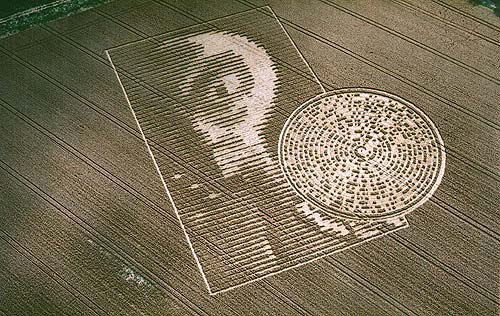
What about crop circles?

It is surprising how much information about crop circles I have gathered over the years - mostly because some of the people whose writings I enjoy for other reasons (such as John Michell) were also very involved in the crop circle phenomenon (Michell called himself a 'cereologist'!).

Since all our 'external' knowledge (including all of science, and academic research) is based on reliable eye-witness reports, and several people whom I regard as reliable have reported strange crop circle phenomena; I am now happy to accept that there is 'something' mysterious about some crop circles.

Most of the people I have encountered who write and speak on the subject are not convincing individuals by my judgement. Nonetheless some of them are; and because some such people are convincing to me, therefore (to put it negatively) I don't believe that the whole crop circle business is a hoax. Positively stated - some crop circles have had a 'supernatural' cause - beyond mainstream possibilities.

But what do I believe?

I believe crop circles are 'real' but trivial, in the same way that most 'mediums' who 'channel' spirits provide some information that may really be of supernatural origin, but which is trivial. Supernatural does not equal profound. Spiritual beings are real, but many of them (even among the broadly-benign) are foolish, conceited, ignorant - just like mortal Men.

Supernatural phenomena may also be evil - indeed they usually are either evil or trivial; esepcially when they are deliberately sought-for, by 'techniques' or strenuous meditational practices. We ought not to be too impressed by such things, esepcially not by their specific content. Yet our cultural materialism has made us naive and credulous of almost anything we believe to be real that we find 'scientifically' inexplicable. This is supernaturally equivalent to believing something simply because 'a bloke in the pub' told us; or because we 'read it in an old book'.  

Over more than thirty years - before and after I became a Christian; my ineradicable conviction is that any spiritual being, or alien visitor, who uses shapes flattened into corn to 'communicate' with humans, when these shapes are enigmatic and can only be seen from the air, must be either crazy or joking! Of all the possible ways to communicate, this has to be one of the silliest imaginable.

If you were a serious angel (or an alien) who wanted to establish contact with people, and to pass on an important message - why on earth would you choose to make patterns in a crop field in Wiltshire; in vague hope that a light aircraft pilot (or nowadays a drone) might fly over and photograph it? Then that 'somebody' would correctly interpret the photographed corn shapes, and disseminate the information so that it reaches the relevant individuals...

The other problem for me is that corn circles are a material phenomenon inviting a materialist explanation; so that they are probably not a good way of inducing people to acknowledge the reality of a spiritual realm.

Nonetheless, there are example of corn circle fascination having served as a kind of 'entry drug' for some people. It gets them out into the countryside to experience things for themselves; makes them suspect the validity-of, and eventually learn to ignore, the mass media; it widens and opens their thinking. It is more possible that such a person may eventually come to Romantic Christianity, than someone who is locked-into the media-bureaucratic mainstream evil virtual reality.

So - while trivial in themselves; for such people, although not for me, crops circles have had a value.

Yet even so I am suspicious of the kind of value - in that sense that even when the speculations about crop circles are not simply materialistic (after all, technologically advanced aliens intervening in the earth using powerful forces or floating balls-of-light are just an extension of mainstream Western scientistic positivism); the focus on the abstract implications of abstract patterns printed on fields is (I believe) not what is required for the healing and progression of modern Man.

What is needed (by my understanding of things) is a recognition of reality as consisting of living, conscious beings with whom we may have direct (unmediated, not indirectly communicated) relationships: a kind of 'conscious animism' in the context of a Christian metaphysics.

By contrast, a spirituality of expert investigators technically unravelling enigmatic geometry, binary codes, fractal shapes and mathematical relationships is pretty the opposite of what I would most wish to see - of what we most need.

If the above remarkable formation - consisting of a stereotypical alien, and an ASCII-coded message to Mankind - is genuinely of supernatural/ extraterrestrial origin... it proves my point about the kind of beings that are involved!

Monday, 11 February 2019

What's going on with UFOs?

I have read quite a lot of UFO writing over the years. The reason I haven't blogged about it is that I don't have a great deal to say on the matter. But yesterday somebody asked - so here goes.

I don't rule out that - at some level - the UFO phenomenon is, or was, genuinely 'paranormal' and purposive. Yet I somehow don't regard the matter as very serious or significant - at least, not unless an interest in UFOs was to lead-onto a more spiritual way of thinking and living, as happened with John Michell (Michell's first book was about Flying Saucers).

My main hypothesis is that UFOs are part of the spiritual warfare between angels and demons; and how this is manifested to certain people in certain circumstances. However, the matter is of UFOs nearly always discussed in a materialist (and unChristian/ anti-Christian) context. In other words, some UFO phenomena are probably angels (or made by them) while others are demonic.

But UFO appearances do not seem to be a very effective method of spiritual intervention - at least not for the angels. Why would angels do such a daft thing? Well, I regard angels as fallible creatures - being not a separate creation from Men, but pre-mortal and resurrected that are Men active in earth life. That is, angels are the not yet born, and the so-called-dead. Such angels are doing their best and learning from the experience; but it is inevitable that some of their ideas will fail to achieve their intended results - and maybe UFOs are an example?

UFOs, when they originated in the late 1940s, might have been modern miracles; spiritual manifestations designed to break the belief in materialism. For example, the Fatima miracles of 1917 would probably have been interpreted as UFOs if they had occurred in 1947*.

So what may be happening with UFOs is that spiritual phenomena of light (with its ancient symbolism of divinity) were misinterpreted materialistically; as high tech spaceships piloted by aliens. Then demons (who are pre-mortal, un-incarnated-spirit Men that are actively opposed to God, Good and divine creation) may have exploited this situation; and engineered other manifestations and contacts, in order to reinforce a world view that favours their evil agenda.

This is just a vague idea, and I don't have much interest in making it more precise; but it is part of my more general understanding that modern people are so deeply and habitually materialistic; that they will reduce anything spiritual into this framework.

Many millions of people very quickly developed strong and detailed beliefs in alien existence, contact, communication and plans that were based on no more than hearsay and dishonest mass media accounts, or (more rarely) on very ambiguous personal experiences of strange phenomena.

And this happened at such a large scale and so rapidly, because modern people find aliens possible (no matter how unlikely); while angels (and demons) are ruled-out a priori - because the metaphysical Christian beliefs that make sense of angels and demons are nowadays (generally and officially) regarded with bored disdain or loathing.


*Indeed, pretty much all the ancient supernatural events of the Christian Bible, and records from other religions, have (at one time or another in the UFO literature) been re-re-interpreted and explained as early examples of interactions between humans and various combinations of alien beings, alien-advanced technologies and flying saucers. Either this - or the opposite mainstream Establishment attitude of complete rejection, mockery and denial - is how a metaphysics of extreme and convinced materialism inevitably deals with anomalous phenomena. 

Sunday, 1 January 2017

Meaning, Purpose, Evolution


Meaning: 

One hot summer afternoon, 20 June 1921, Alfred Watkins was at Blackwardine in Herefordshire. On a high hilltop he stopped and looked at his map before meditating on the view below him. Suddenly, in a flash, he saw something which no one in England had seen for perhaps thousands of years.

Watkins saw straight through the surface of the landscape to a layer deposited in some remote prehistoric age. The barrier of time melted and, spread across the country, he saw a web of lines linking the holy places and sites of antiquity. Mounds, old stones, crosses and old crossroads, churches placed on pre-Christian sites, legendary trees, moats and holy wells stood in exact alignments that ran over beacon hills to cairns and mountain peaks. 

In one moment of transcendental perception Watkins entered a magic world of prehistoric Britain, a world whose very existence had been forgotten. 

John Michell - From The View over Atlantis (1969)

More at: http://albionawakening.blogspot.co.uk/2017/01/michell-and-watkins.html

Purpose:

To recognise 'design' is to recognise meaning; and it is an essential thing.

Because if our lives, the world, everything isn't designed, then it has no meaning - and the only problem remaining is to explain why, then, we should ever have developed the widespread and resistant that there was or is meaning.

If the world is designed then there was a designer - and we are led to a creator deity (at this stage a deity, not necessarily a god - the deity might be some abstract principle of organisation, a force, the universal and necessary way of things...).

But for us to discern design and meaning is only one step - because Why?

For example: Why is there meaning, how come we, personally, can discern it truly - and what difference does, or should, this meaning make to us?  What are the implications of the truth of design?

Thus meaning leads onto purpose - and those who wish us to regard life as purposeless will therefore always argue first of all that it has no meaning; and that life is some kind of a combination of mechaniscal determinism and statistical randomness  - Life Just Happens - therefore it cannot have purpose.

On the other side, anyone who sees a meaning in life will, sooner or later, be prone to wonder what is its purpose. And for there to be any kind of a purpose to the whole things and ourselves in it, which actually matters - then we are led to a personal deity: a god who has some concern not just for setting-up a created universe but also for us as individuals, and our place in the scheme of things.

From this comes the secondary question of why this hasn't already happened, what is stopping it? This leads onto theories of the nature of God. It also leads to evolution ...

Evolution:

Evolution is about the change, movement, stages beyween then, now and the future; it is about the trajectory and nature of the difference between where we have been and where we are supposed to be going.

All coherent theology is evolutionary, because there is always a gap between what wee are and what we should be - requiring some kind of evolution to get from one to the other.

If we regard meaning pointing to purpose; then purpose points to evolution - we live in a reality which has evoluton built-in; and it would be useful to have some description of how this works: what evolution is like...

The most favoured and comprehensible description of evolution is that it is like growth and development; the transition from foetus to child to adult - the idea that this is a metaphor for the (intended, destined) evolution of everything: an analogy for the nature of reality.

Friday, 15 September 2017

Northern Lights... by John Fitzgerald

The Northern Lights have been seen over Britain...

An apocalyptic part of me wants to protest at this. Surely the coming of the Lights is a sign? A foreshadowing of some great event to come, as the appearance of Halley's Comet in April 1066 gave notice retrospectively of the impending Norman Conquest. A balance needs to be struck, therefore, between a rationalistic, unimaginative reading of natural phenomena and a credulous 'signs and wonders' mentality, which leaves us finding messages in cloud formations and the like...

The eye of imagination, the eye of faith, sees beyond the physical components that make up the universe. It does not deny their existence but neither does it view what something 'is made of' as its sole and absolute reality. It goes past the material level (the validity of which it respects) to the spiritual essence which lies at the heart of every created thing...

This theme is illustrated superbly in a passage from Rosemary Sutcliff's Arthurian novel Sword at Sunset (1963). Ambrosius Aurelianus, the High King, is dying of cancer. He takes his lieutenants, Artos (Arthur) and Aquila, on a winter retreat in a remote hunting lodge to secure the succession. A tense political discussion is interrupted by the appearance of the Northern Lights. The tone and flavour of the evening is altered dramatically as new perspectives open up for all three men.

Hearts start to soften. The display outside triggers deep-lying memories in Artos and Aquila and sparks a moment of fraternal understanding. Ambrosius, when he rejoins the conversation, speaks with an imaginative fluidity that was lacking before. The political becomes the mythical. Something hard and tight has been broken apart, creating a space for the deeper pattern behind the flow of surface events to emerge.

This is the lasting impression left on the reader by Sword at Sunset - the political transformed into the mythical. Artos, in the end, follows Ambrosius' recommendation and succeeds him after his death, though not as High King but Emperor of a restored Romano-British Empire. Artos has many scars - physical, emotional and spiritual - and gains little satisfaction from his twenty year reign. He does, however, bring peace and security to the land, and through his words, deeds and presence, sows the seeds of the great national myth that has sustained the imaginative life of our country ever since.

The Northern Lights, on this occasion, are heralds of restoration rather than harbingers of doom, signalling the advent of a mythic, archetypal hero and the flourishing of the realm. Let us hope that their most recent manifestation prophecies equally glad tidings. There is no reason why not. 'We live in a time of revelations,' wrote the maverick English mystic, John Michell. 'When our minds are ready, the pattern will appear.'...

Edited from a longer piece at Albion Awakening.

Monday, 6 May 2019

My favourite YouTube Video with 1 view recommending favourite YouTube videos with less than 200 views...

In a video with one view, the indomitable and inimitable Keri Ford follows up on his 'promise' to recommend some favourite YouTube videos with less than two hundred views. I've checked out the first one he mentions - Shugborough and the Earthly Paradise - and can endorse it; especially for the ex-Albion Awakening readership, and fans of John Michell.


Readers with similar suggestions of worthwhile but not-popular videos are invited to comment - but please name and explain your choices (I won't publish bare URLs).

Friday, 3 October 2025

Magical duels between early Christian missionaries and Druids of the British Isles


In the Roman and post-Roman era; the early Christian missionaries to the British Isles were highly successful at converting the Druidic pagans. 

This may suggest a basic religious compatibility; such that Christianity may have seemed like a natural extension or complement of the Druidic religion. 

For instance; according to Julius Caesar, the Celts of Gaul and Britain seem to have been exceptionally courageous in battle because they did not fear death; being convinced that they would personally survive death in some mode of reincarnation back into this mortal life. 

In a context where personal survival was already an established conviction; the Christian missionaries promise of resurrected eternal life in a Heaven, rather than merely returning to re-live "more-of-the-same", may have been regarded as a significantly better prospect. 


But, even if the post-mortal Christian outcome was better than what Druids could offer; there was the problem of establishing the missionary's authority to promise it. 

After all; why should a Celtic tribal King believe the word of some foreign priest who turned-up at his hall telling a story about the afterlife?  

A Christian missionary would therefore need to establish his own divine authority; and this would usually (it seems) be done by performing "wonders" with divine aid: wonders such as miracles, and also defeating the existing priesthood in trials of spiritual-strength.

This was done to prove the new God was stronger than the old ones, and prove that the new kind of priest spoke with divine authority.   


One such trial of spiritual strength was some variation of the magical duel - analogous to that in the Old Testament (Exodus 7: 8-13) between Aaron and the Pharoah's magical priests - the episode of the magical staffs and the snakes. 

It is important to recognize that the magic of Pharoah's wise Men is depicted as real; but weaker than the magic of Aaron and Moses.

Much the same things were reported in the evangelization of the British Isles, as John Michell summarizes in his 1990 book New light on the ancient mystery of Glastonbury ( pp103-4: I have condensed this passage):   

The great mystery behind early Christianity in Britain is how the first missionaries managed to persuade the chiefs, nobles and Druids to lead their people in converting to the new faith of Christ. Certainly there was opposition, but there is no record of violence or bloodshed. 

Contests between the rival men of religion took place on a professional level, as trials between rival magicians. We only hear about those engagements where Christians won, but it appears that their magic was generally superior to that of their opponents. 

Thus St Patrick prevailed over the Druids of Tara, St Columba defeated the Druids of Bruidh, and St David won a contest with the magician Boia. 

In times when the outcomes of battles were largely determined by the powers of the Druids on each side, a compelling inducement to accept Christianity was that Christian magic proved more effective than that of the pagans.  

The arts of ancient magic are no longer known and it is impossible to say by what combinations of psychology, conjuring, weather control, and elemental invocation; prehistoric battles were conducted. 

It is clear, however, that (unlike Christian magic) the magic of tribal shamans was ineffectual against outsiders of a different religion.


My understanding is that in ancient times magic was real and powerful, and could (in some civilizations) reliably be deployed as required (for instance, to build the pyramids). 

Nowadays, I think magic is still real, still happens; but evidently it is weaker and much less reliable than in the past. Thus; magic cannot nowadays be commanded in ways that seem to have been normal (at least for suitable gifted and trained persons) in Biblical times, or in the early centuries AD.

Nonetheless; it seems only honest to recognize that (bowdlerisations aside) early Christians used magic, as well as other types of miracle, to establish their credentials as speaking with authority on behalf of Jesus. 

Indeed; the remarkable effectiveness of early British missionaries (including those who later became Saints) was sometimes due precisely to the greater effectiveness of the new Christian magic, as compared with the old magic of rival pagan priests.  
 

Saturday, 1 January 2022

Accelerating chaos and evil Not-plans: wishing you a Happy (demonic fake) New Year!...

Old readers will know of my aversion to the official New Year defined as 1st January; which is defined in terms of what it is not (not astronomical, not seasonal and not Christian) rather than what it is - which is to say arbitrarily numerical... 

This means the Year is not truly new, but only demonic-fake-'New'

So, the New Year and its 'celebration' is almost-certainly Satan-spawned - as what else could it be? When we are induced to celebrate the arbitrary, it is only one step away from celebrating the actively-evil.  

Thus your cheerful and social Happy New Year! greetings with neighbours are approximately spiritually-equivalent to a Nazi salute or the clenched fist of Communism... 


(...You're welcome...)


But this is the day one of the calendar-year; and my understanding is that the demons are very keen on arbitrary numerology - on the special significance of certain arbitrary numbers (i.e. fakely-significant numbers); being super-especially fond of decimals, decades, centuries - and the metric system generally, including SI units ("Systeme International" - French, wouldn't you know). 

The lower-ranked (bureaucratic, 'Ahrimanic') demons love these systems because they are made-up by officials; and because of their abstract efficiency, and easily calculational inter-convertibility. 

SI units model the world as-if it was already the single totalitarian System that the Ahriminic demons day-dream about implementing and operating... 


The metric-SI system artificially-'unifies' the world - and achieves this abstract coherence by its indifference to the human.  

By contrast the Imperial System (feet and inches, furlongs and leagues etc) was originally based-on the human body and mind; and the usage of measures that are functionally appropriate to the actual task in hand. This was especially the case in its earlier, 'medieval' forms - e.g. when 'an acre' was the amount of land that could be ploughed in a day, locally. 

There are also sacred, 'magical' number and geometrical 'systems', apparently derived from Pythagorean-Platonic philosophy - and these are universal; but abstract, not human, not functionally-derived.

(See How the world is made: the story of creation according to sacred geometry, by John Michell, 2012.)   

But naturally, none of these genuine, good-aiming spiritualities are of interest to the demonic powers - except when they can be subverted and then inverted; because inversion is the basis of anti-Christian symbolism and ritual - just as inversion of values is the most advanced form of evil. 


It was, presumably, the middle-managers among the demons (as among humans) who chose to make 2020 the year for the global totalitarian coup

2020 is just the kind of meaningless but superficially-significant 'decimal' number which they like best, and which they believe brings them the best results. 

So - what about 2022? Anything special? 

I think not - not for the kind of Being that is engaged in the Ahrimanic programme. They are keen planners and 'strategists', and are explicitly aiming at 2030, the next decade - for the 'completion' of their current strategy of worldwide surveillance and control.  


But as of the approach to 2022; these mid-level demons have apparently lost control, and their plans are not happening to schedule. 

Why? Partly because the plans were based on falsehoods and could never have-worked. 

Partly because of unexpected resistance. 

But mostly because the 'Sorathic' demons of chaos, of sheer destruction and negation, are increasingly in control; and are using The System to inject chaos, destruction and negation into itself.


The Ahrimanic demons intended to use The System to rule the world post 2020... 

But the Sorathic demons want to use The System to destroy The System


There is no doubt that order is collapsing and chaos is increasing - locally and worldwide. 

Therefore: the most likely prediction for 2022 is... Accelerating chaos  

(...Which is actually a bit of a non-prediction - since the nature and location of chaos cannot - by definition - be predicted!) 


But this tsunami of dysfunction is not apparent to the Ahrimanic middle-managers, because they are incompetent and dishonest; self-blinded fools who live by self-serving lies - and they believe that their interests are best served by pretending to omniscience and omnipotence. 

When real knowledge and power are lacking, the adopt the Texas Sharpshooter tactic of claiming that whatever has-happened was exactly what they wanted to happen...


In the face of actual accelerating chaos; demonic middle-managers will continue 'confidently' to assert that everything is getting better... 

...All is on-track and on-schedule; tractor production continues to increase by hundreds of percent per year; and the bureaucratic utopia of own-nothing/ be-happy will be oven-ready for 2030 - all in accordance with plans... 

And this will be asserted, louder and louder, officially and by the mass media - until the world is engulfed by war and famine, disease and death, flame and flood...

At which point they will simply claim that they always meant to do that


Romantic Christians should not be misled by the collapse of the Ahrimanic-bureaucratic plans into assuming that this means the powers of Good are necessarily ascendant. 

The birdemic-peck narrative would indeed collapse because of Christian resistance - if such existed. But does it exist?

Good can only come of good (not from evil-motivations) - and unless there really is a Christian resurgence, then failures of evil planning will not imply a better overall outcome - not if those failure are due to ascendant chaos.  


All complex strategies and functionalities (both Good-motivated, and of evil-intent) that depend on organization, coordination and obedience will - sooner and sooner - be sabotaged by the waxing of Sorathic evil. 

Thus, the failure of evil-plans is not good news when they are being thwarted by evil-not-plans...

But only when evil-plans are thwarted by intentions on the side of Good. 


Monday, 19 July 2021

One can't (now) be agnostic about Christianity - what what about other stuff? Classic conspiracy theories?

Things have been coming to a point for some decades - and have now arrived-at the point; so there are only two choices in the ongoing spiritual war: the side of God, or of Satan. Nobody can be 'an Agnostic' in this sense - can claim 'not to know' about God - because that is to take the side of Satan.

But I think one can be agnostic about other issues, which are not of crucial importance, and/or which cut across the Christian-Evil divide. 

I find myself agnostic about much of the 'conspiracy theory*' field - such topics as are nowadays covered by people such as David Icke, or my penfriend Andy Thomas (or, in the recent past, by John Michell): Illuminati, crop circles, UFOs, 9/11, Atlantis... 


Many of these subjects I feel genuinely agnostic about; in that I could imagine them being either true or untrue - or of containing significant elements of truth, mixed with error and fraud. 

Further; in such matters, being agnostic is very different from rejecting them altogether and outright - which is the mainstream position. Indeed, to be agnostic is closer to being 'a believer' than it is to being a 'skeptic'. 

What is interesting is how and why I should (apparently) be content to stay in my agnostic state, without trying to settle matters one way or the other. Why, for example, don't I actually visit a crop circle, or make efforts to observe a UFO? 

I suppose the answer is that I don't think the answer is of decisive importance either way. I really don't - and that is because for me the answer (whatever it is) is subsumed within the much larger matter of destiny, or providence; that is, God's plans for me and for the world and its people. 


As I understand divine destiny, it is such that these matters are not crucial. 

Whether, for instance, aliens are contacting, or trying to communicate with, Mankind (or whether aliens are deceptive demons) is - for me - a matter of only mild interest; because the answer would be only one factor among innumerable others. It would not affect the way I lead my life, or what I strive for. 

This perspective is, I suspect, incomprehensible to the mass of contemporary conspiracy theorists - who are atheists; and, because things have come to a point, therefore more or less, anti-Christian. But so it is. 

Therefore I read, and have read, a fair bit about these topics; watched videos, listened to audios etc. I have found much of this material interesting, and indeed very useful, in a wide variety of ways. Yet this value does not seem to depend upon reaching a conclusion one way or the other; and so I remain agnostic. 


Note: The term conspiracy theory is itself propaganda on the side of evil; so the conspiracy theory field is an example of The Enemy's enemy. However, most members of that community still seem to be wedded to one or another aspect of the Leftism agenda - so (for all their valuable insights) they fail the Litmus Tests and are on the other side.  

Tuesday, 21 July 2020

The importance of metaphysics

I have found extremely few people who share my conviction of the centrality of metaphysics in life! (Metaphysics being one's primary understanding of the basic nature of reality.)

For most people who can even bother to think about such matters for ten minutes (and these are extremely few!), metaphysics seems like almost the definition of that which is most remote and irrelevant to actual life. But to me, nothing is more relevant - and never a day - hardly a waking hour - passes in which I do not think about such matters.

The reason is that I see metaphysical assumptions behind almost everything of interest to me; and that I am continually aware that the basic understanding of others is nearly always very different from my own.

Here is an example (in italics; which I have edited for clarity and explicitness), from John Michell, at the end of his (excellent and inspiring!) book from 1990: New Light on the Ancient Mystery of Glastonbury. :

One of the conventional symbols of earthly paradise is the union between two cities: the heavenly Jerusalem and the actual city of Jerusalem below. William Blake drew on that image in prophesying that the New Jerusalem would first become manifest in England... 

Plato was more practical-minded than Blake. His imaginary republic was based on the archetype of heavenly paradise, and from there he descended into the world of matter; interpreting the ideal in the form of a social order which he considered to be its best possible reflection. 

Due to its material nature, Plato's republic was necessarily structured, and was governed, by a code of laws. 

It was, as Plato admitted, a mere third-hand version of the ideal; for the original is the heavenly archetype, and its clearest secondhand reflection on earth is that primordial paradise remembered in the Garden of Eden [and substantially experienced by historical nomadic tribespeople...]

From this secondhand version of paradise we have long been barred due to the necessary inhibitions of civilization. 

Most people today enjoy the civilized state and its comforts, and therefore - like Plato - we are concerned in practice with the [third hand] reflection of paradise: a perfectly ordered, permanently settled human society. 

This is not the innocent paradise of Eden, but is the next best thing; and Plato promised that, if its standards were scrupulously maintained, it would be almost as good and long-lasting as the original.

Thus we have the original and best - because perfect, permanent and unchanging - reality located in the transcendental realm of spirit; and all possible earthly and material manifestations as symbolic, temporary secondary and symbolic.

We are removed a step further by 'civilization' - which constrains the originally natural and spontaneous order of Eden (approximated by nomadic hunter-gatherer life) into hierarchy and law: a system into-which individual humans must be conformed.

By my understanding; this Platonic metaphysics has been adopted by mainstream Christian theology; and its assumptions underpin the Christian churches from most of the earliest records - because the Christian churches were themselves of a civilized nature, secondary and symbolic, hierarchical and derived-from laws - and expressing Christianity in the form of hierarchy and law. 

In different words; this is an abstract metaphysics; in which reality is regarded as primarily spiritual and metaphysical. And so dominant is this way of thinking that few people can even imagine any alternative.

But that is the focus of my life work: I mean, to imagine and describe, and then to try and live-by, a different basic understanding of the nature of reality.

That is what I mean when I assert (over and again) the primacy of the Fourth Gospel, and emphasise that it embodies a profoundly, indeed qualitatively, different basic understanding of the nature of reality; and records this as being the teaching of Jesus.

This is the metaphysics in which Beings and their relationships are primary; reality is seen as developmental ('evolutionary'), with mortal life on earth as - not secondary, but a part of this primary reality.

Thus earthly material life is not secondary, nor is it ultimately abstract, nor symbolic; but part of a developmental 'process' (but 'process makes it too abstract) - a history of groth and development - which began before mortal life and continues after biological death.

And this very different metaphysics affects (or ought to affect, if believed and lived-by) pretty much everything that happens in every persons' life; in the most immediate and practical sense of transforming its meaning and relevance.

Friday, 2 June 2017

Sacred Measurement

In which John Michell explains why feet and inches, pints and gallons, pounds and ounces are divine in origin - whereas metres, litres and grams are the devil's work...
http://albionawakening.blogspot.co.uk/2017/06/the-sacred-measures-of-albion.html


I got the idea for posting this from a similarly-themed post by Brett Stephens:
http://www.amerika.org/politics/there-is-nothing-wrong-with-hating-the-metric-system/

Monday, 18 January 2021

The nature of giants

A giant helping to build Stonehenge

As I have previously noted; the original inhabitants of Britain were said to be giants; and there is considerable 'documentary' evidence for the reality of giants. 

But if we accept that there once were giants, then of what nature were they? Presumably not gigantic Men - since that seems biologically impossible - but if not that, what were they? 

Bearing in mind that the age of giants was also the age in which magic was a part of everyday life; one interesting idea comes from John Michell in his beautifully-written superbly imaginative New light on the ancient mystery of Glastonbury (1990) - edited excerpts of pages 51-2 follow:

**

The giants of old undoubtedly symbolized natural forces, but we are repeatedly informed by early historians that sometimes they were visible in monstrous and grotesque forms. They belonged, therefore, to the cryptic category of beings which includes the yetis, Sasquatch and Bigfoot.

These creatures are occasionally seen and heard, but essentially they are phantoms. They represent an aspect of the 'genius loci'; the indwelling spirit of certain mountains, lakes and wild places. Their forms are fluid and adaptable, being determined by the collective imagination of local people. 

In traditional societies, magicians and shamans know about such things, and are sometimes able to invoke them. 

It is often easier to produce phantoms than to dissolve them. Like all 'technologies' they had unwanted side effects. In the course of time, they become more solid and may even bleed when wounded. 

Therefore, not all the spirits raised by magicians were properly laid to rest, and some lingered about the countryside to establish a breed of monsters. This may be the origin of the giants which were apparently still to be found in Britain in the second millenium BC. 

**

Thursday, 19 September 2024

Was the British Celtic Church actually "Paganism with a veneer of Christianity" - or the opposite?


Edited from New light on the ancient mystery of Glastonbury, by John Michell, 1990 

Celtic Christianity has been called a mere reformation of Druidry. 

A unique and remarkable feature of the early Church in Britain in Ireland is that it claimed no martyrs through persecution by the religion it supplanted... 

The Druids had no difficulty in accepting the new religion, because it scarcely interfered with the existing religious and social order. 

The system of the early Church "was really Paganism with a veneer of Christianity". 

**

I have often seen this written; however, I think it more likely that the opposite was true*. 

And the reason for such opposite interpretations is due to very different concepts of what Christianity actually is. 


If Christianity is essentially The Church, and Christendom (a Church dominated and permeated society) - then clearly the newly converted pagans must have only a superficial smattering - a veneer - of the new faith over an substructure that can only be Pagan. 

The newly converted Celtic British Christians did not have a trained and ordained hierarchy of priests - these must have been few, and far between. The Britons did not have a comprehensive coverage by churches offering the sacraments. Nor had they experienced Christian teaching, nor did they live under a system of societal laws in conformity with the Church's understanding.

Instead; there inevitably must have been (for many years) mostly the residue of whatever actually was the system of Druidic religion - its sacred places, its Druids, its practices, and the effects of generations of its teaching. 

Furthermore; Christians seem to have had a deliberate policy of taking-over and re-purposing Pagan shrines or gathering-places. This strategy extended to making Pagan gods into Christian Saints - the best evidenced of which is the Irish god Brigit becoming the famous and beloved Saint of the same name. 


Surely (so this argument goes) all this means that for many years the British were still essentially Pagan - surely, their Christianity was, at first, merely a veneer of Christianized language and symbolism (such as a cross inscribed or erected-upon a megalithic standing stone) on-top-of what long-remained a Pagan religion? 

But if Christianity is accepting Jesus as Saviour, desiring resurrection to eternal Heavenly life, and embracing the intent of living by Love... then none of the substructure of Paganism really matters

By this argument; what makes someone a Christian is the choice to "follow Jesus Christ" (with what that entails in a "cosmic", eternal, post-mortal sense) - and the rest of religion is, at best, an optional extra. 


Of course, there would have been many aspects of Druidic Paganism that conflicted-with and contradicted the basic of Christianity in Love. 

But that applied to the Christian Church as well - much of its actuality contradicts the essence of Christianity, and always has. 

So long as the newly-converted Christian sought resurrection into Heaven by following Jesus Christ; instead of seeking whatever it was that Druidic Paganism had previously promised (generally regarded as having been some kind of reincarnation, perhaps involving metempsychosis) - then I would argue that the new Celtic convert was fully Christian. 


I think there are lessons for Christians here-and-now. 

Any Christian needs to navigate a world - a world including whatever Church he belongs to, and whichever religion or ideology rules his society - that is substantially hostile to his deepest convictions. 

Yet none of this prevents him from being fully a Christian - if that is what he most desires to be.

As Jesus himself said: Christianity is for sinners, not perfect Men; and for this actual sinful world, not some ideal society. 


Society cannot prevent anyone from becoming and being Christian...

Because ultimately Christianity is "not of this world" - and because resurrection and Heaven cones from Jesus, not from this world. 

What we absolutely need to do, and must do, is to want it.


*Note: Certainly, the Celtic Christian era in the British Isles led - over the following centuries - to a greater number and (even more so) concentration of Saints (and great Saints, still remembered as patron Saints, in church and city foundations, and festivals) - like Cuthbert, Patrick, David, Kentigern/ Mungo, and Brigit) than at any other time in the history of these parts.