*
The novelist Terry Pratchett died yesterday - and it seems like a good time to gather my thoughts on him.
First, I would rate him as one of my two favourite British novelists of recent decades (the other is JK Rowling in her Harry Potter series). I am very grateful for the hundreds of hours of enjoyment, stimulation and edification I have received from reading him (often aloud, as bedtime stories for my wife).
Furthermore I am equally grateful that he has been my teenage son's favourite and most important writer for the past several years - my son has read more Pratchett than me, indeed pretty much everything he wrote; and as well as the enjoyment and humour, Pratchett's moral influence on him has been, so far as I can tell, strongly for the good.
I would certainly regard Terry Pratchett as the major English fiction writer of the 1990s and 2000s, and one of permanent significance.
*
Yet there are significant reservations and restrictions on my personal admiration.
Pratchett's novels divide into two main categories - those with female protagonists (especially witches) and those which are satirical (getting fun from a theme like the postal system, the police, the movies etc).
It is the witches novels which I like so much - and, apart from a fondness for the wizards of Unseen University (which I can readily imagine my Discworld alter ego inhabiting) I general don't much like, and sometimes actively dislike, the satirical novels - which bring out Pratchett's faults and limitations, and lack his strengths.
For instance, I am generally unconvinced and unmoved by the supposedly sympathetic character of Sam Vimes; and have never finished any of the books in which he features strongly.
Also, the novels since Pratchett was diagnosed as suffering from dementia, the effects of which I first noticed in Wintersmith (published 2006), are not up to standard. Indeed, I find their prose style almost unrecognisable. I therefore infer that they are actually collaborations, and have been subjected to heavy editing. (I should note that my son has continued to enjoy these later books equally with the earlier.)
*
Pratchett's greatest virtues as a writer are, for me, the sheer fluency and inventiveness of his ideas and humour - which I consider to be superior to any other writer of any period of which I am aware; and the humane qualities he brings to his best female characters - notably Granny Weatherwax and Tiffany Aching.
His faults are a cruel cynicism and a covert fascination-with/ admiration-of ruthless violence and torture - these are what mar many of the satirical novels for me.
In some of his non-fiction, and in some comments by Pratchett's friends, it is apparent that he was driven by considerable anger, irritation and resentment; and while he could not help having these traits built-into him (and they were perhaps what made him so prolific) there is not much sense that Pratchett acknowledged these were defects, 'sins', nor that he repented them - rather, he seems rather self-righteously pound of being so often angry.
*
This segues onto what was undoubtedly the most significant blot on Pratchett's reputation and lifetime achievement - his strident advocacy of what he weasel-worded as the non-existent and nonsensical 'Right to Die', that is, what is more often called Assisted Suicide', but what is actually a call for the legalisation and bureaucratic-proceduralisation of Humane Murder.
http://charltonteaching.blogspot.co.uk/2010/09/euthanasia-antibiotics-and-terry.html
This campaign revealed, or apparently revealed, lack of courage, lack of foresight and was justified by a grossly impoverished and inadequate conception of the meaning and purpose of human life.
However, Pratchett only began this campaign after the onset of dementia, and it is possible/ likely that he was being exploited for this purpose; after all, in later years, his communications were heavily censored and edited, and we only know what various amanuenses and media (who strongly favour 'euthanasia') chose to reveal and publicise. It is unlikely we would have been told of any late reservations or repentance, had they occurred.
*
Terry Pratchett himself - in his non-fictional writings, and speaking as a prominent secular Humanist - said that he expected death to be extinction; but those of us who know better cannot help but be curious concerning his current post-mortal situation.
Who knows what happened as Terry Prtachett approached his end? Sometimes dementia may be part of God's plan - sometimes dementia seems to bring a proud and resentful person (in his innermost soul) face to face with his own state of dependence and the futility of his pride - presents a new choice, and the choice may lead to a dawning of gratitude and humility and open-ness to the gift of grace.
Personally, I regard Pratchett as one of those atheists who 'protest too much' and secretly and guiltily believed in the reality of God (or want very much to believe), but who misunderstand and therefore hate God as they understand Him.
When Pratchett discovers the truth of the reality of God - and the nature and motivation of God; I believe he will (or has) immediately and unhesitatingly repent and accept the salvation offered by Christ.
The man who created, and imaginatively-inhabited, Granny Weatherwax and Tiffany Aching was a man fundamentally good, fundamentally a realist, fundamentally motivated by love. With his experience and abilities, I fully expect Terry Pratchett to become one of the great human benefactors, working from the other side of mortality.
*
Showing posts sorted by relevance for query Pratchett. Sort by date Show all posts
Showing posts sorted by relevance for query Pratchett. Sort by date Show all posts
Friday, 13 March 2015

Thursday, 9 September 2010
Euthanasia, antibiotics and Terry Pratchett
The matter of euthanasia has been 'in the news' lately in England, because of the advocacy of Terry Pratchett.
(Sorry, but I really cannot call him 'Sir' Terry. Sir has by now become a title overwhelmingly associated with a public career of political correctness and bureaucratic dishonesty, and has utterly lost its old romantic connotations of Arthurian knights in armour fighting evil and rescuing maidens in distress).
I can't think of another living novelist whose work I like and enjoy more than Terry Pratchett - especially his books featuring witches (e.g. Granny Weatherwax and Tiffany Aching).
But there is something I find terribly dismaying about TP's campaign to create 'tribunals' for assisted death:
http://www.guardian.co.uk/society/2010/feb/02/terry-pratchett-assisted-suicide-tribunal
*
As is well-known, TP has recently been diagnosed with a slowly-progressive but irreversible dementing illness - and he has expressed an understandable desire to avoid a prolonged decline into helpless dependency before his eventual death.
Terry Pratchett is a prominent atheist (although his best novels implicitly contradict his abstract opinions concerning the nature of the universe, since they are saturated with transcendental meaning).
Therefore TP's discussion of euthanasia is a clear statement of a humanist world view and its implications. Seeing this spelled-out so starkly, and from an author whom I like and respect, I find an uncomfortable, somewhat distressing experience. It has been on my mind for many months now.
TP's tone is the secular modernistic one that regards the value of a life as purely an hedonic matter - the outcome of a quantitative comparison of pleasant versus unpleasant feelings.
Life's value is implicitly assumed to derive from a surplus of good feelings (pleasure, gratification and independance) over bad feelings (misery, pain and dependance); and TP's argument is that when the good feelings have disappeared or the balance towards the bad has gone too far, then we should be assisted in killing ourselves if and when we wish (with abuses supposedly being prevented by the proposed bureaucratic tribinal).
*
TP wants more people to have the possibility of a dignified death, a 'good' death. But it seems to me that the concept of a good death is meaningless unless life itself is seen as more than a matter of balancing subjective positives against subjective negatives.
Therefore, any discussion of the desirability of euthanasia *must* begin with a clear statement of the nature of human existence and the purpose of life. Because the meaning of death can only be understood in a context of the meaning of life.
I know it is meant as a joke - but the idea that a perfect finish to life would be to "die peacefully with Thomas Tallis on my iPod" is horrific. This embodies the secular modern idea that life is *essentially* a matter of maintaining a state of pleasant distraction from awareness of reality (especially the reality of death).
*
But on the other hand, I also find the views of many people who publicly oppose euthanasia to be disturbingly incomplete. TP is describing real and big problems about modern death.
Modern medicine, modern culture, while valuing life no more highly than as a source of pleasure; yet recklessly prolongs this biologically conceptualized existence in vast numbers of humans, using a range of artificial means such as medication and biological support.
The situation is now one in which many people (and an increasing proportion of people) end their lives by enduring many *years* of a twilight, degenerating existence of heavy and increasing-dependency.
In other words, we are nowadays in an extremely un-natural situation. It is this modern and un-natural situation which has led to widespread demands for euthanasia.
Simply to state that euthanasia/ assisted suicide/ assisted death is unacceptable is correct so far as it goes, but does not help this situation. Yet I believe that this situation can indeed be helped, that death can again (on average) be made 'more natural'.
*
Throughout history, death has seldom been dignified or pleasant for humans. The main causes of death in later life have been infectious diseases, starvation, predation/ poisoning and (especially for men) violence and accidents.
The single most important reason why modern people survive for so much longer than in the past is antibiotics. These (and the related antiviral and anti-fungal drugs; also a range of hygienic practices involving antiseptics and disinfectants) mean that humans can survive for many months or years even when very sick, e.g. suffering from advanced cancer or advanced degenerative diseases (such as dementia, Parkinson's disease, strokes and heart disease).
In the past, elderly and/or sick people would (sooner-rather-than-later) rapidly be 'carried away' by overwhelming infectious disease, and this would usually happen over the space of a few hours up to a few days.
Death from overwhelming infection is not likely to be dignified - indeed it is quite likely to involve delirium (acute confusion, disorientation, malaise; maybe fear and paranoia). However, pain, fear and discomfort can usually effectively be treated with opiates - and death is likely to come quickly.
The commonest cause of death among the sick and old was probably pneumonia (which was nicknamed 'the old man's friend'), and other causes may have been bladder/ urinary tract infections, blood-poisoning, gastrointestinal infections and skin infections.
This is because ill people, bedridden or immobile people, people without the ability to care for themselves - are naturally vulnerable to a wide range of infections. Without antibiotics etc. they would soon die.
So it is almost certain that without antibiotics it would be very uncommon for old, decrepit, and chronically sick people to persist for many years in a twilight state of dependant semi-life.
*
Of course there will always be specific and exceptional circumstances in which people are afflicted by prolonged and awful deaths, and these need to be dealt with on an individual basis.
But as a general rule, my advice to Terry Pratchett and others is as follows:
If you are chronically ill or old and want to avoid a prolonged twilight existence of increasing dependency but regard the idea of assisted suicide/ assisted death/ euthanasia with abhorrence; then there are two main things which you should consider.
1. The first and most important is completely to avoid using antibiotics, antivirals, antifungals, antiseptics and the like.
Under ‘natural’ conditions, germs are going to be the commonest cause of death in ill humans, and infection will cut short prolonged sickness and helplessness.
Since everyone will die sooner or later of something or another, we need to remember that preventing one kind of death now, merely means ensuring another kind of death later - and perhaps a much nastier death.
2. Do not use any heroic life-saving measures such as cardioversion/ defibrilliation, ventilation or intensive therapy.
Best is to avoid hospital, hospices and the intensive involvement of health professionals where possible - because if you fall into the hands of health professionals then one or another of them will - sooner or later, for good or bad reason - initiate a course of action such as antibiotics, resuscitation or intensive therapy which it will be difficult/ impossible to reverse once begun.
(Sorry, but I really cannot call him 'Sir' Terry. Sir has by now become a title overwhelmingly associated with a public career of political correctness and bureaucratic dishonesty, and has utterly lost its old romantic connotations of Arthurian knights in armour fighting evil and rescuing maidens in distress).
I can't think of another living novelist whose work I like and enjoy more than Terry Pratchett - especially his books featuring witches (e.g. Granny Weatherwax and Tiffany Aching).
But there is something I find terribly dismaying about TP's campaign to create 'tribunals' for assisted death:
http://www.guardian.co.uk/society/2010/feb/02/terry-pratchett-assisted-suicide-tribunal
*
As is well-known, TP has recently been diagnosed with a slowly-progressive but irreversible dementing illness - and he has expressed an understandable desire to avoid a prolonged decline into helpless dependency before his eventual death.
Terry Pratchett is a prominent atheist (although his best novels implicitly contradict his abstract opinions concerning the nature of the universe, since they are saturated with transcendental meaning).
Therefore TP's discussion of euthanasia is a clear statement of a humanist world view and its implications. Seeing this spelled-out so starkly, and from an author whom I like and respect, I find an uncomfortable, somewhat distressing experience. It has been on my mind for many months now.
TP's tone is the secular modernistic one that regards the value of a life as purely an hedonic matter - the outcome of a quantitative comparison of pleasant versus unpleasant feelings.
Life's value is implicitly assumed to derive from a surplus of good feelings (pleasure, gratification and independance) over bad feelings (misery, pain and dependance); and TP's argument is that when the good feelings have disappeared or the balance towards the bad has gone too far, then we should be assisted in killing ourselves if and when we wish (with abuses supposedly being prevented by the proposed bureaucratic tribinal).
*
TP wants more people to have the possibility of a dignified death, a 'good' death. But it seems to me that the concept of a good death is meaningless unless life itself is seen as more than a matter of balancing subjective positives against subjective negatives.
Therefore, any discussion of the desirability of euthanasia *must* begin with a clear statement of the nature of human existence and the purpose of life. Because the meaning of death can only be understood in a context of the meaning of life.
I know it is meant as a joke - but the idea that a perfect finish to life would be to "die peacefully with Thomas Tallis on my iPod" is horrific. This embodies the secular modern idea that life is *essentially* a matter of maintaining a state of pleasant distraction from awareness of reality (especially the reality of death).
*
But on the other hand, I also find the views of many people who publicly oppose euthanasia to be disturbingly incomplete. TP is describing real and big problems about modern death.
Modern medicine, modern culture, while valuing life no more highly than as a source of pleasure; yet recklessly prolongs this biologically conceptualized existence in vast numbers of humans, using a range of artificial means such as medication and biological support.
The situation is now one in which many people (and an increasing proportion of people) end their lives by enduring many *years* of a twilight, degenerating existence of heavy and increasing-dependency.
In other words, we are nowadays in an extremely un-natural situation. It is this modern and un-natural situation which has led to widespread demands for euthanasia.
Simply to state that euthanasia/ assisted suicide/ assisted death is unacceptable is correct so far as it goes, but does not help this situation. Yet I believe that this situation can indeed be helped, that death can again (on average) be made 'more natural'.
*
Throughout history, death has seldom been dignified or pleasant for humans. The main causes of death in later life have been infectious diseases, starvation, predation/ poisoning and (especially for men) violence and accidents.
The single most important reason why modern people survive for so much longer than in the past is antibiotics. These (and the related antiviral and anti-fungal drugs; also a range of hygienic practices involving antiseptics and disinfectants) mean that humans can survive for many months or years even when very sick, e.g. suffering from advanced cancer or advanced degenerative diseases (such as dementia, Parkinson's disease, strokes and heart disease).
In the past, elderly and/or sick people would (sooner-rather-than-later) rapidly be 'carried away' by overwhelming infectious disease, and this would usually happen over the space of a few hours up to a few days.
Death from overwhelming infection is not likely to be dignified - indeed it is quite likely to involve delirium (acute confusion, disorientation, malaise; maybe fear and paranoia). However, pain, fear and discomfort can usually effectively be treated with opiates - and death is likely to come quickly.
The commonest cause of death among the sick and old was probably pneumonia (which was nicknamed 'the old man's friend'), and other causes may have been bladder/ urinary tract infections, blood-poisoning, gastrointestinal infections and skin infections.
This is because ill people, bedridden or immobile people, people without the ability to care for themselves - are naturally vulnerable to a wide range of infections. Without antibiotics etc. they would soon die.
So it is almost certain that without antibiotics it would be very uncommon for old, decrepit, and chronically sick people to persist for many years in a twilight state of dependant semi-life.
*
Of course there will always be specific and exceptional circumstances in which people are afflicted by prolonged and awful deaths, and these need to be dealt with on an individual basis.
But as a general rule, my advice to Terry Pratchett and others is as follows:
If you are chronically ill or old and want to avoid a prolonged twilight existence of increasing dependency but regard the idea of assisted suicide/ assisted death/ euthanasia with abhorrence; then there are two main things which you should consider.
1. The first and most important is completely to avoid using antibiotics, antivirals, antifungals, antiseptics and the like.
Under ‘natural’ conditions, germs are going to be the commonest cause of death in ill humans, and infection will cut short prolonged sickness and helplessness.
Since everyone will die sooner or later of something or another, we need to remember that preventing one kind of death now, merely means ensuring another kind of death later - and perhaps a much nastier death.
2. Do not use any heroic life-saving measures such as cardioversion/ defibrilliation, ventilation or intensive therapy.
Best is to avoid hospital, hospices and the intensive involvement of health professionals where possible - because if you fall into the hands of health professionals then one or another of them will - sooner or later, for good or bad reason - initiate a course of action such as antibiotics, resuscitation or intensive therapy which it will be difficult/ impossible to reverse once begun.
Monday, 14 January 2019
Robin Redbreast (1971) - notice and context

I don't suppose any readers will have seen, or even heard about, Robin Redbreast - a BBC television play from 1971; which has been re-released on DVD by the British Film Institute, and which I watched on Amazon Prime.
My interest in this obscure corner of the media was that Robin Redbreast seems to have been the first example of a genre that had a fairly big impact on me as a teenager - which is the idea that in remote rural communities, paganism has either been sustained or sometimes revived by a local leader.
This re-imagined ('neo') paganism is portrayed in a way that is both attractive - because of its naturalness and the intensity it evokes (also, its transgressive sexuality is regarded positively); yet also sinister or even horrific, because of its ruthlessness, manipulativeness, and use of scapegoating and human sacrifice - there is considerable ambiguity.
In RR the spiritual leader is called Mr Fisher (presumably a reference to the Fisher King) - a superb, understated acting performance by Bernard Hepton which lifts the whole drama - but we are not told whether he has revived the old traditions or whether they never died out, and he merely sustains them.
Throughout the play, the female protagonist gradually discovers that there is a surface facade of modern normality, but beneath that the villagers have archetypal roles; and are replaying what they regard to be an ancient and necessary ritual. I'll say no more about what happens in case readers wish to see for themselves.
The most famous example of the genre established by Robin Redbreast, although I didn't know about it at the time (because it was adult rated), was The Wicker Man movie of 1973.
But for me, examples would be The Owl Service and Red Shift by Alan Garner; and The Children of the Stones on TV. There were non-fiction books too: Robert Graves's White Goddess and the oral histories of George Ewart Evans (e.g. The Pattern under the Plough), and Colin Wilson's 'occult' series.
(A website listing and describing this cultural phenomenon can be found linked from this post.)
Perhaps most important to me was a Reader's Digest encyclopaedia called Folklore, Myths and Legends of Britain - published in 1973. The idea was that many examples of traditional folklore, myths, legends, children's songs, dances, the 'ritual year' etc - were pagan survivals; and therefore a living link to our ancient past.
For example, the author Terry Pratchett grew up in this environment and this is one basis of his discworld - in its rural aspects, anyway. Pratchett describes Morris Dancers as having a vital role in sustaining the cycle of seasons, and describes uncanny things going-on during The Morris. This was mainstream in the 1970s, and referenced on record sleeves and notes to the Morris Dance music (from which I learned by ear many tunes that I still play on my squeezebox).
Forty-something years on, and the pendulum has swung to the opposite end; and the folklorists now assume that nothing is ancient; and everything is a recent and self-conscious revival. If there is not a written historical account of something, then it is assumed to have been absent.
This view arose because it was discovered that 'traditions' that had been invented at known times by specific known individuals, can very quickly have their origins forgotten and become regarded as having 'always' existed.
However, this specific situation has rapidly become a general assumption - and Folklore is nowadays mostly a cynical exercise is debunking and disenchantment. For instance, Morris Dancing is now supposedly 'nothing but' an ignorant and crude peasant's copy or parody of the sophisticated, urban, courtly dancing of the Tudor period, or thereabouts.
Consequently modern Folklore has ceased to be an artistic inspiration; has ceased to be of any but professional interest...
This is why the seventies remains interesting; especially in Britain - as the time of the last vestige of mainstream media (and population) 'spirituality' - albeit of a debased kind. And why Robin Redbreast remains worth watching.
Monday, 29 June 2015
What is High Fantasy in a novel - disagreeing with Neil Gaiman about Strange and Norrrell
*
Tolkien's Lord of the Rings is the benchmark for adult High Fantasy, and its mark is seriousness and realism about the world depicted.
In other words, pure High Fantasy must not have the slightest hint, trace or taint of ironic detachment or allegory; certainly no parody or satire - that is absolutely fatal; nothing 'arch', no breaking the fourth wall, nothing post-modern; no nudge-nudge humour about the quaint ways or beliefs of the fantasy world...
Of course this means that many people will - and they do - hate High Fantasy, because they find it boring. And many other people read High Fantasy in the wrong spirit - they read it asif it was an allegory - they enjoy it only by subverting it.
By this test, examples of High Fantasy would include Lloyd Alexander's Prydain chronicles, Alan Garner's 'Weirdstone' and 'Gomrath' novels, and JK Rowling's Harry Potter series. It would also include Terry Pratchett's first three Tiffany Aching books.
Most of Fantasy literature is not High Fantasy by this test - for example most of Terry Pratchett's Discworld series is parodic and satirical in its humour. CS Lewis's Narnia books are not consistently High Fantasy either, because of elements of narrator commentary from a modern standpoint - for example, the mockery of Eustace Scrubb and his parents, or of progressive education. And Lewis's Space Trilogy is too allegorical to be High Fantasy.
But I suspect that this interpretation and distinction I am outlining is probably not universally accepted.
When I recently read Jonathan Strange and Mr Norrell by Susanna Clarke, and looked at the reviews, I came across reference to S&N's endorsement by Neil Gaiman, and how he regarded S&N as the 'finest work of English fantasy' written over the previous seventy years.
I certainly agree with the Gaiman's insightful appreciation of S&N's quality
http://charltonteaching.blogspot.co.uk/search?q=norrell
- but I disagree with him about how to classify it.
http://www.theguardian.com/books/2015/may/02/neil-gaiman-why-i-love-jonathan-strange-and-mr-norrell
By 'seventy' years, Gaiman was referencing a novel called Lud-in-the-mist by Hope Mirlees published in 1926. On this basis, I went to to read Mirlees's book, and found it both enjoyable and well written.
However, it was a qualitatively-different kind of book than Strange and Norrell. Lud-in-the-mist is not in the slightest degree believable; Lud is not about world-building or alternative reality - it is rather in the genre of a fin-de-siecle 'exquisite miniature' like Oscar Wilde's stories (e.g. the Selfish Giant). It is arch, satirical, self-consciously modern.
By contrast with Gaiman, I would regard Strange and Norrell as being in essentially the same category as The Lord of the Rings; for the seriousness, depth and realism of its alternative magical and fairy world. For the 'feel' of it.
There are also differences, but this similarity is the one by which I would choose to classify Strange and Norrell.
The thing is, S&N was marketed as a mainstream novel, not a fantasy - and the reviews and publicity focused on its pastiche literary style, as if it was a postmodern take on of Jane Austen - rather like John Fowles's once highly-rated The French Lieutenant’s Woman was a Victorian pastiche (and postmodern commentary).
But I would regard Strange and Norrell as true High Fantasy both in spirit and attainment; and I would therefore prefer if it had been marketed to the fantasy niche, and reviewed as such.
As such, I think S&N would have found more readers who took it with a seriousness appropriate to the book's scope, nature and ambition.
*
Tolkien's Lord of the Rings is the benchmark for adult High Fantasy, and its mark is seriousness and realism about the world depicted.
In other words, pure High Fantasy must not have the slightest hint, trace or taint of ironic detachment or allegory; certainly no parody or satire - that is absolutely fatal; nothing 'arch', no breaking the fourth wall, nothing post-modern; no nudge-nudge humour about the quaint ways or beliefs of the fantasy world...
Of course this means that many people will - and they do - hate High Fantasy, because they find it boring. And many other people read High Fantasy in the wrong spirit - they read it asif it was an allegory - they enjoy it only by subverting it.
By this test, examples of High Fantasy would include Lloyd Alexander's Prydain chronicles, Alan Garner's 'Weirdstone' and 'Gomrath' novels, and JK Rowling's Harry Potter series. It would also include Terry Pratchett's first three Tiffany Aching books.
Most of Fantasy literature is not High Fantasy by this test - for example most of Terry Pratchett's Discworld series is parodic and satirical in its humour. CS Lewis's Narnia books are not consistently High Fantasy either, because of elements of narrator commentary from a modern standpoint - for example, the mockery of Eustace Scrubb and his parents, or of progressive education. And Lewis's Space Trilogy is too allegorical to be High Fantasy.
But I suspect that this interpretation and distinction I am outlining is probably not universally accepted.
When I recently read Jonathan Strange and Mr Norrell by Susanna Clarke, and looked at the reviews, I came across reference to S&N's endorsement by Neil Gaiman, and how he regarded S&N as the 'finest work of English fantasy' written over the previous seventy years.
I certainly agree with the Gaiman's insightful appreciation of S&N's quality
http://charltonteaching.blogspot.co.uk/search?q=norrell
- but I disagree with him about how to classify it.
http://www.theguardian.com/books/2015/may/02/neil-gaiman-why-i-love-jonathan-strange-and-mr-norrell
By 'seventy' years, Gaiman was referencing a novel called Lud-in-the-mist by Hope Mirlees published in 1926. On this basis, I went to to read Mirlees's book, and found it both enjoyable and well written.
However, it was a qualitatively-different kind of book than Strange and Norrell. Lud-in-the-mist is not in the slightest degree believable; Lud is not about world-building or alternative reality - it is rather in the genre of a fin-de-siecle 'exquisite miniature' like Oscar Wilde's stories (e.g. the Selfish Giant). It is arch, satirical, self-consciously modern.
By contrast with Gaiman, I would regard Strange and Norrell as being in essentially the same category as The Lord of the Rings; for the seriousness, depth and realism of its alternative magical and fairy world. For the 'feel' of it.
There are also differences, but this similarity is the one by which I would choose to classify Strange and Norrell.
The thing is, S&N was marketed as a mainstream novel, not a fantasy - and the reviews and publicity focused on its pastiche literary style, as if it was a postmodern take on of Jane Austen - rather like John Fowles's once highly-rated The French Lieutenant’s Woman was a Victorian pastiche (and postmodern commentary).
But I would regard Strange and Norrell as true High Fantasy both in spirit and attainment; and I would therefore prefer if it had been marketed to the fantasy niche, and reviewed as such.
As such, I think S&N would have found more readers who took it with a seriousness appropriate to the book's scope, nature and ambition.
*
Saturday, 30 March 2024
Beaconsfield, Berkshire - the most impressive literary town in England?

If you had asked me last week what was the most impressive literary town (not city) in England; I would probably have said Keswick, in the Lake District - despite that the major figure among Lakeland writers - William Wordsworth - was born and resided nearby, rather than in Keswick itself.
But I now realize that the prize must go to Beaconsfield (pronounced "Beckonsfield") in Berkshire.
I should have noticed the fact years ago, but had not made the connection until I began listening to the audiobook of Terry Pratchett's authorized biography "A Life with Footnotes".
I had not clocked that Pratchett was born and raised in Beaconsfield; but I knew that GK Chesterton had been a long-term resident, and that Robert Frost had also lived there while he was in England. Already a very impressive trio!
But when I checked the relevant page in Wikipedia I was reminded that Enid Blyton had also resided in that small town; along with a large number of other eminent authors including Edmund Burke, Benjamin Disraeli, and Alison Uttley.
While Beaconsfield's roster probably does not match Concord, Massachusetts (Emerson, Thoreau, Hawthorne, Louisa May Alcott...) in terms of literary significance and influence - it is nonetheless probably unbeatable in the UK.
Or is it?
Any other suggestions?
Saturday, 8 February 2014
The cause of quaffing
*

Quaffing is, according to Terry Pratchett, like drinking - only you spill more.
Alternatively, it is a form of drinking where more ends-up in the ears, than the mouth.
Quaffing is mostly done by rough chaps such as Vikings, Bad Medieval Barons and dwarves - although a more genteel version was practised by Robin Hood during his al fresco picnics.
The cause is quite simple, the cause is wide drinking vessels.
It is the diameter of the top of the mug or glass which matters. When the diameter is wide, then the liquid spreads widely, and the deeper the liquid, the more widely it will spread.
So if you try to drink quickly from a wide vessel, the liquid will spread more widely than your mouth: liquid will go around the mouth, rather than into the mouth - and (assuming your head is tilted backwards, as necessary for a vigorous quaff) your ears will soon fill-up with fluid.

*
Quaffing is, according to Terry Pratchett, like drinking - only you spill more.
Alternatively, it is a form of drinking where more ends-up in the ears, than the mouth.
Quaffing is mostly done by rough chaps such as Vikings, Bad Medieval Barons and dwarves - although a more genteel version was practised by Robin Hood during his al fresco picnics.
The cause is quite simple, the cause is wide drinking vessels.
It is the diameter of the top of the mug or glass which matters. When the diameter is wide, then the liquid spreads widely, and the deeper the liquid, the more widely it will spread.
So if you try to drink quickly from a wide vessel, the liquid will spread more widely than your mouth: liquid will go around the mouth, rather than into the mouth - and (assuming your head is tilted backwards, as necessary for a vigorous quaff) your ears will soon fill-up with fluid.
Incipient quaffing
*
Tuesday, 7 June 2016
What I am reading (including audiobooks)...
If I take the past few weeks as a time-slice - the main things I am reading have been mostly reflected on this blog:
1. Major theme: I am exploring the Romantic Metaphysics tradition (I just made-up that name) of Coleridge, Steiner, Barfield and Arkle - by various combinations of slow intensive reading, listening to bits read aloud (this applies mainly to the Steiner, which is available in this form - but my Kindle will read aloud any book, albeit in a robotic and badly-emphasised fashion) and almost random dippings-in by impulse. A bit of Traherne.
2. Jonathan Strange and Mr Norrell - yes... I'm afraid I am listening again to this as an audiobook - from the beginning. And loving it.
3. Tolkien - dipping mainly, but I re-read The Notion Club Papers (nth time), and looking through bits of the History of Middle Earth, and favourite parts of Lord of the Rings; listening (in the car) to Smith of Wootton Major. I tried to listen to The Children of Hurin read by Christopher Lee, but did not like the work or the reading of it.
4. Again in the car, I listened to the funny stories and verse of a Northumbrian farmer - about farming life - called Henry Brewis - who issued three CDs in the 1990s.
5. I have watched a couple of Shakespeare plays on DVD and read in Sam Johnson's and Coleridge's Shakespearian crit.
6. Read various poems from Palgrave's Golden Treasury.
7. Tried to read A Voyage to Arcturus by David Lindsay, but gave up 1/3 of the way through from lack of interest.
8. Bedtime reading aloud (to my wife) - Finished one Miss Read 'Fairacre' novel by Miss Read, and started another - in between got more than halfway through RL Stevenson's Travels with a Donkey (a re-read, maybe fourth time including talking books?) but it didn't work terribly well read aloud and unedited.
9. Family listening in the car - Terry Pratchett - finished Small Gods, am most way through Soul Music.
10. Ground to a halt in listening to an audiobook of the Emerson biography by Robert D Richardson - a book I used to love to the point of obsession, but I now find Emerson too annoying with his multiple proto-progressive views (supported strongly by the biographer).
11. Not much scripture - mainly the Gospel of John.
12. Continuing my rather slow progression through Terryl Givens's Wrestling the Angel account of Mormon theology.
*
Probably more - the large number of works is mainly a reflection of my rather desultory current habits, as I drift from one thing to another...
The reason for so much 'audio' reading is that I listen to books - or cricket - while doing cooking and other kitchen chores.
(When I say 'cooking' I should really write 'food preparation' - of which I do a lot which is necessary and also something I am happy to do for the family; although I very seldom really cook anything. I don't hate it, and I like mealtimes and getting drinks and snacks etc for the family members - but cooking does not give me any intrinsic satisfaction. I have never made a meal I was 'proud of'.)
1. Major theme: I am exploring the Romantic Metaphysics tradition (I just made-up that name) of Coleridge, Steiner, Barfield and Arkle - by various combinations of slow intensive reading, listening to bits read aloud (this applies mainly to the Steiner, which is available in this form - but my Kindle will read aloud any book, albeit in a robotic and badly-emphasised fashion) and almost random dippings-in by impulse. A bit of Traherne.
2. Jonathan Strange and Mr Norrell - yes... I'm afraid I am listening again to this as an audiobook - from the beginning. And loving it.
3. Tolkien - dipping mainly, but I re-read The Notion Club Papers (nth time), and looking through bits of the History of Middle Earth, and favourite parts of Lord of the Rings; listening (in the car) to Smith of Wootton Major. I tried to listen to The Children of Hurin read by Christopher Lee, but did not like the work or the reading of it.
4. Again in the car, I listened to the funny stories and verse of a Northumbrian farmer - about farming life - called Henry Brewis - who issued three CDs in the 1990s.
5. I have watched a couple of Shakespeare plays on DVD and read in Sam Johnson's and Coleridge's Shakespearian crit.
6. Read various poems from Palgrave's Golden Treasury.
7. Tried to read A Voyage to Arcturus by David Lindsay, but gave up 1/3 of the way through from lack of interest.
8. Bedtime reading aloud (to my wife) - Finished one Miss Read 'Fairacre' novel by Miss Read, and started another - in between got more than halfway through RL Stevenson's Travels with a Donkey (a re-read, maybe fourth time including talking books?) but it didn't work terribly well read aloud and unedited.
9. Family listening in the car - Terry Pratchett - finished Small Gods, am most way through Soul Music.
10. Ground to a halt in listening to an audiobook of the Emerson biography by Robert D Richardson - a book I used to love to the point of obsession, but I now find Emerson too annoying with his multiple proto-progressive views (supported strongly by the biographer).
11. Not much scripture - mainly the Gospel of John.
12. Continuing my rather slow progression through Terryl Givens's Wrestling the Angel account of Mormon theology.
*
Probably more - the large number of works is mainly a reflection of my rather desultory current habits, as I drift from one thing to another...
The reason for so much 'audio' reading is that I listen to books - or cricket - while doing cooking and other kitchen chores.
(When I say 'cooking' I should really write 'food preparation' - of which I do a lot which is necessary and also something I am happy to do for the family; although I very seldom really cook anything. I don't hate it, and I like mealtimes and getting drinks and snacks etc for the family members - but cooking does not give me any intrinsic satisfaction. I have never made a meal I was 'proud of'.)
Thursday, 23 May 2024
Won-over by Magpies in Newcastle upon Tyne
From The Detectorists. The performers (The Unthanks) are local to Newcastle.
Folk feelings about magpies (i.e. the Eurasian magpie, Pica pica) are strong in both directions.
In folklore the birds have a generally negative reputation. They are mostly feared; especially when seen (apparently) alone - as with the magpie nursery rhyme "One for sorrow..." in its several variants.
They may be addressed with the kind of propitiatory respect accorded to fairies.
All this is on display in one of Terry Pratchett's best fantasy novels Carpe Jugulum; where the vampire villains are Count de Magpyr and his family, and flocks of magpies are eyes, spies and scavengers under vampire control.
Magpies have a deserved reputation for theft of bright objects (e.g. Rossini's "Thieving Magpie" opera), and for carnivorous aggression - including against song-bird chicks.
Here in Newcastle, the local magpies are credited with having been first to discover how to peck through the foil tops from old style milk bottles, and drink from them; thereby infecting the local population with Campylobacter food poisoning.
(I've suffered this illness, although neither from milk nor magpies, and it was undoubtedly one of the most painful and generally unpleasant weeks of my life! I shall spare you the - ahem - details.)
And yet - I also felt a kind of pride that our local magpies were (allegedly) the ones to discover how to access this source of nutrition (shame about the human misery and occasional fatalities...).
Such positivity towards magpies is - of course - reflected in the world famous black and white vertical stripes of Newcastle United football club: who are nicknames The Magpies.
At times the city streets will be "ablaze" with people dressed as "magpies" with black and white striped flags, shirts, hats, scarves and... pretty much everything.

Newcastle United/ B&W magpie symbolism quite often features on gravestones, too (some rather magnificent).

A Newcastle United fan-badge with magpies instead of sea-horses on the club crest:

Magpies are frequent visitors to our garden; and this led me to observe the birds for myself; and gradually to warm towards them.
Magpies are quite noisy, so their presence is usually obvious. I noticed that they live and work in pairs, and research led me to discover that these are mating pairs, and the bird is monogamous - more close-knit and loyal than most (modern) human marriages!
Mr and Mrs Magpie will operate together in a highly intelligent and coordinated way; and by doing so can repel far larger numbers of other birds; crows - for example when competing for nesting sites, or when crows try to drive magpies away from the vicinity of their nests (and chicks). I have watched a pair of magpies holding-off a great flock of big, mean crows - maybe twenty at a time?
At one point we were feeding the squirrels in our garden, and began to leave out a few peanuts on the platform of the feeder. After just a couple of days I realized that the magpies had already noticed, and were watching and waiting so that the nuts would be taken before I had even walked back to the house.
I began to play a kind of game, by making the nuts harder and harder to access - hiding them, or placing them behind the feeder. The magpies seemed to enjoy this; and would hunt-out the nuts, always finding and getting them - at extremes even hovering beside the feeder to use their beaks to pull-out a single nut tucked between the feeder and the tree.
I asked my scientist colleague Michael Woodley about this; and he confirmed that magpies (and Corvids generally) were indeed one of the most intelligent of native British birds in terms of problem-solving (surpassed only by jackdaws).
So, here we have a clue to the split opinions about magpies: they are more similar to humans than other birds.
We admire and identify-with some of their traits, and are dismayed to see ourselves reflected in others.
And magpies are one of not-many birds (the robin is another) with whom we can feel a personal connection, a flash of empathy between very unlike creatures.

Handsome, as well!
Tuesday, 16 December 2014
Review of The Unexpected Enlightenment of Rachel Griffin by L Jagi Lamplighter
*
L Jagi Lamplighter, The Unexpected Enlightenment of Rachel Griffin, 2013. pp 380.
This was one of the most wholly enjoyable books I have read for some time, thoroughly entertaining and thoroughly interesting; an experience especially welcome coming from an author new to me. And unusual; given that I am increasingly hard to please, therefore not always reading fiction nowadays. I may go for a few weeks without having a novel 'on the go' - and even longer if re-reads are not counted.
It is in the Young Adult fantasy genre, set in a co-educational boarding school for sorcerers - something like a more wholesome and hopeful Terry Pratchett or Douglas Adams: that is to say, a highly intelligent and witty fiction, bubbling with ideas.
The action is seen through the eyes of a thirteen year old girl who - as well as being an untrained sorcerer - has (inherited from her mother) a special power of memory, with total recall and rewind facilities. This ability is central to the plot - and depicted very convincingly. She is just starting at school, and the action of the book unfolds over the first days, consisting of detailed scenes almost in 'real time'.
As might be expected from a young teen heroine and in the 'girls boarding school genre' (a few Enid Blyton examples of which I read as a kid); nearly all the characters are depicted as very good looking, but in different ways and degrees; and life is seen through a lens of friends and friendship-groups. In addition, each child and teacher seems to have some distinctive magical or personal ability - rather like Marvel or DC superhero teams - so the characters are not inter-changeable.
My point is that the style is light, humourous, somewhat detached. Although there is plenty of emotion and action; these have a 'classical' objectivity - more like a Shaw play or a Mozart opera, than the emotional focus of Shakespeare or Puccini! Rachel Griffin has its passions and romances; but is a world away from the 'hormone storms' and doomed love of most YA fiction. The young heroine is precociously intelligent, sensible, philosophical as well as empathic - and consequently dominates the situation in a way which is essentially feminine - but tom-boyishly feminine.
So, from my perspective, Rachel Griffin was a completely-successful example of its type - and had me beguiled and mentally-stimulated throughout. And I was pleased to note that this is the first of a series, and there is another Rachel Griffin book for me to look forward to!
*
L Jagi Lamplighter, The Unexpected Enlightenment of Rachel Griffin, 2013. pp 380.
This was one of the most wholly enjoyable books I have read for some time, thoroughly entertaining and thoroughly interesting; an experience especially welcome coming from an author new to me. And unusual; given that I am increasingly hard to please, therefore not always reading fiction nowadays. I may go for a few weeks without having a novel 'on the go' - and even longer if re-reads are not counted.
It is in the Young Adult fantasy genre, set in a co-educational boarding school for sorcerers - something like a more wholesome and hopeful Terry Pratchett or Douglas Adams: that is to say, a highly intelligent and witty fiction, bubbling with ideas.
The action is seen through the eyes of a thirteen year old girl who - as well as being an untrained sorcerer - has (inherited from her mother) a special power of memory, with total recall and rewind facilities. This ability is central to the plot - and depicted very convincingly. She is just starting at school, and the action of the book unfolds over the first days, consisting of detailed scenes almost in 'real time'.
As might be expected from a young teen heroine and in the 'girls boarding school genre' (a few Enid Blyton examples of which I read as a kid); nearly all the characters are depicted as very good looking, but in different ways and degrees; and life is seen through a lens of friends and friendship-groups. In addition, each child and teacher seems to have some distinctive magical or personal ability - rather like Marvel or DC superhero teams - so the characters are not inter-changeable.
My point is that the style is light, humourous, somewhat detached. Although there is plenty of emotion and action; these have a 'classical' objectivity - more like a Shaw play or a Mozart opera, than the emotional focus of Shakespeare or Puccini! Rachel Griffin has its passions and romances; but is a world away from the 'hormone storms' and doomed love of most YA fiction. The young heroine is precociously intelligent, sensible, philosophical as well as empathic - and consequently dominates the situation in a way which is essentially feminine - but tom-boyishly feminine.
So, from my perspective, Rachel Griffin was a completely-successful example of its type - and had me beguiled and mentally-stimulated throughout. And I was pleased to note that this is the first of a series, and there is another Rachel Griffin book for me to look forward to!
*
Monday, 10 December 2012
Rise of the Guardians (Dreamworks) - movie review
*
I was surprised and very impressed by the new Dreamworks movie Rise of the Guardians. I'd rate it at Four-and-a-half Stars (from a possible Five 5 - see the postscript for why I deducted half a star).
*
I had expected a humorous action adventure, like the Ice Age movies, for instance; but I got a lot more.
Indeed, RotG resembles Pixar's Toy Story 3 in being a very ambitious philosophical statement of the best kind of modern, post-Christian metaphysics - but takes things a step or two further.
http://charltonteaching.blogspot.co.uk/2010/07/toy-story-3-superb-depiction-of-best-of.html
*
In other words, RotG presents a complete and complex new myth (derived and developed from various bits and pieces of old and recent myths and folklore); yet although perhaps not quite so accomplished a movie as TS3, the result is much more hopeful - probably because of the underpinning presence of a benign deity (The Man in the Moon).
(I found TS3 so very sad and nihilistic that, despite regarding it as one of the best movies I have ever seen, I have never been able to re-watch it.)
*
The existential basis of RotG is that modernity is utterly lost in jaded, materialistic, empty alienation; and that the only residue of The Good is in the imagination of young children, and their fantasy beliefs.
These fantasy beliefs are represented by the Guardians.
The premier and most powerful Guardian is the Sandman who brings to children their wholesome dreams. He is depicted as a mute Harpo Marx character that communicates by mime and symbols.
The other Guardians are associated with particular emotions: Santa Claus/ Father Christmas with (wide-eyed) wonder; the Easter Bunny with the renewal of Hope; the Tooth Fairy with happy childhood memories (made accessible in later life because stored in the milk teeth) - and eventually Jack Frost who embodies innocent, shared fun.
*
All of these characters depend on the idea (maybe from Peter Pan, or Terry Pratchett's Small Gods) that the Guardians power, size and existence is linked to the belief of children; thus the happiness and innocence and redemptive power of children are guarded by the consequences of their own beliefs.
Against them is the evil bogeyman, Pitch, who is a classic Satan/ Sauron/ Voldemort villain that intends to engulf the earth in darkness and fear; since the only way he can get people to believe in him (and therefore the only way he can really be alive) is when they fear him.
*
The set up is therefore superficially a witty and suspenseful action movie; but underneath it there is a well-structured and emotionally-satisfying symbolic depiction of spiritual warfare between God and his angels (the Guardians) and Satan and his demons (the Night-Mares).
The moral drawn is rather like that of Tolkien's in On Fairy Stories - the importance of fantasy in our era; as being the last means of contact with reality for many or most people.
*
Naturally, RotG is not explicit about all this; and indeed I doubt whether any kind of Christian symbolism was deliberately intended.
But, by implication, such an interpretation is a natural outcome of the underlying honesty and seriousness of this movie.
***
POSTSCRIPT: I deduct half a star from my rating of this movie because of the disgusting and gratuitous 'sleeve' tattoos on Santa's forearms; which are very frequently on display, including the movie poster. I regard this as a deliberate and strategic act of wicked subversion on the part of (at least) the animator responsible for Santa, and also the producer and publicity people - intended to 'normalize' this gross form of self-mutilation ( http://charltonteaching.blogspot.co.uk/2012/10/actually-modern-christians-do-not-need.html ). It is a measure of the rapidity of our cultural corruption this this kind of thing now passes either unnoticed, or with a cynical grin of approval at making Santa 'edgy', 'relevant' (or something of the kind).
*
I was surprised and very impressed by the new Dreamworks movie Rise of the Guardians. I'd rate it at Four-and-a-half Stars (from a possible Five 5 - see the postscript for why I deducted half a star).
*
I had expected a humorous action adventure, like the Ice Age movies, for instance; but I got a lot more.
Indeed, RotG resembles Pixar's Toy Story 3 in being a very ambitious philosophical statement of the best kind of modern, post-Christian metaphysics - but takes things a step or two further.
http://charltonteaching.blogspot.co.uk/2010/07/toy-story-3-superb-depiction-of-best-of.html
*
In other words, RotG presents a complete and complex new myth (derived and developed from various bits and pieces of old and recent myths and folklore); yet although perhaps not quite so accomplished a movie as TS3, the result is much more hopeful - probably because of the underpinning presence of a benign deity (The Man in the Moon).
(I found TS3 so very sad and nihilistic that, despite regarding it as one of the best movies I have ever seen, I have never been able to re-watch it.)
*
The existential basis of RotG is that modernity is utterly lost in jaded, materialistic, empty alienation; and that the only residue of The Good is in the imagination of young children, and their fantasy beliefs.
These fantasy beliefs are represented by the Guardians.
The premier and most powerful Guardian is the Sandman who brings to children their wholesome dreams. He is depicted as a mute Harpo Marx character that communicates by mime and symbols.
The other Guardians are associated with particular emotions: Santa Claus/ Father Christmas with (wide-eyed) wonder; the Easter Bunny with the renewal of Hope; the Tooth Fairy with happy childhood memories (made accessible in later life because stored in the milk teeth) - and eventually Jack Frost who embodies innocent, shared fun.
*
All of these characters depend on the idea (maybe from Peter Pan, or Terry Pratchett's Small Gods) that the Guardians power, size and existence is linked to the belief of children; thus the happiness and innocence and redemptive power of children are guarded by the consequences of their own beliefs.
Against them is the evil bogeyman, Pitch, who is a classic Satan/ Sauron/ Voldemort villain that intends to engulf the earth in darkness and fear; since the only way he can get people to believe in him (and therefore the only way he can really be alive) is when they fear him.
*
The set up is therefore superficially a witty and suspenseful action movie; but underneath it there is a well-structured and emotionally-satisfying symbolic depiction of spiritual warfare between God and his angels (the Guardians) and Satan and his demons (the Night-Mares).
The moral drawn is rather like that of Tolkien's in On Fairy Stories - the importance of fantasy in our era; as being the last means of contact with reality for many or most people.
*
Naturally, RotG is not explicit about all this; and indeed I doubt whether any kind of Christian symbolism was deliberately intended.
But, by implication, such an interpretation is a natural outcome of the underlying honesty and seriousness of this movie.
***
POSTSCRIPT: I deduct half a star from my rating of this movie because of the disgusting and gratuitous 'sleeve' tattoos on Santa's forearms; which are very frequently on display, including the movie poster. I regard this as a deliberate and strategic act of wicked subversion on the part of (at least) the animator responsible for Santa, and also the producer and publicity people - intended to 'normalize' this gross form of self-mutilation ( http://charltonteaching.blogspot.co.uk/2012/10/actually-modern-christians-do-not-need.html ). It is a measure of the rapidity of our cultural corruption this this kind of thing now passes either unnoticed, or with a cynical grin of approval at making Santa 'edgy', 'relevant' (or something of the kind).
*
Monday, 20 November 2023
Somerset Spirituality in the late 20th century
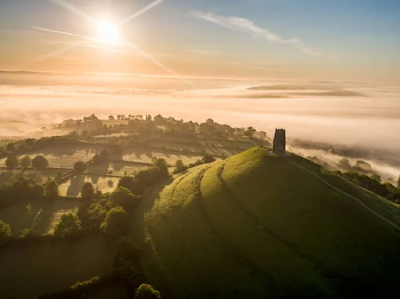
Although born in Devon; I spent all my school years living in a village in north Somerset. But, because I was (mostly) a rationalistic atheist, I was almost unaware that during this time, as well as for some time afterwards, Somerset was a centre for some of the best exponents of spiritual (including Christian) thinking - several of whom lay within a bicycle ride of my own house.
Somerset was indeed the residence of several people who since become some of my most important spiritual mentors.
Mostly, this Christian spirituality was a subset of the fact that (outside of London) the main place for New Age thinking was (as described by historian of paganism Ronald Hutton - who has himself been at Bristol University since 1981) an isosceles triangle with its base cornered by Bristol and Bath, and its point at Glastonbury.
My lack of interest in this kind of thing - at the time - is evidenced by the fact that I did not visit Glastonbury until after I had left school, and the family was was just about to move to Scotland!
Nonetheless; I believe that spiritual influences of place do have an effect; sometimes all the more powerful for being latent and unacknowledged; and in later life these influences began to pile-in upon me.
Terry Pratchett (among other things) wrote superbly on aspects of Southern English folklore; and he was living not far away in in tiny Mendip village of Rowberrow, practicing "self-sufficiency", beginning his publishing career, and absorbing the same Electric Folk influences (especially Steeleye Span with their interest in supernatural ballads) that so much dominated my teenage years.
John Michell - Christian Platonist and Geomancer - was another inhabitant of this region; living in Bath; which city also housed (for a while) our-very-own William Wildblood.
Then there was Geoffrey Ashe. He was the only one of these people of whom I was aware at the time; because he was well known as an advocate of South Cadbury Hill Fort as the location of King Arthur's "Camelot". I even visited this impressive earthwork one gloomy Sunday afternoon with my Dad, and felt some of the site's presence.
William Arkle actually lived in Backwell, the same village as myself ; albeit up on top of Backwell Hill. I knew nothing about him until a few months before I left school, when there was a local BBC TV documentary programme about him. I was intrigued, and tried (without success) to find out more; but was put off making contact by my reflective anti-Christianity (in the programme he talked about God in a manner that I found off-putting). I could very easily have visited and met him - especially since my sister knew the family to talk to, via an interest in ponies - but I didn't...
Another Glastonbury resident in his later life (and a frequent visiter to nearby Winscombe as a child) was Stanley Messenger, an unusually thoughtful and independent-minded Anthroposophist.
[See note added]
All of the above people have, in different ways and to various degrees, been important to me in my spiritual life and development. All have significant Somerset connections, and all (except Stanley M, I think) overlapped with my residence of the county, and were indeed situated nearby.
This now strikes me as quite remarkable - because the above names constitute a large proportion of the authors, thinkers, lecturers - learning from whom has led me to where I am now.
Clearly, Somerset set its mark upon me; and that influence has continued to grow in the 45-plus years since I moved away.
Note added 5th December 2023: I have just discovered that the folk musician Bob Stewart (expert Psaltery player) and scholar of folk mythology (Where is St George? - recommended!) was living in Bristol and Bath from the late 1960s and into the 1980s. He later went on - renamed RJ Stewart - to become associated with Gareth Knight, a prolific and influential author of books on ritual magic, and workshop leader.
Monday, 5 September 2016
Studying Coleridge in Coleridge's Study

Above I am being pretending to be inspired by the spirit of Coleridge, by working in the room that was his study. Pretence aside, it is an inspiring room; and I spent several hours there, tackling Coleridge's main prose work Biographia Literaria (Biographical Sketches of My Literary Life and Opinions).
(This was an old Everyman edition bought cheaply a few days earlier from Bookcase in Carlisle, one of the great secondhand bookshops; an actual exemplar of Terry Pratchett's concept of 'L-Space'.)
But I have rather reluctantly concluded - after several months of intense effort - that Coleridge is 'not for me' in terms of the detail and specificity of his philosophy.
https://charltonteaching.blogspot.co.uk/2016/05/ingwaz-metaphysics-of-ing-of-polarity.html
https://charltonteaching.blogspot.co.uk/2016/05/reality-is-constituted-by-polarity-and.html
From Owen Barfield's wonderful book What Coleridge Thought, I recognised that Coleridge provided a philosophical solution to the primary problem of modernity; but I soon found the memory of this answer slipping away from me; and now - after four months, and despite continuing to struggle with Coleridge - it has altogether gone.
The problem is my inner resistance to the abstract, geometric-mathematical nature of the schema. I can grasp this when I am immersed in the work, but only in the way I grasp mathematical concepts - I don't feel it in my heart, I could not base my life on it - nor could I persuade anybody else of it.
Similarly, Coleridge's metaphysics of Christianity (focused on the mystery of the Trinity) is too abstract and paradoxical for me to find it moving, compelling, inspiring or encouraging.
In sum, Coleridge's ideas are ultimately incompatible with my primary metaphysical understanding of the nature of reality - which is why they keep slipping-away from me.
My conclusion is that Coleridge's solution to the problem of modernity is valid and works for some people such as Owen Barfield - but I will need to find my own philosophical way of understanding and articulating the way forward beyond alienation, nihilism and despair.
This will need to fit with my fundamental metaphysical beliefs; which are pluralist (in William James's sense); and based on the Mormon concept of the destined mortal human condition as a voluntary, incremental exaltation of each man or woman towards ever-fuller deity; including William Arkle's clarity that this process is an ever greater participation in a creation unified and essentially characterised by loving familial relationships.
In other words, as so often, I return to the master metaphor and concrete reality of God being our loving Father; and the human condition as one of (if we choose) developing, growing-up through experience and striving, over a vast timescale - eventually hoping to rise to the same level of being as our heavenly father, and able to know him in an adult (that is fully divine) way.
Subscribe to:
Posts (Atom)