Friday, 3 October 2025
Magical duels between early Christian missionaries and Druids of the British Isles
Friday, 19 September 2025
Traditional Christianity - in practice a New Age type of "radical traditionalism"?
I often dip-into the writings of John Michell - who had a truly delightful ability to evoke an imaginative and romantic vision of the past; especially of past societies and places.
Michell sometimes defined himself a radical traditionalist - in that his lifestyle, methods and society were radical, countercultural and New Age. He is, indeed, regarded as a founder of New Age in Britain, with a delightfully inspiring 1969 book called The View Over Atlantis. A very modern kind of chap, then; eccentric, eclectic, a magpie-collector of lost perspectives and knowledge...
But Michell consistently advocated traditionalism. His greatest hero was Plato, or more exactly the Neoplatonic (perrenialist) tradition that is said to date back at least to Pythagoras; and sees abstract and ideal numbers and geometry, as the basis of created reality.
Michell wrote and spoke eloquently about the ideal civilization as one of perfect unity, balance and form; a society that was served by its people - who were united and found their deepest satisfaction by their love of divine harmony, and whose life was spent in sustaining that harmony.
In spite of his many neo-pagan followers; Michell publicly identified himself as a Christian, in the Catholic tradition of the Church of England; and his vision was a distinctly deistic version of the kind of society most closely approached here during the "Merrie England" era of the Middle Ages.
It struck me that even the most ardent and sincere traditionalists among current Christians, are much more like John Michell than they are like the denizens of Medieval-type societies of the kind they hope shall return.
In other words, like it or not (and they would not embrace the label like John Michel did) they are essentially "New Age Traditionalists" - who are inspired in the present by contemplating an imaginative vision of the past.
More exactly; I regard New Age spirituality as (approximately) an individual centred seeking after participation of consciousness - a personal quest for alleviation of modern alienation; often by discovering "technologies" by which their own consciousness may be manipulated in the desired direction.
And the bottom line is "whatever works for me".
Traditionalist Christians are typically also doing this: they have discovered a religious system, with characteristic ritual, symbolism and sacred books and activities - that "work for them" in inducing the desired spiritual state.
But in most of New Age, this quest may be hedonic, may be wholly here-and-now and this-worldly...
While for traditionalist Christians, such effects, while usually present (I mean, joy, or at least pleasure, from living and participating in church-endorsed activities) is subordinated to other-worldly goals; perhaps including the transformation of this-world into a specifically-Christian version of Michell's more generic ideal structure and forms.
What I am getting-at is that the modern attitude to traditional and (more-or-less) ideal-modelled societies - whether actual and historical or potential and aspired-to - is contemplative and imaginative (at best) - and because of the actuality of our consciousness; it nearly-always takes (as with John Michell) a modern, New Age, and indeed "radical" form.
In sum, traditionalism cannot help but be a radical traditionalism; and this includes individualistic and New Age discernments and evaluations.
No matter how viscerally a traditional Christian may despise New Age spirituality - his own religious life shares essentially the same generic aims and methods.
No matter how earnestly someone may seek to become a traditionalist like those of the past; our whole attitude and method will be "radical" - not least because we need actually to be modern society nonconformists and rejecters - that is radicals; in pursuit of becoming (it is hoped, at some point in the future) obedient traditional society acceptors.
I regard this as an inevitable constraint - a product of the way that we now are, and the way that our consciousness is set-up - individualist and agentic, spontaneously-alienated, inescapably fated to make personal discernments and evaluations.
For a Christian truth is never just "my" truth; but for a modern Christian, strong and motivating saving-truth needs also to be "my" truth - in a way that was not the case in the past.
Thus the spiritually-effective Christian life will inevitably share some version of the New Age "Seeking" quest, and will be calibrated by means of a spiritual-responsivity that may well be individually-distinctive, or else rare among the mass of people.
Thursday, 19 September 2024
Was the British Celtic Church actually "Paganism with a veneer of Christianity" - or the opposite?
Edited from New light on the ancient mystery of Glastonbury, by John Michell, 1990
Celtic Christianity has been called a mere reformation of Druidry.
A unique and remarkable feature of the early Church in Britain in Ireland is that it claimed no martyrs through persecution by the religion it supplanted...
The Druids had no difficulty in accepting the new religion, because it scarcely interfered with the existing religious and social order.
The system of the early Church "was really Paganism with a veneer of Christianity".
**
I have often seen this written; however, I think it more likely that the opposite was true*.
And the reason for such opposite interpretations is due to very different concepts of what Christianity actually is.
If Christianity is essentially The Church, and Christendom (a Church dominated and permeated society) - then clearly the newly converted pagans must have only a superficial smattering - a veneer - of the new faith over an substructure that can only be Pagan.
The newly converted Celtic British Christians did not have a trained and ordained hierarchy of priests - these must have been few, and far between. The Britons did not have a comprehensive coverage by churches offering the sacraments. Nor had they experienced Christian teaching, nor did they live under a system of societal laws in conformity with the Church's understanding.
Instead; there inevitably must have been (for many years) mostly the residue of whatever actually was the system of Druidic religion - its sacred places, its Druids, its practices, and the effects of generations of its teaching.
Furthermore; Christians seem to have had a deliberate policy of taking-over and re-purposing Pagan shrines or gathering-places. This strategy extended to making Pagan gods into Christian Saints - the best evidenced of which is the Irish god Brigit becoming the famous and beloved Saint of the same name.
Surely (so this argument goes) all this means that for many years the British were still essentially Pagan - surely, their Christianity was, at first, merely a veneer of Christianized language and symbolism (such as a cross inscribed or erected-upon a megalithic standing stone) on-top-of what long-remained a Pagan religion?
But if Christianity is accepting Jesus as Saviour, desiring resurrection to eternal Heavenly life, and embracing the intent of living by Love... then none of the substructure of Paganism really matters.
By this argument; what makes someone a Christian is the choice to "follow Jesus Christ" (with what that entails in a "cosmic", eternal, post-mortal sense) - and the rest of religion is, at best, an optional extra.
Of course, there would have been many aspects of Druidic Paganism that conflicted-with and contradicted the basic of Christianity in Love.
But that applied to the Christian Church as well - much of its actuality contradicts the essence of Christianity, and always has.
So long as the newly-converted Christian sought resurrection into Heaven by following Jesus Christ; instead of seeking whatever it was that Druidic Paganism had previously promised (generally regarded as having been some kind of reincarnation, perhaps involving metempsychosis) - then I would argue that the new Celtic convert was fully Christian.
I think there are lessons for Christians here-and-now.
Any Christian needs to navigate a world - a world including whatever Church he belongs to, and whichever religion or ideology rules his society - that is substantially hostile to his deepest convictions.
Yet none of this prevents him from being fully a Christian - if that is what he most desires to be.
As Jesus himself said: Christianity is for sinners, not perfect Men; and for this actual sinful world, not some ideal society.
Society cannot prevent anyone from becoming and being Christian...
Because ultimately Christianity is "not of this world" - and because resurrection and Heaven cones from Jesus, not from this world.
What we absolutely need to do, and must do, is to want it.
*Note: Certainly, the Celtic Christian era in the British Isles led - over the following centuries - to a greater number and (even more so) concentration of Saints (and great Saints, still remembered as patron Saints, in church and city foundations, and festivals) - like Cuthbert, Patrick, David, Kentigern/ Mungo, and Brigit) than at any other time in the history of these parts.
Saturday, 24 August 2024
True measures - Temperature
John Michell summarized the case against the metre (and, by extension, other metric and "SI" measurements) as: it doesn't measure anything.
This is why metres - their decimal divisions and multiplications - are almost useless to think with; whereas many of the Imperial measures are very well suited to inner work: each being a measure of some thing relevant - whether inches, feet, furlongs... or leagues.
[The league ought to be revived, as being the distance an average person walks in an hour. Of course, you need some artificial device for measuring hours - which have no natural correspondence!]
For examples: Understanding the height of everyday objects in feet and inches, or weight in stones and pounds... These are far superior to the metric substitutes.
(Although I don't understand why Americans have abandoned stones - so that peoples' weights are stated given in very large numbers of pounds! This goes absolutely against the common-sense spirit of Imperial measures.)
My favourite instance is the acre as (roughly) defined as how much land could be ploughed in a day - thus an acre in areas with light sandy soil might be several times larger in area than an acre in heavy clay soil; and this difference broadly reflected the agricultural value of the land.
It strikes me that metric measures have only replaced Imperial to the extent that people have stopped being aware of their environment, and ceased thinking about things for themselves.
And have instead handed-over their thinking to machines and computers - devices that just tell us stuff in arbitrary, abstract and incomprehensible terms...
And we are intended uncomprehendingly to submit and obey (and, nowadays, people nearly always do...).
The one bad non-SI measure - which has, significantly, spontaneously (by popular lack-of-demand) been abandoned almost everywhere - is Fahrenheit, which (significantly) is not Old English in origin.
The Fahrenheit doesn't measure anything (in ordinary experience) whereas its more successful rival, the metric (but not SI) measure of Centigrade is rooted in the freezing and boiling of water.
Yet a Centigrade is - as typical of such abstract decimalizations - the wrong size for everyday usage: been too big, too coarse, a measure; so that in practice half degrees Celsius (or less) must be used.
The practical men who devised Imperial measures would have subdivided the difference between freezing and boiling into a larger number of degrees (maybe twenty-four?); and probably in accordance with what was most useful for the usual everyday purposes of measuring temperature - which occur in the lower half of the range.
Note added: By my understanding, however, all mathematics, arithmetic, geometry, number-systems &c are abstractions that remove us from direct (i.e. relational) participation with reality. Just that the Imperial measures are less abstract, more rooted in human experience... It is a matter of degree, not a qualitative distinction. But there will be no Measures in Heaven!
Monday, 20 November 2023
Somerset Spirituality in the late 20th century
Although born in Devon; I spent all my school years living in a village in north Somerset. But, because I was (mostly) a rationalistic atheist, I was almost unaware that during this time, as well as for some time afterwards, Somerset was a centre for some of the best exponents of spiritual (including Christian) thinking - several of whom lay within a bicycle ride of my own house.
Mostly, this Christian spirituality was a subset of the fact that (outside of London) the main place for New Age thinking was (as described by historian of paganism Ronald Hutton - who has himself been at Bristol University since 1981) an isosceles triangle with its base cornered by Bristol and Bath, and its point at Glastonbury.
My lack of interest in this kind of thing - at the time - is evidenced by the fact that I did not visit Glastonbury until after I had left school, and the family was was just about to move to Scotland!
Nonetheless; I believe that spiritual influences of place do have an effect; sometimes all the more powerful for being latent and unacknowledged; and in later life these influences began to pile-in upon me.
Terry Pratchett (among other things) wrote superbly on aspects of Southern English folklore; and he was living not far away in in tiny Mendip village of Rowberrow, practicing "self-sufficiency", beginning his publishing career, and absorbing the same Electric Folk influences (especially Steeleye Span with their interest in supernatural ballads) that so much dominated my teenage years.
John Michell - Christian Platonist and Geomancer - was another inhabitant of this region; living in Bath; which city also housed (for a while) our-very-own William Wildblood.
Then there was Geoffrey Ashe. He was the only one of these people of whom I was aware at the time; because he was well known as an advocate of South Cadbury Hill Fort as the location of King Arthur's "Camelot". I even visited this impressive earthwork one gloomy Sunday afternoon with my Dad, and felt some of the site's presence.
William Arkle actually lived in Backwell, the same village as myself ; albeit up on top of Backwell Hill. I knew nothing about him until a few months before I left school, when there was a local BBC TV documentary programme about him. I was intrigued, and tried (without success) to find out more; but was put off making contact by my reflective anti-Christianity (in the programme he talked about God in a manner that I found off-putting). I could very easily have visited and met him - especially since my sister knew the family to talk to, via an interest in ponies - but I didn't...
Another Glastonbury resident in his later life (and a frequent visiter to nearby Winscombe as a child) was Stanley Messenger, an unusually thoughtful and independent-minded Anthroposophist.
[See note added]
All of the above people have, in different ways and to various degrees, been important to me in my spiritual life and development. All have significant Somerset connections, and all (except Stanley M, I think) overlapped with my residence of the county, and were indeed situated nearby.
This now strikes me as quite remarkable - because the above names constitute a large proportion of the authors, thinkers, lecturers - learning from whom has led me to where I am now.
Clearly, Somerset set its mark upon me; and that influence has continued to grow in the 45-plus years since I moved away.
Note added 5th December 2023: I have just discovered that the folk musician Bob Stewart (expert Psaltery player) and scholar of folk mythology (Where is St George? - recommended!) was living in Bristol and Bath from the late 1960s and into the 1980s. He later went on - renamed RJ Stewart - to become associated with Gareth Knight, a prolific and influential author of books on ritual magic, and workshop leader.
Sunday, 23 October 2022
The corruption of religions, by piling-up of revelations
It seems that there is an almost irresistible tendency for 'religions' (and other things like 'religions' to bulk-up with time: to become, if not more genuinely complex, greater and greater in quantity of assertions.
More and more 'revelations' are added to the original foundations until... well, in the first place the original foundations may become obscured, the reality of the religion may be distorted away from its primary core; and eventually - which may not take long - the actuality of the religion may be directed in the opposite direction from its origins in several or many respects.
In the end, a religion - in its actual practice and effect - may become the inversion of how it began.
This can be seen with Christianity if, like me, one regards the Fourth Gospel as a valid record its its origins. It seems that the primal simplicity of Jesus Christ's example and teaching was substantially added-to (and thereby, significantly, both obscured and distorted) almost immediately after his ascension; and the process continued for centuries.
Some of these post-Christ revelations were helpful clarifications and extrapolations of the consequences of what Jesus said; but most were not; and many were contradictions.
Ideally, it seems to me, it would be best to take the primal simplicity of the origins, and to examine the implications, and to explore what these mean in individual lives and the lives of groups and nations.
However, this process seems to be rare - perhaps because it is cognitively difficult; and because Men have an innate interest in novelty; and in getting immediate answers to their own personal and urgent questions, rather than to exploring the implications of the foundation.
And sometimes because there are successful attempts to manipulate Men; by snowing them with unmanageable information, by generating the incomprehensible, by creating a fixed attitude of inadequacy and therefore de facto obedience and passivity in relation to authority.
At any rate, I observe a very similar trajectory of accumulations of assertions in those religious and spiritual movements of which I have some knowledge.
Mormonism underwent enormous accumulative changes through its first decades from the origins in 1830; and soon became hardly recognizable both in terms of style and content, and in terms of the scale of emphasis.
Similarly Rudolf Steiner's spiritual science movement rapidly accumulated a truly vast mass of assertions, almost wholly from Steiner himself; from its simple origins in the philosophical works and Christian conversion of the late 19th century; and through next quarter century - only terminated by Steiner's death.
The most extreme example is the New Age movement. This was never simple nor coherent, because always eclectic; drawing on CG Jung, the Westernized versions of several Eastern religions, and the 'beatnik'/ hippie youth cultures.
But the New Age movement grew almost entirely by addition. Interest and motivation was maintained by heaping-up more and more possibilities - more alternative healing systems, more techniques of meditation... different psychoactive drugs; divination by astrology, magic or tarot; artifacts such as crystals, pyramids; ever more varieties of neo-paganism (Wicca, Drudism, Shamanism...). And so on.
There were periodic attempts to bring some kind of coherence - for example John Michell's 1969 The View over Atlantis - which linked several themes such as UFOs and ETs, ley lines, and Atlantis as an archetype of ancient high civilizations - my means of a revived Neo-Platonism.
But even in Michell's own work, the strong tendency to accumulate overwhelmed the rigorous exploration of principles. And the New Age movement as a whole simply absorbed and absorbed - and any rigor of reasoning was itself in a playful spirit; designed more to stimulate and entertain rather than to explore the implications of truth.
(In such a situation, the true ruling principles of New Age became those of society at large - in this instance the acceptability boundaries of hegemonic materialistic, atheistic, leftism - within-which all New Age activity functioned. Thus the phenomenon of 'convergence'. New Agers might 'believe' almost anything spiritual - but are united in regarding (e.g.) climate change, racism, and the sexual revolution as among the most important moral issues of the day.)
I see much the same tendency at work in almost all domains of human action; including science where vast superstructures of 'research' are built on arbitrary or false claims (CO2 warmism - with its foundational lie of being able to predict global climate - is the egregious example). And in law - where legally-nonsensical and/or undefined-undefinable principles (such as 'hate crimes', 'racism', 'asylum-seeker', 'diversity', 'inclusion') are used to underpin truly enormous superstructures of bureaucracy; and to determine the fate of nations and civilizations.
All these many tendencies have led to where we now stand; where Men's mind are utterly stunned and rendered ineffective by the incomprehensibly enormous accumulation of assertions.
This leads, inevitably, to passivity; and to an attitude of 'not even trying' to understand but instead a stance of fluid, pragmatic, unprincipled, unmoored, here-and-now, expediency - getting-by, getting-along, making-the-best-of-it...
And yet: anther possibility remains as a living alternative. To discover, each for himself, the stark simplicities that underpin the incomprehensible superstructures: first and crucially in religion, especially including Christianity - but also everywhere else.
...And then to determine whether these fundamentals are indeed true to reality as we know it; simply by paying them sustained attention, and learning from what eventuates.
Saturday, 1 January 2022
Accelerating chaos and evil Not-plans: wishing you a Happy (demonic fake) New Year!...
Old readers will know of my aversion to the official New Year defined as 1st January; which is defined in terms of what it is not (not astronomical, not seasonal and not Christian) rather than what it is - which is to say arbitrarily numerical...
This means the Year is not truly new, but only demonic-fake-'New'.
So, the New Year and its 'celebration' is almost-certainly Satan-spawned - as what else could it be? When we are induced to celebrate the arbitrary, it is only one step away from celebrating the actively-evil.
Thus your cheerful and social Happy New Year! greetings with neighbours are approximately spiritually-equivalent to a Nazi salute or the clenched fist of Communism...
(...You're welcome...)
But this is the day one of the calendar-year; and my understanding is that the demons are very keen on arbitrary numerology - on the special significance of certain arbitrary numbers (i.e. fakely-significant numbers); being super-especially fond of decimals, decades, centuries - and the metric system generally, including SI units ("Systeme International" - French, wouldn't you know).
The lower-ranked (bureaucratic, 'Ahrimanic') demons love these systems because they are made-up by officials; and because of their abstract efficiency, and easily calculational inter-convertibility.
SI units model the world as-if it was already the single totalitarian System that the Ahriminic demons day-dream about implementing and operating...
The metric-SI system artificially-'unifies' the world - and achieves this abstract coherence by its indifference to the human.
By contrast the Imperial System (feet and inches, furlongs and leagues etc) was originally based-on the human body and mind; and the usage of measures that are functionally appropriate to the actual task in hand. This was especially the case in its earlier, 'medieval' forms - e.g. when 'an acre' was the amount of land that could be ploughed in a day, locally.
There are also sacred, 'magical' number and geometrical 'systems', apparently derived from Pythagorean-Platonic philosophy - and these are universal; but abstract, not human, not functionally-derived.
(See How the world is made: the story of creation according to sacred geometry, by John Michell, 2012.)
But naturally, none of these genuine, good-aiming spiritualities are of interest to the demonic powers - except when they can be subverted and then inverted; because inversion is the basis of anti-Christian symbolism and ritual - just as inversion of values is the most advanced form of evil.
It was, presumably, the middle-managers among the demons (as among humans) who chose to make 2020 the year for the global totalitarian coup.
2020 is just the kind of meaningless but superficially-significant 'decimal' number which they like best, and which they believe brings them the best results.
So - what about 2022? Anything special?
I think not - not for the kind of Being that is engaged in the Ahrimanic programme. They are keen planners and 'strategists', and are explicitly aiming at 2030, the next decade - for the 'completion' of their current strategy of worldwide surveillance and control.
But as of the approach to 2022; these mid-level demons have apparently lost control, and their plans are not happening to schedule.
Why? Partly because the plans were based on falsehoods and could never have-worked.
Partly because of unexpected resistance.
But mostly because the 'Sorathic' demons of chaos, of sheer destruction and negation, are increasingly in control; and are using The System to inject chaos, destruction and negation into itself.
The Ahrimanic demons intended to use The System to rule the world post 2020...
But the Sorathic demons want to use The System to destroy The System.
There is no doubt that order is collapsing and chaos is increasing - locally and worldwide.
Therefore: the most likely prediction for 2022 is... Accelerating chaos
(...Which is actually a bit of a non-prediction - since the nature and location of chaos cannot - by definition - be predicted!)
But this tsunami of dysfunction is not apparent to the Ahrimanic middle-managers, because they are incompetent and dishonest; self-blinded fools who live by self-serving lies - and they believe that their interests are best served by pretending to omniscience and omnipotence.
When real knowledge and power are lacking, the adopt the Texas Sharpshooter tactic of claiming that whatever has-happened was exactly what they wanted to happen...
In the face of actual accelerating chaos; demonic middle-managers will continue 'confidently' to assert that everything is getting better...
...All is on-track and on-schedule; tractor production continues to increase by hundreds of percent per year; and the bureaucratic utopia of own-nothing/ be-happy will be oven-ready for 2030 - all in accordance with plans...
And this will be asserted, louder and louder, officially and by the mass media - until the world is engulfed by war and famine, disease and death, flame and flood...
At which point they will simply claim that they always meant to do that.
Romantic Christians should not be misled by the collapse of the Ahrimanic-bureaucratic plans into assuming that this means the powers of Good are necessarily ascendant.
The birdemic-peck narrative would indeed collapse because of Christian resistance - if such existed. But does it exist?
Good can only come of good (not from evil-motivations) - and unless there really is a Christian resurgence, then failures of evil planning will not imply a better overall outcome - not if those failure are due to ascendant chaos.
All complex strategies and functionalities (both Good-motivated, and of evil-intent) that depend on organization, coordination and obedience will - sooner and sooner - be sabotaged by the waxing of Sorathic evil.
Thus, the failure of evil-plans is not good news when they are being thwarted by evil-not-plans...
But only when evil-plans are thwarted by intentions on the side of Good.
Monday, 19 July 2021
One can't (now) be agnostic about Christianity - what what about other stuff? Classic conspiracy theories?
Things have been coming to a point for some decades - and have now arrived-at the point; so there are only two choices in the ongoing spiritual war: the side of God, or of Satan. Nobody can be 'an Agnostic' in this sense - can claim 'not to know' about God - because that is to take the side of Satan.
But I think one can be agnostic about other issues, which are not of crucial importance, and/or which cut across the Christian-Evil divide.
I find myself agnostic about much of the 'conspiracy theory*' field - such topics as are nowadays covered by people such as David Icke, or my penfriend Andy Thomas (or, in the recent past, by John Michell): Illuminati, crop circles, UFOs, 9/11, Atlantis...
Many of these subjects I feel genuinely agnostic about; in that I could imagine them being either true or untrue - or of containing significant elements of truth, mixed with error and fraud.
Further; in such matters, being agnostic is very different from rejecting them altogether and outright - which is the mainstream position. Indeed, to be agnostic is closer to being 'a believer' than it is to being a 'skeptic'.
What is interesting is how and why I should (apparently) be content to stay in my agnostic state, without trying to settle matters one way or the other. Why, for example, don't I actually visit a crop circle, or make efforts to observe a UFO?
I suppose the answer is that I don't think the answer is of decisive importance either way. I really don't - and that is because for me the answer (whatever it is) is subsumed within the much larger matter of destiny, or providence; that is, God's plans for me and for the world and its people.
As I understand divine destiny, it is such that these matters are not crucial.
Whether, for instance, aliens are contacting, or trying to communicate with, Mankind (or whether aliens are deceptive demons) is - for me - a matter of only mild interest; because the answer would be only one factor among innumerable others. It would not affect the way I lead my life, or what I strive for.
This perspective is, I suspect, incomprehensible to the mass of contemporary conspiracy theorists - who are atheists; and, because things have come to a point, therefore more or less, anti-Christian. But so it is.
Therefore I read, and have read, a fair bit about these topics; watched videos, listened to audios etc. I have found much of this material interesting, and indeed very useful, in a wide variety of ways. Yet this value does not seem to depend upon reaching a conclusion one way or the other; and so I remain agnostic.
Note: The term conspiracy theory is itself propaganda on the side of evil; so the conspiracy theory field is an example of The Enemy's enemy. However, most members of that community still seem to be wedded to one or another aspect of the Leftism agenda - so (for all their valuable insights) they fail the Litmus Tests and are on the other side.
Monday, 18 January 2021
The nature of giants
As I have previously noted; the original inhabitants of Britain were said to be giants; and there is considerable 'documentary' evidence for the reality of giants.
But if we accept that there once were giants, then of what nature were they? Presumably not gigantic Men - since that seems biologically impossible - but if not that, what were they?
Bearing in mind that the age of giants was also the age in which magic was a part of everyday life; one interesting idea comes from John Michell in his beautifully-written superbly imaginative New light on the ancient mystery of Glastonbury (1990) - edited excerpts of pages 51-2 follow:
**
The giants of old undoubtedly symbolized natural forces, but we are repeatedly informed by early historians that sometimes they were visible in monstrous and grotesque forms. They belonged, therefore, to the cryptic category of beings which includes the yetis, Sasquatch and Bigfoot.
These creatures are occasionally seen and heard, but essentially they are phantoms. They represent an aspect of the 'genius loci'; the indwelling spirit of certain mountains, lakes and wild places. Their forms are fluid and adaptable, being determined by the collective imagination of local people.
In traditional societies, magicians and shamans know about such things, and are sometimes able to invoke them.
It is often easier to produce phantoms than to dissolve them. Like all 'technologies' they had unwanted side effects. In the course of time, they become more solid and may even bleed when wounded.
Therefore, not all the spirits raised by magicians were properly laid to rest, and some lingered about the countryside to establish a breed of monsters. This may be the origin of the giants which were apparently still to be found in Britain in the second millenium BC.
**
Tuesday, 21 July 2020
The importance of metaphysics
For most people who can even bother to think about such matters for ten minutes (and these are extremely few!), metaphysics seems like almost the definition of that which is most remote and irrelevant to actual life. But to me, nothing is more relevant - and never a day - hardly a waking hour - passes in which I do not think about such matters.
The reason is that I see metaphysical assumptions behind almost everything of interest to me; and that I am continually aware that the basic understanding of others is nearly always very different from my own.
Here is an example (in italics; which I have edited for clarity and explicitness), from John Michell, at the end of his (excellent and inspiring!) book from 1990: New Light on the Ancient Mystery of Glastonbury. :
One of the conventional symbols of earthly paradise is the union between two cities: the heavenly Jerusalem and the actual city of Jerusalem below. William Blake drew on that image in prophesying that the New Jerusalem would first become manifest in England...
Plato was more practical-minded than Blake. His imaginary republic was based on the archetype of heavenly paradise, and from there he descended into the world of matter; interpreting the ideal in the form of a social order which he considered to be its best possible reflection.
Due to its material nature, Plato's republic was necessarily structured, and was governed, by a code of laws.
It was, as Plato admitted, a mere third-hand version of the ideal; for the original is the heavenly archetype, and its clearest secondhand reflection on earth is that primordial paradise remembered in the Garden of Eden [and substantially experienced by historical nomadic tribespeople...]
From this secondhand version of paradise we have long been barred due to the necessary inhibitions of civilization.
Most people today enjoy the civilized state and its comforts, and therefore - like Plato - we are concerned in practice with the [third hand] reflection of paradise: a perfectly ordered, permanently settled human society.
This is not the innocent paradise of Eden, but is the next best thing; and Plato promised that, if its standards were scrupulously maintained, it would be almost as good and long-lasting as the original.
Thus we have the original and best - because perfect, permanent and unchanging - reality located in the transcendental realm of spirit; and all possible earthly and material manifestations as symbolic, temporary secondary and symbolic.
We are removed a step further by 'civilization' - which constrains the originally natural and spontaneous order of Eden (approximated by nomadic hunter-gatherer life) into hierarchy and law: a system into-which individual humans must be conformed.
By my understanding; this Platonic metaphysics has been adopted by mainstream Christian theology; and its assumptions underpin the Christian churches from most of the earliest records - because the Christian churches were themselves of a civilized nature, secondary and symbolic, hierarchical and derived-from laws - and expressing Christianity in the form of hierarchy and law.
In different words; this is an abstract metaphysics; in which reality is regarded as primarily spiritual and metaphysical. And so dominant is this way of thinking that few people can even imagine any alternative.
But that is the focus of my life work: I mean, to imagine and describe, and then to try and live-by, a different basic understanding of the nature of reality.
That is what I mean when I assert (over and again) the primacy of the Fourth Gospel, and emphasise that it embodies a profoundly, indeed qualitatively, different basic understanding of the nature of reality; and records this as being the teaching of Jesus.
This is the metaphysics in which Beings and their relationships are primary; reality is seen as developmental ('evolutionary'), with mortal life on earth as - not secondary, but a part of this primary reality.
Thus earthly material life is not secondary, nor is it ultimately abstract, nor symbolic; but part of a developmental 'process' (but 'process makes it too abstract) - a history of groth and development - which began before mortal life and continues after biological death.
And this very different metaphysics affects (or ought to affect, if believed and lived-by) pretty much everything that happens in every persons' life; in the most immediate and practical sense of transforming its meaning and relevance.
Monday, 6 May 2019
My favourite YouTube Video with 1 view recommending favourite YouTube videos with less than 200 views...
Readers with similar suggestions of worthwhile but not-popular videos are invited to comment - but please name and explain your choices (I won't publish bare URLs).
Monday, 11 February 2019
What's going on with UFOs?
I don't rule out that - at some level - the UFO phenomenon is, or was, genuinely 'paranormal' and purposive. Yet I somehow don't regard the matter as very serious or significant - at least, not unless an interest in UFOs was to lead-onto a more spiritual way of thinking and living, as happened with John Michell (Michell's first book was about Flying Saucers).
My main hypothesis is that UFOs are part of the spiritual warfare between angels and demons; and how this is manifested to certain people in certain circumstances. However, the matter is of UFOs nearly always discussed in a materialist (and unChristian/ anti-Christian) context. In other words, some UFO phenomena are probably angels (or made by them) while others are demonic.
But UFO appearances do not seem to be a very effective method of spiritual intervention - at least not for the angels. Why would angels do such a daft thing? Well, I regard angels as fallible creatures - being not a separate creation from Men, but pre-mortal and resurrected that are Men active in earth life. That is, angels are the not yet born, and the so-called-dead. Such angels are doing their best and learning from the experience; but it is inevitable that some of their ideas will fail to achieve their intended results - and maybe UFOs are an example?
UFOs, when they originated in the late 1940s, might have been modern miracles; spiritual manifestations designed to break the belief in materialism. For example, the Fatima miracles of 1917 would probably have been interpreted as UFOs if they had occurred in 1947*.
So what may be happening with UFOs is that spiritual phenomena of light (with its ancient symbolism of divinity) were misinterpreted materialistically; as high tech spaceships piloted by aliens. Then demons (who are pre-mortal, un-incarnated-spirit Men that are actively opposed to God, Good and divine creation) may have exploited this situation; and engineered other manifestations and contacts, in order to reinforce a world view that favours their evil agenda.
This is just a vague idea, and I don't have much interest in making it more precise; but it is part of my more general understanding that modern people are so deeply and habitually materialistic; that they will reduce anything spiritual into this framework.
Many millions of people very quickly developed strong and detailed beliefs in alien existence, contact, communication and plans that were based on no more than hearsay and dishonest mass media accounts, or (more rarely) on very ambiguous personal experiences of strange phenomena.
And this happened at such a large scale and so rapidly, because modern people find aliens possible (no matter how unlikely); while angels (and demons) are ruled-out a priori - because the metaphysical Christian beliefs that make sense of angels and demons are nowadays (generally and officially) regarded with bored disdain or loathing.
*Indeed, pretty much all the ancient supernatural events of the Christian Bible, and records from other religions, have (at one time or another in the UFO literature) been re-re-interpreted and explained as early examples of interactions between humans and various combinations of alien beings, alien-advanced technologies and flying saucers. Either this - or the opposite mainstream Establishment attitude of complete rejection, mockery and denial - is how a metaphysics of extreme and convinced materialism inevitably deals with anomalous phenomena.
Friday, 1 February 2019
What about crop circles?
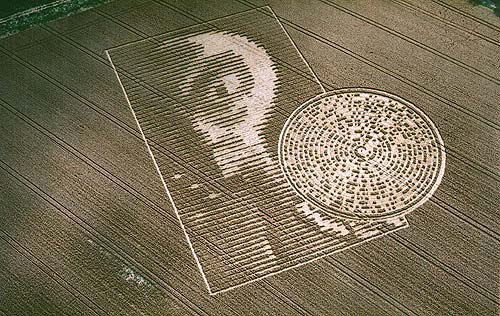
Since all our 'external' knowledge (including all of science, and academic research) is based on reliable eye-witness reports, and several people whom I regard as reliable have reported strange crop circle phenomena; I am now happy to accept that there is 'something' mysterious about some crop circles.
Most of the people I have encountered who write and speak on the subject are not convincing individuals by my judgement. Nonetheless some of them are; and because some such people are convincing to me, therefore (to put it negatively) I don't believe that the whole crop circle business is a hoax. Positively stated - some crop circles have had a 'supernatural' cause - beyond mainstream possibilities.
But what do I believe?
I believe crop circles are 'real' but trivial, in the same way that most 'mediums' who 'channel' spirits provide some information that may really be of supernatural origin, but which is trivial. Supernatural does not equal profound. Spiritual beings are real, but many of them (even among the broadly-benign) are foolish, conceited, ignorant - just like mortal Men.
Supernatural phenomena may also be evil - indeed they usually are either evil or trivial; esepcially when they are deliberately sought-for, by 'techniques' or strenuous meditational practices. We ought not to be too impressed by such things, esepcially not by their specific content. Yet our cultural materialism has made us naive and credulous of almost anything we believe to be real that we find 'scientifically' inexplicable. This is supernaturally equivalent to believing something simply because 'a bloke in the pub' told us; or because we 'read it in an old book'.
Over more than thirty years - before and after I became a Christian; my ineradicable conviction is that any spiritual being, or alien visitor, who uses shapes flattened into corn to 'communicate' with humans, when these shapes are enigmatic and can only be seen from the air, must be either crazy or joking! Of all the possible ways to communicate, this has to be one of the silliest imaginable.
If you were a serious angel (or an alien) who wanted to establish contact with people, and to pass on an important message - why on earth would you choose to make patterns in a crop field in Wiltshire; in vague hope that a light aircraft pilot (or nowadays a drone) might fly over and photograph it? Then that 'somebody' would correctly interpret the photographed corn shapes, and disseminate the information so that it reaches the relevant individuals...
The other problem for me is that corn circles are a material phenomenon inviting a materialist explanation; so that they are probably not a good way of inducing people to acknowledge the reality of a spiritual realm.
Nonetheless, there are example of corn circle fascination having served as a kind of 'entry drug' for some people. It gets them out into the countryside to experience things for themselves; makes them suspect the validity-of, and eventually learn to ignore, the mass media; it widens and opens their thinking. It is more possible that such a person may eventually come to Romantic Christianity, than someone who is locked-into the media-bureaucratic mainstream evil virtual reality.
So - while trivial in themselves; for such people, although not for me, crops circles have had a value.
Yet even so I am suspicious of the kind of value - in that sense that even when the speculations about crop circles are not simply materialistic (after all, technologically advanced aliens intervening in the earth using powerful forces or floating balls-of-light are just an extension of mainstream Western scientistic positivism); the focus on the abstract implications of abstract patterns printed on fields is (I believe) not what is required for the healing and progression of modern Man.
What is needed (by my understanding of things) is a recognition of reality as consisting of living, conscious beings with whom we may have direct (unmediated, not indirectly communicated) relationships: a kind of 'conscious animism' in the context of a Christian metaphysics.
By contrast, a spirituality of expert investigators technically unravelling enigmatic geometry, binary codes, fractal shapes and mathematical relationships is pretty the opposite of what I would most wish to see - of what we most need.
Tuesday, 27 November 2018
The numinosity of hilltop tree clumps
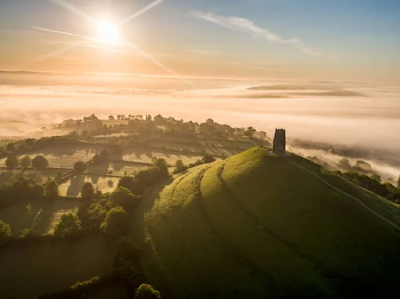
This landscape feature is one that much appeals to me, and which seldom fails to induce a yearning kind of numinosity.
I realised recently that the interest and feeling probably came from the cover of my teenage-bought edition of Alfred Watkins's The Old Straight Track.
So that is the (suggested) link between such tree clunps and ancient landscape features - they are supposed to mark 'ley lines', which - according to Watkins - were Neolithic pathways criss-crossing Southern England.
I heard about Watkins's book from the references at the end of The Moon of Gomrath by Alan Garner - and found a copy in the Bristol City Library; Garner has the Old Straight Track as a magical path visible only at full moon, as the moon rises - it plays an important part in the story, and provides its most memorable scene.
Later, John Michell (in A View over Atlantis) took Watkins's Ley Lines and made them into lines of spiritual power - but I knew nothing of this during my teens.
Anyway, all this seems to have left me with a particular sensitivity to a particular landscape feature. The Hundred Acre Wood in Winnie the Pooh is also sometimes depicted like this - which may have been a further latent aspect of my interest; as also a very good children's book called Borrobil by William Croft Dickinson (1944) - a kind of neo-pagan precursor to Narnia, and also written by a Professor.